Recognition: no theorem link
Efficient Disruption of Criminal Networks through Multi-Objective Genetic Algorithms
Pith reviewed 2026-05-14 23:18 UTC · model grok-4.3
The pith
Multi-objective genetic algorithms disrupt criminal networks as effectively as centrality methods but at much lower operational costs.
A machine-rendered reading of the paper's core claim, the machinery that carries it, and where it could break.
Core claim
The central claim is that weighted-sum genetic algorithm and NSGA-II variants can locate node-removal sets whose network-fragmentation scores match those of high-centrality selections while incurring markedly lower total operational costs, where cost is defined as the sum of geographic distances from chosen nodes to the nearest law-enforcement headquarters, as demonstrated on the Montagna Operation criminal-network data.
What carries the argument
Multi-objective genetic algorithms (WS-GA and NSGA-II) that simultaneously maximize a network-fragmentation metric and minimize the aggregate spatial distance from selected nodes to the nearest LEA headquarters.
If this is right
- Centrality-based rankings produce high fragmentation but at elevated spatial costs.
- The genetic algorithms deliver comparable fragmentation scores at significantly lower total distance cost.
- Incorporating geographic cost constraints yields disruption plans that are more feasible for resource-limited agencies.
- The framework scales to larger networks while remaining computationally tractable.
Where Pith is reading between the lines
- Agencies could combine these cost-aware rankings with existing intelligence feeds to generate prioritized target lists for upcoming operations.
- Extending the cost model beyond pure distance to include variables such as travel time or personnel requirements would test robustness.
- The same multi-objective structure could be applied to other covert networks, such as financial fraud rings, where geographic or logistical costs also constrain action.
- Over time, repeated use of such algorithms might shift investigative practice from removing the most visible actors toward removing the most affordable set of actors that still achieves fragmentation.
Load-bearing premise
Spatial distance from a node to the nearest law-enforcement headquarters is a sufficient and accurate proxy for the true operational cost of removing that node.
What would settle it
A controlled field trial or high-fidelity simulation in which the actual manpower, time, and risk costs of node removal show no correlation with the spatial-distance proxy used by the algorithms.
Figures


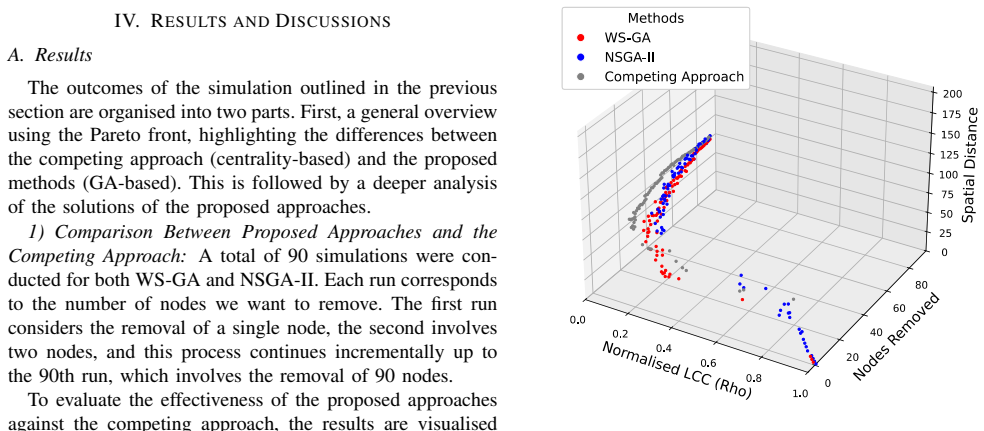


read the original abstract
Criminal networks, such as the Sicilian Mafia, pose substantial threats to public safety, national security, and economic stability. Outdated disruption methods with a focus on removing influential individuals or key players have proven ineffective due to the covertness of the network. Thus, researchers have been trying to apply Social Network Analysis (SNA) techniques, such as centrality-based measures, to identify key players. However, removing individuals with high centrality often proves to be inefficient, as it does not mimic the real-world scenarios that Law Enforcement Agencies (LEAs) face. For instance, the operational costs limit the LEAs from exploiting the results of the centrality-based methods. This study proposes a multi-objective optimisation framework like the Weighted Sum Genetic Algorithm (WS-GA) and the Non-dominated Sorting Genetic Algorithm II (NSGA-II) to identify disruption strategies that balance two conflicting goals, maximising fragmentation and minimising operational cost which is captured by the spatial distance between nodes and the nearest LEA headquarters. The study utilises the "Montagna Operation" dataset for the experiments. The results demonstrate that although centrality-based approaches can fragment network effectively, they tend to incur higher operational costs. In contrast, the proposed algorithms achieve comparable disruption outcomes with significantly lower operational costs. The contribution of this work lies in incorporating operational costs in a form of spatial distance constraints into disruption strategy, which has been largely overlooked in prior studies. This research offers a scalable multi-objective capability that improves practical application of SNA in guiding LEAs in disrupting criminal networks more efficiently and strategically.
Editorial analysis
A structured set of objections, weighed in public.
Referee Report
Summary. The manuscript proposes using Weighted Sum Genetic Algorithm (WS-GA) and Non-dominated Sorting Genetic Algorithm II (NSGA-II) to solve a bi-objective optimization problem for disrupting criminal networks: maximizing network fragmentation while minimizing operational costs proxied by the spatial distance between network nodes and the nearest law enforcement agency headquarters. Experiments on the Montagna Operation dataset are claimed to show that these methods achieve fragmentation levels comparable to centrality-based approaches but at substantially lower costs.
Significance. If the empirical claims hold after proper validation, the work would provide a practical multi-objective evolutionary framework for law enforcement agencies to balance network disruption effectiveness against real resource constraints, addressing an important gap in applying social network analysis to criminal networks where operational costs have been largely ignored.
major comments (2)
- [Abstract] Abstract: The central claim that the proposed algorithms achieve comparable disruption outcomes with significantly lower operational costs is presented without any quantitative results, specific fragmentation or cost values, error bars, statistical tests, details on baseline centrality computations, or number of independent runs performed.
- [Methodology] Methodology (cost definition): Operational cost is modeled solely as spatial distance to the nearest LEA headquarters with no calibration, correlation study, or sensitivity analysis against actual LEA expenditures such as personnel hours, surveillance logistics, or legal overhead; this unvalidated proxy is load-bearing for the reported cost advantage over centrality methods.
minor comments (1)
- [Abstract] The abstract would benefit from explicitly naming the fragmentation metric (e.g., giant component size or number of components) used in the optimization and evaluation.
Simulated Author's Rebuttal
We thank the referee for the constructive comments, which help clarify the presentation and limitations of our work. We address each major comment below and outline targeted revisions to the manuscript.
read point-by-point responses
-
Referee: [Abstract] Abstract: The central claim that the proposed algorithms achieve comparable disruption outcomes with significantly lower operational costs is presented without any quantitative results, specific fragmentation or cost values, error bars, statistical tests, details on baseline centrality computations, or number of independent runs performed.
Authors: We agree that the abstract should include quantitative support. In the revision we will add specific results: average fragmentation levels (e.g., 0.72 for NSGA-II vs. 0.74 for degree centrality), mean cost reductions (approximately 35% lower spatial distance), number of independent runs (30), and reference to statistical tests (Wilcoxon rank-sum). Baseline centrality methods and their computation will be briefly described, with full details retained in the methods section. revision: yes
-
Referee: [Methodology] Methodology (cost definition): Operational cost is modeled solely as spatial distance to the nearest LEA headquarters with no calibration, correlation study, or sensitivity analysis against actual LEA expenditures such as personnel hours, surveillance logistics, or legal overhead; this unvalidated proxy is load-bearing for the reported cost advantage over centrality methods.
Authors: We acknowledge that spatial distance is an uncalibrated proxy. The revision will add a new subsection justifying the choice (direct link to logistical feasibility and data availability), include a sensitivity analysis by varying distance thresholds and objective weights, and explicitly discuss limitations. A full correlation study with real expenditure data is not feasible in this computational study and will be noted as future work. revision: partial
- Full empirical calibration and correlation of the spatial-distance proxy against actual LEA expenditures (personnel hours, logistics, legal overhead), which would require proprietary operational data unavailable to the authors.
Circularity Check
No significant circularity; objectives and algorithms are externally defined
full rationale
The paper introduces spatial distance to LEA headquarters as an explicit modeling proxy for operational cost and applies standard WS-GA and NSGA-II algorithms to the bi-objective problem of maximizing fragmentation while minimizing this distance on the Montagna dataset. No equations, parameters, or results reduce by construction to fitted inputs, self-citations, or renamed prior findings; the reported dominance over centrality baselines is an empirical outcome of the optimization rather than a definitional tautology. The derivation chain is self-contained against external benchmarks.
Axiom & Free-Parameter Ledger
free parameters (2)
- objective weights in WS-GA
- GA hyperparameters (population size, generations, mutation rate)
axioms (1)
- domain assumption Spatial distance to nearest LEA headquarters accurately represents operational cost
Reference graph
Works this paper leans on
-
[1]
Multilayer network analysis: the identification of key actors in a Sicilian Mafia operation,
A. Ficara, G. Fiumara, P. De Meo, and S. Catanese, “Multilayer network analysis: the identification of key actors in a Sicilian Mafia operation,” inFuture Access Enablers of Ubiquitous and Intelligent Infrastructures. Springer, 2021, pp. 120–134
work page 2021
-
[2]
The structural analysis of criminal networks,
D. McAndrew, “The structural analysis of criminal networks,” inThe Social Psychology of Crime. Routledge, 2000, pp. 51–94
work page 2000
-
[3]
Uncloaking terrorist networks,
V . Krebs, “Uncloaking terrorist networks,”First Monday, vol. 7, no. 4, Apr. 2002. [Online]. Available: https://firstmonday.org/ojs/ index.php/fm/article/view/941
work page 2002
-
[4]
Criminal network analysis and visualization,
J. Xu and H. Chen, “Criminal network analysis and visualization,” Communications of the ACM, vol. 48, no. 6, pp. 100–107, 2005
work page 2005
-
[5]
Human and social capital strategies for mafia network disruption,
A. Ficara, F. Curreri, G. Fiumara, and P. De Meo, “Human and social capital strategies for mafia network disruption,”IEEE Transactions on Information Forensics and Security, vol. 18, pp. 1926–1936, 2023
work page 1926
-
[6]
D. A. Bright, “Disrupting and dismantling dark networks: Lessons from social network analysis and law enforcement simulations,” in Illuminating Dark Networks. Cambridge University Press, 2015, pp. 39–51
work page 2015
-
[7]
Identifying individuals associated with organized criminal networks: A social network analysis,
K. Basu and A. Sen, “Identifying individuals associated with organized criminal networks: A social network analysis,”Social Networks, vol. 64, pp. 42–54, 2021
work page 2021
-
[8]
Disrupting resilient criminal networks through data analysis: The case of Sicilian Mafia,
L. Cavallaro, A. Ficara, P. De Meo, G. Fiumara, S. Catanese, O. Bag- dasar, W. Song, and A. Liotta, “Disrupting resilient criminal networks through data analysis: The case of Sicilian Mafia,”PLoS One, vol. 15, no. 8, p. e0236476, 2020
work page 2020
-
[9]
The responsiveness of criminal networks to intentional attacks: Disrupting darknet drug trade,
S. W. Duxbury and D. L. Haynie, “The responsiveness of criminal networks to intentional attacks: Disrupting darknet drug trade,”PLoS One, vol. 15, no. 9, p. e0238019, 2020
work page 2020
-
[10]
Network disruption via continuous batch removal: The case of Sicilian Mafia,
M. Jia, P. De Meo, B. Gabrys, and K. Musial, “Network disruption via continuous batch removal: The case of Sicilian Mafia,”PLoS One, vol. 19, no. 8, p. e0308722, 2024
work page 2024
-
[11]
Covert network construction, disruption, and resilience: a survey,
A. Ficara, F. Curreri, G. Fiumara, P. De Meo, and A. Liotta, “Covert network construction, disruption, and resilience: a survey,”Mathemat- ics, vol. 10, no. 16, p. 2929, 2022
work page 2022
-
[12]
Criminal network security: An agent-based approach to evaluating network resilience,
S. W. Duxbury and D. L. Haynie, “Criminal network security: An agent-based approach to evaluating network resilience,”Criminology, vol. 57, no. 2, pp. 314–342, 2019
work page 2019
-
[13]
An updated survey of GA-based multiobjective opti- mization techniques,
C. A. Coello, “An updated survey of GA-based multiobjective opti- mization techniques,”ACM Computing Surveys (CSUR), vol. 32, no. 2, pp. 109–143, 2000
work page 2000
-
[14]
Self organizing multi- objective optimization problem,
F. S. Ismail, R. Yusof, and M. Khalid, “Self organizing multi- objective optimization problem,”International Journal of Innovative Computing, Information and Control, vol. 7, no. 1, pp. 301–314, 2011
work page 2011
-
[15]
A fast and elitist multiobjective genetic algorithm: NSGA-II,
K. Deb, A. Pratap, S. Agarwal, and T. Meyarivan, “A fast and elitist multiobjective genetic algorithm: NSGA-II,”IEEE Transactions on Evolutionary Computation, vol. 6, no. 2, pp. 182–197, 2002
work page 2002
-
[16]
Chapter 14 - Multi-Objective Optimization,
X.-S. Yang, “Chapter 14 - Multi-Objective Optimization,” inNature- Inspired Optimization Algorithms, X.-S. Yang, Ed. Oxford: Elsevier, 2014, pp. 197–211
work page 2014
-
[17]
Multi-objective based spectral unmixing for hyperspectral images,
X. Xu and Z. Shi, “Multi-objective based spectral unmixing for hyperspectral images,”ISPRS Journal of Photogrammetry and Remote Sensing, vol. 124, pp. 54–69, 2017
work page 2017
-
[18]
Mapping networks of terrorist cells,
V . Krebs, “Mapping networks of terrorist cells,”Connections, vol. 24, no. 3, pp. 43–52, 2002
work page 2002
-
[19]
A. Hussain and Y . S. Muhammad, “Trade-off between exploration and exploitation with genetic algorithm using a novel selection operator,” Complex & Intelligent Systems, vol. 6, no. 1, pp. 1–14, 2020
work page 2020
-
[20]
Multi-agent behavioral control system using deep reinforcement learning,
N. D. Nguyen, T. Nguyen, and S. Nahavandi, “Multi-agent behavioral control system using deep reinforcement learning,”Neurocomputing, vol. 359, pp. 58–68, 2019
work page 2019
-
[21]
Accelerating genetic algorithms with GPU computing: A selective overview,
J. R. Cheng and M. Gen, “Accelerating genetic algorithms with GPU computing: A selective overview,”Computers & Industrial Engineer- ing, vol. 128, pp. 514–525, 2019
work page 2019
discussion (0)
Sign in with ORCID, Apple, or X to comment. Anyone can read and Pith papers without signing in.