i-Rheo-Tempo: A Model-Free, Quadrature-Free Reconstruction of the Shear Relaxation Modulus from Complex Viscosity
Pith reviewed 2026-05-10 17:54 UTC · model grok-4.3
The pith
A quadrature-free method reconstructs the shear relaxation modulus from complex viscosity data using piecewise linear approximations.
A machine-rendered reading of the paper's core claim, the machinery that carries it, and where it could break.
Core claim
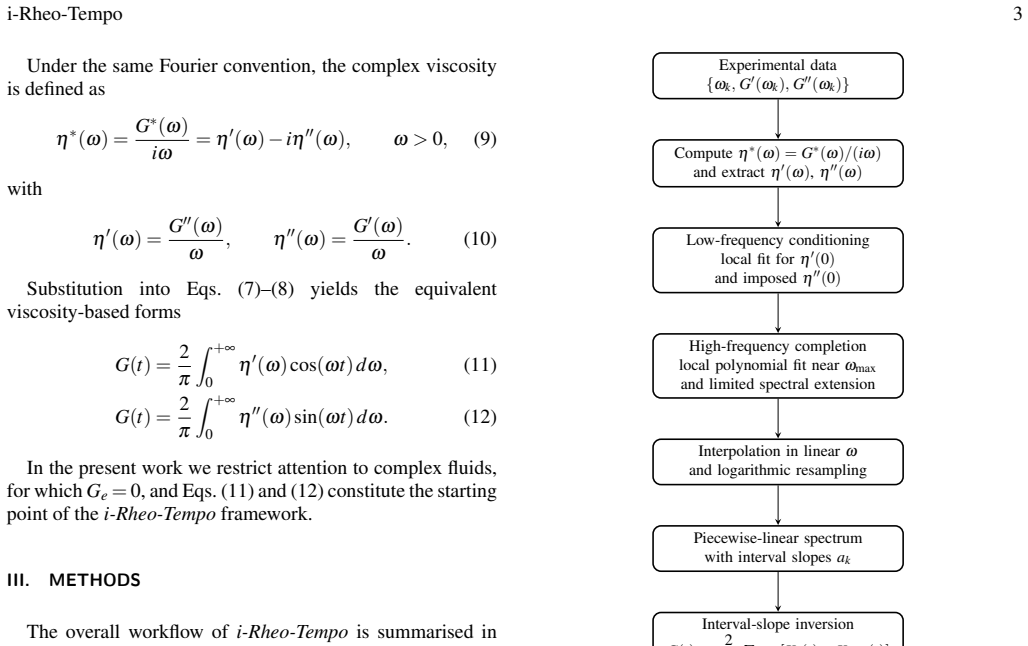
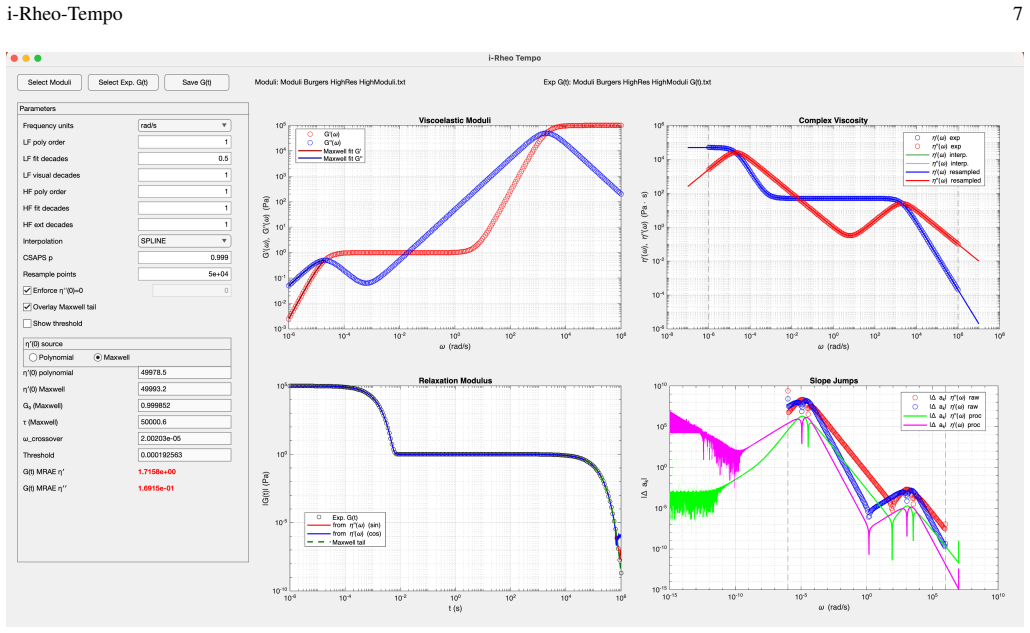
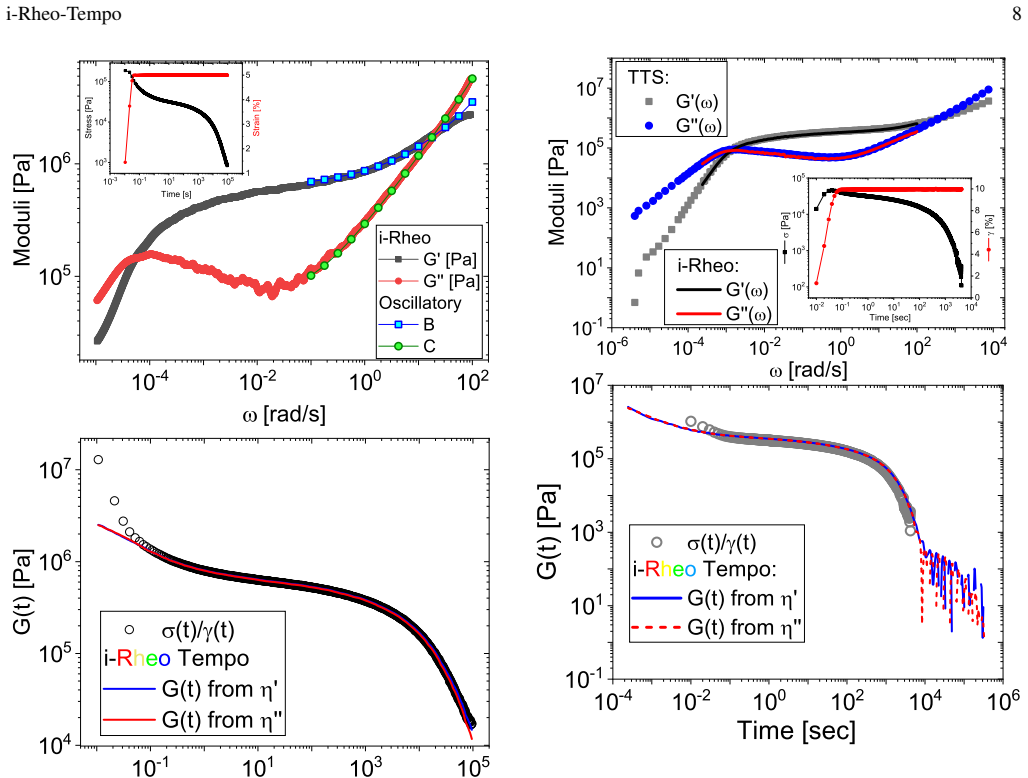
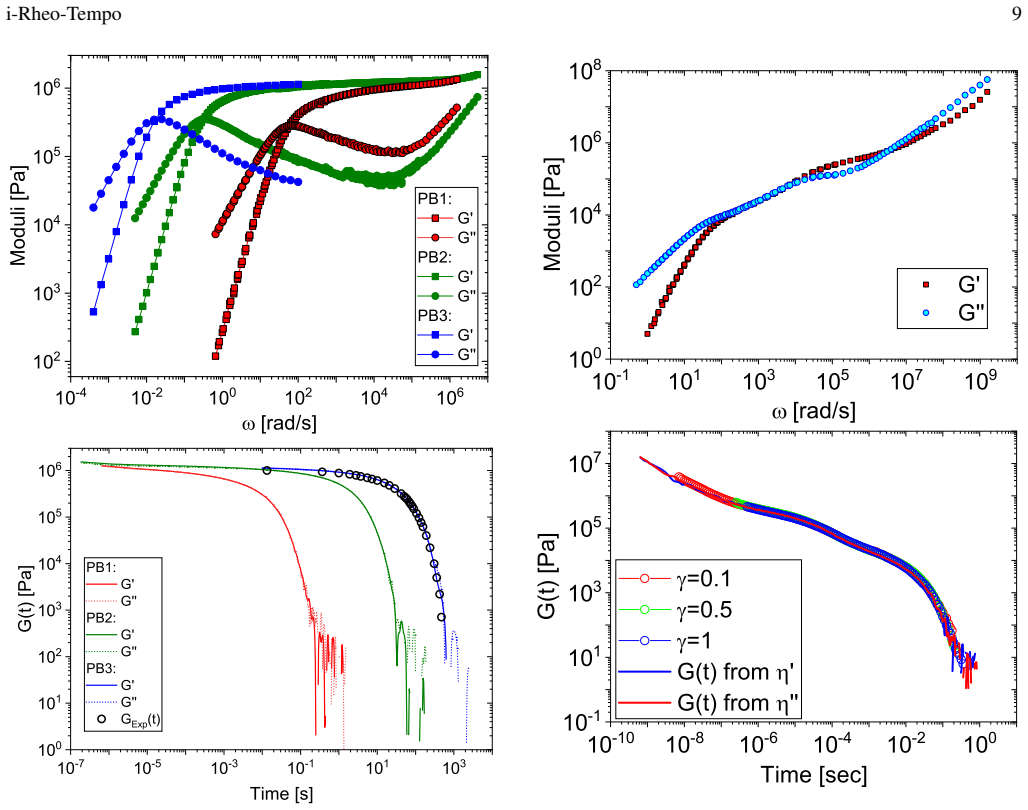
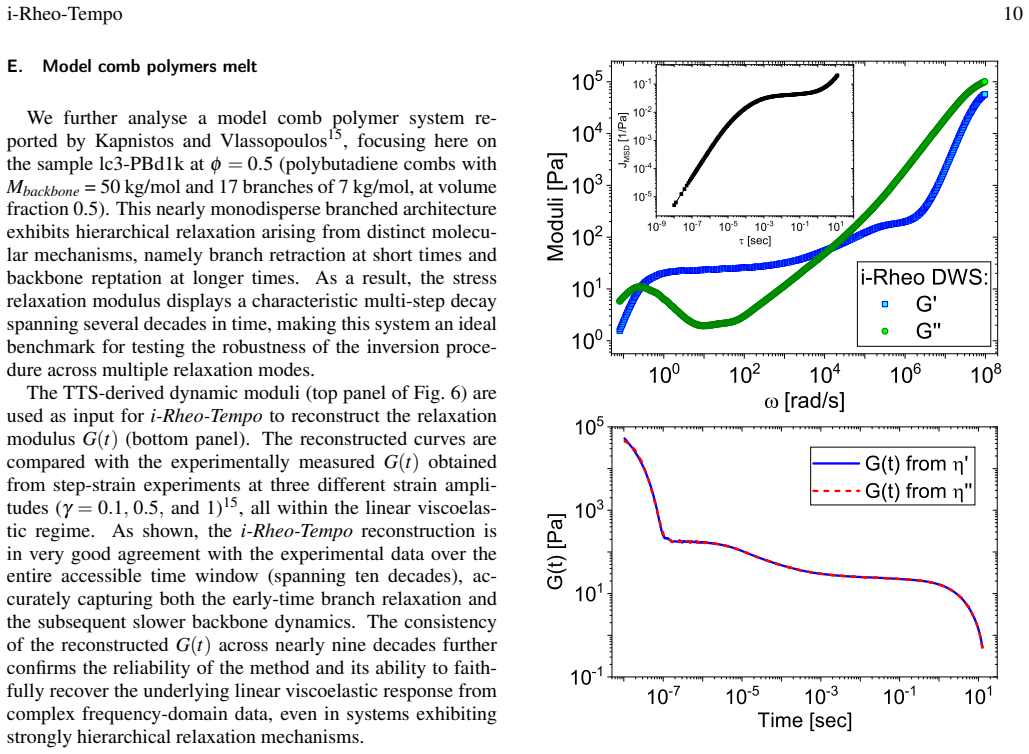
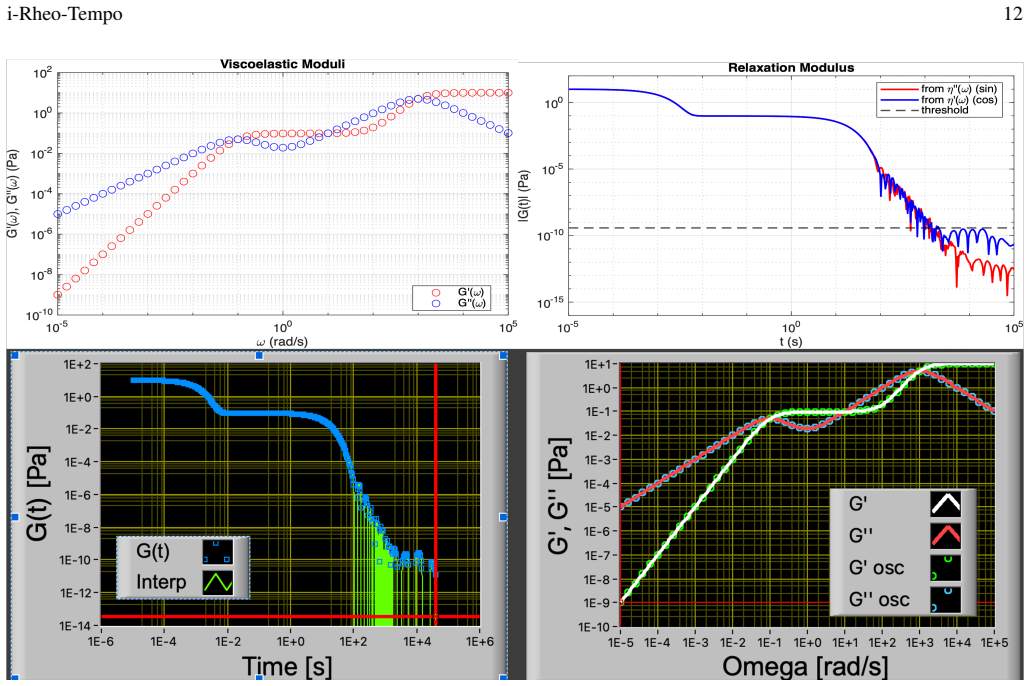
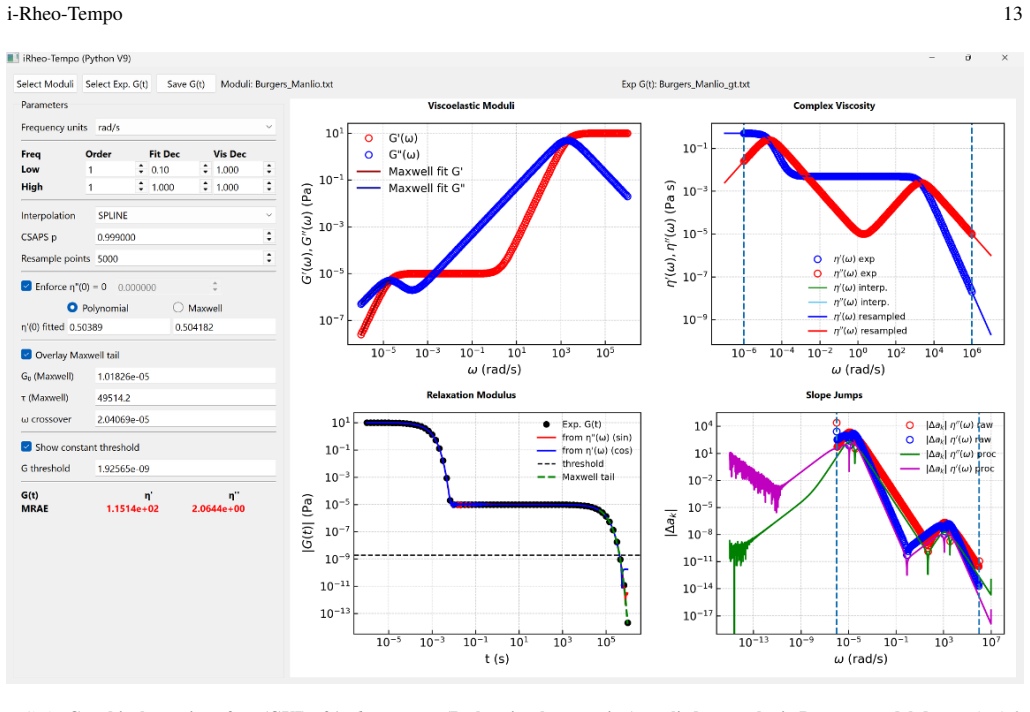
i-Rheo-Tempo reconstructs the shear relaxation modulus directly from dynamic measurements through an exact second-derivative representation of the complex viscosity. When the spectrum is approximated as piecewise linear, the inversion reduces to a compact interval-slope formulation based solely on local spectral properties, avoiding numerical quadrature, parametric fitting, and predefined relaxation spectra. The method is validated against synthetic models, polymer melts, industrial elastomers, comb polymers, and broadband microrheology datasets spanning nearly nine decades in frequency, with the reconstructed modulus in quantitative agreement with independent time-domain measurements.
What carries the argument
An exact second-derivative representation of the complex viscosity under piecewise linear spectrum approximation, which converts the inversion into a local interval-slope calculation from measured data points.
If this is right
- The reconstructed relaxation modulus matches independent time-domain measurements quantitatively for multiple classes of complex fluids.
- The procedure operates without parametric models or numerical integration across frequency ranges spanning nine decades.
- Local spectral properties alone suffice to obtain the time-domain function, eliminating the need for global fitting or assumed relaxation spectra.
- The same framework applies to polymer melts, industrial elastomers, comb polymers, and microrheology experiments.
Where Pith is reading between the lines
- The local-slope approach may generalize to recover other time-domain functions such as creep compliance from their complex counterparts.
- Because the calculation uses only neighboring data points, it could handle experimental spectra with irregular frequency spacing more flexibly than global methods.
- Applying the method to dielectric or acoustic relaxation spectra would test whether the second-derivative identity holds in analogous linear-response problems.
Load-bearing premise
The measured complex viscosity spectrum can be treated as piecewise linear between discrete frequency points.
What would settle it
A mismatch between the i-Rheo-Tempo output and direct stress-relaxation or creep measurements on a fluid whose relaxation modulus is known analytically, such as a single-mode Maxwell fluid.
Figures
read the original abstract
Reliable transformation between frequency- and time-domain material functions remains a central challenge in linear viscoelasticity due to finite bandwidth, discrete sampling, and experimental noise. We introduce \emph{i\text{-}Rheo-Tempo}, a quadrature-free method that reconstructs the shear relaxation modulus directly from dynamic measurements through an exact second-derivative representation of the complex viscosity. When the spectrum is approximated as piecewise linear, the inversion reduces to a compact interval-slope formulation based solely on local spectral properties, avoiding numerical quadrature, parametric fitting, and predefined relaxation spectra. The method is validated against a set of complex fluids including synthetic models, polymer melts, industrial elastomers, comb polymers, and broadband microrheology datasets spanning nearly nine decades in frequency. In all cases, the reconstructed relaxation modulus is in quantitative agreement with independent time-domain measurements. These results demonstrate that \emph{i\text{-}Rheo-Tempo} provides a robust, model-free solution to the frequency-to-time inverse problem and, more generally, establishes a framework for recovering time-domain responses from experimentally measured complex spectra.
Editorial analysis
A structured set of objections, weighed in public.
Referee Report
Summary. The paper introduces i-Rheo-Tempo, a quadrature-free, model-free method to reconstruct the shear relaxation modulus G(t) from measured complex viscosity spectra. It starts from an exact second-derivative identity for the complex viscosity and, under a piecewise-linear approximation to the spectrum, reduces the inversion to a compact interval-slope formula depending only on local spectral properties. The approach is validated on synthetic models, polymer melts, industrial elastomers, comb polymers, and broadband microrheology data spanning nearly nine decades in frequency, with reported quantitative agreement to independent time-domain measurements.
Significance. If the reconstruction remains accurate under the stated approximation, the work supplies a practical, parameter-free route to the frequency-to-time inverse problem that avoids both numerical quadrature and global parametric fitting. The breadth of validation sets and the reduction to strictly local spectral quantities are genuine strengths that could make the method widely usable in soft-matter rheology.
major comments (2)
- [§3] §3 (derivation of the interval-slope formula): the exact second-derivative relation is algebraically exact, but the subsequent reduction to the compact interval-slope expression holds only inside each linear segment; no truncation-error bound or propagation analysis is supplied for spectra that deviate from piecewise linearity (e.g., near terminal zones or crossover frequencies), which directly limits the robustness claim for general experimental data.
- [Validation section] Validation section and associated figures: quantitative agreement is asserted across the reported datasets, yet the manuscript does not quantify how reconstruction error grows when the underlying spectrum contains curvature or when realistic experimental noise is added; without such controlled tests the central claim that the method is robust for arbitrary complex spectra remains incompletely supported.
minor comments (2)
- [Figures] Figure captions and axis labels should explicitly state the error metric (e.g., relative L2 norm or pointwise deviation) used to declare 'quantitative agreement'.
- [Introduction] The introduction would benefit from a brief comparison table or paragraph contrasting i-Rheo-Tempo with existing quadrature-based or Prony-series inversion methods, including their respective bandwidth and noise sensitivities.
Simulated Author's Rebuttal
We thank the referee for the positive evaluation of i-Rheo-Tempo and for the constructive comments that identify opportunities to strengthen the manuscript. We address each major comment below and will incorporate revisions to improve the rigor of the error analysis and validation.
read point-by-point responses
-
Referee: [§3] §3 (derivation of the interval-slope formula): the exact second-derivative relation is algebraically exact, but the subsequent reduction to the compact interval-slope expression holds only inside each linear segment; no truncation-error bound or propagation analysis is supplied for spectra that deviate from piecewise linearity (e.g., near terminal zones or crossover frequencies), which directly limits the robustness claim for general experimental data.
Authors: We agree that the interval-slope formula is derived under the piecewise-linear approximation within each segment, as explicitly stated in the manuscript. Although the method performs well on the broad range of experimental spectra examined, we acknowledge that an explicit truncation-error analysis would better support the robustness claim. In the revised manuscript we will add a new paragraph to §3 that derives a leading-order truncation-error estimate for spectra containing curvature, discusses error propagation through the local slope calculations, and illustrates the magnitude of the error near terminal zones and crossover frequencies using both analytic and numerical examples. revision: yes
-
Referee: [Validation section] Validation section and associated figures: quantitative agreement is asserted across the reported datasets, yet the manuscript does not quantify how reconstruction error grows when the underlying spectrum contains curvature or when realistic experimental noise is added; without such controlled tests the central claim that the method is robust for arbitrary complex spectra remains incompletely supported.
Authors: The referee is correct that the present validation demonstrates agreement on real and synthetic data sets but does not include systematic, controlled quantification of error growth with curvature or added noise. To address this limitation we will expand the validation section with a new subsection containing numerical experiments. These will apply controlled levels of curvature (via quadratic perturbations to linear segments) and realistic experimental noise (Gaussian noise scaled to typical measurement uncertainties) to synthetic spectra, then report the resulting reconstruction errors as functions of curvature strength and noise amplitude. The added material will directly quantify the robustness limits of the method. revision: yes
Circularity Check
No circularity: derivation starts from exact identity and uses explicit approximation without self-referential reduction.
full rationale
The paper's central chain begins with an exact second-derivative representation of complex viscosity (a mathematical identity independent of the reconstruction method) and then applies an explicit piecewise-linear spectrum approximation to obtain the interval-slope formula. This approximation is stated as an assumption, not derived from or fitted to the target G(t). No step renames a fitted parameter as a prediction, invokes a self-citation as the sole justification for uniqueness, or smuggles an ansatz via prior work. Validation against independent time-domain data on multiple datasets provides external falsifiability. The approach is therefore self-contained and non-circular.
Axiom & Free-Parameter Ledger
axioms (1)
- domain assumption The frequency spectrum of the complex viscosity can be approximated as piecewise linear without significant loss of accuracy for the inversion.
Reference graph
Works this paper leans on
-
[1]
merlin.mbs aapmrev4-1.bst 2010-07-25 4.21a (PWD, AO, DPC) hacked
FUNCTION id.bst "merlin.mbs aapmrev4-1.bst 2010-07-25 4.21a (PWD, AO, DPC) hacked" ENTRY address archive archivePrefix author bookaddress booktitle chapter collaboration doi edition editor eid eprint howpublished institution isbn issn journal key language month note number organization pages primaryClass publisher school SLACcitation series title translat...
work page 2010
-
[2]
merlin.mbs aipauth4-1.bst 2010-07-25 4.21a (PWD, AO, DPC) hacked
FUNCTION id.bst "merlin.mbs aipauth4-1.bst 2010-07-25 4.21a (PWD, AO, DPC) hacked" ENTRY address archive archivePrefix author bookaddress booktitle chapter collaboration doi edition editor eid eprint howpublished institution isbn issn journal key language month note number organization pages primaryClass publisher school SLACcitation series title translat...
work page 2010
-
[3]
merlin.mbs aipnum4-1.bst 2010-07-25 4.21a (PWD, AO, DPC) hacked
FUNCTION id.bst "merlin.mbs aipnum4-1.bst 2010-07-25 4.21a (PWD, AO, DPC) hacked" ENTRY address archive archivePrefix author bookaddress booktitle chapter collaboration doi edition editor eid eprint howpublished institution isbn issn journal key language month note number organization pages primaryClass publisher school SLACcitation series title translati...
work page 2010
-
[4]
merlin.mbs apsrev4-1.bst 2010-07-25 4.21a (PWD, AO, DPC) hacked
FUNCTION id.bst "merlin.mbs apsrev4-1.bst 2010-07-25 4.21a (PWD, AO, DPC) hacked" ENTRY address archive archivePrefix author bookaddress booktitle chapter collaboration doi edition editor eid eprint howpublished institution isbn issn journal key language month note number organization pages primaryClass publisher school SLACcitation series title translati...
work page 2010
-
[5]
merlin.mbs apsrmp4-1.bst 2010-07-25 4.21a (PWD, AO, DPC) hacked
FUNCTION id.bst "merlin.mbs apsrmp4-1.bst 2010-07-25 4.21a (PWD, AO, DPC) hacked" ENTRY address archive archivePrefix author bookaddress booktitle chapter collaboration doi edition editor eid eprint howpublished institution isbn issn journal key language month note number organization pages primaryClass publisher school SLACcitation series title translati...
work page 2010
discussion (0)
Sign in with ORCID, Apple, or X to comment. Anyone can read and Pith papers without signing in.