Recognition: unknown
Claim2Vec: Embedding Fact-Check Claims for Multilingual Similarity and Clustering
Pith reviewed 2026-05-10 16:51 UTC · model grok-4.3
The pith
Claim2Vec fine-tunes multilingual encoders on similar claim pairs to improve clustering of recurring fact-check claims.
A machine-rendered reading of the paper's core claim, the machinery that carries it, and where it could break.
Core claim
Optimizing a multilingual encoder through contrastive learning on pairs of similar multilingual claims produces vector embeddings that improve claim clustering performance, specifically by increasing cluster label alignment and enhancing the geometric structure of the embedding space across multiple cluster configurations and datasets.
What carries the argument
Contrastive learning on similar multilingual claim pairs, which refines the embedding space so that claims resolvable by the same fact-check are placed closer together regardless of language.
If this is right
- Claims that share a fact-check can be grouped more reliably even when they appear in different languages.
- Multilingual clusters show measurable gains from cross-lingual transfer during fine-tuning.
- The improvements hold across different clustering algorithms and varying numbers of clusters.
- Standard multilingual encoders without this specific fine-tuning produce weaker cluster structures on the same tasks.
Where Pith is reading between the lines
- Fact-checking pipelines could reduce redundant checks by routing entire clusters to a single verification step.
- The method might extend to other text clustering domains where recurring items need to be grouped across languages, such as social media topics.
- Pairing the embeddings with retrieval systems could further speed up matching new claims to existing fact-checks.
Load-bearing premise
The pairs of similar multilingual claims used for contrastive fine-tuning are accurately labeled and representative of real-world recurring claims.
What would settle it
Clustering performance fails to improve, or the geometric structure does not tighten, when the model is tested on new claim datasets whose recurring patterns were not represented in the fine-tuning pairs.
Figures


read the original abstract
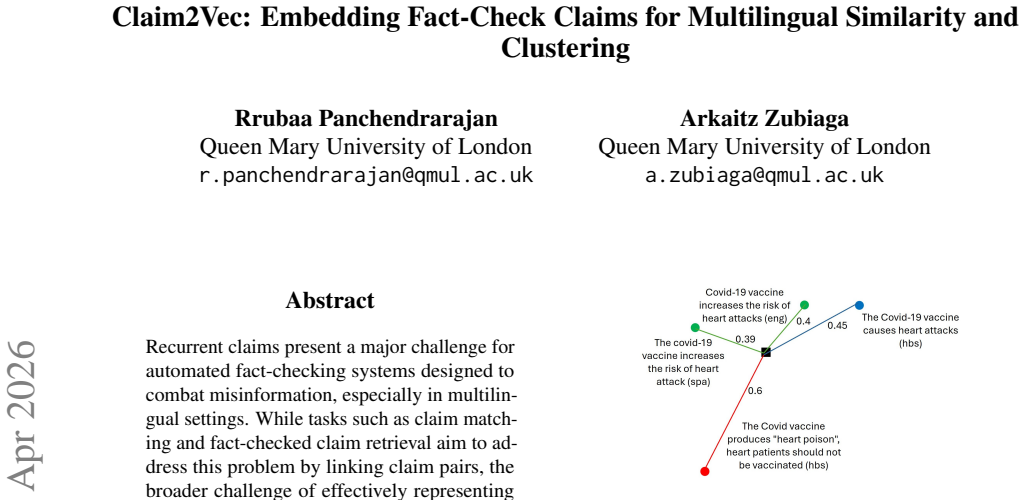
Recurrent claims present a major challenge for automated fact-checking systems designed to combat misinformation, especially in multilingual settings. While tasks such as claim matching and fact-checked claim retrieval aim to address this problem by linking claim pairs, the broader challenge of effectively representing groups of similar claims that can be resolved with the same fact-check via claim clustering remains relatively underexplored. To address this gap, we introduce Claim2Vec, the first multilingual embedding model optimized to represent fact-check claims as vectors in an improved semantic embedding space. We fine-tune a multilingual encoder using contrastive learning with similar multilingual claim pairs. Experiments on the claim clustering task using three datasets, 14 multilingual embedding models, and 7 clustering algorithms demonstrate that Claim2Vec significantly improves clustering performance. Specifically, it enhances both cluster label alignment and the geometric structure of the embedding space across different cluster configurations. Our multilingual analysis shows that clusters containing multiple languages benefit from fine-tuning, demonstrating cross-lingual knowledge transfer.
Editorial analysis
A structured set of objections, weighed in public.
Referee Report
Summary. The paper introduces Claim2Vec, the first multilingual embedding model for fact-check claims, obtained by contrastive fine-tuning of a multilingual encoder on similar multilingual claim pairs. It evaluates the approach on a claim clustering task across three datasets, 14 multilingual embedding models, and 7 clustering algorithms, claiming significant gains in cluster label alignment and geometric structure of the embedding space, with additional benefits for multilingual clusters via cross-lingual transfer.
Significance. If the reported clustering improvements hold after rigorous validation of the training pairs and statistical controls, the work would be significant for multilingual automated fact-checking by enabling better grouping of recurrent claims that share fact-checks. The comparative experimental design across multiple models, algorithms, and datasets is a strength, as is the focus on an underexplored clustering formulation rather than pairwise matching.
major comments (2)
- [Methods / Data preparation] The construction, sourcing, labeling, and validation of the similar multilingual claim pairs used for contrastive fine-tuning are not described in sufficient detail (see abstract and any methods section on data preparation). This is load-bearing for the central claim, as unvalidated automatic matching, shared metadata without noise filtering, or overlap with the three evaluation datasets could produce gains via label leakage or domain match rather than semantic improvements in the embedding space.
- [Experiments / Results] The experimental results claim that Claim2Vec 'significantly improves' clustering performance across 14 models and 7 algorithms (abstract), yet no details are provided on statistical significance testing, error bars, variance across runs, or preprocessing steps. This undermines assessment of whether the gains in label alignment and geometric structure are robust or could be explained by confounds.
minor comments (2)
- [Abstract] The abstract states that clusters with multiple languages 'benefit from fine-tuning' but does not specify the exact multilingual analysis method or metrics used to demonstrate cross-lingual knowledge transfer.
- [Methods] Notation for the contrastive loss and embedding objectives could be clarified with explicit equations to aid reproducibility.
Simulated Author's Rebuttal
We thank the referee for the detailed and constructive comments. We address each major point below and have prepared revisions to improve the manuscript's clarity and rigor.
read point-by-point responses
-
Referee: [Methods / Data preparation] The construction, sourcing, labeling, and validation of the similar multilingual claim pairs used for contrastive fine-tuning are not described in sufficient detail (see abstract and any methods section on data preparation). This is load-bearing for the central claim, as unvalidated automatic matching, shared metadata without noise filtering, or overlap with the three evaluation datasets could produce gains via label leakage or domain match rather than semantic improvements in the embedding space.
Authors: We agree that the current description of the training pair construction is insufficiently detailed. The revised manuscript will include an expanded methods subsection that specifies: (1) the exact sources and collection process for the multilingual claim pairs, (2) the similarity labeling procedure (including any automated matching rules and subsequent manual or semi-automated validation steps), (3) noise-filtering criteria applied to the pairs, and (4) explicit verification that no claim pairs overlap with the three evaluation datasets used for clustering. These additions will allow readers to assess whether the reported gains stem from genuine semantic improvements rather than leakage or domain artifacts. revision: yes
-
Referee: [Experiments / Results] The experimental results claim that Claim2Vec 'significantly improves' clustering performance across 14 models and 7 algorithms (abstract), yet no details are provided on statistical significance testing, error bars, variance across runs, or preprocessing steps. This undermines assessment of whether the gains in label alignment and geometric structure are robust or could be explained by confounds.
Authors: We acknowledge the need for greater statistical transparency. In the revision we will: (a) describe all preprocessing steps in detail, (b) report performance metrics with error bars derived from multiple independent runs (different random seeds for clustering initialization and fine-tuning), (c) include statistical significance tests (e.g., paired t-tests or non-parametric equivalents with corrected p-values) comparing Claim2Vec against the strongest baselines, and (d) discuss observed variance across the 7 algorithms and 3 datasets. These changes will allow a more rigorous evaluation of the robustness of the improvements. revision: yes
Circularity Check
No circularity: empirical fine-tuning and external evaluation
full rationale
The paper introduces Claim2Vec via contrastive fine-tuning of a multilingual encoder on similar claim pairs, then evaluates clustering performance on three external datasets using 14 models and 7 algorithms. No equations, derivations, or predictions are presented that reduce to fitted parameters or self-referential definitions by construction. All central claims rest on comparative experimental results against baselines, with no self-citation load-bearing the core argument or uniqueness imported from prior author work. The work is self-contained against external benchmarks.
Axiom & Free-Parameter Ledger
free parameters (1)
- contrastive learning hyperparameters
axioms (1)
- domain assumption Contrastive learning on similar claim pairs yields embeddings with improved geometric structure for clustering
Reference graph
Works this paper leans on
-
[1]
InEuropean conference on information retrieval, pages 367–381
Did i see it before? detecting previously- checked claims over twitter. InEuropean conference on information retrieval, pages 367–381. Springer. Watheq Mansour, Tamer Elsayed, and Abdulaziz Al- Ali. 2023. This is not new! spotting previously- verified claims over twitter.Information Processing & Management, 60(4):103414. Leland McInnes, John Healy, Steve ...
2023
-
[2]
hdbscan: Hierarchical density based clustering. J. Open Source Softw., 2(11):205. Leland McInnes, John Healy, Nathaniel Saul, and Lukas Großberger. 2018. Umap: Uniform manifold ap- proximation and projection.Journal of Open Source Software, 3(29). Niklas Muennighoff, Nouamane Tazi, Loïc Magne, and Nils Reimers. 2023. Mteb: Massive text embedding benchmark...
-
[3]
Multilingual E5 Text Embeddings: A Technical Report
Sciclops: Detecting and contextualizing sci- entific claims for assisting manual fact-checking. InProceedings of the 30th ACM international con- ference on information & knowledge management, pages 1692–1702. Vincent A Traag, Ludo Waltman, and Nees Jan Van Eck. 2019. From louvain to leiden: guarantee- ing well-connected communities.Scientific reports, 9(1...
work page internal anchor Pith review arXiv 2019
-
[4]
Qwen3 technical report.arXiv preprint arXiv:2505.09388. Tian Zhang, Raghu Ramakrishnan, and Miron Livny
work page internal anchor Pith review Pith/arXiv arXiv
-
[5]
Birch: an efficient data clustering method for very large databases.ACM sigmod record, 25(2):103– 114. AMultiClaimTrain & Test Partition Topics Figure 7: 2D Projection of Two Topic Groups inMulti- Claim Figure 7 shows the 2D projection of claims be- longing to the two topic groups inMultiClaim. Al- though the groups were originally identified using the to...
-
[6]
for just 30 seconds
Table 11 shows an example fromMultiClaim- Test, whereBGE-M3fails to correctly group claims written in four different languages, resulting in dis- tinct clusters. In contrast,Claim2Vecsuccessfully corrects this split, likely due to the cross-lingual knowledge transfer learned during fine-tuning. (a) Topic Group 1 (b) Topic Group 2 Figure 8: Top 30 Frequent...
discussion (0)
Sign in with ORCID, Apple, or X to comment. Anyone can read and Pith papers without signing in.