Recognition: unknown
Gait Recognition with Temporal Kolmogorov-Arnold Networks
Pith reviewed 2026-05-10 16:30 UTC · model grok-4.3
The pith
Temporal Kolmogorov-Arnold Networks replace fixed weights with learnable functions and add dual memory to model walking patterns for person identification.
A machine-rendered reading of the paper's core claim, the machinery that carries it, and where it could break.
Core claim
The paper claims that the Temporal Kolmogorov-Arnold Network framework, by substituting fixed edge weights with learnable one-dimensional functions and combining short-term RKAN sublayers with a gated long-term pathway, enables efficient temporal modeling of gait sequences that preserves both local cycle details and extended context without the sequential optimization problems of recurrent networks or the data and compute costs of transformers.
What carries the argument
Temporal Kolmogorov-Arnold Network (TKAN), a neural layer architecture that replaces fixed connection weights with learnable one-dimensional functions and integrates short-term RKAN sublayers with a gated long-term memory pathway to jointly model local gait cycles and broader motion trends.
If this is right
- Joint modeling of local gait cycles and longer-term motion trends becomes feasible inside a compact backbone.
- Robustness to clothing, carrying, and view variations improves in silhouette-based sequences.
- Processing of long or noisy gait sequences avoids the forgetting issues of recurrent networks and the scaling problems of transformers.
- Recognition performance reaches competitive levels on CASIA-B without demanding larger training sets or greater computational resources.
Where Pith is reading between the lines
- The same learnable-function replacement could apply to other video sequence tasks that need balanced short and long temporal dependencies.
- Dual memory levels might serve as a lighter alternative to attention mechanisms in general action or motion recognition pipelines.
- Testing the architecture on outdoor surveillance sequences with uncontrolled lighting and occlusions would reveal how far the cycle-plus-context modeling extends beyond controlled lab data.
Load-bearing premise
That learnable one-dimensional functions combined with short-term sublayers and a gated long-term pathway will capture both fine cycle-level dynamics and extended temporal context more effectively and compactly than recurrent or transformer alternatives while staying robust to appearance changes.
What would settle it
A side-by-side evaluation on the CASIA-B dataset in which the CNN+TKAN model fails to match or exceed the recognition accuracy of standard recurrent or transformer-based gait systems across normal, clothing, carrying, and multi-view test conditions.
Figures
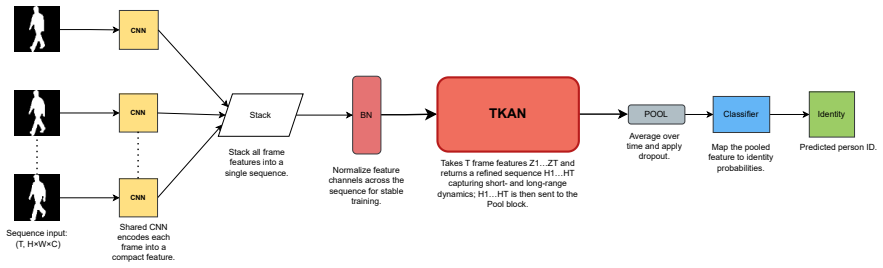


read the original abstract
Gait recognition is a biometric modality that identifies individuals from their characteristic walking patterns. Unlike conventional biometric traits, gait can be acquired at a distance and without active subject cooperation, making it suitable for surveillance and public safety applications. Nevertheless, silhouette-based temporal models remain sensitive to long sequences, observation noise, and appearance-related covariates. Recurrent architectures often struggle to preserve information from earlier frames and are inherently sequential to optimize, whereas transformer-based models typically require greater computational resources and larger training sets and may be sensitive to irregular sequence lengths and noisy inputs. These limitations reduce robustness under clothing variation, carrying conditions, and view changes, while also hindering the joint modeling of local gait cycles and longer-term motion trends. To address these challenges, we introduce a Temporal Kolmogorov-Arnold Network (TKAN) for gait recognition. The proposed model replaces fixed edge weights with learnable one-dimensional functions and incorporates a two-level memory mechanism consisting of short-term RKAN sublayers and a gated long-term pathway. This design enables efficient modeling of both cycle-level dynamics and broader temporal context while maintaining a compact backbone. Experiments on the CASIA-B dataset indicate that the proposed CNN+TKAN framework achieves strong recognition performance under the reported evaluation setting.
Editorial analysis
A structured set of objections, weighed in public.
Referee Report
Summary. The manuscript proposes a CNN+TKAN architecture for silhouette-based gait recognition. TKAN replaces fixed edge weights with learnable one-dimensional functions and adds a two-level memory mechanism (short-term RKAN sublayers plus gated long-term pathway) intended to jointly capture cycle-level dynamics and longer temporal context while remaining compact. The central claim is that this design yields strong recognition performance on the CASIA-B dataset under the reported evaluation setting, addressing limitations of RNNs and transformers with respect to sequence length, noise, and covariates such as clothing, carrying, and viewpoint.
Significance. If the performance claims are substantiated with quantitative results, the work would introduce a Kolmogorov-Arnold-inspired temporal module that offers a parameter-efficient alternative to recurrent and attention-based models for gait sequences. This could improve robustness to appearance covariates while preserving modeling of both local periodicity and extended motion trends, which is relevant for surveillance applications.
major comments (2)
- [Abstract] Abstract: the assertion that the CNN+TKAN framework 'achieves strong recognition performance' is unsupported by any numerical accuracy values, baseline comparisons, error bars, dataset splits, or covariate-specific results. Without these, it is impossible to evaluate whether the learnable 1D functions and two-level memory mechanism deliver the claimed joint modeling of cycle dynamics and longer context or improve robustness over prior methods.
- [Abstract] The central claim that the two-level memory (short-term RKAN sublayers + gated long-term pathway) enables efficient modeling of both local gait cycles and broader temporal context while remaining robust to clothing/carrying/view changes is load-bearing, yet no ablation studies isolating the contribution of the gated long-term pathway or the learnable functions versus a standard KAN or RNN baseline are referenced.
Simulated Author's Rebuttal
We thank the referee for the careful reading and constructive suggestions. We agree that the abstract would be strengthened by including concrete numerical results and references to supporting analyses from the main text. We will revise the abstract accordingly in the next version. Our point-by-point responses to the major comments are provided below.
read point-by-point responses
-
Referee: [Abstract] Abstract: the assertion that the CNN+TKAN framework 'achieves strong recognition performance' is unsupported by any numerical accuracy values, baseline comparisons, error bars, dataset splits, or covariate-specific results. Without these, it is impossible to evaluate whether the learnable 1D functions and two-level memory mechanism deliver the claimed joint modeling of cycle dynamics and longer context or improve robustness over prior methods.
Authors: We acknowledge that the current abstract is too high-level and does not cite specific metrics. The full manuscript (Section 4) reports rank-1 accuracies on CASIA-B under the standard protocol, with results broken down by normal, bag, and coat conditions, direct comparisons to CNN+RNN and CNN+Transformer baselines, and standard deviations across multiple runs. We will revise the abstract to include the key quantitative figures (e.g., overall accuracy and relative gains) and a brief statement of the evaluation setting so that readers can immediately assess the performance claims. revision: yes
-
Referee: [Abstract] The central claim that the two-level memory (short-term RKAN sublayers + gated long-term pathway) enables efficient modeling of both local gait cycles and broader temporal context while remaining robust to clothing/carrying/view changes is load-bearing, yet no ablation studies isolating the contribution of the gated long-term pathway or the learnable functions versus a standard KAN or RNN baseline are referenced.
Authors: The manuscript contains ablation studies (Section 4.3) that isolate the effects of the learnable 1D functions, the short-term RKAN sublayers, and the gated long-term pathway, including direct comparisons against a standard KAN and an RNN baseline. These experiments quantify the contribution of each component to robustness under covariates. The abstract does not currently reference these results. We will add a concise sentence summarizing the ablation findings to support the central claim about the two-level memory mechanism. revision: yes
Circularity Check
No circularity detected in TKAN model proposal or claims
full rationale
The paper introduces TKAN as an original architecture that replaces fixed edge weights with learnable 1D functions and adds a two-level memory (short-term RKAN + gated long-term pathway). No equations, derivations, or self-citations are shown that reduce any claimed result to a quantity defined by the model's own fitted parameters or prior self-work. The CASIA-B performance statement is framed as an empirical outcome under a reported setting, not as a prediction forced by construction from inputs. The central design choices remain independent of the target recognition metric, satisfying the self-contained criterion.
Axiom & Free-Parameter Ledger
free parameters (1)
- parameters of the learnable one-dimensional functions
axioms (1)
- standard math Kolmogorov-Arnold representation theorem permits decomposition of multivariate functions into sums and compositions of univariate functions
invented entities (1)
-
Temporal Kolmogorov-Arnold Network (TKAN) with two-level memory
no independent evidence
Reference graph
Works this paper leans on
-
[1]
GaitPart: Temporal Part-based Model for Gait Recognition,
C. Fan, Y. Peng, C. Cao, X. Liu, S. Hou, J. Chi, Y. Huang, Q. Li, and Z. He, “GaitPart: Temporal Part-based Model for Gait Recognition,” inProc. CVPR, 2020, pp. 14225–14233
2020
-
[2]
Context-SensitiveTemporalFeatureLearn- ing for Gait Recognition,
X. Huang, D. Zhu, H. Wang, and X. Wang, “Context-SensitiveTemporalFeatureLearn- ing for Gait Recognition,” inProc. ICCV, 2021, pp. 12913–12922
2021
-
[3]
Gait Recog- nition via Effective Global-Local Feature Representation and Local Temporal Aggre- gation,
B. Lin, S. Zhang, and X. Yu, “Gait Recog- nition via Effective Global-Local Feature Representation and Local Temporal Aggre- gation,” inProc. ICCV, 2021, pp. 14648– 14657
2021
-
[4]
3D Local Con- volutional Neural Networks for Gait Recog- nition,
Z. Huang, D. Xue, X. Shen, X. Tian, H. Li, J. Huang, and X.-S. Hua, “3D Local Con- volutional Neural Networks for Gait Recog- nition,” inProc. ICCV, 2021, pp. 14920– 14929
2021
-
[5]
GaitGraph: Graph Convolutional Network for Skeleton- Based Gait Recognition,
T. Teepe, A. Khan, J. Gilg, F. Herzog, S. Hörmann, and G. Rigoll, “GaitGraph: Graph Convolutional Network for Skeleton- Based Gait Recognition,” inProc. ICIP, 2021, pp. 2314–2318. 8
2021
-
[6]
Gait Recogni- tion Based on Gait Optical Flow Network with Inherent Feature Pyramid,
H. Ye, T. Sun, and K. Xu, “Gait Recogni- tion Based on Gait Optical Flow Network with Inherent Feature Pyramid,”Applied Sciences, vol. 13, no. 19, p. 10975, 2023
2023
-
[7]
A Comprehensive Sur- vey on Deep Gait Recognition: Al- gorithms, Datasets, and Challenges,
C. Shen, S. Yu, J. Wang, G. Q. Huang, and L. Wang, “A Comprehensive Sur- vey on Deep Gait Recognition: Al- gorithms, Datasets, and Challenges,” arXiv:2206.13732, 2022
-
[8]
Emerging Trends in Gait Recognition Based on Deep Learning: A Survey,
V. Munusamy, C. Shah, D. Ahirrao, R. Maitri, and N. Koradia, “Emerging Trends in Gait Recognition Based on Deep Learning: A Survey,”Multimedia Tools and Applications, 2024
2024
-
[9]
A Framework for Evaluating the Effect of View Angle, Clothing and Carrying Condition on Gait Recognition,
S. Yu, D. Tan, and T. Tan, “A Framework for Evaluating the Effect of View Angle, Clothing and Carrying Condition on Gait Recognition,” inProc. ICPR, 2006, pp. 441– 444
2006
-
[10]
KAN: Kolmogorov-Arnold Networks
Z. Liu, Y. Wang, S. Vaidya, F. Ruehle, J. Halverson, M. Soljačić, T. Y. Hou, and M. Tegmark, “KAN: Kolmogorov–Arnold Networks,” arXiv:2404.19756, 2024
work page internal anchor Pith review arXiv 2024
-
[11]
R. Genet and H. Inzirillo, “TKAN: Temporal Kolmogorov–Arnold Networks,” arXiv:2405.07344, 2024
-
[12]
Learning Visual Prompt for Gait Recognition (VPNet),
K. Maet al., “Learning Visual Prompt for Gait Recognition (VPNet),” inProc. CVPR, 2024
2024
-
[13]
H. Xionget al., “Causality-inspired Dis- criminative Feature Learning in Triple Do- mains for Gait Recognition (CLTD),” in Proc. ECCV, 2024. (also arXiv:2407.12519)
-
[14]
Hierarchical Spatio- Temporal Representation Learning for Gait Recognition (HSTL),
L. Wanget al., “Hierarchical Spatio- Temporal Representation Learning for Gait Recognition (HSTL),” inProc. ICCV, 2023
2023
-
[15]
GaitGCI: Generative Coun- terfactual Intervention for Gait Recogni- tion,
H. Douet al., “GaitGCI: Generative Coun- terfactual Intervention for Gait Recogni- tion,” inProc. CVPR, 2023
2023
-
[16]
DyGait: Exploit- ing Dynamic Representations for High- Performance Gait Recognition,
M. Wanget al., “DyGait: Exploit- ing Dynamic Representations for High- Performance Gait Recognition,” inProc. ICCV, 2023
2023
-
[17]
GaitGS: Temporal Feature Learning in Granularity and Span Dimen- sion for Gait Recognition,
H. Xionget al., “GaitGS: Temporal Feature Learning in Granularity and Span Dimen- sion for Gait Recognition,” inProc. ICIP,
- [18]
-
[19]
S. Houet al., “GaitSnippet: Gait Recogni- tion Beyond Unordered Sets and Ordered Sequences,” arXiv:2508.07782, 2025
-
[20]
Gait Lateral Network: Learning Discrim- inative and Compact Representations for Gait Recognition,
S. Hou, C. Chen, X. Liu, and Z. He, “Gait Lateral Network: Learning Discrim- inative and Compact Representations for Gait Recognition,” inProc. ECCV, 2020, pp. 524–541
2020
-
[21]
Gait Recognition in the Wild with Dense 3D Representations and a Benchmark,
J. Zheng, X. Liu, W. Liu, L. He, C. Yan, and T. Mei, “Gait Recognition in the Wild with Dense 3D Representations and a Benchmark,” inProc. CVPR, 2022, pp. 20228–20237
2022
-
[22]
SkeletonGait: Gait Recognition Using Skeleton Maps,
C. Fan, Y. Zhou, S. Zhang, and X. Yu, “SkeletonGait: Gait Recognition Using Skeleton Maps,” inProc. AAAI, vol. 38, no. 2, 2024, pp. 1662–1669
2024
-
[23]
Human Gait Recognition Based on Frame-by-Frame Gait Energy Images and Convolutional Long Short-Term Memory,
X. Wang and W. Q. Yan, “Human Gait Recognition Based on Frame-by-Frame Gait Energy Images and Convolutional Long Short-Term Memory,”International Journal of Neural Systems, vol. 30, no. 1, p. 1950027, 2020
2020
-
[24]
Convolutional Bi- LSTM Based Human Gait Recognition Us- ing Video Sequences,
J. Amin, M. A. Anjum, M. Sharif, S. Kadry, Y. Nam, and S. Wang, “Convolutional Bi- LSTM Based Human Gait Recognition Us- ing Video Sequences,”Computers, Mate- rials & Continua, vol. 68, no. 2, pp. 2693– 2709, 2021
2021
-
[25]
Gait Recognition by Combining the Long-Short- Term Attention Network and Personal Physiological Features,
C. Hua, Y. Pan, J. Li, and Z. Wang, “Gait Recognition by Combining the Long-Short- Term Attention Network and Personal Physiological Features,”Sensors, vol. 22, no. 22, p. 8779, 2022
2022
-
[26]
Gait-ViT: Gait Recognition 9 with Vision Transformer,
J. N. Mogan, C. P. Lee, K. M. Lim, and K. S. Muthu, “Gait-ViT: Gait Recognition 9 with Vision Transformer,”Sensors, vol. 22, no. 19, p. 7362, 2022
2022
-
[27]
Multi-Scale Context-Aware Network with Transformer for Gait Recognition,
D. Zhu, X. Huang, X. Wang, B. Yang, B. He, W. Liu, and B. Feng, “Multi-Scale Context-Aware Network with Transformer for Gait Recognition,” arXiv:2204.03270, 2022. 10
discussion (0)
Sign in with ORCID, Apple, or X to comment. Anyone can read and Pith papers without signing in.