Recognition: unknown
Ring formation around giant planets by tidal disruption of a single passing large Kuiper belt object II: The dynamical fate of tidal fragments
Pith reviewed 2026-05-10 16:31 UTC · model grok-4.3
The pith
Fragments from a tidally disrupted Kuiper belt object form narrow circular equatorial rings around Saturn only when the object's inclination is low to moderate.
A machine-rendered reading of the paper's core claim, the machinery that carries it, and where it could break.
Core claim
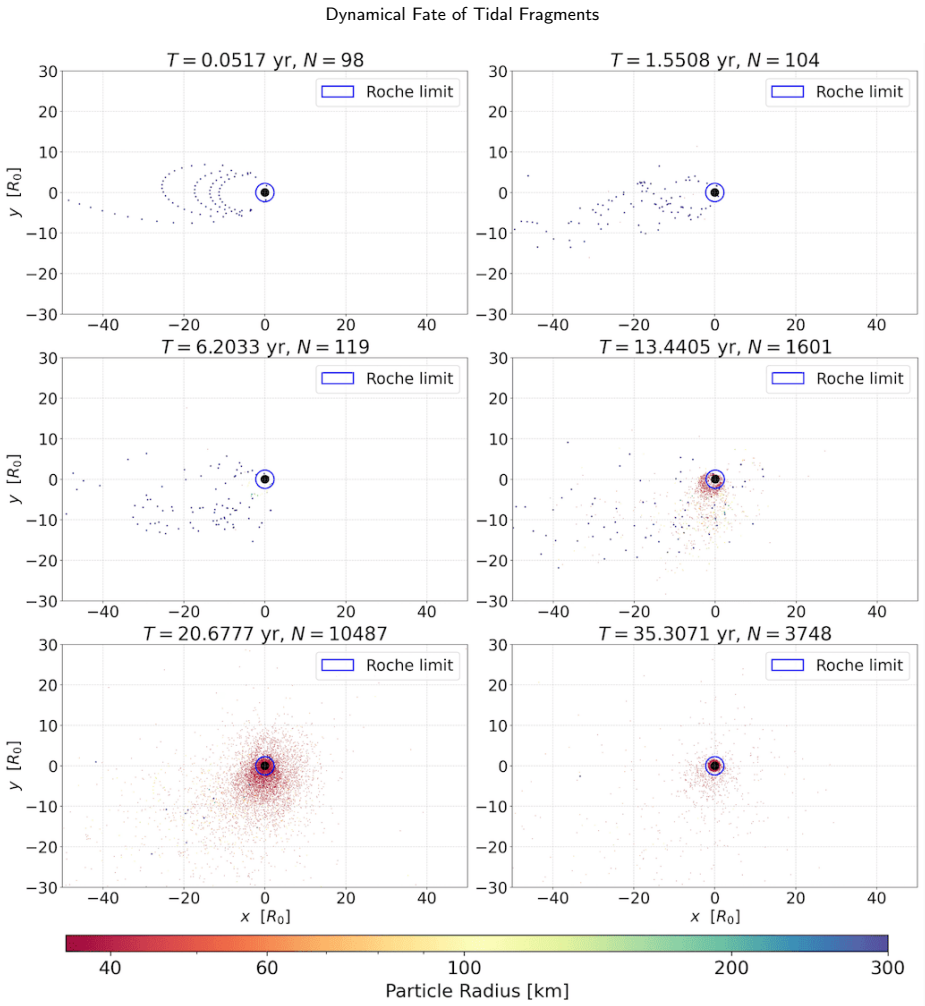
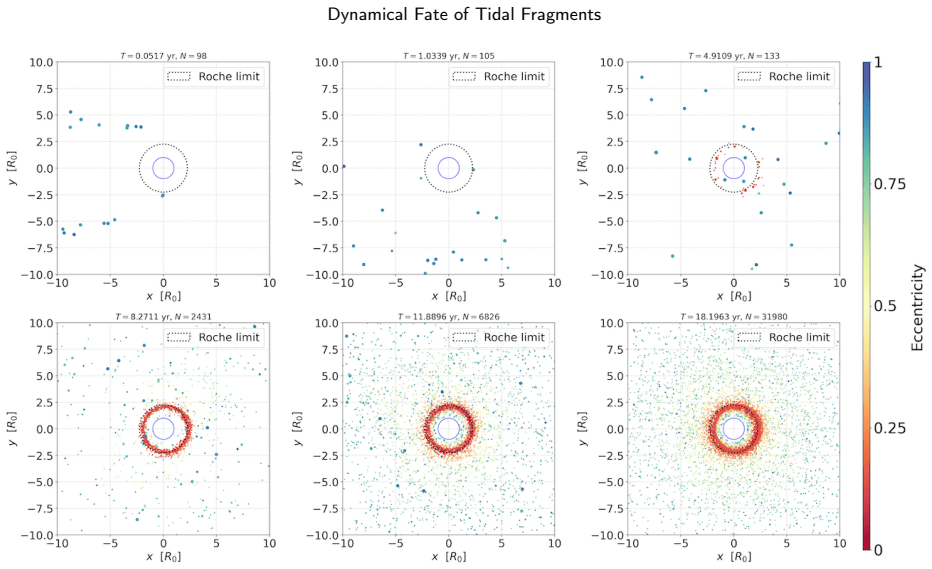
For low to moderate iTD, narrow, circular and equatorial rings finally form whose orbital radius is well predicted by an analytically derived equivalent circular radius based on the conservation of the vertical component of angular momentum. In contrast, for high iTD, collisional damping causes a substantial fraction of the material to fall onto the planet, preventing the formation of a massive ring. The results of N-body simulations are compiled with analytical predictions on the (qTD, iTD) parameter space to specify the region where sufficient mass survives to form Saturn's present rings and inner satellites.
What carries the argument
Equivalent circular radius from conservation of vertical angular momentum, used to predict ring location after collisional damping in N-body simulations of fragments in the planet's J2 gravitational field.
If this is right
- Narrow equatorial rings form at a specific radius determined by angular momentum conservation for moderate inclinations.
- A substantial portion of fragment mass is lost to the planet at high inclinations, limiting ring formation.
- The viable parameter space in pericenter distance and inclination is identified for producing rings with mass comparable to Saturn's.
- The timing of eccentricity and inclination damping depends on the initial inclination of the passing body.
- Inner satellites may also form from surviving fragments under the same conditions.
Where Pith is reading between the lines
- This single-event mechanism could be tested by comparing predicted ring masses and locations with those around other giant planets.
- If the required inclinations are rare in the Kuiper belt population, multiple disruption events might be necessary over solar system history.
- The model predicts that any remnant material outside the main ring should be on nearly equatorial orbits after damping.
- Extending the simulations to include gas drag or other effects could refine the mass survival estimates.
Load-bearing premise
The collisional fragmentation and damping outcomes for icy bodies at high velocities match real behavior, and the initial conditions from one passing large KBO represent the typical formation pathway.
What would settle it
An observation of significant mass in Saturn's rings on orbits with high inclinations or at radii inconsistent with the equivalent circular radius prediction would contradict the central claim.
Figures






read the original abstract
Planetary rings are ubiquitous structure in our Solar System, but their formation mechanisms remain under debate. One of the proposed scenarios is the tidal disruption of a nearby passing body that enters within a planet's Roche limit, producing fragments that are gravitationally captured and finally form the rings. In this study, we investigate the detailed dynamical path and fate of such tidally captured fragments using direct Nbody simulations including collisional fragmentation with analytical arguments. Focusing on Saturn as a representative case, we explore how the inclination iTD and pericenter distance qTD of the orbit of the passing body control the subsequent orbital evolution, collisional grinding, and the survival of fragments mass. Our simulations show that initially highly eccentric and inclined fragments experience differential precession driven by the planet's J2 potential, followed by destructive high-velocity collisions that damp their eccentricities and inclinations. The timing and pathway of this evolution strongly depend on iTD, modifying the dynamical picture proposed in the previous work. For low to moderate iTD, a narrow, circular and equatorial rings finally form whose orbital radius is well predicted by an analytically derived equivalent circular radius based on the conservation of the vertical component of angular momentum. In contrast, for high iTD, collisional damping causes a substantial fraction of the material to fall onto the planet, preventing the formation of a massive ring. We compile our results of Nbody simulations with the analytical predictions on (qTD, iTD) parameter space and specify the parameter region where sufficient mass to form Saturn's present rings and inner satellites survives.
Editorial analysis
A structured set of objections, weighed in public.
Referee Report
Summary. The manuscript investigates the dynamical fate of fragments from tidal disruption of a single large Kuiper belt object passing near Saturn via direct N-body simulations that include collisional fragmentation. It shows that the inclination iTD of the passing body's orbit governs the outcome: low-to-moderate iTD produces narrow, circular, equatorial rings whose radius matches an analytical prediction derived from conservation of the vertical component of angular momentum, whereas high iTD leads to collisional damping and substantial mass infall to the planet. The results are mapped onto the (qTD, iTD) parameter space to identify the region where enough mass survives to account for Saturn's rings and inner satellites.
Significance. If the adopted collisional model holds, the work supplies a concrete, simulation-supported pathway for ring formation from a single tidal disruption event, extending earlier analytic and numerical studies by incorporating J2-driven differential precession and fragment collisions. The combination of N-body results with an angular-momentum-based analytical radius prediction and the explicit (qTD, iTD) survival map provides falsifiable predictions for ring location and mass budget. These elements strengthen the manuscript's contribution to the ongoing debate on giant-planet ring origins.
major comments (3)
- [§2 (Numerical Methods, collision prescriptions)] §2 (Numerical Methods, collision prescriptions): The specific rules for fragment size distribution, velocity restitution coefficients, and energy dissipation in high-velocity (~km s^{-1}) icy-body collisions are not validated against laboratory data or independent high-speed collision simulations. Because these prescriptions directly set the collisional damping timescale and the mass-loss fraction to the planet, they control the location of the ring-formation boundary in the (qTD, iTD) plane.
- [Analytical radius derivation (likely §4)] Analytical radius derivation (likely §4): The equivalent-circular-radius formula assumes strict conservation of the vertical angular-momentum component for the entire initial fragment population. The N-body runs, however, report substantial mass infall at high iTD; the manuscript must show that the surviving mass still obeys this conservation or quantify the resulting shift in the predicted ring radius.
- [§3 (Results, numerical resolution)] §3 (Results, numerical resolution): No information is given on the number of particles, fragment size bins, or convergence tests with respect to particle number or time-stepping. Without these, it is impossible to judge whether the reported collisional damping rates and infall fractions are numerically robust.
minor comments (2)
- [Abstract] The symbols iTD and qTD appear in the abstract without definition; they should be introduced at first use.
- [Figure captions] Figure captions would benefit from explicit cross-references to the analytical radius formula and to the (qTD, iTD) survival contour.
Simulated Author's Rebuttal
We thank the referee for the constructive and detailed report. We address each major comment point by point below, indicating where revisions will be made to improve clarity and robustness.
read point-by-point responses
-
Referee: §2 (Numerical Methods, collision prescriptions): The specific rules for fragment size distribution, velocity restitution coefficients, and energy dissipation in high-velocity (~km s^{-1}) icy-body collisions are not validated against laboratory data or independent high-speed collision simulations. Because these prescriptions directly set the collisional damping timescale and the mass-loss fraction to the planet, they control the location of the ring-formation boundary in the (qTD, iTD) plane.
Authors: We used a standard collisional fragmentation model with fragment size distribution following a power-law index typical for disruptive impacts and restitution coefficients drawn from literature values for icy bodies at km/s velocities (e.g., as employed in prior N-body studies of satellite disruption and ring formation). These choices are not newly derived here but follow established prescriptions. We agree that explicit validation against lab data would strengthen the work; however, comprehensive laboratory coverage for the exact velocity and size regime remains limited. In the revised manuscript we will expand §2 with a dedicated paragraph citing the specific sources for each parameter, discussing their applicability to high-velocity icy collisions, and presenting a limited sensitivity test showing how moderate variations in restitution coefficient affect the final ring mass and damping timescale. This will clarify the robustness of the (qTD, iTD) boundary without requiring new laboratory campaigns. revision: partial
-
Referee: Analytical radius derivation (likely §4): The equivalent-circular-radius formula assumes strict conservation of the vertical angular-momentum component for the entire initial fragment population. The N-body runs, however, report substantial mass infall at high iTD; the manuscript must show that the surviving mass still obeys this conservation or quantify the resulting shift in the predicted ring radius.
Authors: The analytical formula is applied only to the subset of fragments that remain bound after the initial high-velocity phase and ultimately form a ring; it is not claimed to hold for material that is lost to the planet. In the low-to-moderate iTD regime where rings form, the simulated final radii match the analytic prediction to within a few percent, indicating that vertical angular momentum is effectively conserved for the surviving population. At high iTD, where most mass is lost, no ring is reported and the formula is not used for prediction. To make this explicit, the revised §4 will include a direct comparison of the initial and final vertical angular momentum summed over only the surviving particles (those with semi-major axes outside the planet’s radius at t = 10^4 yr), together with a quantitative estimate of any small radius offset caused by the modest mass loss that still occurs even in the ring-forming cases. revision: yes
-
Referee: §3 (Results, numerical resolution): No information is given on the number of particles, fragment size bins, or convergence tests with respect to particle number or time-stepping. Without these, it is impossible to judge whether the reported collisional damping rates and infall fractions are numerically robust.
Authors: We omitted these details in the interest of brevity. The revised manuscript will add to §3 (and the methods appendix) the following information: typical particle number (N ≈ 2 × 10^4 fragments per run), the logarithmic size bins used for collisional outcomes, the adopted time-step criterion, and results of convergence tests performed with N doubled and halved as well as with time steps reduced by a factor of two. These tests confirm that both the collisional damping timescale and the final mass-infall fraction change by less than 10 % once N exceeds 10^4, thereby demonstrating numerical robustness of the reported trends. revision: yes
Circularity Check
No significant circularity: results from independent N-body simulations plus first-principles angular-momentum conservation
full rationale
The paper's core claims rest on direct N-body integrations of tidally captured fragments under J2-driven precession and collisional damping, together with an analytical equivalent-circular-radius formula derived from conservation of the vertical angular-momentum component. Neither step reduces to a fit of the same data, a self-definitional loop, or a load-bearing self-citation whose validity is presupposed by the present work. The reference to prior work merely notes that the present simulations modify an earlier dynamical picture; the (qTD, iTD) survival map and ring-radius prediction are generated anew here and are externally falsifiable against the conservation law and the simulation outputs themselves.
Axiom & Free-Parameter Ledger
axioms (2)
- standard math Gravitational N-body dynamics including planetary oblateness (J2 potential)
- domain assumption Collisional fragmentation and damping for icy bodies at high velocities
Forward citations
Cited by 1 Pith paper
-
Dynamical Evolution of V-Shaped Collision Debris
V-shaped collision debris from proto-satellites reaccretes near the original impact radius rather than forming massive rings due to dominant inter-arm collisions.
Reference graph
Works this paper leans on
-
[1]
On the Character and Consequences of Large Impacts in the Late Stage of Terrestrial Planet Formation. Icarus 142, 219–237. doi:10.1006/icar.1999.6201. Araki, S., Tremaine, S.,
-
[2]
The dynamics of dense particle disks. Icarus 65, 83–109. doi:10.1016/0019-1035(86)90065-5. Asphaug, E.,
-
[3]
Chemie der Erde / Geochemistry 70, 199–219
Similar-sized collisions and the diversity of planets. Chemie der Erde / Geochemistry 70, 199–219. doi:10.1016/j.chemer. 2010.01.004. Braga-Ribas,F.,Sicardy,B.,Ortiz,J.L.,Snodgrass,C.,Roques,F.,Vieira-Martins,R.,Camargo,J.I.B.,Assafin,M.,Duffard,R.,Jehin,E.,Pollock, J., Leiva, R., Emilio, M., Machado, D.I., Colazo, C., Lellouch, E., Skottfelt, J., Gillon,...
-
[4]
A ring system detected around the Centaur (10199) Chariklo. Nature 508, 72–75. doi:10.1038/nature13155,arXiv:1409.7259. Canup, R.M.,
-
[5]
Origin of Saturn’s rings and inner moons by mass removal from a lost Titan-sized satellite. Nature 468, 943–946. doi:10.1038/nature09661. Chambers, J.E.,
-
[6]
Making More Terrestrial Planets. Icarus 152, 205–224. doi:10.1006/icar.2001.6639. Chambers, J.E.,
-
[8]
Accretion of Saturn’s mid-sized moons during the viscous spreading of young massive rings: Solving the paradox of silicate-poor rings versus silicate-rich moons. Icarus 216, 535–550. doi:10.1016/j.icarus.2011.09.017,arXiv:1109.3360. Charnoz, S., Morbidelli, A., Dones, L., Salmon, J.,
-
[9]
doi:10.1016/j.icarus.2008.10.019,arXiv:0809.5073
Did Saturn’s rings form during the Late Heavy Bombardment? Icarus 199, 413–428. doi:10.1016/j.icarus.2008.10.019,arXiv:0809.5073. Charnoz,S.,Salmon,J.,Crida,A.,2010. TherecentformationofSaturn’smoonletsfromviscousspreadingofthemainrings. Nature465,752–754. doi:10.1038/nature09096. Torii et al.:Preprint submitted to ElsevierPage 26 of 30 Dynamical Fate of ...
-
[10]
Crida, A., Charnoz, S., Hsu, H.W., Dones, L.,
doi:10.1126/ science.1226477,arXiv:1301.3808. Crida, A., Charnoz, S., Hsu, H.W., Dones, L.,
-
[11]
Viscosity in a Dense Planetary Ring with Self-Gravitating Particles. Icarus 154, 296–312. doi:10.1006/ icar.2001.6716. Dones, L.,
-
[12]
doi:10.1016/0019-1035(91)90045-U
A recent cometary origin for Saturn’s rings? Icarus 92, 194–203. doi:10.1016/0019-1035(91)90045-U. Dubinski, J.,
-
[13]
A recent origin for Saturn’s rings from the collisional disruption of an icy moon. Icarus 321, 291–306. doi:10.1016/j. icarus.2018.11.034,arXiv:1709.08768. Durisen, R.H., Estrada, P.R.,
work page doi:10.1016/j 2018
-
[14]
Large mass inflow rates in Saturn’s rings due to ballistic transport and mass loading. Icarus 400, 115221. doi:10.1016/j.icarus.2022.115221,arXiv:2305.13578. Elliot, J.L., Dunham, E., Mink, D.,
-
[15]
The rings of Uranus. Nature 267, 328–330. doi:10.1038/267328a0. Estrada, P.R., Durisen, R.H.,
-
[16]
Constraints on the initial mass, age and lifetime of Saturn’s rings from viscous evolutions that include pollution and transport due to micrometeoroid bombardment. Icarus 400, 115296. doi:10.1016/j.icarus.2022.115296,arXiv:2305.13609. French, R.G., McGhee-French, C.A., Gordon, M., Baron, R.L., Bosh, A.S., Buie, M.W., Chanover, N., Clark, M.A., Dunham, E.W...
-
[17]
Uranus ring occultation observations: 1977-2006. Icarus 395, 115474. doi:10.1016/j.icarus.2023.115474. Genda,H.,Kokubo,E.,Ida,S.,2012. MergingCriteriaforGiantImpactsofProtoplanets. Astrophys.J.744,137. doi:10.1088/0004-637X/744/ 2/137,arXiv:1109.4330. Gomes, R., Levison, H.F., Tsiganis, K., Morbidelli, A.,
-
[18]
Origin of the cataclysmic Late Heavy Bombardment period of the terrestrial planets. Nature 435, 466–469. doi:10.1038/nature03676. Hedman,M.M.,Nicholson,P.D.,Baines,K.H.,Buratti,B.J.,Sotin,C.,Clark,R.N.,Brown,R.H.,French,R.G.,Marouf,E.A.,2010.TheArchitecture of the Cassini Division. Astron. J. 139, 228–251. doi:10.1088/0004-6256/139/1/228,arXiv:0911.2438. ...
-
[19]
Occultation detection of a neptunian ring-like arc. Nature 319, 636–640. doi:10.1038/319636a0. Hyodo,R.,Charnoz,S.,Ohtsuki,K.,Genda,H.,2017. RingformationaroundgiantplanetsbytidaldisruptionofasinglepassinglargeKuiperbelt object. Icarus 282, 195–213. doi:10.1016/j.icarus.2016.09.012,arXiv:1609.02396. Hyodo, R., Genda, H.,
-
[20]
Hyodo, R., Genda, H., Madeira, G.,
doi:10.3847/ 1538-4357/abf6d8,arXiv:2104.04981. Hyodo, R., Genda, H., Madeira, G.,
-
[21]
Pollution resistance of Saturn’s ring particles during micrometeoroid impact. Nature Geoscience 18, 44–49. doi:10.1038/s41561-024-01598-9. Hyodo,R.,Ida,S.,2025. RingedversusRinglessWorlds:HowPoynting-RobertsonDragShapesRingsacrosstheSolarSystem. Astrophys.J.Lett. 994, L15. doi:10.3847/2041-8213/ae194b,arXiv:2510.25302. Iess, L., Militzer, B., Kaspi, Y., N...
-
[22]
Measurement and implications of Saturn’s gravity field and ring mass. Science 364, aat2965. doi:10.1126/science. aat2965. Ishigaki, Y., Kominami, J., Makino, J., Fujimoto, M., Iwasawa, M.,
-
[23]
Particle-particle particle-tree code for planetary system formation with individual cut-off method: GPLUM. Publ. Astron. Soc. Jpn. 73, 660–676. doi:10.1093/pasj/psab028,arXiv:2007.15432. Iwasawa, M., Namekata, D., Sakamoto, R., Nakamura, T., Kimura, Y., Nitadori, K., Wang, L., Tsubouchi, M., Makino, J., Liu, Z., Fu, H., Yang, G.,
-
[24]
The International Journal of High Performance Computing Applications 34, 615–628
Implementation and performance of barnes-hut n-body algorithm on extreme-scale heterogeneous many-core architectures. The International Journal of High Performance Computing Applications 34, 615–628. URL:https://doi.org/10.1177/1094342020943652, doi:10.1177/1094342020943652,arXiv:https://doi.org/10.1177/1094342020943652. Kaula, W.M.,
-
[25]
Origin of Mars’s moons by disruptive partial capture of an asteroid. Icarus 425, 116337. doi:10.1016/j.icarus.2024.116337,arXiv:2407.15936. Kempf, S., Altobelli, N., Schmidt, J., Cuzzi, J.N., Estrada, P.R., Srama, R.,
-
[26]
Micrometeoroid infall onto Saturn’s rings constrains their age to no more than a few hundred million years. Science Advances 9, eadf8537. doi:10.1126/sciadv.adf8537. Kokubo, E., Ida, S.,
-
[27]
Formation of Terrestrial Planets from Protoplanets. II. Statistics of Planetary Spin. Astrophys. J. 671, 2082–2090. doi:10.1086/522364. Kraus,R.G.,Senft,L.E.,Stewart,S.T.,2011. ImpactsontoH 2Oice:Scalinglawsformelting,vaporization,excavation,andfinalcratersize. Icarus 214, 724–738. doi:10.1016/j.icarus.2011.05.016. Lange, M.A., Ahrens, T.J.,
-
[28]
Journal of Geophysical Research: Solid Earth 88, 1197–1208
The dynamic tensile strength of ice and ice silicate mixtures. Journal of Geophysical Research: Solid Earth 88, 1197–1208. doi:10.1029/JB088iB02p01197. Leinhardt,Z.M.,Stewart,S.T.,2012. CollisionsbetweenGravity-dominatedBodies.I.OutcomeRegimesandScalingLaws. Astrophys.J.745,79. doi:10.1088/0004-637X/745/1/79,arXiv:1106.6084. Liang,Y.,Hyodo,R.,2023. Giga-y...
-
[29]
A dense ring of the trans-Neptunian object Quaoar outside its Roche limit. Nature 614, 239–243. doi:10.1038/s41586-022-05629-6. Murray, C.D., Dermott, S.F.,
-
[30]
Solar System Dynamics. doi:10.1017/CBO9781139174817. Nesvorný, D., Alvarellos, J.L.A., Dones, L., Levison, H.F.,
-
[31]
Orbital and Collisional Evolution of the Irregular Satellites. Astron. J. 126, 398–429. doi:10.1086/375461. Nesvorný, D., Vokrouhlický, D.,
-
[32]
Nesvorný, D., Vokrouhlický, D., Morbidelli, A.,
doi:10.3847/0004-637X/ 825/2/94,arXiv:1602.06988. Nesvorný, D., Vokrouhlický, D., Morbidelli, A.,
-
[33]
Capture of Irregular Satellites during Planetary Encounters. Astron. J. 133, 1962–1976. doi:10.1086/512850. Nicholson,P.D.,Cooke,M.L.,Matthews,K.,Elias,J.H.,Gilmore,G.,1990. FivestellaroccultationsbyNeptune:Furtherobservationsofringarcs. Icarus 87, 1–39. doi:10.1016/0019-1035(90)90020-A. Nicholson, P.D., Persson, S.E., Matthews, K., Goldreich, P., Neugebauer, G.,
-
[34]
The rings of Uranus: results of the 10 April 1978 occultation. Astron. J. 83, 1240–1248. doi:10.1086/112318. Ortiz,J.L.,Santos-Sanz,P.,Sicardy,B.,Benedetti-Rossi,G.,Bérard,D.,Morales,N.,Duffard,R.,Braga-Ribas,F.,Hopp,U.,Ries,C.,Nascimbeni, V., Marzari, F., Granata, V., Pál, A., Kiss, C., Pribulla, T., Komžík, R., Hornoch, K., Pravec, P., Bacci, P., Maestr...
-
[35]
L., Santos-Sanz, P., Sicardy, B., et al
The size, shape, density and ring of the dwarf planet Haumea from a stellar occultation. Nature 550, 219–223. doi:10.1038/nature24051,arXiv:2006.03113. Oshino, S., Funato, Y., Makino, J.,
-
[36]
doi:10.1093/pasj/63.4.881,arXiv:1101.5504. Pereira,C.L.,Braga-Ribas,F.,Sicardy,B.,Leiva,R.,Assafin,M.,Morgado,B.E.,Ortiz,J.L.,Santos-Sanz,P.,Camargo,J.I.B.,Margoti,G.,Kilic,Y., Benedetti-Rossi, G., Vieira-Martins, R., Pinheiro, T.F.L.L., Sfair, R., Rommel, F.L., Gomes-Júnior, A.R., Boufleur, R.C., Duffard, R., Desmars, J., Souami, D., Morales, N., Arrese,...
-
[37]
The Rings of (2060) Chiron: Evidence of an Evolving System. Astrophys. J. Lett. 992, L19. doi:10.3847/2041-8213/ae0b6d,arXiv:2510.12388. Porco, C.C., Baker, E., Barbara, J., Beurle, K., Brahic, A., Burns, J.A., Charnoz, S., Cooper, N., Dawson, D.D., Del Genio, A.D., Denk, T., Dones, L., Dyudina, U., Evans, M.W., Giese, B., Grazier, K., Helfenstein, P., In...
-
[38]
Cassini Imaging Science: Initial Results on Saturn’s Rings and Small Satellites. Science 307, 1226–1236. doi:10.1126/science.1108056. Salmon, J., Canup, R.M.,
-
[39]
Salmon, J., Charnoz, S., Crida, A., Brahic, A.,
doi:10.3847/1538-4357/836/1/109,arXiv:1702.04385. Salmon, J., Charnoz, S., Crida, A., Brahic, A.,
-
[40]
Long-term and large-scale viscous evolution of dense planetary rings. Icarus 209, 771–785. doi:10.1016/j.icarus.2010.05.030,arXiv:1006.0633. Schmitz, B., Tassinari, M., Peucker-Ehrenbrink, B.,
-
[41]
Earth and Planetary Science Letters 194, 1–15
A rain of ordinary chondritic meteorites in the early Ordovician. Earth and Planetary Science Letters 194, 1–15. doi:10.1016/S0012-821X(01)00559-3. Senft, L.E., Stewart, S.T.,
-
[42]
Meteoritics & Planetary Sci- ence43(12), 1917–1938 (2008)
Impact crater formation in icy layered terrains on Mars. Meteoritics & Planetary Science 43, 1993–2013. doi:10.1111/j.1945-5100.2008.tb00657.x. Stewart, S.T., Ahrens, T.J.,
-
[43]
Correction to the Dynamic Tensile Strength of Ice and Ice-Silicate Mixtures (Lange & Ahrens 1983), in: Lunar and Planetary Science Conference, p
1983
-
[44]
Velocity-Dependent Catastrophic Disruption Criteria for Planetesimals. Astrophys. J. 691, L133–L137. doi:10.1088/0004-637X/691/2/L133. Stewart, S.T., Seifter, A., Obst, A.W.,
-
[45]
Shocked H2O ice: Thermal emission measurements and the criteria for phase changes during impact events. Geophys. Res. Lett. 35, L23203. doi:10.1029/2008GL035947. Teodoro, L.F.A., Kegerreis, J.A., Estrada, P.R., Ćuk, M., Eke, V.R., Cuzzi, J.N., Massey, R.J., Sandnes, T.D.,
-
[46]
Tiscareno, M.S., Burns, J.A., Nicholson, P.D., Hedman, M.M., Porco, C.C.,
doi:10.3847/1538-4357/acf4ed,arXiv:2309.15156. Tiscareno, M.S., Burns, J.A., Nicholson, P.D., Hedman, M.M., Porco, C.C.,
-
[47]
Cassini imaging of Saturn’s rings. II. A wavelet tech- nique for analysis of density waves and other radial structure in the rings. Icarus 189, 14–34. doi:10.1016/j.icarus.2006.12.025, arXiv:astro-ph/0610242. Tiscareno,M.S.,Hedman,M.M.,Burns,J.A.,Castillo-Rogez,J.,2013. CompositionsandOriginsofOuterPlanetSystems:InsightsfromtheRoche Critical Density. Astr...
-
[48]
Properties, Structure, and Evolution
Planetary Ring Systems. Properties, Structure, and Evolution. doi:10.1017/9781316286791. Tiscareno, M.S., Nicholson, P.D., Cuzzi, J.N., Spilker, L.J., Murray, C.D., Hedman, M.M., Colwell, J.E., Burns, J.A., Brooks, S.M., Clark, R.N., Torii et al.:Preprint submitted to ElsevierPage 28 of 30 Dynamical Fate of Tidal Fragments Figure 20:The zoom-in view of Fi...
-
[49]
J., Morbidelli, A., Raymond, S
Dynamics of Planetary Systems. Tsiganis,K.,Gomes,R.,Morbidelli,A.,Levison,H.F.,2005. OriginoftheorbitalarchitectureofthegiantplanetsoftheSolarSystem. Nature435, 459–461. doi:10.1038/nature03539. Weaver, H.A., A’Hearn, M.F., Arpigny, C., Boice, D.C., Feldman, P.D., Larson, S.M., Lamy, P., Levy, D.H., Marsden, B.G., Meech, K.J., Noll, K.S., Scotti, J.V., Se...
-
[50]
Science 267, 1282–1288. doi:10.1126/science.7871424. Wisdom, J., Dbouk, R., Militzer, B., Hubbard, W.B., Nimmo, F., Downey, B.G., French, R.G.,
-
[51]
Loss of a satellite could explain Saturn’s obliquity and young rings. Science 377, 1285–1289. doi:10.1126/science.abn1234. Zhang, Z., Hayes, A.G., Janssen, M.A., Nicholson, P.D., Cuzzi, J.N., de Pater, I., Dunn, D.E., 2017a. Exposure age of Saturn’s A and B rings, and the Cassini Division as suggested by their non-icy material content. Icarus 294, 14–42. ...
discussion (0)
Sign in with ORCID, Apple, or X to comment. Anyone can read and Pith papers without signing in.