Spectral Signatures of Active Fluctuations in Semiflexible Polymers
Pith reviewed 2026-05-10 15:50 UTC · model grok-4.3
The pith
Active baths reorganize semiflexible polymer fluctuations by boosting low modes and shifting spectral weight to longer wavelengths.
A machine-rendered reading of the paper's core claim, the machinery that carries it, and where it could break.
Core claim
Starting from explicit active forces, an effective description in terms of temporally persistent and spatially correlated noise captures how activity reorganizes the polymer's fluctuation spectrum at the mode level, with force boosting low modes and persistence shifting weight toward longer wavelengths, though it underestimates global sizes due to absent contour-length renormalization.
What carries the argument
Effective temporally persistent and spatially correlated active noise derived from active Brownian particle bath statistics.
If this is right
- The polymer's mode spectrum acts as a multiscale probe that resolves the temporal and spatial structure of nonequilibrium forcing.
- Explicit and implicit active bath models show strong qualitative correspondence over a broad parameter range.
- Fixed-contour-length theories miss systematic activity-induced effects on global polymer size measures.
Where Pith is reading between the lines
- Semiflexible polymers could be used in experiments to distinguish different active forcing structures by reading their mode spectra.
- Allowing variable contour length in the effective model would likely remove the underestimation of radius of gyration and related global measures.
Load-bearing premise
The polymer contour length remains fixed under activity, ignoring bond stretching and renormalization.
What would settle it
Compare measured radius of gyration in explicit active-bath simulations that allow bond stretching against predictions from the fixed-contour theory; the gap should close if contour-length effects are the source of the underestimate.
Figures




read the original abstract
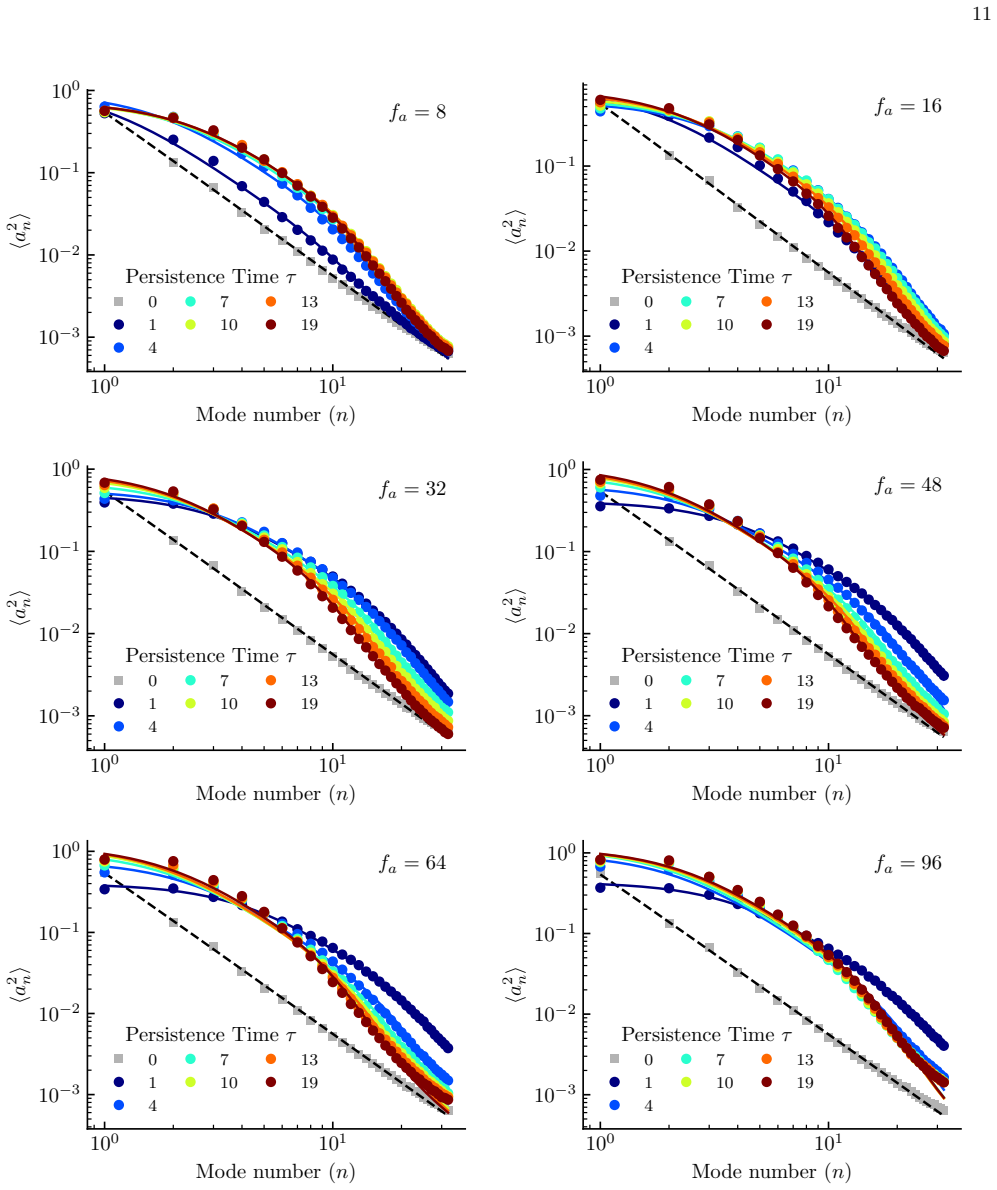
We study how an active bath is transduced into the internal fluctuation spectrum of a semiflexible polymer. Starting from the statistics of active forces exerted by an explicit bath of active Brownian particles, we derive an effective description in terms of temporally persistent and spatially correlated noise, and test it against simulations of both explicit-bath and implicit-noise models. We find that activity reorganizes polymer fluctuations spectrally rather than uniformly: increasing the active force predominantly enhances the lowest modes, while increasing persistence shifts the spectral weight toward progressively longer wavelengths. The theory captures this mode-level reorganization well and explains the strong qualitative correspondence between explicit and implicit active baths over a broad parameter range. In contrast, global size measures such as the radius of gyration are systematically underestimated, which we trace to activity-induced bond stretching and contour-length renormalization absent from the present fixed-contour theory. Our results show that a semiflexible polymer acts as a multiscale probe of active matter, resolving the temporal and spatial structure of nonequilibrium forcing through its mode spectrum.
Editorial analysis
A structured set of objections, weighed in public.
Referee Report
Summary. The manuscript derives an effective description of active fluctuations in a semiflexible polymer as temporally persistent and spatially correlated noise, starting from the explicit statistics of an active Brownian particle bath. It tests this model against simulations of both explicit-bath and implicit-noise realizations, reporting that activity reorganizes the fluctuation spectrum by preferentially enhancing the lowest modes with increasing active force strength and shifting spectral weight toward longer wavelengths with increasing persistence. The effective theory is said to capture this mode-level reorganization well and to explain the qualitative correspondence between explicit and implicit baths over a broad parameter range, while global size measures (e.g., radius of gyration) are systematically underestimated due to the fixed-contour-length approximation that neglects activity-induced bond stretching and contour renormalization.
Significance. If the central spectral claims hold, the work is significant for establishing semiflexible polymers as multiscale probes that resolve the temporal and spatial structure of nonequilibrium active forcing. The first-principles derivation from explicit active-particle statistics, followed by direct comparison to separate simulations of explicit and implicit models, provides a concrete strength that supports the reported qualitative agreement and the explanation for bath correspondence. This advances the field beyond uniform scaling pictures of activity and offers a framework for interpreting fluctuation spectra in active matter contexts.
major comments (2)
- [Abstract] Abstract: the statement that the effective theory 'captures this mode-level reorganization well' is presented without any quantitative fit metrics (e.g., mean-squared deviation, correlation coefficient, or error bars on the mode amplitudes) for the spectral comparisons across active force and persistence values; given the acknowledged discrepancy in global size measures, the absence of such metrics leaves the strength of the 'well' agreement difficult to assess.
- [Theory/derivation section] Theory/derivation section: the fixed-contour-length assumption is correctly identified as the source of underestimated global sizes, yet no analysis is provided of whether (or how) this approximation propagates into the derived effective noise correlations or biases the reported low-mode enhancements and wavelength shifts; because the central claim concerns spectral reorganization, a short sensitivity test or bounding argument on contour fluctuations would be required to confirm the approximation does not undermine the mode-level results.
minor comments (2)
- Figure captions and legends should explicitly list the numerical parameter values (active force magnitude, persistence time, polymer length, etc.) used for each curve or panel to facilitate direct comparison with the stated broad parameter range.
- The manuscript would benefit from a brief methods paragraph or supplementary note detailing the simulation protocols (e.g., integration timestep, ensemble size, equilibration criteria) for both explicit-bath and implicit-noise runs, as these are essential for reproducibility of the reported qualitative matches.
Simulated Author's Rebuttal
We thank the referee for the positive evaluation and the recommendation for minor revision. We address each major comment below and will incorporate the suggested improvements in the revised manuscript.
read point-by-point responses
-
Referee: [Abstract] Abstract: the statement that the effective theory 'captures this mode-level reorganization well' is presented without any quantitative fit metrics (e.g., mean-squared deviation, correlation coefficient, or error bars on the mode amplitudes) for the spectral comparisons across active force and persistence values; given the acknowledged discrepancy in global size measures, the absence of such metrics leaves the strength of the 'well' agreement difficult to assess.
Authors: We agree that quantitative metrics would allow a more objective assessment of the agreement. In the revised manuscript we will report correlation coefficients and mean-squared deviations between the effective-theory predictions and the simulation data for the mode amplitudes, across the active-force and persistence values shown in the figures. These metrics will be added to the figure captions or a supplementary table. revision: yes
-
Referee: [Theory/derivation section] Theory/derivation section: the fixed-contour-length assumption is correctly identified as the source of underestimated global sizes, yet no analysis is provided of whether (or how) this approximation propagates into the derived effective noise correlations or biases the reported low-mode enhancements and wavelength shifts; because the central claim concerns spectral reorganization, a short sensitivity test or bounding argument on contour fluctuations would be required to confirm the approximation does not undermine the mode-level results.
Authors: The referee correctly identifies that we have not explicitly examined how the fixed-contour-length approximation affects the derived noise correlations or the reported spectral reorganization. In the revision we will add a short bounding argument in the theory section: we will estimate the magnitude of activity-induced contour-length fluctuations from the explicit-bath simulations and show that, for the parameter range considered, these fluctuations remain small enough that they do not qualitatively change the relative low-mode enhancements or the wavelength shifts. The effective noise correlations themselves are derived from the bath statistics and are independent of contour length to leading order. revision: yes
Circularity Check
No significant circularity
full rationale
The derivation begins from the explicit statistics of active Brownian particles and produces an effective temporally persistent, spatially correlated noise model that is then validated against independent simulations of both explicit-bath and implicit-noise polymer models. The reported spectral reorganization (preferential enhancement of low modes with active force, wavelength shift with persistence) is presented as an output of this derivation and is compared to simulation data rather than being fitted or defined in terms of the target observables. Global size discrepancies are explicitly attributed to the fixed-contour-length approximation, which is flagged as a limitation rather than hidden. No self-definitional steps, fitted inputs renamed as predictions, or load-bearing self-citations appear in the provided abstract or reader summary; the central claims remain independently testable against external simulation benchmarks.
Axiom & Free-Parameter Ledger
Reference graph
Works this paper leans on
-
[1]
F. S. Gnesotto, F. Mura, J. Gladrow, and C. P. Broed- ersz, Broken detailed balance and non-equilibrium dy- namics in living systems: a review, Reports on Progress in Physics81, 066601 (2018)
work page 2018
-
[2]
J. O’Byrne, Y. Kafri, J. Tailleur, and F. van Wij- land, Time irreversibility in active matter, from micro to macro, Nature Reviews Physics4, 167 (2022)
work page 2022
- [3]
-
[4]
G. Gr´ egoire, H. Chat´ e, and Y. Tu, Comment on” parti- cle diffusion in a quasi-two-dimensional bacterial bath”, Physical Review Letters86, 556 (2001)
work page 2001
-
[5]
G. Mino, T. E. Mallouk, T. Darnige, M. Hoyos, J. Dauchet, J. Dunstan, R. Soto, Y. Wang, A. Rous- selet, and E. Clement, Enhanced diffusion due to active swimmers at a solid surface, Physical review letters106, 048102 (2011)
work page 2011
-
[6]
D. T. Chen, A. Lau, L. A. Hough, M. F. Islam, M. Gou- lian, T. C. Lubensky, and A. G. Yodh, Fluctuations and rheology in active bacterial suspensions, Physical review letters99, 148302 (2007)
work page 2007
-
[7]
L. Angelani, C. Maggi, M. Bernardini, A. Rizzo, and R. Di Leonardo, Effective interactions between colloidal particles suspended in a bath of swimming cells, Physical review letters107, 138302 (2011)
work page 2011
-
[8]
L. F. Cugliandolo, The effective temperature, Journal of Physics A: Mathematical and Theoretical44, 483001 (2011)
work page 2011
-
[9]
D. Loi, S. Mossa, and L. F. Cugliandolo, Effective tem- perature of active complex matter, Soft Matter7, 3726 (2011)
work page 2011
- [10]
-
[11]
J. Palacci, C. Cottin-Bizonne, C. Ybert, and L. Bocquet, Sedimentation and effective temperature of active col- loidal suspensions, Physical Review Letters105, 088304 (2010)
work page 2010
- [12]
-
[13]
S. Dal Cengio, D. Levis, and I. Pagonabarraga, Linear re- sponse theory and green-kubo relations for active matter, Physical review letters123, 238003 (2019)
work page 2019
-
[14]
L. F. Cugliandolo, G. Gonnella, and I. Petrelli, Effec- tive temperature in active brownian particles, Fluctua- tion and Noise letters18, 1940008 (2019)
work page 2019
-
[15]
I. Petrelli, L. F. Cugliandolo, G. Gonnella, and A. Suma, Effective temperatures in inhomogeneous passive and ac- tive bidimensional brownian particle systems, Physical Review E102, 012609 (2020)
work page 2020
-
[16]
L. Hecht, L. Caprini, H. L¨ owen, and B. Liebchen, How to define temperature in active sys- tems?, The Journal of Chemical Physics161, https://doi.org/10.1063/5.0234370 (2024)
- [17]
-
[18]
J. Reichert and T. Voigtmann, Tracer dynamics in crowded active-particle suspensions, Soft Matter17, 10492 (2021)
work page 2021
-
[19]
E. W. Burkholder and J. F. Brady, Nonlinear microrheol- ogy of active brownian suspensions, Soft Matter16, 1034 (2020)
work page 2020
-
[20]
L. Caprini and U. Marini Bettolo Marconi, Active mat- ter at high density: Velocity distribution and kinetic temperature, The Journal of Chemical Physics153, https://doi.org/10.1063/5.0029710 (2020). 15
-
[21]
S. S. Khali, F. Peruani, and D. Chaudhuri, When an ac- tive bath behaves as an equilibrium one, Physical Review E109, 024120 (2024)
work page 2024
- [22]
- [23]
-
[24]
´E. Fodor and M. C. Marchetti, The statistical physics of active matter: From self-catalytic colloids to living cells, Physica A: Statistical Mechanics and its Applica- tions504, 106 (2018)
work page 2018
-
[25]
Maes, Fluctuating motion in an active environment, Physical Review Letters125, 208001 (2020)
C. Maes, Fluctuating motion in an active environment, Physical Review Letters125, 208001 (2020)
work page 2020
-
[26]
J. Gladrow, N. Fakhri, F. C. MacKintosh, C. F. Schmidt, and C. P. Broedersz, Broken detailed balance of fila- ment dynamics in active networks, Phys. Rev. Lett.116, 248301 (2016)
work page 2016
-
[27]
H. Vandebroek and C. Vanderzande, Dynamics of a poly- mer in an active and viscoelastic bath, Phys. Rev. E92, 060601 (2015)
work page 2015
-
[28]
N. Samanta and R. Chakrabarti, Chain reconfiguration in active noise, Journal of Physics A: Mathematical and Theoretical49, 195601 (2016)
work page 2016
-
[29]
A. Baskaran and M. C. Marchetti, Enhanced diffusion and ordering of self-propelled rods, Phys. Rev. Lett.101, 268101 (2008)
work page 2008
-
[30]
A. Ghosh and N. Gov, Dynamics of active semiflexible polymers, Biophysical Journal107, 1065 (2014)
work page 2014
-
[31]
T. Eisenstecken, G. Gompper, and R. G. Winkler, Con- formational properties of active semiflexible polymers, Polymers8, 304 (2016)
work page 2016
-
[32]
T. Eisenstecken, G. Gompper, and R. G. Winkler, Inter- nal dynamics of semiflexible polymers with active noise, The Journal of chemical physics146(2017)
work page 2017
-
[33]
T. Eisenstecken and R. G. Winkler, Path integral de- scription of semiflexible active brownian polymers, The Journal of Chemical Physics156(2022)
work page 2022
-
[34]
L. B. Frechette, A. Baskaran, and M. F. Hagan, Active- noise-induced dynamic clustering of passive colloidal par- ticles, Newton1, 100167 (2025)
work page 2025
-
[35]
R. Ananthakrishnan and A. Ehrlicher, The forces behind cell movement, International journal of biological sciences 3, 303 (2007)
work page 2007
-
[36]
R. G. Winkler and G. Gompper, The physics of active polymers and filaments, The journal of chemical physics 153, 10.1063/5.0011466 (2020)
- [37]
- [38]
-
[39]
R. G. Winkler, J. Elgeti, and G. Gompper, Active poly- mers—emergent conformational and dynamical proper- ties: A brief review, Journal of the Physical Society of Japan86, 101014 (2017)
work page 2017
-
[40]
J. Shin, A. G. Cherstvy, W. K. Kim, and R. Metzler, Fa- cilitation of polymer looping and giant polymer diffusiv- ity in crowded solutions of active particles, New Journal of Physics17, 113008 (2015)
work page 2015
-
[41]
C. J. Anderson, G. Briand, O. Dauchot, and A. Fern´ andez-Nieves, Polymer-chain configurations in ac- tive and passive baths, Physical Review E106, 064606 (2022)
work page 2022
-
[42]
M. S. Aporvari, M. Utkur, E. U. Saritas, G. Volpe, and J. Stenhammar, Anisotropic dynamics of a self-assembled colloidal chain in an active bath, Soft Matter16, 5609 (2020)
work page 2020
-
[43]
S. M. Mousavi, G. Gompper, and R. G. Winkler, Active bath-induced localization and collapse of passive semi- flexible polymers, The journal of chemical physics155, https://doi.org/10.1063/5.0058150 (2021)
-
[44]
P. L. Muzzeddu, A. Gambassi, J.-U. Sommer, and A. Sharma, Migration and separation of polymers in nonuniform active baths, Physical Review Letters133, 118102 (2024)
work page 2024
- [45]
-
[46]
S. Paul, S. Majumder, and W. Janke, Activity mediated globule to coil transition of a flexible polymer in a poor solvent, Soft Matter18, 6392 (2022)
work page 2022
-
[47]
A. Martin-Gomez, T. Eisenstecken, G. Gompper, and R. G. Winkler, Hydrodynamics of polymers in an active bath, Physical Review E101, 052612 (2020)
work page 2020
-
[48]
M. Foglino, E. Locatelli, C. Brackley, D. Michieletto, C. Likos, and D. Marenduzzo, Non-equilibrium effects of molecular motors on polymers, Soft matter15, 5995 (2019)
work page 2019
- [49]
-
[50]
A. Shee, N. Gupta, A. Chaudhuri, and D. Chaudhuri, A semiflexible polymer in a gliding assay: Reentrant tran- sition, role of turnover and activity, Soft Matter17, 2120 (2021)
work page 2021
- [51]
-
[52]
C. P. Brangwynne, G. H. Koenderink, E. Barry, Z. Dogic, F. C. MacKintosh, and D. A. Weitz, Bending dynamics of fluctuating biopolymers probed by automated high- resolution filament tracking, Biophysical Journal93, 346 (2007)
work page 2007
-
[53]
C. P. Brangwynne, G. H. Koenderink, F. C. MacKin- tosh, and D. A. Weitz, Nonequilibrium microtubule fluc- tuations in a model cytoskeleton, Phys. Rev. Lett.100, 118104 (2008)
work page 2008
-
[54]
C. Singh and A. Chaudhuri, Anomalous dynamics of a passive droplet in active turbulence, Nature Communi- cations15, 3704 (2024)
work page 2024
- [55]
-
[56]
D. T. Gillespie, Exact numerical simulation of the ornstein-uhlenbeck process and its integral, Physical re- view E54, 2084 (1996)
work page 2084
-
[57]
F.-Y. Chu, A. S. Clavijo, S. Lee, and A. Zidovska, Transcription-dependent mobility of single genes and genome-wide motions in live human cells, Nature Com- munications15, 8879 (2024). 16
work page 2024
-
[58]
A. Zidovska, The self-stirred genome: large-scale chro- matin dynamics, its biophysical origins and implications, Current opinion in genetics & development61, 83 (2020). Appendix A: Mapping of simulation parameterαto persistence timeτ In LAMMPS, the rotational Langevin thermostat for ABPs is controlled by a parameter (internallyangmom, denotedαhere), defi...
work page 2020
-
[59]
Transverse contributionR 2 g,⊥ Integrating the tangent expansion gives r⊥(s) = Z s 0 ds′ u⊥(s′) = X n≥1 an r 2 L sin(qns) qn .(G3) The transverse radius of gyration is R2 g,⊥ ≡ 1 L Z L 0 ds D r⊥(s)−r ⊥,cm 2E ,(G4) wherer ⊥,cm ≡ 1 L R L 0 dsr ⊥(s).Using Eq. (G3), mode de- coupling, and 1 L R L 0 dssin 2(qns) = 1 2, we obtain 1 L Z L 0 ds⟨|r ⊥(s)|2⟩= X n≥1 ...
-
[60]
Longitudinal contributionR 2 g,∥ Inextensibility implies (∂ sx)2 +|u ⊥|2 = 1. Therefore, ∂sx= p 1− |u ⊥|2 ≃1− 1 2 |u⊥|2,(G9) which givesx(s) =s−ϵ(s) with ϵ(s)≡ 1 2 Z s 0 ds′ |u⊥(s′)|2.(G10) The longitudinal radius of gyration is R2 g,∥ ≡ 1 L Z L 0 ds D x(s)−x cm 2E ,(G11) wherex cm = 1 L R L 0 ds x(s) = L 2 −¯ϵ,with ¯ϵ≡1 L R L 0 ds ϵ(s). Expanding to firs...
-
[61]
TotalR 2 g Within this approximation the total squared radius of gyration decomposes as R2 g ≃R 2 g,∥ +R 2 g,⊥,(G17) withR 2 g,⊥ from Eq. (G8) andR 2 g,∥ from Eq. (G16). In practical evaluations, the mode sums are truncated at the microscopic cutoff set by discretization. 22 Appendix H: Exact finite-Nreconstruction of the radius of gyration In this append...
discussion (0)
Sign in with ORCID, Apple, or X to comment. Anyone can read and Pith papers without signing in.