Recognition: unknown
Brittle-to-ductile fracturing transition: A chemo-mechanical phase-field framework
Pith reviewed 2026-05-10 16:16 UTC · model grok-4.3
The pith
A phase-field model shows that competing timescales of chemical dissolution and mechanical loading determine whether fractures in reactive materials fail in a brittle or ductile manner.
A machine-rendered reading of the paper's core claim, the machinery that carries it, and where it could break.
Core claim
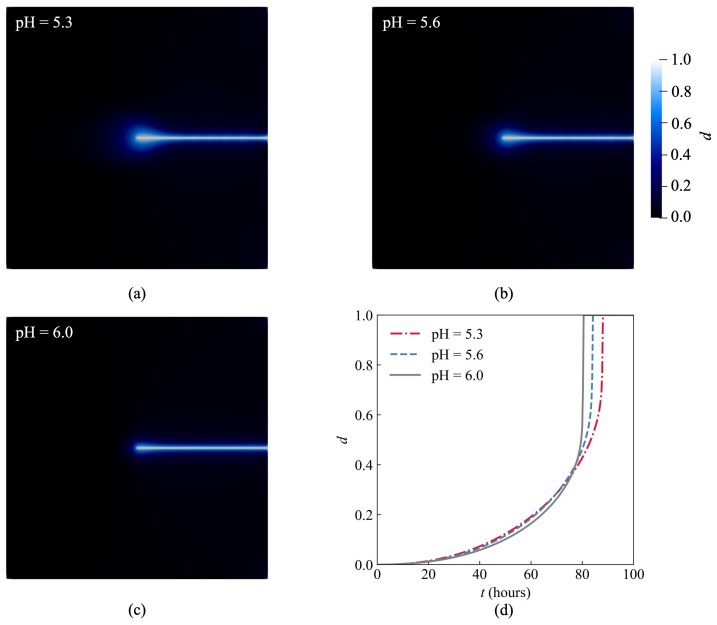
The transition between brittle and ductile failure modes is dictated by the competing timescales of chemical degradation and mechanical deformation. Highly acidic environments enhance matrix dissolution and promote ductile fracture, whereas rapid mechanical loading limits chemical interaction and preserves brittle failure mode. The model captures an enlarged fracture process zone driven by chemical mass removal that blunts the sharp crack tip, alleviates near-tip stress concentrations, and produces a more gradual accumulation of damage with delayed onset of macroscopic failure.
What carries the argument
A phase-field framework that dynamically couples local mass removal to the fracture length scale while incorporating damage-accelerated reaction-diffusion processes.
If this is right
- An enlarged fracture process zone develops from chemical mass removal, widening the damage region ahead of the crack.
- Near-tip stress concentrations are alleviated, causing measurable stiffness loss before final failure.
- Damage accumulates more gradually and macroscopic failure is delayed under conditions favoring chemical activity.
- Ductile fracture is promoted in highly acidic environments while brittle failure is preserved under rapid mechanical loading.
Where Pith is reading between the lines
- The timescale-competition view could be tested by running the same model on other reactive solids such as metals undergoing corrosion-assisted cracking.
- Long-term predictions for underground storage or geothermal systems would need to track how local acidity evolves with fluid flow rather than assuming constant pH.
- If the mass-removal coupling proves robust, the framework might be adapted to predict how temperature or pressure shifts the brittle-ductile boundary in reactive settings.
Load-bearing premise
The dynamic coupling of local mass removal directly to the fracture length scale together with damage-accelerated reaction-diffusion is assumed to capture the dominant physics without requiring post-hoc tuning or higher-order corrections.
What would settle it
Laboratory tests on geomaterial samples under controlled pH and strain rates that show no change in failure mode or process-zone width when acidity is varied at fixed loading speed.
Figures




read the original abstract
In chemically reactive environments, the mechanical integrity of geomaterials is fundamentally compromised by solid matrix dissolution. In this study, we propose a fully coupled chemo-mechanical phase-field framework to capture the dynamic interplay between mineral dissolution and fracture propagation. A key feature of the proposed model is the dynamic coupling of local mass removal to the fracture length scale, while also incorporating the damage-accelerated reaction-diffusion processes. Our results capture the development of an enlarged fracture process zone driven by chemical mass removal. This chemically induced widening blunts the sharp crack tip, alleviating the near-tip stress concentrations and causing a pronounced degradation in material stiffness before failure. Furthermore, we reveal a distinct ductilization effect, characterized by a more gradual accumulation of damage and a delayed onset of macroscopic failure. We show that the transition between brittle and ductile failure modes is dictated by the competing timescales of chemical degradation and mechanical deformation. Highly acidic environments enhance matrix dissolution and promote ductile fracture, whereas rapid mechanical loading limits chemical interaction and preserves brittle failure mode.
Editorial analysis
A structured set of objections, weighed in public.
Referee Report
Summary. The manuscript proposes a chemo-mechanical phase-field framework for fracture propagation in reactive environments. It features dynamic coupling of local mass removal (dissolution) to the phase-field length scale together with damage-accelerated reaction-diffusion. Simulations illustrate an enlarged process zone, crack-tip blunting, stiffness degradation, and a transition from brittle to ductile failure modes controlled by the relative timescales of chemical degradation and mechanical loading, with acidic conditions favoring ductility and rapid loading preserving brittleness.
Significance. If the novel coupling can be shown to be thermodynamically consistent, the work would provide a mechanistic explanation for environmentally assisted ductilization in geomaterials and could guide predictions of failure under varying pH and loading rates. The emphasis on competing timescales is a clear strength and aligns with observed phenomenology; however, the absence of explicit consistency checks or quantitative experimental validation currently limits the immediate impact.
major comments (2)
- [Model formulation] Model formulation section: the dynamic coupling that makes the phase-field length scale l a function of local concentration c (mass removal) is introduced without derivation from a dissipation potential or free-energy functional. This leaves open whether the variational derivative still guarantees non-negative dissipation, so the reported process-zone widening and tip blunting may be regularization artifacts rather than direct consequences of timescale competition.
- [Results] Results section: the central claim that competing chemical and mechanical timescales dictate the brittle-to-ductile transition rests on the evolving length scale producing blunting and gradual damage accumulation. No verification of global energy balance or mesh independence for the variable length scale is supplied, which is load-bearing for the ductilization prediction.
minor comments (2)
- [Abstract] Abstract: the functional dependence of the length scale on concentration and the precise form of the damage-acceleration term are not stated, hindering immediate assessment of the model's novelty.
- [Figures] Figure captions: parameters controlling reaction rate, loading speed, and initial pH should be listed explicitly so that the timescale ratios corresponding to each panel can be reproduced.
Simulated Author's Rebuttal
We thank the referee for the detailed and constructive report. The two major comments identify important points for strengthening the thermodynamic foundation and numerical robustness of the chemo-mechanical coupling. We address each below and will incorporate the suggested additions in the revised manuscript.
read point-by-point responses
-
Referee: Model formulation section: the dynamic coupling that makes the phase-field length scale l a function of local concentration c (mass removal) is introduced without derivation from a dissipation potential or free-energy functional. This leaves open whether the variational derivative still guarantees non-negative dissipation, so the reported process-zone widening and tip blunting may be regularization artifacts rather than direct consequences of timescale competition.
Authors: We agree that an explicit derivation from a dissipation potential would place the coupling on firmer variational ground. In the revised manuscript we will introduce the length-scale evolution directly from a dissipation potential that augments the standard phase-field fracture energy with a chemo-mechanical interaction term. We will then verify that the resulting variational derivative yields a non-negative dissipation rate for the coupled system, confirming that the observed process-zone widening and crack-tip blunting are physical consequences of the competing timescales rather than artifacts of the regularization. revision: yes
-
Referee: Results section: the central claim that competing chemical and mechanical timescales dictate the brittle-to-ductile transition rests on the evolving length scale producing blunting and gradual damage accumulation. No verification of global energy balance or mesh independence for the variable length scale is supplied, which is load-bearing for the ductilization prediction.
Authors: We acknowledge that explicit numerical checks are required to support the ductilization claim. In the revision we will add (i) time histories of the global energy balance (elastic, fracture, chemical, and dissipation contributions) demonstrating that the total energy remains conserved within the expected tolerance throughout the simulations, and (ii) a mesh-convergence study performed with successively refined discretizations for the variable-length-scale formulation. These verifications will be placed in the Results section and will confirm that the brittle-to-ductile transition is insensitive to mesh size and is driven by the timescale competition. revision: yes
Circularity Check
No significant circularity; transition emerges from numerical solution of coupled PDEs rather than by construction.
full rationale
The paper introduces a chemo-mechanical phase-field model with explicit coupling terms (local mass removal affecting the length scale l and damage-accelerated reaction-diffusion). The brittle-to-ductile transition is reported as an outcome of competing timescales in the solved system, not a redefinition or fit of input parameters. No self-citation chains, uniqueness theorems, or ansatzes are invoked to force the result. The derivation remains self-contained against the stated balance laws and constitutive choices.
Axiom & Free-Parameter Ledger
axioms (1)
- standard math Phase-field regularization of sharp cracks via a length-scale parameter
invented entities (1)
-
dynamic mass-removal-to-fracture-length-scale coupling
no independent evidence
Reference graph
Works this paper leans on
-
[1]
Approximation of functional depending on jumps by elliptic functional via t-convergence
Approximation of functional depending on jumps by elliptic functional via t-convergence. Communications on Pure and Applied Mathematics 43, 999–1036. doi:10.1002/cpa.3160430805. Amor, H., Marigo, J.J., Maurini, C.,
-
[2]
Journal of the Mechanics and Physics of Solids 57, 1209–1229
Regularized formulation of the variational brittle fracture with unilateral contact: Numerical experiments. Journal of the Mechanics and Physics of Solids 57, 1209–1229. doi:10.1016/j.jmps.2009.04.011. Backers, T., Stanchits, S., Dresen, G.,
-
[3]
International Journal of Rock Mechanics and Mining Sciences 42, 1094–1101
Tensile fracture propagation and acoustic emission activity in sandstone: The effect of loading rate. International Journal of Rock Mechanics and Mining Sciences 42, 1094–1101. doi:10.1016/j.ijrmms.2005.05.011. Barenblatt, G.I.,
-
[4]
The Mathematical Theory of Equilibrium Cracks in Brittle Fracture
The Mathematical Theory of Equilibrium Cracks in Brittle Fracture, in: Advances in Applied Mechanics. Elsevier. volume 7, pp. 55–129. doi:10.1016/S0065-2156(08)70121-2. Belytschko, T., Black, T.,
-
[5]
International Journal for Numerical Methods in Engineering 45, 601–620
Elastic crack growth in finite elements with minimal remeshing. International Journal for Numerical Methods in Engineering 45, 601–620. doi:10.1002/(SICI)1097-0207(19990620)45:5<601::AID-NME598>3.0.CO;2-S. Bilgen, C., Weinberg, K.,
-
[6]
On the crack-driving force of phase-field models in linearized and finite elasticity
On the crack-driving force of phase-field models in linearized and finite elasticity. Computer Methods in Applied Mechanics and Engineering 353, 348–372. doi:10.1016/j.cma.2019.05.009. Borden, M.J., Hughes, T.J.R., Landis, C.M., Anvari, A., Lee, I.J.,
-
[7]
Computer Methods in Applied Mechanics and Engineering 312, 130–166
A phase-field formulation for fracture in ductile materials: Finite deformation balance law derivation, plastic degradation, and stress triaxiality effects. Computer Methods in Applied Mechanics and Engineering 312, 130–166. doi:10.1016/j.cma.2016.09.005. Borja, R.I., Chen, W., Odufisan, A.R.,
-
[8]
Journal of the Mechanics and Physics of Solids 173, 105198
A constitutive framework for rocks undergoing solid dissolution. Journal of the Mechanics and Physics of Solids 173, 105198. doi:10.1016/j.jmps.2023.105198. Bourdin, B., Francfort, G.A., Marigo, J.J.,
-
[9]
Journal of the Mechanics and Physics of Solids 48, 797–826
Numerical experiments in revisited brittle fracture. Journal of the Mechanics and Physics of Solids 48, 797–826. doi:10.1016/S0022-5096(99)00028-9. Bourdin, B., Francfort, G.A., Marigo, J.J.,
-
[10]
Journal of Geotechnical and Geoenvironmental Engineering 130, 728–739
Oedometric Tests on Artificially Weathered Carbonatic Soft Rocks. Journal of Geotechnical and Geoenvironmental Engineering 130, 728–739. doi:10.1061/(ASCE)1090-0241(2004)130:7(728). Chen, J., Hu, M.,
-
[11]
Geomechanics for Energy and the Environment 37, 100526
Single fluid-driven crack propagation in analogue rock assisted by chemical environment. Geomechanics for Energy and the Environment 37, 100526. doi:10.1016/j.gete.2023.100526. Chen, J., Hu, M.,
-
[12]
URL:https: //hal.science/hal-05343935
Chemically enhanced fluid-driven crack propagation in analogue rock, in: 3rd International Conference on Energy Geotechnics 2025, Navier Laboratory, Ecole Nationale des Ponts et Chauss´ees, Universit´e Gustave Eiffel, CNRS, Paris, France. URL:https: //hal.science/hal-05343935. Chukwudozie, C., Bourdin, B., Yoshioka, K.,
2025
-
[13]
Computer Methods in Applied Mechanics and Engineering 347, 957–982
A variational phase-field model for hydraulic fracturing in porous media. Computer Methods in Applied Mechanics and Engineering 347, 957–982. doi:10.1016/j.cma.2018.12.037. Ciantia, M.O., Castellanza, R., Crosta, G.B., Hueckel, T.,
-
[14]
Effects of mineral suspension and dissolution on strength and compressibility of soft carbonate rocks. Engineering Geology 184, 1–18. doi:10.1016/j.enggeo.2014.10.024. Ciantia, M.O., Hueckel, T.,
-
[15]
Weathering of submerged stressed calcarenites: chemo-mechanical coupling mechanisms. G ´eotechnique 63, 768–785. doi:10.1680/geot.SIP13.P.024. Cui, C., Ma, R., Mart´ınez-Pa˜neda, E.,
-
[16]
Journal of the Mechanics and Physics of Solids 147, 104254
A phase field formulation for dissolution-driven stress corrosion cracking. Journal of the Mechanics and Physics of Solids 147, 104254. doi:10.1016/j.jmps.2020.104254. Dugdale, D.S.,
-
[17]
Journal of the Mechanics and Physics of Solids 212, 106585
A variational phase-field model for anisotropic fracture accounting for multiple cohesive lengths. Journal of the Mechanics and Physics of Solids 212, 106585. doi:10.1016/j.jmps.2026.106585. Fei, F., Choo, J., Liu, C., White, J.A.,
-
[18]
International Journal for Numerical and Analytical Methods in Geomechanics 46, 841–868
Phase-field modeling of rock fractures with roughness. International Journal for Numerical and Analytical Methods in Geomechanics 46, 841–868. doi:10.1002/nag.3317. Fei, F., Costa, A., Dolbow, J.E., Settgast, R.R., Cusini, M.,
-
[19]
International Journal for Numerical and Analytical Methods in Geomechanics 47, 3065–3089
A phase-field model for hydraulic fracture nucleation and propagation in porous media. International Journal for Numerical and Analytical Methods in Geomechanics 47, 3065–3089. doi:10.1002/nag.3612. Francfort, G.A., Marigo, J.J.,
-
[20]
Journal of the Mechanics and Physics of Solids , author =
Revisiting brittle fracture as an energy minimization problem. Journal of the Mechanics and Physics of Solids 46, 1319–1342. doi:10.1016/S0022-5096(98)00034-9. Gaston, D., Newman, C., Hansen, G., Lebrun-Grandi´e, D.,
-
[21]
Nuclear Engineering and Design 239, 1768–1778
MOOSE: A parallel computational framework for coupled systems of nonlinear equations. Nuclear Engineering and Design 239, 1768–1778. doi:10.1016/j.nucengdes.2009.05.021. Guo, Y ., Na, S.,
-
[22]
Computer Methods in Applied Mechanics and Engineering 419, 116645
A reactive-transport phase-field modelling approach of chemo-assisted cracking in saturated sandstone. Computer Methods in Applied Mechanics and Engineering 419, 116645. doi:10.1016/j.cma.2023.116645. Gu´evel, A., Meng, Y ., Peco, C., Juanes, R., Dolbow, J.E.,
-
[23]
Journal of the Mechanics and Physics of Solids 181, 105427
A Darcy–Cahn–Hilliard model of multiphase fluid-driven fracture. Journal of the Mechanics and Physics of Solids 181, 105427. doi:10.1016/j.jmps.2023.105427. Horne, R., Genter, A., McClure, M., Ellsworth, W., Norbeck, J., Schill, E.,
-
[24]
Nature Reviews Clean Technology 1, 148–160
Enhanced geothermal systems for clean firm energy generation. Nature Reviews Clean Technology 1, 148–160. doi:10.1038/s44359-024-00019-9. Hu, M., Hueckel, T.,
-
[25]
Environmentally enhanced crack propagation in a chemically degrading isotropic shale. G ´eotechnique 63, 313–321. doi:10.1680/geot.SIP13.P.020. Hu, M., Hueckel, T.,
-
[26]
Geomechanics for Energy and the Environment 19, 100114
Modeling of subcritical cracking in acidized carbonate rocks via coupled chemo-elasticity. Geomechanics for Energy and the Environment 19, 100114. doi:10.1016/j.gete.2019.01.003. Hu, T.,
-
[27]
Computers and Geotechnics 36, 934–943
Feedback mechanisms in chemo-mechanical multi-scale modeling of soil and sediment compaction. Computers and Geotechnics 36, 934–943. doi:10.1016/j.compgeo.2009.02.005. 22 Ilgen, A.G., Newell, P., Hueckel, T., Espinoza, D.N., Hu, M.,
-
[28]
(Eds.), Science of Carbon Storage in Deep Saline Formations
Coupled Chemical-Mechanical Processes Associated With the Injection of CO2 into Subsurface, in: Newell, P., Ilgen, A.G. (Eds.), Science of Carbon Storage in Deep Saline Formations. Elsevier, pp. 337–359. doi:10.1016/B978-0-12-812752-0.00015-0. Ip, S.C.Y ., Borja, R.I.,
-
[29]
Journal of the Mechanics and Physics of Solids 181, 105441
Modeling heterogeneity and permeability evolution in a compaction band using a phase-field approach. Journal of the Mechanics and Physics of Solids 181, 105441. doi:10.1016/j.jmps.2023.105441. Jiang, W., Hu, T., Aagesen, L.K., Biswas, S., Gamble, K.A.,
-
[30]
Theoretical and Applied Fracture Mechanics 119, 103348
A phase-field model of quasi-brittle fracture for pressurized cracks: Application to UO2 high-burnup microstructure fragmentation. Theoretical and Applied Fracture Mechanics 119, 103348. doi:10.1016/j.tafmec.2022. 103348. Kristensen, P.K., Niordson, C.F., Mart´ınez-Pa˜neda, E.,
-
[31]
Journal of the Mechanics and Physics of Solids 143, 104093
A phase field model for elastic-gradient-plastic solids undergoing hydrogen embrit- tlement. Journal of the Mechanics and Physics of Solids 143, 104093. doi:10.1016/j.jmps.2020.104093. Kristensen, P.K., Niordson, C.F., Mart´ınez-Pa˜neda, E.,
-
[32]
An assessment of phase field fracture: crack initiation and growth. Philosophical Transactions of the Royal Society A: Mathematical, Physical and Engineering Sciences 379, 20210021. doi:10.1098/rsta.2021.0021. Ling, B., Sodwatana, M., Kohli, A., Ross, C.M., Jew, A., Kovscek, A.R., Battiato, I.,
-
[33]
Proceedings of the National Academy of Sciences 119, e2122520119
Probing multiscale dissolution dynamics in natural rocks through microfluidics and compositional analysis. Proceedings of the National Academy of Sciences 119, e2122520119. doi:10.1073/ pnas.2122520119. Liu, C., Kang, X., Calo, V .M., Hu, M., Regenauer-Lieb, K., 2026a. Automatically adaptive finite element method via residual minimization onto dual norms ...
-
[34]
Liu, S., Wang, Y ., Geng, X., Wu, W., 2026b
doi:10.3390/ma11101921. Liu, S., Wang, Y ., Geng, X., Wu, W., 2026b. A generalized higher-order phase-field model for brittle fracture in anisotropic rocks. Journal of the Mechanics and Physics of Solids 210, 106526. doi:10.1016/j.jmps.2026.106526. Mart´ınez-Pa˜neda, E., Golahmar, A., Niordson, C.F.,
-
[35]
Computer Methods in Applied Mechanics and Engineering 342, 742–761
A phase field formulation for hydrogen assisted cracking. Computer Methods in Applied Mechanics and Engineering 342, 742–761. doi:10.1016/j.cma.2018.07.021. Miehe, C., Dal, H., Sch¨anzel, L.M., Raina, A.,
-
[36]
International Journal for Numerical Methods in Engineering 106, 683–711
A phase-field model for chemo-mechanical induced fracture in lithium-ion battery electrode particles. International Journal for Numerical Methods in Engineering 106, 683–711. doi:10.1002/nme.5133. Miehe, C., Hofacker, M., Welschinger, F., 2010a. A phase field model for rate-independent crack propagation: Robust algorithmic implementation based on operator...
-
[37]
Phase field modeling of fracture in multi-physics problems. Part III. Crack driving forces in hydro-poro-elasticity and hydraulic fracturing of fluid-saturated porous media. Computer Methods in Applied Mechanics and Engineering 304, 619–655. doi:10.1016/ j.cma.2015.09.021. Miehe, C., Welschinger, F., Hofacker, M., 2010b. Thermodynamically consistent phase...
-
[38]
Cement and Concrete Research 199, 108012
Fracture in concrete: X-ray tomography with in-situ testing, digital volume correlation and phase-field modeling. Cement and Concrete Research 199, 108012. doi:10.1016/j.cemconres.2025.108012. Mollaali, M., Yoshioka, K., Lu, R., Montoya, V ., Vilarrasa, V ., Kolditz, O.,
-
[39]
International Journal for Numerical Methods in Engineering 126, e7621
Variational Phase-Field Fracture Approach in Reactive Porous Media. International Journal for Numerical Methods in Engineering 126, e7621. doi:10.1002/nme.7621. Mo¨es, N., Dolbow, J., Belytschko, T.,
-
[40]
International Journal for Numerical Methods in Engineering , author =
A finite element method for crack growth without remeshing. International Journal for Numerical Methods in Engineering 46, 131–150. doi:10.1002/(SICI)1097-0207(19990910)46:1<131::AID-NME726>3.0.CO;2-J. Nguyen, T.T., Yvonnet, J., Bornert, M., Chateau, C.,
-
[41]
Journal of the Mechanics and Physics of Solids 95, 320–350
Initiation and propagation of complex 3D networks of cracks in heterogeneous quasi- brittle materials: Direct comparison betweenin situtesting-microCT experiments and phase field simulations. Journal of the Mechanics and Physics of Solids 95, 320–350. doi:10.1016/j.jmps.2016.06.004. Peerlings, R.H.J., De Borst, R., Brekelmans, W.a.M., De Vree, J.H.P.,
-
[42]
International Journal for Numerical Methods in Engineering 39, 3391–3403
Gradient Enhanced Damage for Quasi-Brittle Materials. International Journal for Numerical Methods in Engineering 39, 3391–3403. doi:10.1002/(SICI)1097-0207(19961015)39:19<3391::AID-NME7>3. 0.CO;2-D. Peerlings, R.H.J., Geers, M.G.D., de Borst, R., Brekelmans, W.A.M.,
-
[43]
International Journal of Solids and Structures 38, 7723–7746
A critical comparison of nonlocal and gradient-enhanced softening continua. International Journal of Solids and Structures 38, 7723–7746. doi:10.1016/S0020-7683(01)00087-7. Permann, C.J., Gaston, D.R., Andr ˇs, D., Carlsen, R.W., Kong, F., Lindsay, A.D., Miller, J.M., Peterson, J.W., Slaughter, A.E., Stogner, R.H., Martineau, R.C.,
-
[44]
MOOSE: Enabling massively parallel multiphysics simulation. SoftwareX 11, 100430. doi:10.1016/j.softx.2020. 100430. Ruan, H., Rezaei, S., Yang, Y ., Gross, D., Xu, B.X.,
-
[45]
A thermo-mechanical phase-field fracture model: Application to hot cracking simulations in additive manufacturing. Journal of the Mechanics and Physics of Solids 172, 105169. doi:10.1016/j.jmps.2022.105169. Rutqvist, J., Chijimatsu, M., Jing, L., Millard, A., Nguyen, T.S., Rejeb, A., Sugita, Y ., Tsang, C.F.,
-
[46]
Part 3: Effects of THM coupling in sparsely fractured rocks
A numerical study of THM effects on the near-field safety of a hypothetical nuclear waste repository—BMT1 of the DECOV ALEX III project. Part 3: Effects of THM coupling in sparsely fractured rocks. International Journal of Rock Mechanics and Mining Sciences 42, 745–755. doi:10.1016/j.ijrmms.2005.03.012. Schuler, L., Ilgen, A.G., Newell, P.,
-
[47]
Computer Methods in Applied Mechanics and Engineering 362, 112838
Chemo-mechanical phase-field modeling of dissolution-assisted fracture. Computer Methods in Applied Mechanics and Engineering 362, 112838. doi:10.1016/j.cma.2020.112838. Stefanou, I., Sulem, J.,
-
[48]
Journal of Geophysical Research: Solid Earth 119, 880–899
Chemically induced compaction bands: Triggering conditions and band thickness. Journal of Geophysical Research: Solid Earth 119, 880–899. doi:10.1002/2013JB010342. Tang, X., Hu, M.,
-
[49]
Rock Mechanics and Rock Engineering 56, 515–533
A Reactive-Chemo-Mechanical Model for Weak Acid-Assisted Cavity Expansion in Carbonate Rocks. Rock Mechanics and Rock Engineering 56, 515–533. doi:10.1007/s00603-022-03077-2. Tang, X., Hu, M.,
-
[50]
Rock Mechanics and Rock Engineering doi:10.1007/s00603-025-04485-w
The Effect of Chemical Environment on Crack Propagation in Pressure-Sensitive Rocks. Rock Mechanics and Rock Engineering doi:10.1007/s00603-025-04485-w. 23 Vafaie, A., Cama, J., Soler, J.M., Kivi, I.R., Vilarrasa, V .,
-
[51]
Renewable and Sustainable Energy Reviews 178, 113270
Chemo-hydro-mechanical effects of CO2 injection on reservoir and seal rocks: A review on laboratory experiments. Renewable and Sustainable Energy Reviews 178, 113270. doi:10.1016/j.rser.2023.113270. Wu, F., Hu, M.,
-
[52]
Journal of Geophysical Research: Solid Earth 130, e2024JB030896
Influence of Carbon Dioxide on Micro-Cracking in Calcite: An Atomistic Scale Investigation. Journal of Geophysical Research: Solid Earth 130, e2024JB030896. doi:10.1029/2024JB030896. Wu, F., Sac-Morane, A., Rattez, H., Veveakis, M., Hu, M.,
-
[53]
International Journal of Rock Mechanics and Mining Sciences 196, 106319
Onset of reactive brittle cracking in sandstones: DEM-informed phase-field modeling. International Journal of Rock Mechanics and Mining Sciences 196, 106319. doi:10.1016/j.ijrmms.2025.106319. Wu, J.Y .,
-
[54]
Journal of the Mechanics and Physics of Solids 103, 72–99
A unified phase-field theory for the mechanics of damage and quasi-brittle failure. Journal of the Mechanics and Physics of Solids 103, 72–99. doi:10.1016/j.jmps.2017.03.015. Wu, J.Y ., Hong, Y .F.,
-
[55]
Journal of the Mechanics and Physics of Solids 172, 105168
Crack nucleation and propagation of electromagneto-thermo-mechanical fracture in bulk superconductors during magnetization. Journal of the Mechanics and Physics of Solids 172, 105168. doi:10.1016/j.jmps.2022.105168. Wu, T., De Lorenzis, L.,
-
[56]
Computer Methods in Applied Mechanics and Engineering 312, 196–223
A phase-field approach to fracture coupled with diffusion. Computer Methods in Applied Mechanics and Engineering 312, 196–223. doi:10.1016/j.cma.2016.05.024. Zietlow, W.K., Labuz, J.F.,
-
[57]
International Journal of Rock Mechanics and Mining Sciences 35, 291–299
Measurement of the intrinsic process zone in rock using acoustic emission. International Journal of Rock Mechanics and Mining Sciences 35, 291–299. doi:10.1016/S0148-9062(97)00323-9. 24
discussion (0)
Sign in with ORCID, Apple, or X to comment. Anyone can read and Pith papers without signing in.