Beyond Whittle: exact finite-time multispectral statistics from a single Brownian trajectory in a harmonic trap
Pith reviewed 2026-05-10 15:06 UTC · model grok-4.3
The pith
Finite-time spectral estimators from a single Brownian trajectory in a harmonic trap obey an exact joint law with explicit inter-frequency correlations.
A machine-rendered reading of the paper's core claim, the machinery that carries it, and where it could break.
Core claim
For a collection of frequencies {ω_i}, the finite-time estimators {S(ω_i,T)} of the power spectrum of an overdamped Brownian particle in a harmonic trap possess an exact joint law, together with a covariance-explicit Gaussian representation of the associated Fourier projections; this representation renders the observation-window-induced correlations between different frequencies transparent and shows that they vanish as T→∞, thereby recovering the asymptotic Whittle picture and enabling a hierarchy of spectral likelihoods for single-trajectory inference.
What carries the argument
The covariance-explicit Gaussian representation of the finite-time Fourier projections, which directly supplies the joint law of the spectral estimators {S(ω_i,T)}.
If this is right
- Inter-frequency correlations induced by the finite window become negligible only as T→∞.
- Spectral likelihoods can be constructed at successive levels of approximation, from fully factorized to blockwise covariance-aware.
- Single-trajectory estimates of trap stiffness and friction improve when cross-frequency correlations are retained.
- The finite-T theory supplies a controlled benchmark against which asymptotic spectral methods can be tested.
Where Pith is reading between the lines
- The same Gaussian-projection approach could be tested on other linear stochastic processes whose Green's functions are known.
- For experimental records shorter than several trap relaxation times, the covariance-aware likelihoods should measurably reduce bias in parameter recovery compared with the Whittle approximation.
- The explicit correlation structure offers a route to optimal frequency binning or blocking strategies that minimize estimation variance for fixed record length.
Load-bearing premise
The particle obeys the standard overdamped Langevin equation in a purely harmonic potential with no additional noise sources or inertial terms.
What would settle it
Direct numerical integration of the overdamped Langevin equation for finite T, followed by computation of the empirical joint distribution or covariance matrix of the spectral estimators at two or more frequencies, would deviate systematically from the exact expressions derived in the paper.
Figures

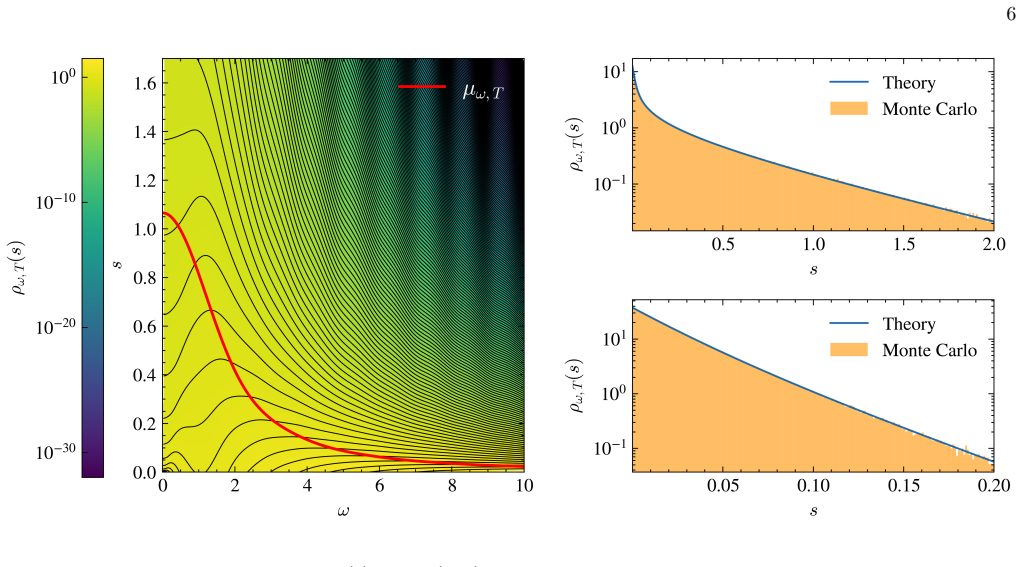


read the original abstract
Power spectral densities are often interpreted through ensemble averages and long-time asymptotics. In many experiments, however, only a single finite record is available, so spectral estimators remain broadly distributed and the usual independence assumptions across frequencies need not hold. Here we develop an exact finite-$T$ multispectral theory for an overdamped Brownian particle in a harmonic trap. For a collection of frequencies $\{\omega_i\}$, we obtain an exact characterization of the joint law of the finite-time estimators $\{S(\omega_i,T)\}$, together with a covariance-explicit Gaussian representation for the associated Fourier projections. This representation makes the observation-window-induced inter-frequency correlations explicit and shows how they vanish as $T\to\infty$, thereby recovering the asymptotic Whittle picture. We then use this structure to formulate a hierarchy of spectral likelihoods for inference from a single trajectory, ranging from the factorized Whittle approximation to blockwise covariance-aware approximations in frequency space. Monte Carlo simulations validate the finite-time theory and quantify the effect of neglected cross-frequency correlations on single-trajectory estimates of the trap parameters. Our results provide a controlled finite-time benchmark for spectral inference beyond the asymptotic regime.
Editorial analysis
A structured set of objections, weighed in public.
Referee Report
Summary. The manuscript develops an exact finite-T multispectral theory for the joint statistics of spectral estimators {S(ω_i,T)} extracted from a single finite-length trajectory of an overdamped Brownian particle in a harmonic trap. Starting from the known two-time correlation function of the underlying Gaussian process, it constructs a covariance-explicit Gaussian representation for the finite-time Fourier projections and thereby obtains the exact joint law of the quadratic estimators. This structure is used to define a hierarchy of spectral likelihoods (from the factorized Whittle approximation to blockwise covariance-aware forms) that explicitly incorporate observation-window-induced inter-frequency correlations. Monte Carlo simulations are presented to validate the finite-time expressions and to quantify the bias incurred by neglecting cross-frequency terms when inferring trap parameters.
Significance. If the central derivation holds, the work supplies a controlled, non-asymptotic benchmark for single-trajectory spectral inference that is directly relevant to optical-trap and single-particle tracking experiments. The explicit Gaussian representation and the demonstration that inter-frequency correlations vanish as T→∞ recover the classical Whittle picture in a transparent way. The resulting likelihood hierarchy offers a practical route to improved finite-T parameter estimation without ad-hoc corrections.
minor comments (3)
- [§2.1] §2.1: the definition of the finite-time Fourier projection (Eq. 4) uses a rectangular window; a brief remark on the effect of alternative tapering functions would clarify the scope of the exact result.
- [§3.3] §3.3, Fig. 4: the Monte Carlo error bars on the off-diagonal covariance elements are not shown; adding them would strengthen the visual comparison with the analytic prediction.
- The transition from the joint Gaussian law of the projections to the law of the quadratic estimators {S(ω_i,T)} is stated but the explicit characteristic function or moment-generating function is not written out; including it would make the subsequent likelihood construction fully self-contained.
Simulated Author's Rebuttal
We thank the referee for their positive and accurate summary of our work, as well as for the recommendation to accept the manuscript. The report correctly highlights the exact finite-T joint law for the multispectral estimators, the covariance-explicit Gaussian representation of the Fourier projections, the explicit treatment of observation-window-induced inter-frequency correlations, and the resulting hierarchy of spectral likelihoods that recover the Whittle approximation in the long-time limit.
Circularity Check
No significant circularity
full rationale
The central derivation obtains the exact joint law of finite-T spectral estimators {S(ω_i,T)} by noting that the overdamped harmonic Langevin equation produces a Gaussian process whose two-time correlation is known in closed form; any finite set of linear functionals (Fourier projections) is therefore jointly Gaussian with an explicitly computable covariance matrix, from which the quadratic estimators follow directly. This construction uses only the standard linear stochastic dynamics and the definition of the estimators; no parameter is fitted to data and then relabeled as a prediction, no self-citation supplies a load-bearing uniqueness theorem or ansatz, and the T→∞ recovery of the Whittle picture is the ordinary decorrelation of that covariance matrix. The derivation is therefore self-contained against external benchmarks and does not reduce to its own inputs by construction.
Axiom & Free-Parameter Ledger
axioms (1)
- domain assumption Motion obeys the overdamped Langevin equation in a harmonic trap.
Reference graph
Works this paper leans on
-
[1]
(39) Thus, even after aggregation overLfrequencies, the total spectral power remains broadly distributed at finiteT; summation over frequencies can at best reduce the relative fluctuations asL −1/2. Appendix F extends this trace formula to weighted multispectral powersY q(ω, T) = PL i=1 qiS(ωi, T) withq i ≥0, showing that their coefficient of variation is...
work page 2025
-
[2]
R. F. Voss and J. Clarke, Nature258, 317 (1975)
work page 1975
- [3]
-
[4]
R. O. Weber and P. Talkner, Journal of Geophysical Research: Atmospheres106, 20131 (2001)
work page 2001
- [5]
-
[6]
K. Berg-Sørensen and H. Flyvbjerg, Review of Scientific Instruments75, 594 (2004)
work page 2004
-
[7]
W. P. Wong and K. Halvorsen, Optics Express14, 12517 (2006)
work page 2006
-
[8]
L. P´ erez-Garc´ ıa, M. Selin, A. Ciarlo, A. Magazz` u, G. Pesce, A. Sasso, G. Volpe, I. P´ erez Castillo, and A. V. Arzola, Biomedical Optics Express14, 6442 (2023)
work page 2023
-
[9]
J. Gieseler, J. R. Gomez-Solano, A. Magazz` u, I. P. Castillo, L. P. Garc´ ıa, M. Gironella-Torrent, X. Viader-Godoy, F. Ritort, G. Pesce, A. V. Arzola,et al., Advances in Optics and Photonics13, 74 (2021)
work page 2021
- [10]
-
[11]
U. Grenander and M. Rosenblatt,Statistical Analysis of Stationary Time Series(John Wiley & Sons, New York, 1957)
work page 1957
-
[12]
M. B. Priestley,Spectral Analysis and Time Series(Academic Press, London, 1981)
work page 1981
-
[13]
D. R. Brillinger,Time Series: Data Analysis and Theory, 2nd ed. (Holden-Day, San Francisco, 1981)
work page 1981
-
[14]
P. J. Brockwell and R. A. Davis,Time Series: Theory and Methods(Springer, New York, 1991)
work page 1991
-
[15]
K. Norregaard, R. Metzler, C. M. Ritter, K. Berg-Sørensen, and L. B. Oddershede, Chemical reviews117, 4342 (2017)
work page 2017
-
[16]
D. B. Kemp, K. Eichenseer, and W. Kiessling, Nature Communications6, 1 (2015)
work page 2015
- [17]
- [18]
- [19]
-
[20]
V. Sposini, R. Metzler, and G. Oshanin, New Journal of Physics21, 073043 (2019)
work page 2019
-
[21]
A. Squarcini, E. Marinari, G. Oshanin, L. Peliti, and L. Rondoni, Journal of Physics A: Mathematical and Theoretical 55, 405001 (2022)
work page 2022
-
[22]
A. Squarcini, E. Marinari, G. Oshanin, L. Peliti, and L. Rondoni, New Journal of Physics24, 093031 (2022)
work page 2022
-
[23]
Whittle, Journal of the Royal Statistical Society: Series B (Methodological)15, 125 (1953)
P. Whittle, Journal of the Royal Statistical Society: Series B (Methodological)15, 125 (1953)
work page 1953
-
[24]
A. M. Sykulski, S. C. Olhede, A. P. Guillaumin, J. M. Lilly, and J. J. Early, Biometrika106, 251 (2019). 18
work page 2019
- [25]
-
[26]
S. Das, S. Subba Rao, and J. Yang, Journal of Time Series Analysis42, 597 (2021)
work page 2021
-
[27]
Z. Yu, F. Ventola, and K. Kersting, inProceedings of the 38th International Conference on Machine Learning (ICML) (2021)
work page 2021
-
[28]
i r 2λ T Z T 0 dt(vcos(ωt) +wsin(ωt))X(t) # = Z dvdw 2π exp − v2 2 − w2 2 E{Wx(t)} exp
The lower bound results when the two eigenvalues are equal while the upper bound is obtained from the fact thatx 2 +y 2 ≤ (x+y) 2 forxandypositive. Appendix A: Single-frequency case For the centered deterministic initialization used in the main text,X 0 = 0, the formal solution of the stochastic equation (10) is X(t) = √ 2D Z t 0 dse−(t−s)/τ Wx(s). (A1) S...
discussion (0)
Sign in with ORCID, Apple, or X to comment. Anyone can read and Pith papers without signing in.