Complementary Quantum Time Distributions from a Single Operational Protocol
Pith reviewed 2026-05-10 15:28 UTC · model grok-4.3
The pith
One quantum protocol yields two inequivalent time distributions via different post-processing of the same measurements.
A machine-rendered reading of the paper's core claim, the machinery that carries it, and where it could break.
Core claim
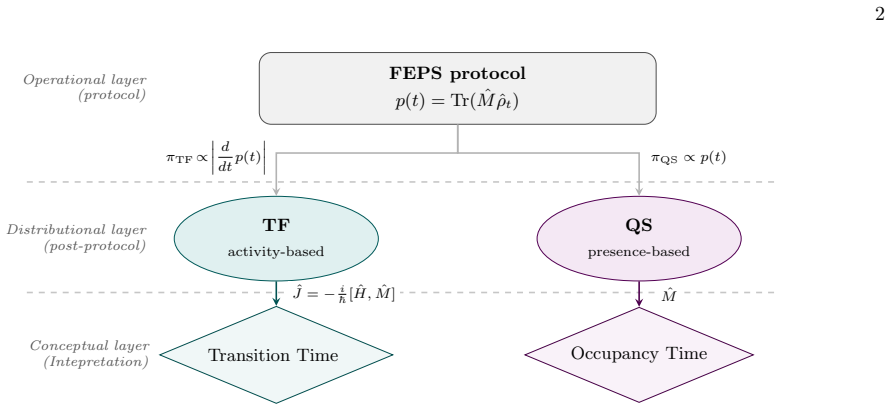
A single operational protocol based on free evolution and projective measurements yields inequivalent quantum time distributions through distinct post-processing procedures. We construct an activity-based time-of-flow (TF) distribution and a presence-based quantum stroboscopic (QS) distribution, providing complementary operational notions of time. Applied to tunneling, the regional QS mean saturates, whereas the TF mean first decreases in the Hartman regime and then grows for larger barrier widths. Within this framework, we provide an operational interpretation of the Hartman effect in terms of quantum time distributions associated with flow through the exit region and occupation within the障
What carries the argument
Activity-based time-of-flow (TF) and presence-based quantum stroboscopic (QS) distributions, both extracted from the identical sequence of free evolution and projective measurements but using different post-processing rules on the recorded outcomes.
If this is right
- The quantum stroboscopic mean time inside the barrier region saturates once the barrier exceeds a certain width during tunneling.
- The time-of-flow mean time decreases while the barrier width is in the Hartman regime and then increases again for still wider barriers.
- The Hartman effect receives an operational account in terms of early penetration into the barrier, dominant reflection, and spectral filtering of the transmitted components.
- Complementary operational meanings of time can be obtained from flow at the exit versus occupation inside the region using one shared protocol.
Where Pith is reading between the lines
- Different post-processing of one quantum measurement record can expose distinct physical facets of time without requiring separate experimental runs.
- The same single-protocol method could be applied to arrival-time or decay problems to test whether complementary time notions appear there as well.
- Disagreements about which tunneling time is correct may partly reflect a choice of post-processing rule rather than the existence of only one true time.
Load-bearing premise
That two different ways of processing the same set of measurement records from free evolution plus projective measurements genuinely correspond to inequivalent physical notions of time rather than merely two mathematical filters on identical data.
What would settle it
An experiment in which both the time-of-flow mean and the quantum stroboscopic mean remain identical or follow the same monotonic trend as barrier width is varied through the Hartman regime would show the distributions are not inequivalent.
Figures


read the original abstract
A single operational protocol based on free evolution and projective measurements yields inequivalent quantum time distributions through distinct post-processing procedures. We construct an activity-based time-of-flow (TF) distribution and a presence-based quantum stroboscopic (QS) distribution, providing complementary operational notions of time. Applied to tunneling, the regional QS mean saturates, whereas the TF mean first decreases in the Hartman regime and then grows for larger barrier widths. Within this framework, we provide an operational interpretation of the Hartman effect in terms of quantum time distributions associated with flow through the exit region and occupation within the barrier, capturing the mechanism of early penetration, dominant reflection, and spectrally filtered transmission.
Editorial analysis
A structured set of objections, weighed in public.
Referee Report
Summary. The manuscript claims that a single operational protocol based on free evolution and projective measurements yields two inequivalent quantum time distributions via distinct post-processing procedures: an activity-based time-of-flow (TF) distribution and a presence-based quantum stroboscopic (QS) distribution. These provide complementary operational notions of time. Applied to tunneling, the regional QS mean saturates while the TF mean decreases then grows with barrier width in the Hartman regime. The framework supplies an operational interpretation of the Hartman effect in terms of flow through the exit region and occupation within the barrier, capturing early penetration, dominant reflection, and spectrally filtered transmission.
Significance. If the derivations and inequivalence are rigorously established, the work offers a unified operational framework for quantum time concepts from one protocol, potentially clarifying the Hartman effect by distinguishing flow and occupation without superluminal implications. The single-protocol approach to generating complementary distributions is a conceptual strength that could enable new experimental tests of tunneling times.
major comments (2)
- [Abstract and protocol section] Abstract and § on protocol definition: The claim that TF and QS constitute inequivalent complementary physical notions (rather than alternative mathematical filters on identical projective outcomes) is load-bearing for the complementarity and Hartman reinterpretation. The manuscript must demonstrate either that the post-processing rules map to distinct laboratory procedures or that no fixed, parameter-independent transformation exists between the two distributions; without this, differences in Hartman-regime means remain statistical artifacts.
- [Tunneling application] Tunneling application section: The reported behaviors (QS mean saturation vs. non-monotonic TF mean) and the operational interpretation via early penetration and spectrally filtered transmission require explicit post-processing equations, error analysis, and verification that the means are not sensitive to arbitrary choices in the regional definitions or stroboscopic sampling; the current presentation leaves open whether these follow rigorously from the shared measurement statistics.
minor comments (1)
- All post-processing rules and distribution definitions should be stated with explicit formulas and pseudocode for reproducibility.
Simulated Author's Rebuttal
We thank the referee for their careful reading and constructive comments on our manuscript. We address each major comment point by point below, providing the strongest honest defense of our claims while incorporating revisions where the presentation requires strengthening.
read point-by-point responses
-
Referee: [Abstract and protocol section] Abstract and § on protocol definition: The claim that TF and QS constitute inequivalent complementary physical notions (rather than alternative mathematical filters on identical projective outcomes) is load-bearing for the complementarity and Hartman reinterpretation. The manuscript must demonstrate either that the post-processing rules map to distinct laboratory procedures or that no fixed, parameter-independent transformation exists between the two distributions; without this, differences in Hartman-regime means remain statistical artifacts.
Authors: We agree that rigorously establishing the inequivalence is essential. In the revised manuscript we add an explicit demonstration that no fixed, parameter-independent transformation relates the TF and QS distributions: we construct a family of counterexamples in which any attempted mapping between the two distributions requires explicit knowledge of the Hamiltonian parameters (barrier height and width). We further clarify that the post-processing rules correspond to distinct laboratory procedures—the TF distribution is obtained by recording the detection times of projective measurements that register particle flow through the exit region, whereas the QS distribution is generated by stroboscopic projective measurements of presence at fixed time intervals. These operational distinctions are now detailed in a new subsection of the protocol section, showing that the reported differences in the Hartman regime are not statistical artifacts of a single underlying dataset. revision: yes
-
Referee: [Tunneling application] Tunneling application section: The reported behaviors (QS mean saturation vs. non-monotonic TF mean) and the operational interpretation via early penetration and spectrally filtered transmission require explicit post-processing equations, error analysis, and verification that the means are not sensitive to arbitrary choices in the regional definitions or stroboscopic sampling; the current presentation leaves open whether these follow rigorously from the shared measurement statistics.
Authors: We acknowledge that the tunneling section would benefit from greater explicitness. The revised manuscript now includes the complete post-processing equations that convert the shared projective measurement outcomes into both the TF and QS distributions. We add a statistical error analysis based on finite sampling of the measurement ensemble. We also report a sensitivity study confirming that the qualitative features—saturation of the regional QS mean and the non-monotonic TF mean in the Hartman regime—remain unchanged under reasonable variations of the spatial region boundaries and stroboscopic sampling intervals. These additions establish that the behaviors and the operational interpretation of the Hartman effect follow directly from the single-protocol measurement statistics. revision: yes
Circularity Check
No circularity; derivation self-contained via distinct post-processing on shared protocol
full rationale
The paper constructs TF and QS distributions explicitly as outputs of two different post-processing procedures applied to the same free-evolution-plus-projective-measurement records. No equations are shown that define one distribution in terms of the other, no fitted parameters are relabeled as predictions, and no load-bearing self-citations or uniqueness theorems imported from prior author work are invoked to force the complementarity. The claimed inequivalence and operational interpretation of the Hartman effect therefore rest on the mathematical distinction between the two filters rather than reducing to the inputs by construction.
Axiom & Free-Parameter Ledger
Reference graph
Works this paper leans on
-
[1]
Pauli, Die allgemeinen prinzipien der wellenmechanik, inQuantentheorie, edited by H
W. Pauli, Die allgemeinen prinzipien der wellenmechanik, inQuantentheorie, edited by H. Bethe, F. Hund, N. F. Mott, W. Pauli, A. Rubinowicz, G. Wentzel, and A. Smekal (Springer Berlin Heidelberg, Berlin, Heidel- berg, 1933) pp. 83–272
work page 1933
-
[2]
J. G. Muga, R. S. Mayato, and I. L. Egusquiza, eds., Time in Quantum Mechanics – Vol. 1, 2nd ed., Lecture Notes in Physics, Vol. 734 (Springer, Berlin, Heidelberg, 2008)
work page 2008
-
[3]
G. Muga, A. Ruschhaupt, and A. del Campo, eds.,Time in Quantum Mechanics – Vol. 2, 1st ed., Lecture Notes in Physics, Vol. 789 (Springer, Berlin, Heidelberg, 2009)
work page 2009
-
[4]
D. N. Page and W. K. Wootters, Phys. Rev. D27, 2885 (1983)
work page 1983
-
[5]
Rovelli, International Journal of Theoretical Physics 35, 1637 (1996)
C. Rovelli, International Journal of Theoretical Physics 35, 1637 (1996)
work page 1996
-
[6]
V. Giovannetti, S. Lloyd, and L. Maccone, Phys. Rev. D 92, 045033 (2015)
work page 2015
- [7]
-
[8]
Kijowski, Reports on Mathematical Physics6, 361 (1974)
J. Kijowski, Reports on Mathematical Physics6, 361 (1974)
work page 1974
-
[9]
Werner, Journal of Mathematical Physics27, 793 (1986)
R. Werner, Journal of Mathematical Physics27, 793 (1986)
work page 1986
-
[10]
N. Grot, C. Rovelli, and R. S. Tate, Phys. Rev. A54, 4676 (1996)
work page 1996
- [11]
-
[12]
E. A. Galapon, Proceedings: Mathematical, Physical and Engineering Sciences458, 2671 (2002)
work page 2002
-
[13]
Allcock, Annals of Physics53, 253 (1969)
G. Allcock, Annals of Physics53, 253 (1969). 5
work page 1969
- [14]
- [15]
- [16]
-
[17]
H. M. Wiseman, Phys. Rev. A65, 032111 (2002)
work page 2002
- [18]
-
[19]
Beau, Entropy27, 10.3390/e27100996 (2025)
M. Beau, Entropy27, 10.3390/e27100996 (2025)
- [20]
- [21]
-
[22]
Martellini, Entropy28, 10.3390/e28030315 (2026)
L. Martellini, Entropy28, 10.3390/e28030315 (2026)
-
[23]
T. E. Hartman, J. Appl. Phys.33, 3427–3433 (1962)
work page 1962
- [24]
-
[25]
E. H. Hauge and J. A. Støvneng, Rev. Mod. Phys.61, 917 (1989)
work page 1989
-
[26]
A. M. Steinberg, Phys. Rev. Lett.74, 2405 (1995)
work page 1995
-
[27]
H. G. Winful, Physics Reports436, 1 (2006)
work page 2006
- [28]
-
[29]
C. R. Leavens, Phys. Rev. A58, 840 (1998)
work page 1998
-
[30]
J. J. Halliwell and J. M. Yearsley, Phys. Rev. A79, 062101 (2009)
work page 2009
- [31]
-
[32]
M. Beau, M. Barbier, R. Martellini, and L. Martellini, Phys. Rev. A110, 052217 (2024)
work page 2024
-
[33]
A. J. Bracken and G. F. Melloy, J. Phys. A27, 2197 (1994)
work page 1994
-
[34]
E. P. Wigner, Phys. Rev.98, 145 (1955)
work page 1955
-
[35]
J. G. Muga, I. L. Egusquiza, J. A. Damborenea, and F. Delgado, Phys. Rev. A66, 042115 (2002)
work page 2002
-
[36]
See Supplemental Material for: detailed derivations of the TF and QS distributions, including exact spec- tral representations, controlled narrow-band expansions, asymptotic analyses across tunneling regimes, and asso- ciated time-uncertainty bounds, together with their do- mains of validity
-
[37]
F. T. Smith, Phys. Rev.118, 349 (1960). SUPPLEMENTARY MATERIAL CONTENTS References 4 Tunneling-Time Derivations 5 Setup: scattering states and exact formulas 5 TF mean time: exact derivation 7 Local QS mean 8 Regional QS mean time 9 Quantum time uncertainty 9 Unified stationary-phase estimates for the mean and spread of TF and regional QS 9 Gaussian estim...
work page 1960
discussion (0)
Sign in with ORCID, Apple, or X to comment. Anyone can read and Pith papers without signing in.