Uncertainty Quantification for Noisy Low-tubal-rank Tensor Completion
Pith reviewed 2026-05-10 15:08 UTC · model grok-4.3
The pith
Double-sample debiasing followed by low-rank projection yields asymptotically Gaussian estimators for tensor inference.
A machine-rendered reading of the paper's core claim, the machinery that carries it, and where it could break.
Core claim
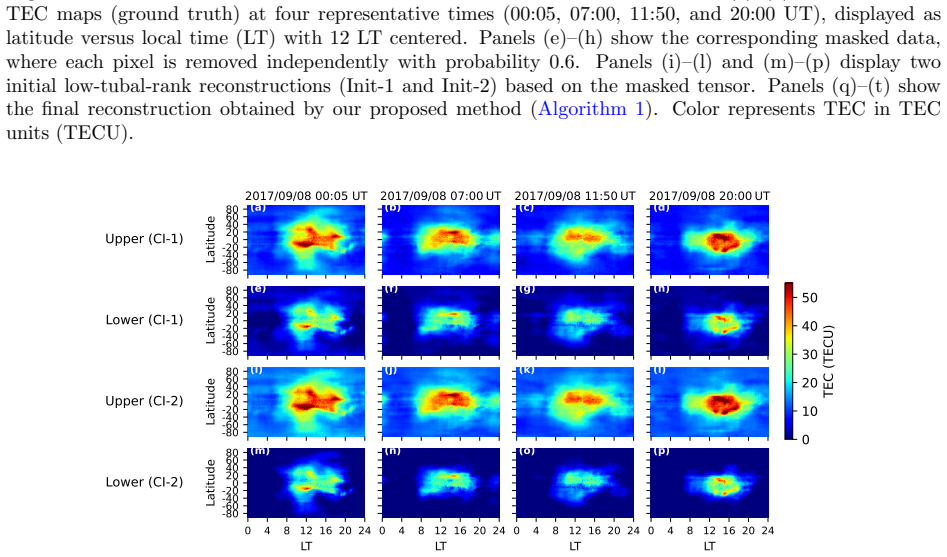
Employing a double-sample debiasing technique followed by a low-rank projection, we construct asymptotically Gaussian estimators that yield valid statistical inference under mild assumptions. More precisely, we can perform hypothesis testing and construct confidence intervals with this result. We validate the theoretical results through extensive simulations and demonstrate the practical effectiveness of our method in completing the global total electron content data.
What carries the argument
Double-sample debiasing followed by low-rank projection, which produces estimators that are asymptotically normal and therefore usable for inference on linear forms of the tensor.
If this is right
- Hypothesis tests become available for any linear functional of the completed tensor.
- Entrywise confidence intervals can be formed for the imputed tensor values.
- The framework applies directly to geophysical tensor datasets such as total electron content.
- Numerical experiments confirm that the intervals remain robust under the stated conditions.
Where Pith is reading between the lines
- The same debiasing-plus-projection idea could be tested on other tensor rank notions such as CP or Tucker rank.
- If the mild conditions hold in practice, the method could be embedded in existing tensor completion pipelines to supply uncertainty measures automatically.
- Adaptive sampling designs that exploit the asymptotic normality might further reduce the number of observations needed for reliable inference.
Load-bearing premise
The tensor has low-tubal-rank structure and the noise distribution plus sampling mechanism satisfy conditions that make the estimators asymptotically Gaussian.
What would settle it
Simulations or real data in which the nominal 95 percent confidence intervals achieve coverage rates far from 95 percent would show that the asymptotic Gaussianity does not hold.
Figures


read the original abstract
High-dimensional tensor data often exhibit strong temporal correlations that appear as low-dimensional structures in the frequency domain. While the low-tubal-rank tensor model effectively captures these spectral features, making it potentially suitable for geophysical data, existing methods primarily focus on point estimation. Uncertainty quantification (UQ) of imputed values and rigorous statistical inference for these models remain largely unexplored. In this work, we propose a flexible inference framework for linear forms of high-dimensional tensors. Employing a double-sample debiasing technique followed by a low-rank projection, we construct asymptotically Gaussian estimators that yield valid statistical inference under mild assumptions. More precisely, we can perform hypothesis testing and construct confidence intervals with this result. We validate the theoretical results through extensive simulations and demonstrate the practical effectiveness of our method in completing the global total electron content data. We demonstrate, using those numerical results, that our entrywise confidence intervals are robust and reliable, yielding informative uncertainty quantification that captures underlying variability.
Editorial analysis
A structured set of objections, weighed in public.
Referee Report
Summary. The paper develops an inference framework for linear functionals of high-dimensional tensors under the noisy low-tubal-rank model. It uses double-sample debiasing followed by a low-rank projection (via t-SVD) to produce asymptotically Gaussian estimators, enabling hypothesis tests and entrywise confidence intervals under mild assumptions on the tensor structure, noise, and sampling. The claims are supported by simulations and an application to global total electron content (TEC) data, where the resulting intervals are reported to be robust.
Significance. If the asymptotic normality and coverage guarantees hold under realistic conditions, the work would fill an important gap by moving low-tubal-rank tensor completion from point estimation to valid statistical inference, which is particularly relevant for geophysical applications where uncertainty quantification is needed. The double-sample debiasing approach and the demonstration on real TEC data are concrete strengths that could make the method practically useful once the supporting conditions are clarified.
major comments (1)
- [Abstract] Abstract: The central claim of asymptotically Gaussian estimators and valid CIs after debiasing plus low-tubal-rank projection rests on 'mild assumptions,' but these assumptions do not explicitly require or verify a spectral gap of sufficient size (relative to the noise level after sampling) on the Fourier-domain singular values. Without such a gap the projection step can reintroduce bias of the same order as the debiasing correction, invalidating the Gaussian limit and the subsequent inference; this condition is load-bearing for the geophysical application where the low-tubal-rank model is typically only approximate.
minor comments (1)
- [Abstract] The abstract repeats the phrase 'we demonstrate' in consecutive sentences; a single concise statement of the numerical validation would improve readability.
Simulated Author's Rebuttal
We thank the referee for their careful reading and constructive feedback on our work. We address the major comment below.
read point-by-point responses
-
Referee: [Abstract] Abstract: The central claim of asymptotically Gaussian estimators and valid CIs after debiasing plus low-tubal-rank projection rests on 'mild assumptions,' but these assumptions do not explicitly require or verify a spectral gap of sufficient size (relative to the noise level after sampling) on the Fourier-domain singular values. Without such a gap the projection step can reintroduce bias of the same order as the debiasing correction, invalidating the Gaussian limit and the subsequent inference; this condition is load-bearing for the geophysical application where the low-tubal-rank model is typically only approximate.
Authors: We appreciate the referee for identifying this important technical point. The low-rank projection step does require that the Fourier-domain singular values maintain a sufficient gap relative to the post-sampling noise level; otherwise the projection can indeed reintroduce bias comparable to the debiasing term and invalidate the asymptotic normality. Our analysis incorporates this requirement through the stated conditions on the tensor structure and noise (which bound the singular values away from the noise floor), but we agree that the abstract and the discussion of assumptions would benefit from an explicit statement of the spectral-gap condition. We will revise the abstract and Section 3 accordingly to make the requirement clear. For the TEC application, the low-tubal-rank model is approximate, yet our numerical results indicate that the estimated singular values exhibit a clear gap and that the resulting intervals remain reliable; we will add a brief remark on this empirical observation in the revised manuscript. revision: yes
Circularity Check
No significant circularity in the derivation
full rationale
The paper constructs asymptotically Gaussian estimators for linear functionals of low-tubal-rank tensors by applying a double-sample debiasing step followed by projection onto an estimated low-tubal-rank subspace via t-SVD. This follows standard statistical debiasing practices to separate estimation from inference without any quoted reduction of the target Gaussian limit or variance estimator to a fitted parameter or self-referential definition. No load-bearing self-citations, uniqueness theorems imported from the same authors, or ansatz smuggling appear in the abstract or described chain; the mild assumptions are external to the construction itself. The derivation is therefore self-contained against the stated inputs.
Axiom & Free-Parameter Ledger
axioms (2)
- domain assumption The observed tensor admits an approximate low-tubal-rank structure
- domain assumption Noise terms satisfy regularity conditions allowing asymptotic normality after debiasing
Reference graph
Works this paper leans on
-
[1]
[1]B. Barak and A. Moitra,Noisy tensor completion via the sum-of-squares hierarchy, Math. Program., 193 (2022), pp. 513–548. [2]X. Bi, X. Tang, Y. Yuan, Y. Zhang, and A. Qu,Tensors in statistics, Annu. Rev. Stat. Appl., 8 (2021), pp. 345–368. [3]C. Cai, G. Li, H. V. Poor, and Y. Chen,Nonconvex low-rank tensor completion from noisy data, Oper. Res., 70 (20...
work page 2022
-
[2]
[21]J. Li, J.-F. Cai, Y. Chen, and D. Xia,Online tensor learning: Computational and statis- tical trade-offs, adaptivity and optimal regret, Ann. Statist., to appear. [22]X.-Y. Liu, S. Aeron, V. Aggarwal, and X. Wang,Low-tubal-rank tensor completion using alternating minimization, IEEE Trans. Inform. Theory, 66 (2020), pp. 1714–1737. [23]C. Lu, J. Feng, Y...
work page 2020
-
[3]
[33]H. Sun, Z. Hua, J. Ren, S. Zou, Y. Sun, and Y. Chen,Matrix completion methods for the total electron content video reconstruction, Ann. Appl. Stat., 16 (2022), pp. 1333–1358. [34]H. Sun, J. Ren, Y. Chen, S. Zou, Y. Chang, Z. Wang, and A. Coster,VISTA TEC Database (ver 2.0). [Data set], University of Michigan - Deep Blue Data,
work page 2022
-
[4]
[35]T. Tong, C. Ma, A. Prater-Bennette, E. Tripp, and Y. Chi,Scaling and scalabil- ity: Provable nonconvex low-rank tensor estimation from incomplete measurements, J. Mach. Learn. Res., 23 (2022), pp. 1–77. [36]J. A. Tropp,User-friendly tail bounds for sums of random matrices, Found. Comput. Math., 12 (2012), pp. 389–434. [37]R. Vershynin,High-Dimensional...
work page 2022
-
[5]
[39]H. Wang, J. Chen, and K. Wei,Implicit regularization and entrywise convergence of Rie- mannian optimization for low Tucker-rank tensor completion, J. Mach. Learn. Res., 24 (2023), pp. 1–84. [40]D. Xia,Normal approximation and confidence region of singular subspaces, Electron. J. Stat., 15 (2021), pp. 3798–3851. [41]D. Xia and M. Yuan,On polynomial tim...
work page 2023
-
[6]
,Statistical inferences of linear forms for noisy matrix completion, J. R. Stat. Soc. Ser. B. Stat. Methodol., 83 (2021), pp. 58–77. [43]D. Xia, M. Yuan, and C.-H. Zhang,Statistically optimal and computationally efficient low rank tensor completion from noisy entries, Ann. Statist., 49 (2021), pp. 76–99. [44]Z. Zhang and S. Aeron,Exact tensor completion u...
work page 2021
discussion (0)
Sign in with ORCID, Apple, or X to comment. Anyone can read and Pith papers without signing in.