Thermal Segregation and Reddening in Europa's Double Ridges
Pith reviewed 2026-05-10 15:32 UTC · model grok-4.3
The pith
Self-heating in Europa's double ridge troughs raises temperatures by up to 20 K and drives formation of dark lag layers that redden the surface.
A machine-rendered reading of the paper's core claim, the machinery that carries it, and where it could break.
Core claim
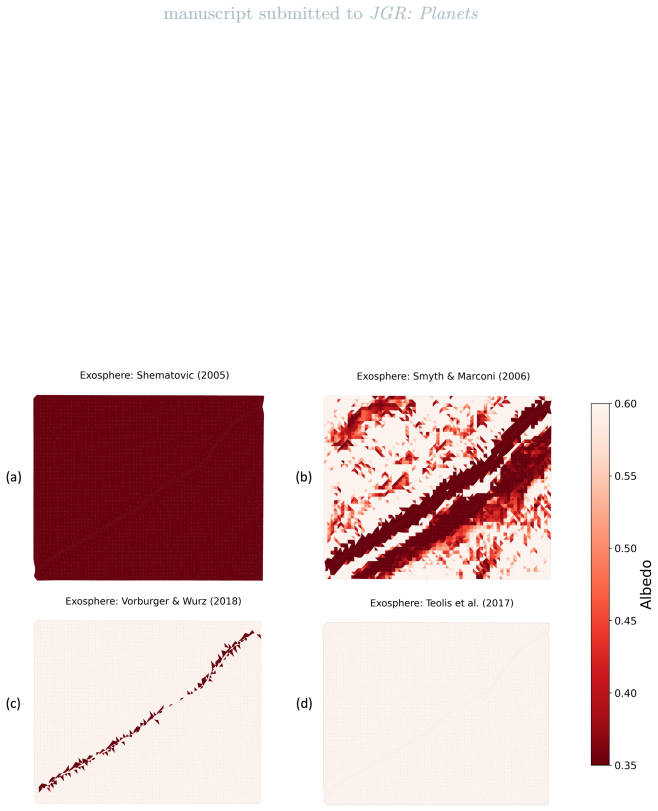
Application of a 3D thermophysical model to digital elevation models of Europa double ridges demonstrates that self-heating through mutual radiation exchange in the troughs increases maximum temperatures by up to 20 K and accelerates sublimation. Combined with a simple exosphere model and an assumed initial 10 percent concentration of 1 μm non-ice particles, this thermal segregation produces dark lag layers that cause reddening from the equator to middle latitudes on timescales of 10-100 years, while the effect is negligible at 60 degrees and higher. Lag formation supplies positive feedback that further raises surface heating, and the net mass balance is highly sensitive to exosphere column,
What carries the argument
3D thermophysical model incorporating shadowing and self-heating via mutual radiation exchange, paired with a simple exosphere model that tracks sublimation and lag deposition from non-ice particles.
If this is right
- Dark lag layers form in ridge troughs over 10-100 years and produce observable reddening at latitudes below 60 degrees.
- Low-albedo lag deposits create positive feedback that increases surface heating beyond the initial self-heating effect.
- Darkening can extend to terrain surrounding the ridges as lag material is redistributed.
- Net surface change flips from ablation of ~1 μm yr⁻¹ to deposition of ~10 μm yr⁻¹ when exosphere density rises from ~10^16 to ~10^18 molec/m².
- Resulting low-albedo trough material supplies concrete predictions that can be checked against Europa Clipper observations.
Where Pith is reading between the lines
- Color and albedo contrasts in ridges could be used to place bounds on Europa's global exosphere density.
- Any temperature excess above the modeled 20 K self-heating difference might indicate additional endogenic heat sources.
- The same topographic self-heating mechanism may operate on other icy moons that host ridges or linear depressions.
Load-bearing premise
The model assumes an initial 10 percent concentration of 1 μm non-ice particles and treats exosphere density as a free parameter that decides net ablation versus deposition.
What would settle it
High-resolution albedo and color maps of double ridge troughs at multiple latitudes that either match or contradict the predicted lag thickness and reddening pattern, especially when paired with independent exosphere density measurements near 10^16 or 10^18 molec/m².
Figures



read the original abstract
Europa's double ridges often display lower albedo and redder color than their surroundings. Their unique topography may cause sublimation-driven darkening due to illumination and self-heating, a process known as thermal segregation. We apply an advanced 3D thermophysical model, including shadowing and self-heating through mutual exchange of radiation, to digital elevation models of double ridges at a range of latitudes and orientations. Results show that self-heating in ridge troughs can markedly increase temperatures and sublimation rates, with a difference in maximum trough temperatures of up to 20 K, which may have implications for detection of endogenic heat. Incorporating a simple exosphere model and assuming an initial 10% concentration of 1 $\mu$m non-ice particles, we find thermal segregation can produce reddening in the form of dark lag layers from the equator to the middle latitudes, but is generally negligible at 60 degrees or higher. Lag formation timescales in ridge troughs are 10 - 100 yr to produce an optically thick layer. Modeling suggests that low-albedo lag layer formation provides positive feedback, further increasing surface heating. These effects may also darken Europa's surface in areas surrounding the ridges. However, the net mass balance controlling sublimation and lag formation is highly sensitive to the global water exosphere density: values $\sim 10^{16}$ molec/m$^{2}$ produce reddening in the trough and ablation of $\sim1~\mu\mathrm{m~yr^{-1}}$ of material, while values $\sim10^{18}$ molec/m$^{2}$ result in net deposition of $\sim 10~\mu\mathrm{m~yr^{-1}}$. Model predictions of resulting low albedo material in double ridge troughs are provided, which can be tested with eventual data from Europa Clipper.
Editorial analysis
A structured set of objections, weighed in public.
Referee Report
Summary. The paper applies a 3D thermophysical model including shadowing and self-heating to DEMs of Europa's double ridges across latitudes and orientations. It reports that self-heating in troughs raises maximum temperatures by up to 20 K, increasing sublimation rates. Incorporating a simple exosphere model and assuming an initial 10% concentration of 1 μm non-ice particles, the authors conclude that thermal segregation produces dark lag layers causing reddening from the equator to middle latitudes on 10-100 yr timescales (negligible at ≥60°), with net ablation (~1 μm yr⁻¹) at exosphere densities ~10^{16} molec/m² and deposition (~10 μm yr⁻¹) at ~10^{18} molec/m². Positive feedback from low-albedo layers is noted, and specific predictions for low-albedo material in ridge troughs are offered for testing with Europa Clipper data.
Significance. If the central results hold, this provides a plausible exogenic mechanism for the observed lower albedo and redder color of double ridges, reducing reliance on endogenic heat for explaining thermal anomalies and offering a framework for interpreting surface evolution on icy satellites. The incorporation of 3D self-heating and mutual radiation exchange is a clear methodological advance over simpler models, and the generation of quantitative, observationally testable predictions for lag-layer albedo strengthens the paper's utility for mission planning. The identification of positive feedback loops from darkening further contributes to understanding surface processes. The results remain conditional on the chosen parameters, so their broader significance depends on addressing the robustness concerns below.
major comments (3)
- [§3] §3 (exosphere model): the global water exosphere density is treated as a free parameter that directly sets the sign of net mass flux (ablation required for lag formation occurs only at densities ≲10^{16} molec/m², while higher values yield deposition). Because the reddening claim depends on net ablation to concentrate non-ice particles into an optically thick lag, the central quantitative result is not a general prediction but holds only inside an externally imposed density window with no internal model constraint or observational anchor provided.
- [§2.2] §2.2 (particle properties): the initial 10% concentration of 1 μm non-ice particles is assumed without derivation, reference to measurements, or sensitivity tests. This choice, together with particle size, directly determines the reported 10-100 yr lag-formation timescale to optical thickness; varying the concentration by even a factor of two would alter the timescale and the latitude range over which reddening occurs.
- [§4.1] §4.1 (temperature results): the claimed 20 K difference in maximum trough temperatures is load-bearing for the enhanced sublimation argument, yet no comparison to 1D models, no propagation of DEM resolution uncertainties, and no error bars on the temperature fields are shown. Without these, it is unclear whether the difference is robust or an artifact of the self-heating implementation.
minor comments (3)
- [Abstract] Abstract: the phrase 'middle latitudes' is used without a numerical range; the results section should state the exact cutoff (e.g., 45°) for consistency.
- [Figures] Figure captions: several temperature and lag-thickness maps lack explicit color-bar units or scale information, hindering quantitative interpretation.
- [§5] §5 (Discussion): the positive-feedback claim from low-albedo layers is stated qualitatively; a simple estimate of the additional temperature increase due to the albedo change would make the argument more concrete.
Simulated Author's Rebuttal
We thank the referee for their insightful comments on our manuscript. We address each of the major comments point by point below and indicate the revisions we will make to strengthen the paper.
read point-by-point responses
-
Referee: [§3] §3 (exosphere model): the global water exosphere density is treated as a free parameter that directly sets the sign of net mass flux (ablation required for lag formation occurs only at densities ≲10^{16} molec/m², while higher values yield deposition). Because the reddening claim depends on net ablation to concentrate non-ice particles into an optically thick lag, the central quantitative result is not a general prediction but holds only inside an externally imposed density window with no internal model constraint or observational anchor provided.
Authors: We agree that the exosphere density is a critical parameter and that our results are conditional on it. The manuscript already emphasizes the high sensitivity of net mass balance to this value and presents outcomes for two literature-based estimates. We will revise the text to more explicitly state that the reddening via lag formation requires net ablation, which occurs only for exosphere densities below approximately 10^{16} molec/m², and discuss the range of densities reported in the literature (e.g., from HST observations and models). While we cannot provide an internal model constraint, we will add a note on how Europa Clipper measurements could help anchor this parameter. This clarifies the conditions for the mechanism without overgeneralizing the prediction. revision: partial
-
Referee: [§2.2] §2.2 (particle properties): the initial 10% concentration of 1 μm non-ice particles is assumed without derivation, reference to measurements, or sensitivity tests. This choice, together with particle size, directly determines the reported 10-100 yr lag-formation timescale to optical thickness; varying the concentration by even a factor of two would alter the timescale and the latitude range over which reddening occurs.
Authors: The assumed 10% concentration and 1 μm particle size are drawn from typical values for non-volatile contaminants in Europa's ice as discussed in prior literature on surface composition and regolith. We will add references to these studies in the revised manuscript. To address the lack of sensitivity analysis, we will include additional modeling results or a parameter study showing how changes in initial concentration (e.g., 5%, 10%, 20%) and particle size affect the timescale for achieving optical thickness and the latitudinal extent of reddening. This will demonstrate the robustness of the 10-100 year timescale within reasonable parameter ranges. revision: yes
-
Referee: [§4.1] §4.1 (temperature results): the claimed 20 K difference in maximum trough temperatures is load-bearing for the enhanced sublimation argument, yet no comparison to 1D models, no propagation of DEM resolution uncertainties, and no error bars on the temperature fields are shown. Without these, it is unclear whether the difference is robust or an artifact of the self-heating implementation.
Authors: We will enhance §4.1 by adding direct comparisons of the 3D temperature fields to 1D thermophysical model runs for the same locations, isolating the effects of 3D shadowing and self-heating. We will also perform and report sensitivity tests using DEMs with varying resolutions or smoothing to propagate uncertainties from the topographic data. Where feasible, we will include uncertainty estimates or error bars on the reported temperature differences based on model input variations. These additions will confirm that the up to 20 K increase in trough maximum temperatures is a robust result of the self-heating process. revision: yes
Circularity Check
No circularity; forward modeling with explicit assumptions and parameter sensitivity
full rationale
The paper applies a 3D thermophysical model to external DEM topography of ridges at various latitudes, incorporates a simple exosphere model treating global water density as an explicit free parameter (showing results for ~10^16 vs ~10^18 molec/m²), and assumes an initial 10% concentration of 1 μm non-ice particles. It reports temperature differences, sublimation rates, lag formation timescales (10-100 yr), and reddening outcomes as contingent on these inputs without fitting any parameter to the observed albedo/reddening data or deriving the assumptions from the target results. No self-citations, self-definitional steps, or renaming of known results appear in the abstract or described chain. The central claims remain independent forward predictions testable by future data.
Axiom & Free-Parameter Ledger
free parameters (2)
- initial non-ice particle concentration
- global water exosphere density
axioms (2)
- domain assumption The 3D thermophysical model correctly captures shadowing and mutual radiative exchange in ridge topography.
- domain assumption Sublimation and lag formation are controlled by the simple exosphere model without additional atmospheric dynamics.
Reference graph
Works this paper leans on
-
[1]
Abramov, O., & Spencer, J. R. (2008, 5). Numerical modeling of endo- genic thermal anomalies on Europa.Icarus,195(1), 378–385. Retrieved from https://www.sciencedirect.com/science/article/pii/S0019103507005970?casa token=TxSUzKK1u1gAAAAA:IcjBoP4vXpHFBlWS7U-1AiuAxqR0D9 eRcgVwrqJzjCrb6ZN WcVP1iZUKWna FpBVxGQ1mpRIAdoi: 10.1016/J.ICARUS.2007.11.027 Addison, P...
-
[2]
Retrieved fromhttps://iopscience.iop.org/article/10.3847/PSJ/ adcab9https://iopscience.iop.org/article/10.3847/PSJ/adcab9/metadoi: 10 .3847/PSJ/ADCAB9 Cashion, M. D., Johnson, B. C., Gibson, H., Turtle, E. P., Sori, M. M., & Melosh, H. J. (2024, 2). Europa’s Double Ridges Produced by Ice Wedging.Journal of Geophysical Research: Planets,129(2), e2023JE0080...
-
[3]
doi: 10.3847/0004-6256/151/6/163 Marti, J., & Mauersberger, K. (1993, 3). A survey and new measurements of ice vapor pressure at temperatures between 170 and 250K.Geophysical Research Let- ters,20(5), 363–366. Retrieved fromhttps://onlinelibrary.wiley.com/doi/ full/10.1029/93GL00105https://onlinelibrary.wiley.com/doi/abs/10.1029/ 93GL00105https://agupubs....
-
[4]
Retrieved fromhttps://iopscience.iop.org/article/10.3847/ PSJ/ac382ahttps://iopscience.iop.org/article/10.3847/PSJ/ac382a/metadoi: 10.3847/PSJ/AC382A O’Brien, P., & Byrne, S. (2021, 2). Physical and Chemical Evolution of Lunar Mare Regolith.Journal of Geophysical Research: Planets,126(2), e2020JE006634. Retrieved from/doi/pdf/10.1029/2020JE006634https://o...
-
[5]
Retrieved from https://www.swsc-journal.org/articles/swsc/full html/2024/01/swsc230047/ swsc230047.htmlhttps://www.swsc-journal.org/articles/swsc/abs/2024/01/ swsc230047/swsc230047.htmldoi: 10.1051/SWSC/2024008 Richardson, J. E. (2009, 12). Cratering saturation and equilibrium: A new model looks at an old problem.Icarus,204(2), 697–715. Retrieved fromhttp...
discussion (0)
Sign in with ORCID, Apple, or X to comment. Anyone can read and Pith papers without signing in.