Recognition: unknown
Accessing gluon GTMD F^g_{1,4} via the langlesin(2φ)rangle azimuthal asymmetry of exclusive π⁰ production in ep collisions
Pith reviewed 2026-05-10 15:47 UTC · model grok-4.3
The pith
The sin(2φ) azimuthal asymmetry in exclusive neutral pion production probes the imaginary part of gluon GTMD F^g_{1,4}.
A machine-rendered reading of the paper's core claim, the machinery that carries it, and where it could break.
Core claim
The longitudinal single-target spin asymmetry in exclusive π⁰ production in ep collisions appears as a characteristic sin(2φ) azimuthal correlation due to Coulomb-nuclear interference and is therefore sensitive to the imaginary part of the gluon GTMD F^g_{1,4}. The Primakoff process must be included. The authors compute the gluon distributions in a light-front spectator model with explicit gluonic degrees of freedom, present the first model calculation of Im(F^g_{1,4}), and give predictions for the resulting asymmetries at EIC and EicC kinematics.
What carries the argument
The gluon GTMD F^g_{1,4} (specifically its imaginary part), accessed through the sin(2φ) azimuthal spin asymmetry generated by Coulomb-nuclear interference in the Primakoff process.
If this is right
- The sin(2φ) asymmetry provides a concrete experimental handle on a previously uncalculated gluon GTMD component.
- Accurate predictions require explicit inclusion of the Primakoff process alongside the nuclear contribution.
- The light-front model supplies first numerical values for Im(F^g_{1,4}) that can be directly compared with data.
- Predictions are available for the kinematics expected at the Electron-Ion Collider and the proposed EicC.
Where Pith is reading between the lines
- Confirmation at the EIC would open a new experimental channel for mapping the three-dimensional gluon structure of the proton at moderate x.
- The same interference mechanism could be examined in other exclusive meson channels to constrain additional GTMD components.
- If the spectator model is validated here, it could be applied to related observables such as single-spin asymmetries in other processes.
Load-bearing premise
The light-front spectator model with explicit gluonic degrees of freedom correctly captures the non-perturbative gluon dynamics that determine Im(F^g_{1,4}).
What would settle it
A measurement of the sin(2φ) azimuthal asymmetry in exclusive π⁰ electroproduction at EIC energies that differs substantially in magnitude or sign from the model's numerical predictions would show that the asymmetry does not probe Im(F^g_{1,4}) as calculated here.
Figures


read the original abstract
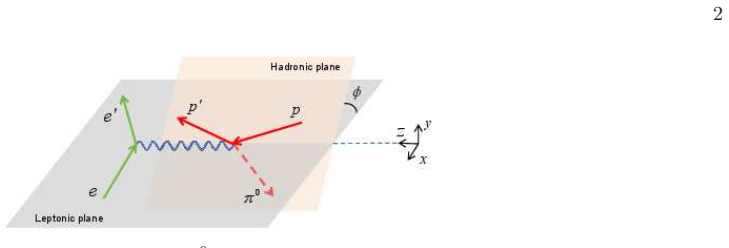
The longitudinal single-target spin asymmetry in exclusive $\pi^0$ production in $ep$ collisions is a sensitive probe of the imaginary part of the gluon generalized transverse momentum dependent distribution $F_{1,4}^g$. It appears as a characteristic $\sin(2\phi)$ azimuthal correlation between the transverse momenta of the scattered electron and the recoil proton, generated by Coulomb-nuclear interference; consequently, the Primakoff process should be included. We compute the relevant gluon distributions in a light-front spectator model of the proton that explicitly incorporates gluonic degrees of freedom. This work presents the first model calculation of the imaginary part of $F_{1,4}^g$ and delivers predictions for the resulting asymmetries in kinematics relevant to the planned Electron-Ion Colliders (EIC and EicC), providing theoretical predictions for upcoming measurements.
Editorial analysis
A structured set of objections, weighed in public.
Referee Report
Summary. The manuscript claims that the longitudinal single-target spin asymmetry in exclusive π⁰ production in ep collisions appears as a ⟨sin(2φ)⟩ azimuthal asymmetry generated by Coulomb-nuclear interference in the Primakoff process, thereby providing access to the imaginary part of the gluon GTMD F^g_{1,4}. The authors compute this distribution for the first time in a light-front spectator model of the proton that includes explicit gluonic degrees of freedom and present numerical predictions for the asymmetry in EIC and EicC kinematics.
Significance. If the model evaluation of Im(F^g_{1,4}) is reliable, the work supplies the first quantitative predictions for a novel observable that could be measured at future electron-ion colliders, offering a potential new probe of gluon transverse-momentum-dependent structure beyond standard GPDs.
major comments (2)
- [§3] §3 (light-front spectator model): The computation of Im(F^g_{1,4}) rests entirely on this model, yet the manuscript provides no comparison of the same framework to lattice QCD moments of gluon distributions, unpolarized GTMDs, or any other gluon-sensitive observable that can be confronted with existing data. This absence leaves the magnitude and sign of the predicted asymmetry as an unanchored model output rather than a robust extraction.
- [§5] §5 (numerical predictions): The asymmetry results at EIC/EicC kinematics are presented as direct consequences of the model; without external validation or uncertainty estimates tied to model assumptions, it is unclear whether the claimed sensitivity can be translated into a reliable extraction strategy once data arrive.
minor comments (2)
- [Abstract] The abstract states that the Primakoff process 'should be included' but does not quantify its relative contribution to the sin(2φ) term versus other mechanisms; a brief estimate in the introduction would improve clarity.
- [Introduction] Notation for the GTMD F^g_{1,4} is introduced without an explicit reference to the standard parametrization (e.g., the relation to the gluon helicity flip amplitude); adding one sentence with the defining equation would aid readers unfamiliar with the GTMD literature.
Simulated Author's Rebuttal
We thank the referee for the careful reading of our manuscript and the constructive comments. We address each major comment point by point below. We have revised the manuscript to incorporate additional discussion and uncertainty estimates where feasible, while noting the limitations inherent to this being the first calculation of Im(F^g_{1,4}).
read point-by-point responses
-
Referee: [§3] §3 (light-front spectator model): The computation of Im(F^g_{1,4}) rests entirely on this model, yet the manuscript provides no comparison of the same framework to lattice QCD moments of gluon distributions, unpolarized GTMDs, or any other gluon-sensitive observable that can be confronted with existing data. This absence leaves the magnitude and sign of the predicted asymmetry as an unanchored model output rather than a robust extraction.
Authors: We agree that the manuscript would benefit from explicit context on the model's prior validations. The light-front spectator model with explicit gluons has been used in our previous works to compute unpolarized gluon GTMDs and related quantities, where it reproduces known limits and is constrained by phenomenological inputs. However, because Im(F^g_{1,4}) has no existing lattice QCD results or data for direct comparison, such benchmarks are not yet possible. In the revised manuscript we will add a dedicated paragraph referencing our earlier validations of the same framework for gluon distributions and explain that the sign of the asymmetry is fixed by the model's Dirac structure rather than free parameters. We view this as sufficient anchoring for a first theoretical study while acknowledging that full lattice comparisons remain a future goal. revision: partial
-
Referee: [§5] §5 (numerical predictions): The asymmetry results at EIC/EicC kinematics are presented as direct consequences of the model; without external validation or uncertainty estimates tied to model assumptions, it is unclear whether the claimed sensitivity can be translated into a reliable extraction strategy once data arrive.
Authors: We accept that uncertainty quantification would improve the utility of the predictions. In the revised manuscript we will add a new subsection estimating theoretical uncertainties by varying the model parameters within ranges fixed by our prior fits to other gluon observables. We will also expand the discussion to outline a possible extraction strategy, emphasizing that the sin(2φ) asymmetry provides direct access to Im(F^g_{1,4}) via Coulomb-nuclear interference and that its qualitative features are stable under reasonable parameter changes. These additions should clarify how the observable can be used once data become available. revision: yes
Circularity Check
Light-front spectator model computation of Im(F^g_{1,4}) is self-contained with no reduction to fitted inputs or self-citations
full rationale
The paper defines a light-front spectator model with explicit gluonic degrees of freedom, computes the gluon GTMD F^g_{1,4} (specifically its imaginary part) from that model, and then uses the result to predict the sin(2φ) asymmetry in exclusive π⁰ production. This is a standard forward model calculation: the model is specified independently of the target observable, the GTMD follows directly from the model's wave functions or overlaps, and the asymmetry is obtained by inserting the computed distribution into the standard cross-section formula. No equations reduce the final prediction to a fit of the same data, no uniqueness theorem is imported from prior self-work, and no ansatz is smuggled via citation. The abstract explicitly frames the work as 'the first model calculation,' confirming the derivation chain is open and falsifiable against future data rather than tautological. Therefore no circular steps exist.
Axiom & Free-Parameter Ledger
axioms (1)
- domain assumption Light-front spectator model with explicit gluonic degrees of freedom accurately represents the proton's gluon GTMDs
Reference graph
Works this paper leans on
-
[1]
(22) 6 As a complex-valued function, F g 1, 4 = ReF g 1, 4 +iImF g 1, 4
via the helicity difference: W↑↑ − W↓↓ = 2iǫij ⊥ ki ⊥ ∆ j ⊥ M 2 √ 1 − ξ2 F g 1, 4. (22) 6 As a complex-valued function, F g 1, 4 = ReF g 1, 4 +iImF g 1, 4. As mentioned in Ref. [ 27], the imaginary part of the gluon GTMD F g 1, 2 is linked to the Sivers function in the forward limit ( ξ → 0, ∆ ⊥ → 0) via ImF g 1, 2(x, 0, k2 ⊥ , 0, 0) = −f ⊥ g 1T (x, k2 ⊥ )...
-
[2]
We use 1000 data points in the range 0
to the NNPDF3.1 dataset for xf g 1 (x) [ 51] at the initial scale µ 0 = 2 GeV. We use 1000 data points in the range 0 . 001 ≤ x ≤ 1 (step size 0.001). Simultaneous fitting of the unpolarized and helicity PDFs to NNPDF3.1 a nd NNPDFpol1.1 [ 10] was attempted but yielded significant deviations in the small- x region (0. 001 < x <0. 01), so we focus on the unp...
-
[3]
(35) From the figure, one can observe that the peak magnitude decrea ses and shifts to larger k⊥ asx increases
3, while the right panel displays the first transverse moment of the gluon sivers function defined as f ⊥ (1)g 1T (x) = ∫ d2k⊥ k2 ⊥ 2M 2f ⊥ g 1T (x, k2 ⊥ ). (35) From the figure, one can observe that the peak magnitude decrea ses and shifts to larger k⊥ asx increases. The Sivers function in our model is negative in the entire x region, consistent with the ex...
-
[4]
We also set α s = 0
In the forward and perturbative- Q2 limit the Odderon-induced cross section can be written as [ 35] dσ Odderon dtdQ2dxB ≈ π 5α 2 emα 2 sf 2 π 8xBN 2cM 2Q6 [ 1 − y + y2 2 ][ ∫ 1 0 dz φ π (z) z(1 − z) ∫ d2k⊥ k2 ⊥xf ⊥ g(d) 1T (x, k2 ⊥ ) k2 ⊥ +z(1 − z)Q2 ] 2 , (37) where Nc = 3, α em = 1/ 137, and fπ = 131 MeV is the π 0 decay constant. We also set α s = 0. 3...
-
[5]
Ashman et al
J. Ashman et al. [European Muon Collaboration]: A Measurement of the Spin As ymmetry and Determination of the Structure Function g(1) in Deep Inelastic Muon-Proton Scat tering. Phys. Lett. B 206, 364 (1988)
1988
-
[6]
R. L. Jaffe, A. Manohar: The g1 Problem: Fact and Fantasy on the Spin of the Proton. Nucl. Phys. B 337, 509–546 (1990)
1990
-
[7]
X. D. Ji: Gauge-Invariant Decomposition of Nucleon Spin . Phys. Rev. Lett. 78, 610–613 (1997). [arXiv:hep-ph/9603249 [hep-ph]]
work page Pith review arXiv 1997
-
[8]
The angular momentum controversy: What's it all about and does it matter?
E. Leader, C. Lorc´ e: The angular momentum controversy: What’s it all about and does it matter? Phys. Rept. 541, 163–248 (2014). [arXiv:1309.4235 [hep-ph]]
work page Pith review arXiv 2014
- [9]
- [10]
-
[11]
E. Leader: Role of the subsidiary fields in the momentum an d angular momentum in covariantly quantized QED and QCD. Phys. Rev. D 105, 036005 (2022). [arXiv:2111.03369 [hep-th]]
-
[12]
Ashman et al
J. Ashman et al. [European Muon Collaboration]: An Investigation of the Spi n Structure of the Proton in Deep Inelastic Scattering of Polarized Muons on Polarized Protons. Nucl. Phys. B 328, 1 (1989)
1989
-
[13]
Extraction of Spin-Dependent Parton Densities and Their Uncertainties
D. de Florian, R. Sassot, M. Stratmann, W. Vogelsang: Ext raction of Spin-Dependent Parton Densities and Their Uncertainties. Phys. Rev. D 80, 034030 (2009). [arXiv:0904.3821 [hep-ph]]
work page Pith review arXiv 2009
-
[14]
E. R. Nocera et al. [NNPDF Collaboration]: A first unbiased global determinati on of polarized PDFs and their uncer- tainties. Nucl. Phys. B 887, 276–308 (2014). [arXiv:1406.5539 [hep-ph]]
work page Pith review arXiv 2014
-
[15]
J. J. Ethier, N. Sato, W. Melnitchouk: First simultaneo us extraction of spin-dependent parton distributions and f rag- mentation functions from a global QCD analysis. Phys. Rev. Lett. 119, 132001 (2017). [arXiv:1705.05889 [hep-ph]]
work page Pith review arXiv 2017
-
[16]
L. Adamczyk et al. [STAR Collaboration]: Precision Measurement of the Longit udinal Double-spin Asymmetry for Inclu- sive Jet Production in Polarized Proton Collisions at √ s = 200 GeV. Phys. Rev. Lett. 115, 092002 (2015). [arXiv:1406.3801 [nucl-ex]]
-
[17]
Evidence for polarization of gluons in the proton
D. de Florian, R. Sassot, M. Stratmann, W. Vogelsang: Ev idence for polarization of gluons in the proton. Phys. Rev. Lett. 113, 012001 (2014). [arXiv:1404.4293 [hep-ph]]
work page Pith review arXiv 2014
- [18]
- [19]
-
[20]
R. Abdul Khalek, A. Accardi, J. Adam, D. Adamiak, W. Aker s, M. Albaladejo, A. Al-bataineh, M. G. Alexeev, F. Ameli, P. Antonioli et al. : Science Requirements and Detector Concepts for the Electr on-Ion Collider: EIC Yellow Report. Nucl. Phys. A 1026, 122447 (2022). [arXiv:2103.05455 [physics.ins-det]]
- [21]
-
[22]
X. D. Ji: Deeply virtual Compton scattering. Phys. Rev. D 55, 7114–7125 (1997). [arXiv:hep-ph/9609381 [hep-ph]]
work page Pith review arXiv 1997
- [23]
-
[24]
C. Lorc´ e, B. Pasquini: Quark Wigner Distributions and Orbital Angular Momentum. Phys. Rev. D 84, 014015 (2011). [arXiv:1104.4687 [hep-ph]]
-
[25]
Hatta: Notes on the orbital angular momentum of quark s in the nucleon
Y. Hatta: Notes on the orbital angular momentum of quark s in the nucleon. Phys. Lett. B 708, 186–190 (2012). [arXiv:1111.3278 [hep-ph]]
-
[26]
C. Lorc´ e, B. Pasquini, X. Xiong, F. Yuan: The quark orbi tal angular momentum from Wigner distributions and light-c one wave functions. Phys. Rev. D 85, 114006 (2012). [arXiv:1111.4827 [hep-ph]] 13
- [27]
-
[28]
V. Bertone: Matching generalised transverse-momentu m-dependent distributions onto generalised parton distri butions at one loop. Eur. Phys. J. C 82, 941 (2022). [arXiv:2206.02870 [hep-ph]]
- [29]
-
[30]
Hidden symmetries, null geodesics, and photon capture in the Sen black hole,
S. Meissner, A. Metz, M. Schlegel, K. Goeke: Generalize d parton correlation functions for a spin-0 hadron. JHEP 08, 038 (2008). [arXiv:0805.3146 [hep-ph]]
-
[31]
S. Meissner, A. Metz, M. Schlegel: Generalized parton c orrelation functions for a spin-1/2 hadron. JHEP 08, 056 (2009). [arXiv:0906.5323 [hep-ph]]
-
[32]
S. Bhattacharya, A. Metz, J. Zhou: Generalized TMDs and the exclusive double Drell–Yan process. Phys. Lett. B 771, 396–400 (2017); Erratum: Phys. Lett. B 810, 135866 (2020). [arXiv:1703.08260 [hep-ph]]
-
[33]
S. Bhattacharya, D. Zheng, J. Zhou: Probing the Quark Or bital Angular Momentum at Electron-Ion Colliders Using Exclusive π 0 Production. Phys. Rev. Lett. 133, 051901 (2024). [arXiv:2308.10859 [hep-ph]]
- [34]
- [35]
-
[36]
S. Bhattacharya, R. Boussarie, Y. Hatta: Signature of t he Gluon Orbital Angular Momentum. Phys. Rev. Lett. 128, 182002 (2022). [arXiv:2201.07579 [hep-ph]]
-
[37]
S. Bhattacharya, A. Metz, V. K. Ojha, J. Y. Tsai, J. Zhou: Exclusive double quarkonium production and generalized TMDs of gluons. Phys. Lett. B 833, 137383 (2022). [arXiv:1810.04137 [hep-ph]]
-
[38]
R. Boussarie, Y. Hatta, B. W. Xiao, F. Yuan: Probing the W eizs¨ acker-Williams gluon Wigner distribution inpp collisions. Phys. Rev. D 98, 074015 (2018). [arXiv:1806.05681 [hep-ph]]
-
[39]
and Joshi, Chaitanya K and Schmidt, Victor and Miret, Santiago and Malliaros, Fragkiskos D
S. Bhattacharya, D. Zheng, J. Zhou: Accessing the gluon GTMD F 1,4 in exclusive π 0 production in ep collisions. Phys. Rev. D 109, 096029 (2024). [arXiv:2312.07511 [hep-ph]]
-
[40]
H. Primakoff: Photoproduction of neutral mesons in nucl ear electric fields and the mean life of the neutral meson. Phys. Rev. 81, 899 (1951). https://doi.org/10.1103/PhysRev.81.899
-
[41]
G. Liping, R. Miskimen, A. Gasparian, J. Goity, W. Rong, C. Xurong: Primakoff Physics with an e-p Collider. Nucl. Phys. Rev. 31, 453–459 (2014). https://doi.org/10.11804/NuclPhysRev .31.04.453
-
[42]
M. M. Kaskulov, U. Mosel: Primakoff production of π 0, η and η′ in the Coulomb field of a nucleus. Phys. Rev. C 84, 065206 (2011). https://doi.org/10.1103/PhysRevC.84.06 5206 [arXiv:1103.2097 [nucl-th]]
-
[43]
G. P. Lepage, S. J. Brodsky: Exclusive Processes in Pert urbative Quantum Chromodynamics. Phys. Rev. D 22, 2157 (1980). https://doi.org/10.1103/PhysRevD.22.2157
-
[44]
Khodjamirian: Form-factors of γ ∗ ρ → π and γ ∗ γ → π 0 transitions and light cone sum rules
A. Khodjamirian: Form-factors of γ ∗ ρ → π and γ ∗ γ → π 0 transitions and light cone sum rules. Eur. Phys. J. C 6, 477–484 (1999). https://doi.org/10.1007/s100520050357 [arXiv:hep-ph/9712451 [hep-ph]]
-
[45]
Y. Jia, Z. Mo, J. Pan, J. Y. Zhang: Photoproduction of C-e ven quarkonia at the EIC and EicC. Phys. Rev. D 108, 016015 (2023). https://doi.org/10.1103/PhysRevD.108.0 16015 [arXiv:2207.14171 [hep-ph]]
- [46]
-
[47]
N. Kaur, H. Dahiya: T-even gluon TMDs of proton in light- cone spectator model. DAE Symp. Nucl. Phys. 64, 641–642 (2019)
2019
-
[48]
A. Bacchetta, F. G. Celiberto, M. Radici, P. Taels: Tran sverse-momentum-dependent gluon distribution functions in a spectator model. Eur. Phys. J. C 80, 733 (2020). [arXiv:2004.02320 [hep-ph]]
-
[49]
A. Bacchetta, F. G. Celiberto, M. Radici: T-odd gluon di stribution functions in a spectator model. Eur. Phys. J. C 84, 576 (2024). [arXiv:2402.04097 [hep-ph]]
-
[50]
D. Chakrabarti, P. Choudhary, B. Gurjar, R. Kishore, T. Maji, C. Mondal, A. Mukherjee: Gluon distributions in the proton in a light-front spectator model. Phys. Rev. D 108, 014009 (2023). [arXiv:2303.09649 [hep-ph]]
- [51]
-
[52]
D. Chakrabarti, P. Choudhary, B. Gurjar, T. Maji, C. Mon dal, A. Mukherjee: Gluon generalized parton distributions of the proton at nonzero skewness. Phys. Rev. D 109, 114040 (2024). [arXiv:2402.07514 [hep-ph]]
- [53]
- [54]
-
[55]
R. D. Ball et al. [NNPDF Collaboration]: Parton distributions from high-pr ecision collider data. Eur. Phys. J. C 77, 663 (2017). [arXiv:1706.00428 [hep-ph]]
work page internal anchor Pith review Pith/arXiv arXiv 2017
-
[56]
U. D’Alesio, F. Murgia, C. Pisano: Towards a first estima te of the gluon Sivers function from AN data in pp collisions at RHIC. JHEP 09, 119 (2015). [arXiv:1506.03081 [hep-ph]]
-
[57]
M. Anselmino, M. Boglione, U. D’Alesio, A. Kotzinian, S . Melis, F. Murgia, A. Prokudin, C. Turk: Sivers Effect for Pio n and Kaon Production in Semi-Inclusive Deep Inelastic Scatt ering. Eur. Phys. J. A 39, 89–100 (2009). [arXiv:0805.2637 [hep-ph]] 14
-
[58]
C. Adolph et al. [COMPASS Collaboration]: First measurement of the Sivers a symmetry for gluons using SIDIS data. Phys. Lett. B 772, 854–864 (2017). [arXiv:1702.02153 [hep-ex]]
-
[59]
A. Bacchetta, M. Boglione, A. Henneman, P. J. Mulders: B ounds on transverse momentum dependent distribution and fragmentation functions. Phys. Rev. Lett. 85, 712–715 (2000). [arXiv:hep-ph/9912490 [hep-ph]]
-
[60]
P. J. Mulders, J. Rodrigues: Transverse momentum depen dence in gluon distribution and fragmentation functions. Phys. Rev. D 63, 094021 (2001). [arXiv:hep-ph/0009303 [hep-ph]]
work page internal anchor Pith review arXiv 2001
-
[61]
C. Lorc´ e, B. Pasquini: Structure analysis of the gener alized correlator of quark and gluon for a spin-1/2 target. JHEP 09, 138 (2013). [arXiv:1307.4483 [hep-ph]]
-
[62]
A. Mukherjee, S. Nair, V. K. Ojha: Wigner distributions for gluons in a light-front dressed quark model. Phys. Rev. D 91, 054018 (2015). https://doi.org/10.1103/PhysRevD.91.0 54018 [arXiv:1501.03728 [hep-ph]]
-
[63]
K. Kanazawa, C. Lorc´ e, A. Metz, B. Pasquini, M. Schlege l: Twist-2 generalized transverse-momentum de- pendent parton distributions and the spin/orbital structu re of the nucleon. Phys. Rev. D 90, 014028 (2014). https://doi.org/10.1103/PhysRevD.90.014028 [arXiv:1403.5226 [hep-ph]]
-
[64]
C. Tan, Z. Lu: Gluon GTMDs at nonzero skewness and impact parameter dependent parton distributions. Eur. Phys. J. C 84, 637 (2024). https://doi.org/10.1140/epjc/s10052-024- 12976-3 [arXiv:2402.17162 [hep-ph]]
-
[65]
J. Czyzewski, J. Kwiecinski, L. Motyka, M. Sadzikowski : Exclusive ηc photoproduction and electroproduction at HERA as a possible probe of the odderon singularity in QCD. Phys. Lett. B 398, 400–406 (1997); Erratum: Phys. Lett. B 411, 402 (1997). [arXiv:hep-ph/9610399 [hep-ph]]
-
[66]
A. Dumitru, T. Stebel: Multiquark matrix elements in th e proton and three gluon exchange for exclusive ηc production in photon-proton diffractive scattering. Phys. Rev. D 99, 094038 (2019). [arXiv:1902.05070 [hep-ph]]
- [67]
-
[68]
L. A. Harland-Lang, V. A. Khoze, A. D. Martin, M. G. Ryski n: Searching for the Odderon in Ultraperipheral Proton–Ion Collisions at the LHC. Phys. Rev. D 99, 034011 (2019). [arXiv:1811.05478 [hep-ph]]
work page Pith review arXiv 2019
-
[69]
R. Boussarie, Y. Hatta, L. Szymanowski, S. Wallon: Prob ing the Gluon Sivers Function with an Unpolarized Target: GTMD Distributions and the Odderons. Phys. Rev. Lett. 124, 172501 (2020). [arXiv:1910.03699 [hep-ph]]
- [70]
-
[71]
Zhou: Transverse single spin asymmetries at small x a nd the anomalous magnetic moment
J. Zhou: Transverse single spin asymmetries at small x a nd the anomalous magnetic moment. Phys. Rev. D 89, 074050 (2014). [arXiv:1311.1386 [hep-ph]]
- [72]
- [73]
- [74]
- [75]
- [76]
- [77]
-
[78]
F. Dominguez, B. W. Xiao, F. Yuan: kt-factorization for Hard Processes in Nuclei. Phys. Rev. Lett. 106, 022301 (2011). [arXiv:1009.2141 [hep-ph]]
-
[79]
F. Dominguez, C. Marquet, B. W. Xiao, F. Yuan: Universal ity of Unintegrated Gluon Distributions at small x. Phys. Rev. D 83, 105005 (2011). [arXiv:1101.0795 [hep-ph]]
-
[80]
A. Bacchetta, C. Bomhof, U. D’Alesio, P. J. Mulders, F. M urgia: The Sivers single-spin asymmetry in photon-jet production. Phys. Rev. Lett. 99, 212002 (2007). [arXiv:0707.2074 [hep-ph]]
discussion (0)
Sign in with ORCID, Apple, or X to comment. Anyone can read and Pith papers without signing in.