The non-local Hong-Ou-Mandel effect
Pith reviewed 2026-05-10 16:33 UTC · model grok-4.3
The pith
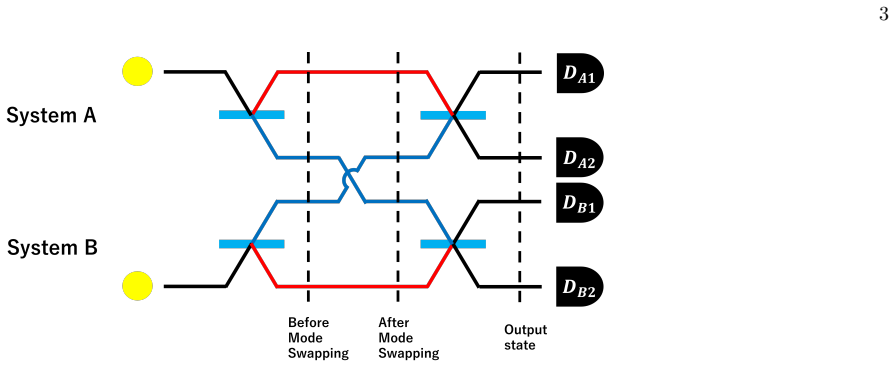
The Hong-Ou-Mandel effect appears in correlations between photons detected at spatially separated locations through post-selection on non-local output modes.
A machine-rendered reading of the paper's core claim, the machinery that carries it, and where it could break.
Core claim
The interference between locally propagating photons and photons exchanged by a mode swap can be implemented by post-selecting spatially separated photon outputs of a four-path interferometer. Even though the photons detected at spatially separated locations must have travelled along paths that never met up at the same beam splitter, the Hong-Ou-Mandel effect can be observed in correlations between the output ports that originate from the association of detection events with non-local output modes defined by the two single photon inputs. Local phase shifts can be used to map out non-classical correlations between the photons detected at different output locations, clarifying the role of lin
What carries the argument
Non-local output modes defined by the two single photon inputs, which associate post-selected detections in the four-path interferometer to produce the HOM interference signature.
If this is right
- Local phase shifts applied in the interferometer map out non-classical correlations between photons detected at different output locations.
- Linear optics generates entanglement between spatially separated photons through this non-local interference mechanism.
- A fundamental relation holds between multiphoton interference and entanglement, opening new possibilities in optical quantum technologies.
Where Pith is reading between the lines
- This non-local association could allow similar post-selection to extend other two-photon interference effects to distant detectors without requiring physical overlap.
- Testing would involve checking whether the observed visibility depends only on input-mode indistinguishability rather than local path details.
- The approach might enable more flexible designs for generating entangled photon pairs in quantum networks by relaxing the need for spatial coincidence.
Load-bearing premise
Post-selection on spatially separated detections correctly associates events with non-local output modes defined solely by the input photons, without hidden local interactions or additional assumptions about path indistinguishability.
What would settle it
An experiment that applies the four-path interferometer and post-selects on spatially separated detections but finds no bunching or no phase-dependent interference visibility in the output correlations would show the non-local association does not produce the claimed effect.
Figures

read the original abstract
Two-photon interference effects arise because photons are indistinguishable particles. In the wellknown Hong-Ou-Mandel (HOM) effect, the transmission of two photons at a beam splitter interferes destructively with the reflection of both photons, requiring both photons to "bunch up" by leaving the beam splitter on the same side. Here, we show that the interference between locally propagating photons and photons exchanged by a mode swap can be implemented by post-selecting spatially separated photon outputs of a four-path interferometer. Even though the photons detected at spatially separated locations must have travelled along paths that never met up at the same beam splitter, the Hong-Ou-Mandel effect can be observed in correlations between the output ports that originate from the association of detection events with non-local output modes defined by the two single photon inputs. Local phase shifts can be used to map out non-classical correlations between the photons detected at different output locations, clarifying the role of linear optics in generating entanglement between spatially separated photons. Our work thus establishes a fundamental relation between multiphoton interference and entanglement, opening the door to new possibilities in optical quantum technologies.
Editorial analysis
A structured set of objections, weighed in public.
Referee Report
Summary. The manuscript proposes a non-local realization of the Hong-Ou-Mandel (HOM) effect in a four-path linear-optical interferometer. By post-selecting coincidence detections at spatially separated output ports, the authors claim that the characteristic factor-of-two suppression of coincidences appears in correlations between non-local output modes defined solely by the two input single-photon states, even though no photon pair shares a common beam splitter. Local phase shifts are introduced to map the resulting non-classical correlations, which the authors interpret as establishing a direct link between multiphoton interference and entanglement generation in linear optics.
Significance. If the post-selection argument is rigorously substantiated, the result would clarify how linear optics can produce entanglement between photons that never occupy the same spatial mode at any beam splitter, with potential implications for distributed quantum information processing. The approach uses only standard unitary transformations and post-selection, introducing no free parameters or ad-hoc entities, which is a conceptual strength. However, the central claim hinges on whether the post-selected amplitudes are demonstrably free of residual local interference contributions.
major comments (2)
- [Abstract and interferometer description] The abstract and main text do not supply the explicit two-photon amplitude calculation for the four-path unitary. Without this derivation it is impossible to confirm that the post-selected coincidence probability reproduces the HOM bunching factor of 1/2 for indistinguishable photons while remaining independent of any local mode swaps or phase relations at the individual beam splitters (see the section describing the interferometer and the paragraph on post-selection).
- [Post-selection and non-local modes paragraph] The claim that the detected photons 'must have travelled along paths that never met up at the same beam splitter' is load-bearing for the non-local interpretation. The manuscript must show that the post-selection projector onto spatially separated ports does not implicitly reintroduce local indistinguishability conditions through the beam-splitter unitaries; otherwise the effect reduces to a relabeling of standard local HOM interference.
minor comments (2)
- [Abstract] The abstract refers to 'non-local output modes defined by the two single photon inputs' without first defining the input-mode basis or the precise association between detection events and these modes; a short clarifying sentence would improve readability.
- [Figures] Figure captions (if present) should explicitly label which ports correspond to the post-selected non-local modes versus the local beam-splitter outputs to avoid ambiguity in the correlation plots.
Simulated Author's Rebuttal
We thank the referee for the careful reading and constructive feedback on our manuscript. The comments highlight areas where additional explicit calculations will improve clarity and rigor. We address each point below and will revise the manuscript accordingly.
read point-by-point responses
-
Referee: [Abstract and interferometer description] The abstract and main text do not supply the explicit two-photon amplitude calculation for the four-path unitary. Without this derivation it is impossible to confirm that the post-selected coincidence probability reproduces the HOM bunching factor of 1/2 for indistinguishable photons while remaining independent of any local mode swaps or phase relations at the individual beam splitters (see the section describing the interferometer and the paragraph on post-selection).
Authors: We agree that the explicit two-photon amplitude calculation is necessary to fully substantiate the claims. In the revised manuscript we will add a dedicated derivation (in the main text or an appendix) of the four-path unitary acting on the two-photon input state. This will explicitly compute the post-selected coincidence probability, confirming the factor-of-1/2 suppression for indistinguishable photons and demonstrating its independence from local phases or mode swaps at individual beam splitters. revision: yes
-
Referee: [Post-selection and non-local modes paragraph] The claim that the detected photons 'must have travelled along paths that never met up at the same beam splitter' is load-bearing for the non-local interpretation. The manuscript must show that the post-selection projector onto spatially separated ports does not implicitly reintroduce local indistinguishability conditions through the beam-splitter unitaries; otherwise the effect reduces to a relabeling of standard local HOM interference.
Authors: We will strengthen the manuscript by providing an explicit amplitude analysis showing that the post-selection does not reintroduce local conditions. The four-path interferometer routes the two input photons along distinct, non-overlapping path pairs so that they never share a beam splitter. The post-selection projector onto spatially separated output ports excludes amplitudes in which photons would have bunched locally at any single beam splitter. We will demonstrate this by separating the two-photon amplitudes into local and exchange contributions and showing that only the non-local exchange term survives in the post-selected subspace, thereby establishing that the observed interference is genuinely non-local rather than a relabeling of standard HOM. revision: yes
Circularity Check
No significant circularity in derivation of non-local HOM effect
full rationale
The paper's central argument derives the non-local Hong-Ou-Mandel signature from post-selection on spatially separated detections in a four-path interferometer, associating output ports with non-local modes defined by the input photons via standard linear-optics unitaries. No equations or definitions in the provided abstract or described claims reduce the claimed effect to a fitted parameter, self-referential quantity, or input by construction. The derivation rests on established quantum optics principles of photon indistinguishability and beam-splitter transformations without invoking self-citations as load-bearing for the uniqueness of the non-local interpretation or smuggling ansatzes. The result is self-contained against external benchmarks of multiphoton interference.
Axiom & Free-Parameter Ledger
axioms (2)
- standard math Photons are indistinguishable bosons whose paths interfere according to quantum mechanics
- domain assumption Linear optical elements implement unitary mode transformations including swaps
Reference graph
Works this paper leans on
-
[1]
However, each of these output modes is delocalized, with one component inAand the other inB. The output photon statistics can be written as ˆa† A1(0)ˆa† B2(0)|vac.⟩=− 1 4 ˆb† A2 + ˆb† B1 2 |vac.⟩ − 1 4 ˆb† A1 − ˆb† B2 2 |vac.⟩, (10) where both photons exit in the same non-local mode [29]. Even if the photons are detected in different systems, they are sti...
-
[2]
L. Mandel, Quantum effects in one-photon and two-photon interference, Reviews of Modern Physics71, S274 (1999)
work page 1999
-
[3]
X.-Y. Zou, L. J. Wang, and L. Mandel, Induced coherence and indistinguishability in optical interference, Physical review letters67, 318 (1991)
work page 1991
-
[4]
C. Santori, D. Fattal, J. Vuˇ ckovi´ c, G. S. Solomon, and Y. Yamamoto, Indistinguishable photons from a single-photon device, nature419, 594 (2002)
work page 2002
-
[5]
Mandel, Coherence and indistinguishability, Optics letters16, 1882 (1991)
L. Mandel, Coherence and indistinguishability, Optics letters16, 1882 (1991)
work page 1991
-
[6]
C. Lang, C. Eichler, L. Steffen, J. Fink, M. J. Woolley, A. Blais, and A. Wallraff, Correlations, indistinguishability and entanglement in hong–ou–mandel experiments at microwave frequencies, Nature Physics9, 345 (2013)
work page 2013
-
[7]
A. J. Menssen, A. E. Jones, B. J. Metcalf, M. C. Tichy, S. Barz, W. S. Kolthammer, and I. A. Walmsley, Distinguishability and many-particle interference, Physical review letters118, 153603 (2017)
work page 2017
-
[8]
V. S. Shchesnovich, Partial indistinguishability theory for multiphoton experiments in multiport devices, Phys. Rev. A91, 013844 (2015)
work page 2015
-
[9]
H. M. Wiseman and J. A. Vaccaro, Entanglement of indistinguishable particles shared between two parties, Phys. Rev. Lett.91, 097902 (2003)
work page 2003
- [10]
-
[11]
P. Kok, W. J. Munro, K. Nemoto, T. C. Ralph, J. P. Dowling, and G. J. Milburn, Linear optical quantum computing with photonic qubits, Rev. Mod. Phys.79, 135 (2007)
work page 2007
-
[12]
R. Okamoto, J. L. O’Brien, H. F. Hofmann, T. Nagata, K. Sasaki, and S. Takeuchi, An entanglement filter, Science323, 483 (2009)
work page 2009
-
[13]
F. Flamini, N. Spagnolo, and F. Sciarrino, Photonic quantum information processing: a review, Reports on Progress in Physics82, 016001 (2018)
work page 2018
-
[14]
D. J. Brod, E. F. Galv˜ ao, A. Crespi, R. Osellame, N. Spagnolo, and F. Sciarrino, Photonic implementation of boson sampling: a review, Advanced Photonics1, 034001 (2019)
work page 2019
-
[15]
S. Aaronson and A. Arkhipov, The computational complexity of linear optics, inProceedings of the forty-third annual ACM symposium on Theory of computing(2011) pp. 333–342
work page 2011
-
[16]
J. B. Spring, B. J. Metcalf, P. C. Humphreys, W. S. Kolthammer, X.-M. Jin, M. Barbieri, A. Datta, N. Thomas-Peter, N. K. Langford, D. Kundys,et al., Boson sampling on a photonic chip, Science339, 798 (2013)
work page 2013
-
[17]
N. Gisin and R. Thew, Quantum communication, Nature photonics1, 165 (2007)
work page 2007
-
[18]
H. J. Kimble, The quantum internet, Nature453, 1023 (2008)
work page 2008
-
[19]
N. Sangouard, C. Simon, H. de Riedmatten, and N. Gisin, Quantum repeaters based on atomic ensembles and linear optics, Rev. Mod. Phys.83, 33 (2011). 8
work page 2011
-
[20]
S. Aaronson and A. Arkhipov, The computational complexity of linear optics, inResearch in Optical Sciences(Optica Publishing Group, 2014) p. QTh1A.2
work page 2014
-
[21]
V. Giovannetti, S. Lloyd, and L. Maccone, Advances in quantum metrology, Nature photonics5, 222 (2011)
work page 2011
- [22]
-
[23]
J. P. Dowling, Quantum optical metrology–the lowdown on high-n00n states, Contemporary physics49, 125 (2008)
work page 2008
- [24]
-
[25]
C.-K. Hong, Z.-Y. Ou, and L. Mandel, Measurement of subpicosecond time intervals between two photons by interference, Physical review letters59, 2044 (1987)
work page 2044
- [26]
-
[27]
T. Kiyohara, N. Yamashiro, R. Okamoto, H. Araki, J.-Y. Wu, H. F. Hofmann, and S. Takeuchi, Direct and efficient verification of entanglement between two multimode–multiphoton systems, Optica7, 1517 (2020)
work page 2020
-
[28]
K. Qian, K. Wang, L. Chen, Z. Hou, M. Krenn, S. Zhu, and X.-s. Ma, Multiphoton non-local quantum interference controlled by an undetected photon, Nature Communications14, 1480 (2023)
work page 2023
-
[29]
K. Wang, Z. Hou, K. Qian, L. Chen, M. Krenn, M. Aspelmeyer, A. Zeilinger, S. Zhu, and X.-S. Ma, Violation of bell inequality with unentangled photons, Science Advances11, eadr1794 (2025)
work page 2025
-
[30]
H. F. Hofmann, Y. Kodama, and J. R. Hance, Implementation of nonlocal multi-photon interference by mode swapping, Proc. SPIE13618, 136180H (2025)
work page 2025
-
[31]
H. M. Wiseman, S. J. Jones, and A. C. Doherty, Steering, entanglement, nonlocality, and the einstein-podolsky-rosen paradox, Phys. Rev. Lett.98, 140402 (2007)
work page 2007
discussion (0)
Sign in with ORCID, Apple, or X to comment. Anyone can read and Pith papers without signing in.