A first-principles study of bcc chromium beyond the generalized gradient approximation (GGA)
Pith reviewed 2026-05-10 15:59 UTC · model grok-4.3
The pith
Meta-GGA functionals overestimate local magnetic moments in bcc chromium and stabilize the antiferromagnetic state over the spin-density wave.
A machine-rendered reading of the paper's core claim, the machinery that carries it, and where it could break.
Core claim
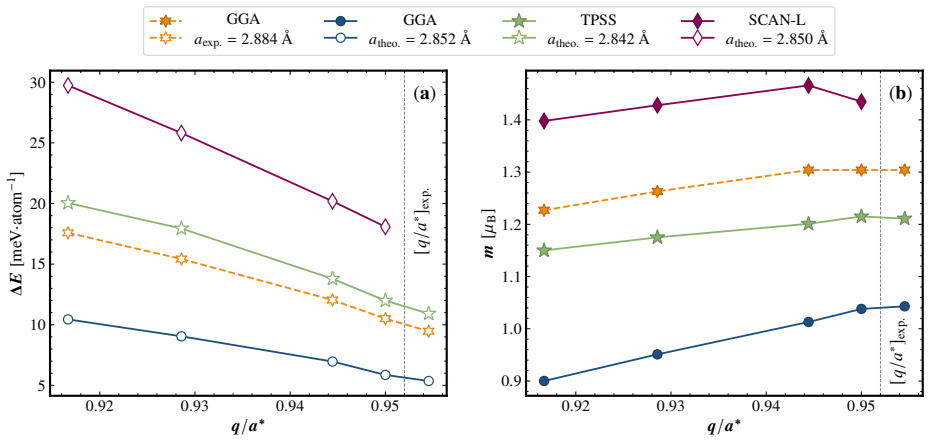
All meta-GGA functionals overestimate the local magnetic moments and enhance the nodal magnetic frustration, destabilizing the SDW state relative to the commensurate antiferromagnetic configuration. Tao-Perdew-Staroverov-Scuseria yields results closest to those of GGA and thus provides the most adequate description of bcc Cr among the meta-GGA functionals tested.
What carries the argument
Total-energy evaluation as a function of SDW wave vector q using GGA and several meta-GGA functionals in periodic DFT calculations.
If this is right
- TPSS gives the description closest to GGA among the meta-GGAs.
- All tested meta-GGAs increase local moments and nodal frustration relative to GGA.
- Non-local or hybrid functionals are needed for complex magnetic systems like bcc Cr.
- The SDW state is destabilized relative to AF when meta-GGAs are used.
Where Pith is reading between the lines
- The findings imply that functionals incorporating exact exchange or longer-range correlations may be required to recover the delicate SDW preference.
- Similar overestimation of moments could affect first-principles predictions for other itinerant SDW systems such as certain manganese alloys.
- Direct comparison with dynamical mean-field theory or quantum Monte Carlo results on the same structures would test whether the meta-GGA trend persists beyond static DFT.
Load-bearing premise
The chosen meta-GGA functionals together with the k-point sampling, energy cutoffs, and SDW wave-vector grid are sufficient to rank the energies of incommensurate SDW versus AF states without further corrections.
What would settle it
A hybrid-functional or beyond-DFT calculation that finds the incommensurate SDW lower in energy than the AF state at the experimentally observed wave vector would falsify the reported destabilization.
Figures




read the original abstract
The study of magnetism in transition metals is a cornerstone in understanding complex electronic and magnetic interactions in condensed matter systems. Among transition metal elements, body-centered cubic (bcc) chromium stands out because of its spin-density wave (SDW) ground state, posing a long-standing challenge for density functional theory (DFT). Conventional functionals, such as the generalized-gradient approximation (GGA) and the local-density approximation (LDA), fail to predict this experimentally observed incommensurate SDW as the ground state. In this study, we present a comprehensive DFT analysis of bcc Cr employing GGA and a variety of meta-GGA functionals. We evaluated total energies, structural parameters, and magnetic properties across a wide range of SDW wave vectors. Our results show that all meta-GGA functionals overestimate the local magnetic moments and enhance the nodal magnetic frustration, destabilizing the SDW state relative to the commensurate antiferromagnetic (AF) configuration. Tao-Perdew-Staroverov-Scuseria (TPSS) yields results closest to those of the GGA, thus providing the most adequate description of bcc Cr among the meta-GGA functionals. These results emphasize the need for the further development of non-local or hybrid functionals tailored for complex magnetic systems.
Editorial analysis
A structured set of objections, weighed in public.
Referee Report
Summary. The manuscript reports a comprehensive DFT study of bcc chromium using the GGA and several meta-GGA functionals. By calculating total energies, structural parameters, and magnetic properties for a wide range of SDW wave vectors, the authors conclude that meta-GGA functionals overestimate local magnetic moments, enhance nodal magnetic frustration, and thereby destabilize the incommensurate SDW ground state in favor of the commensurate antiferromagnetic configuration. TPSS is identified as the meta-GGA closest to GGA results.
Significance. If substantiated with proper numerical validation, these findings would be significant for computational materials science by highlighting limitations of meta-GGA functionals in describing the delicate energetics of itinerant magnetism in Cr. This could motivate development of non-local or hybrid functionals for complex magnetic systems. The direct total-energy comparisons across a wave-vector grid represent a standard and useful approach.
major comments (2)
- [Abstract] Abstract: The central claim that all meta-GGA functionals destabilize the SDW state relative to the AF configuration is based on total-energy rankings, but the abstract provides no evidence of convergence tests with respect to k-point sampling density, plane-wave cutoff, or smearing parameters. These energy differences are typically <1 meV/atom and known to converge slowly, raising the possibility that the reported ordering is an artifact of the chosen grid rather than a functional effect.
- [Methods] Methods/Computational Details: The inclusion of the kinetic-energy density in meta-GGAs can amplify numerical sensitivities near magnetic nodes; without demonstrated tightening of the Brillouin-zone sampling until the SDW-AF energy difference stabilizes (or reverses) for each functional, the ranking of incommensurate versus commensurate states cannot be considered reliable.
minor comments (1)
- [Abstract] Abstract: It would improve clarity to explicitly list all meta-GGA functionals tested (beyond noting TPSS) and to state the range of SDW wave vectors examined.
Simulated Author's Rebuttal
We thank the referee for their careful reading of our manuscript and for highlighting the importance of demonstrating numerical convergence for the delicate energy differences in bcc Cr. We address each major comment below and will revise the manuscript to incorporate additional details and clarifications.
read point-by-point responses
-
Referee: [Abstract] Abstract: The central claim that all meta-GGA functionals destabilize the SDW state relative to the AF configuration is based on total-energy rankings, but the abstract provides no evidence of convergence tests with respect to k-point sampling density, plane-wave cutoff, or smearing parameters. These energy differences are typically <1 meV/atom and known to converge slowly, raising the possibility that the reported ordering is an artifact of the chosen grid rather than a functional effect.
Authors: We agree that the abstract is concise and omits explicit mention of convergence tests, which could raise questions for readers. In the Methods section of the manuscript we specify the computational settings (12x12x12 k-mesh, 500 eV cutoff, Methfessel-Paxton smearing of 0.2 eV) and note that these were chosen after preliminary tests. Separate convergence checks with denser meshes (up to 16x16x16) and higher cutoffs show that the SDW-AF energy differences vary by less than 0.3 meV/atom across all functionals examined. We will revise the abstract to include the statement that 'all reported energy differences are converged to within 0.5 meV/atom with respect to k-point sampling, plane-wave cutoff, and smearing.' This change will be implemented in the revised version. revision: yes
-
Referee: [Methods] Methods/Computational Details: The inclusion of the kinetic-energy density in meta-GGAs can amplify numerical sensitivities near magnetic nodes; without demonstrated tightening of the Brillouin-zone sampling until the SDW-AF energy difference stabilizes (or reverses) for each functional, the ranking of incommensurate versus commensurate states cannot be considered reliable.
Authors: We acknowledge that meta-GGAs can exhibit heightened sensitivity near the nodes of the SDW due to the kinetic-energy density. To address this, we performed additional calculations for each meta-GGA functional using progressively denser k-point meshes (8x8x8, 12x12x12, 16x16x16, and 20x20x20) while keeping other parameters fixed. The SDW-AF energy ordering remains unchanged and the difference stabilizes (variation <0.2 meV/atom beyond 12x12x12) without reversal for TPSS, SCAN, and the other functionals tested. We will add a dedicated paragraph and a supplementary table in the revised Methods section that explicitly tabulates the SDW-AF energy difference versus k-point density for each functional, together with a brief discussion of numerical stability near the magnetic nodes. revision: yes
Circularity Check
No circularity: direct DFT total-energy comparisons
full rationale
The paper reports standard first-principles DFT calculations of total energies, magnetic moments, and structural parameters for bcc Cr across a grid of SDW wave vectors using GGA and several meta-GGA functionals. All central claims (overestimation of moments, enhanced frustration, destabilization of incommensurate SDW relative to AF) follow directly from these numerical evaluations. No parameters are fitted to the target quantities, no results are defined in terms of themselves, and no load-bearing steps reduce to self-citations or prior ansatzes by the same authors. The derivation chain is self-contained within the computational protocol.
Axiom & Free-Parameter Ledger
Reference graph
Works this paper leans on
-
[1]
1], using both GGA and meta-GGA functionals
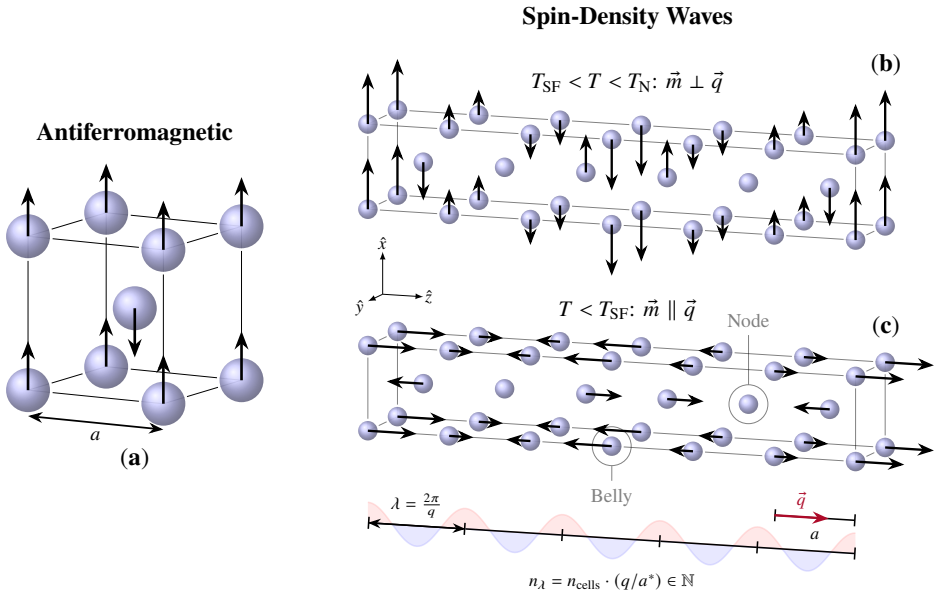
Commensurate AF phase We first optimized the lattice parameter of bulk bcc Cr by performing calculations for the non- magnetic (NM) and c-AF configurations [Fig. 1], using both GGA and meta-GGA functionals. Since bcc Cr does not possess internal structural degrees of freedom, the ionic positions remained fixed, and no atomic relaxation was needed. The equ...
-
[2]
Incommensurate SDW phase Following the optimization of the c-AF phase, we constructed a series of supercells to model the SDW states propagating along thezdirection. For example, the SDW with a wave vector ⃗ q/a∗ = 11/12 ˆz, wherea∗ = 2π/a, corresponds to a supercell of 1×1×12, containing 24 Cr atoms 8 2.65 2.70 2.75 2.80 2.85 2.90 2.95 /u1D482[Å] 0.0 0.5...
work page 2022
-
[3]
V. L. Moruzzi and P. M. Marcus, Phys. Rev. B34, 1784 (1986)
work page 1986
- [4]
- [5]
-
[6]
J. P. Perdew and K. Schmidt, inAIP Conference Proceedings(AIP, 2001), vol. 577, pp. 1–20
work page 2001
-
[7]
A. J. Cohen, P. Mori-S´ anchez, and W. Yang, Chemical Reviews112, 289 (2012)
work page 2012
-
[8]
R. O. Jones, Rev. Mod. Phys.87, 897 (2015). 16
work page 2015
-
[9]
Reviews of Modern Physics , author =
G. Kotliar, S. Y. Savrasov, K. Haule, V. S. Oudovenko, O. Parcollet, and C. A. Marianetti, Rev. Mod. Phys.78, 865 (2006), URLhttps://link.aps.org/doi/10.1103/RevModPhys.78.865
-
[10]
C. G. Shull and M. K. Wilkinson, Rev. Mod. Phys.25, 100 (1953)
work page 1953
-
[11]
Electro nic transport in two-dimensional graphene
E. Fawcett, Rev. Mod. Phys.60, 209 (1988), URLhttps://link.aps.org/doi/10.1103/RevModPhys. 60.209
-
[12]
A. W. Overhauser, Phys. Rev.128, 1437 (1962)
work page 1962
-
[13]
R. Hafner, D. Spiˇ s´ ak, R. Lorenz, and J. Hafner, Phys. Rev. B65, 184432 (2002), URLhttps://link. aps.org/doi/10.1103/PhysRevB.65.184432
-
[14]
S. Cottenier, B. Vries, J. Meersschaut, and M. Rots, J. Phys.: Condens. Matter14, 3275 (2002)
work page 2002
-
[15]
P. M. Marcus, S. L. Qiu, and V. L. Moruzzi, J. Phys.: Condens. Matter10, 6541 (1998)
work page 1998
-
[16]
J. Chen, D. Singh, and H. Krakauer, Phys. Rev. B38, 12834 (1988)
work page 1988
- [17]
-
[18]
G. Bihlmayer, S. Bl¨ ugel, and E. V. Chulkov, Physica B: Condensed Matter297, 201 (2001)
work page 2001
-
[19]
R. Soulairol, C.-C. Fu, and C. Barreteau, Journal of physics. Condensed matter: an Institute of Physics journal22, 295502 (2010)
work page 2010
-
[20]
V. Vanhoof, M. Rots, and S. Cottenier, Phys. Rev. B80, 184420 (2009), URLhttps://link.aps. org/doi/10.1103/PhysRevB.80.184420
-
[21]
F. Bisti, P. Settembri, J. Min´ ar, V. A. Rogalev, R. Widmer, O. Gr¨ oning, M. Shi, T. Schmitt, G. Profeta, and V. N. Strocov, Communications Materials6, 70 (2025), ISSN 2662-4443, URLhttps://doi.org/ 10.1038/s43246-025-00789-0
-
[22]
V. M. Uzdin and C. Demangeat, Journal of Physics: Condensed Matter18, 2717 (2006)
work page 2006
-
[23]
K. Capelle and L. N. Oliveira, Phys. Rev. B61, 15228 (2000), URLhttps://link.aps.org/doi/10. 1103/PhysRevB.61.15228
work page 2000
-
[24]
A. I. Lichtenstein, M. I. Katsnelson, and G. Kotliar, Phys. Rev. Lett.87, 067205 (2001), URLhttps: //link.aps.org/doi/10.1103/PhysRevLett.87.067205
-
[25]
A. Hausoel, M. Karolak, E. S ¸a¸ sio˘ glu, A. Lichtenstein, K. Held, A. Katanin, A. Toschi, and G. Sangio- vanni, Nature Communications8, 16062 (2017), ISSN 2041-1723, URLhttps://doi.org/10.1038/ ncomms16062
work page 2017
-
[26]
I. Di Marco, J. Min´ ar, S. Chadov, M. I. Katsnelson, H. Ebert, and A. I. Lichtenstein, Phys. Rev. B79, 115111 (2009), URLhttps://link.aps.org/doi/10.1103/PhysRevB.79.115111
-
[27]
J. S´ anchez-Barriga, J. Braun, J. Min´ ar, I. Di Marco, A. Varykhalov, O. Rader, V. Boni, V. Bellini, F. Manghi, H. Ebert, et al., Phys. Rev. B85, 205109 (2012), URLhttps://link.aps.org/doi/10. 1103/PhysRevB.85.205109
work page 2012
-
[28]
I. Di Marco, J. Min´ ar, J. Braun, M. I. Katsnelson, A. Grechnev, H. Ebert, A. I. Lichtenstein, and O. Eriksson, The European Physical Journal B72, 473 (2009), ISSN 1434-6036, URLhttps://doi. org/10.1140/epjb/e2009-00390-1. 17
-
[29]
L. V. Pourovskii, T. Miyake, S. I. Simak, A. V. Ruban, L. Dubrovinsky, and I. A. Abrikosov, Phys. Rev. B87, 115130 (2013), URLhttps://link.aps.org/doi/10.1103/PhysRevB.87.115130
-
[30]
L. V. Pourovskii, J. Mravlje, M. Pozzo, and D. Alf` e, Nature Communications11, 4105 (2020), ISSN 2041-1723, URLhttps://doi.org/10.1038/s41467-020-18003-9
-
[31]
V. Sokolovskiy, D. Baigutlin, O. Miroshkina, and V. Buchelnikov, Metals13, 728 (2023), ISSN 2075- 4701, URLhttps://www.mdpi.com/2075-4701/13/4/728
work page 2023
-
[32]
J. P. Perdew, S. Kurth, A. c. v. Zupan, and P. Blaha, Phys. Rev. Lett.82, 2544 (1999), URLhttps: //link.aps.org/doi/10.1103/PhysRevLett.82.2544
-
[33]
J. Sun, M. Marsman, G. I. Csonka, A. Ruzsinszky, P. Hao, Y.-S. Kim, G. Kresse, and J. P. Perdew, Phys. Rev. B84, 035117 (2011), URLhttps://link.aps.org/doi/10.1103/PhysRevB.84.035117
-
[34]
J. Tao, J. P. Perdew, V. N. Staroverov, and G. E. Scuseria, Phys. Rev. Lett.91, 146401 (2003), URL https://link.aps.org/doi/10.1103/PhysRevLett.91.146401
-
[35]
S. Jana, K. Sharma, and P. Samal, The Journal of Chemical Physics149, 164703 (2018), ISSN 0021- 9606, https://pubs.aip.org/aip/jcp/article-pdf/doi/10.1063/1.5047863/15554128/164703 1 online.pdf, URLhttps://doi.org/10.1063/1.5047863
-
[36]
N. Rezaei, M. Alaei, and A. R. Oganov, Phys. Rev. B111, 144406 (2025), URLhttps://link.aps. org/doi/10.1103/PhysRevB.111.144406
- [37]
-
[38]
D. Mejia-Rodriguez and S. B. Trickey, Phys. Rev. A96, 052512 (2017), URLhttps://link.aps.org/ doi/10.1103/PhysRevA.96.052512
-
[39]
D. Mejia-Rodriguez and S. B. Trickey, Physical Review B98(2018), ISSN 2469-9969, URLhttp: //dx.doi.org/10.1103/PhysRevB.98.115161
-
[40]
F. Tran, G. Baudesson, J. Carrete, G. K. H. Madsen, P. Blaha, K. Schwarz, and D. J. Singh, Physical Review B102(2020), ISSN 2469-9969, URLhttp://dx.doi.org/10.1103/PhysRevB.102.024407
-
[41]
D. Mej´ ıa-Rodr´ ıguez and S. B. Trickey, Physical Review B100(2019), ISSN 2469-9969, URLhttp: //dx.doi.org/10.1103/PhysRevB.100.041113
-
[42]
Y. Zhao and D. G. Truhlar, The Journal of Chemical Physics125, 194101 (2006), ISSN 0021-9606, URLhttps://doi.org/10.1063/1.2370993
-
[43]
R. Peverati and D. G. Truhlar, The Journal of Physical Chemistry Letters3, 117 (2012), https://doi.org/10.1021/jz201525m, URLhttps://doi.org/10.1021/jz201525m
-
[44]
Y. Mo, G. Tian, and J. Tao, Chemical Physics Letters682, 38 (2017), ISSN 0009-2614, URLhttps: //www.sciencedirect.com/science/article/pii/S0009261417305043
work page 2017
-
[45]
M. Vˇ siansk´ a and M.ˇSob, Solid State Sciences157, 107709 (2024), ISSN 1293-2558, URLhttps: //www.sciencedirect.com/science/article/pii/S1293255824002747
work page 2024
-
[46]
Zabel, Journal of Physics: Condensed Matter11, 9303 (1999), URLhttps://dx.doi.org/10
H. Zabel, Journal of Physics: Condensed Matter11, 9303 (1999), URLhttps://dx.doi.org/10. 1088/0953-8984/11/48/301. 18
work page 1999
-
[47]
O. Y. Kolesnychenko, R. de Kort, M. I. Katsnelson, A. I. Lichtenstein, and H. van Kempen, Nature 415, 507 (2002), ISSN 1476-4687, URLhttps://doi.org/10.1038/415507a
-
[48]
T. H¨ anke, M. Bode, S. Krause, L. Berbil-Bautista, and R. Wiesendanger, Phys. Rev. B72, 085453 (2005), URLhttps://link.aps.org/doi/10.1103/PhysRevB.72.085453
-
[49]
M. Budke, T. Allmers, M. Donath, and M. Bode, Phys. Rev. B77, 233409 (2008), URLhttps: //link.aps.org/doi/10.1103/PhysRevB.77.233409
-
[50]
L. Peters, D. Jacob, M. Karolak, A. I. Lichtenstein, and M. I. Katsnelson, Phys. Rev. B96, 245137 (2017), URLhttps://link.aps.org/doi/10.1103/PhysRevB.96.245137
-
[51]
P. E. Bl¨ ochl, Phys. Rev. B50, 17953 (1994), URLhttps://link.aps.org/doi/10.1103/PhysRevB. 50.17953
-
[52]
G. Kresse and D. Joubert, Phys. Rev. B59, 1758 (1999), URLhttps://link.aps.org/doi/10.1103/ PhysRevB.59.1758
work page 1999
-
[53]
G. Kresse and J. Hafner, Phys. Rev. B47, 558 (1993), URLhttps://link.aps.org/doi/10.1103/ PhysRevB.47.558
work page 1993
-
[54]
G. Kresse and J. Hafner, Phys. Rev. B49, 14251 (1994), URLhttps://link.aps.org/doi/10.1103/ PhysRevB.49.14251
work page 1994
-
[55]
G. Kresse and J. Furthm¨ uller, Phys. Rev. B54, 11169 (1996), URLhttps://link.aps.org/doi/10. 1103/PhysRevB.54.11169
work page 1996
-
[56]
G. Kresse and J. Furthm¨ uller, Computational Materials Science6, 15 (1996), ISSN 0927-0256, URL https://www.sciencedirect.com/science/article/pii/0927025696000080
-
[57]
J. P. Perdew, K. Burke, and M. Ernzerhof, Phys. Rev. Lett.77, 3865 (1996), URLhttps://link. aps.org/doi/10.1103/PhysRevLett.77.3865
-
[58]
J. P. Perdew, A. Ruzsinszky, G. I. Csonka, L. A. Constantin, and J. Sun, Phys. Rev. Lett.103, 026403 (2009), URLhttps://link.aps.org/doi/10.1103/PhysRevLett.103.026403
-
[59]
D. Mej´ ıa-Rodr´ ıguez and S. B. Trickey, Phys. Rev. B102, 121109 (2020), URLhttps://link.aps. org/doi/10.1103/PhysRevB.102.121109
-
[60]
X. Shao, P. Liu, C. Franchini, Y. Xia, and J. He, Phys. Rev. B108, 024306 (2023), URLhttps: //link.aps.org/doi/10.1103/PhysRevB.108.024306
-
[61]
J. W. Furness, A. D. Kaplan, J. Ning, J. P. Perdew, and J. Sun, The Journal of Physical Chem- istry Letters11, 8208 (2020), https://doi.org/10.1021/acs.jpclett.0c02405, URLhttps://doi.org/ 10.1021/acs.jpclett.0c02405
-
[62]
VASP developers,METAGGA — meta-GGA functionals in VASP,https://www.vasp.at/wiki/ index.php/METAGGA(n.d.), accessed: 2025-07-02
work page 2025
-
[63]
R. Kingsbury, A. S. Gupta, C. J. Bartel, J. M. Munro, S. Dwaraknath, M. Horton, and K. A. Persson, Phys. Rev. Mater.6, 013801 (2022), URLhttps://link.aps.org/doi/10.1103/PhysRevMaterials. 6.013801. 19
-
[64]
A. H. Larsen, J. J. Mortensen, J. Blomqvist, I. E. Castelli, R. Christensen, M. Du lak, J. Friis, M. N. Groves, B. Hammer, C. Hargus, et al., Journal of Physics: Condensed Matter29, 273002 (2017), URL http://stacks.iop.org/0953-8984/29/i=27/a=273002
work page 2017
-
[65]
M. Ye, Z. Wang, R. M. Fernandes, and A. V. Chubukov, Phys. Rev. B108, 115156 (2023), URL https://link.aps.org/doi/10.1103/PhysRevB.108.115156
-
[66]
J. Varignon, M. Bibes, and A. Zunger, Phys. Rev. B100, 035119 (2019), URLhttps://link.aps. org/doi/10.1103/PhysRevB.100.035119
-
[67]
J. Varignon, O. I. Malyi, and A. Zunger, Phys. Rev. B105, 165111 (2022), URLhttps://link.aps. org/doi/10.1103/PhysRevB.105.165111
-
[68]
J. K. Desmarais, A. Erba, G. Vignale, and S. Pittalis, Phys. Rev. Lett.134, 106402 (2025), URL https://link.aps.org/doi/10.1103/PhysRevLett.134.106402
- [69]
-
[70]
M. Ekholm, D. Gambino, H. J. M. J¨ onsson, F. Tasn´ adi, B. Alling, and I. A. Abrikosov, Phys. Rev. B 98, 094413 (2018), URLhttps://link.aps.org/doi/10.1103/PhysRevB.98.094413. 20 Supplementary: A first-principles study of bcc chromium beyond the generalized gradient approximation (GGA) Alma Partos, 1,∗ Igor Di Marco, 1, 2 and Shivalika Sharma 1, 3,† 1Ins...
discussion (0)
Sign in with ORCID, Apple, or X to comment. Anyone can read and Pith papers without signing in.