Recognition: unknown
Dynamical Regimes of Discrete Diffusion Models
Pith reviewed 2026-05-10 16:18 UTC · model grok-4.3
The pith
A simple effective model for discrete diffusion on Ising data shows that backward dynamics feature a speciation transition via second-order phase transition and a collapse transition via random-energy-model condensation.
A machine-rendered reading of the paper's core claim, the machinery that carries it, and where it could break.
Core claim
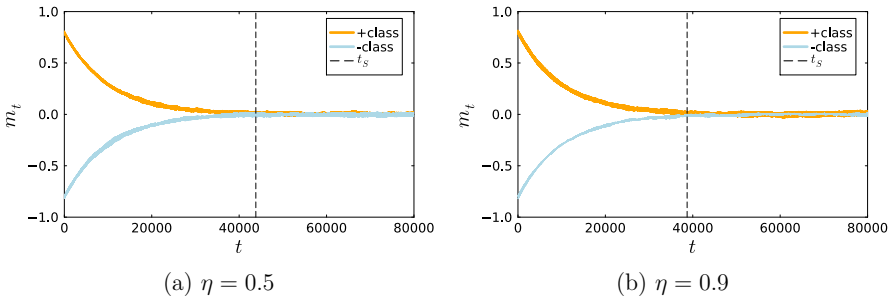
In the proposed effective model the backward dynamics undergo a speciation transition that is located by a second-order phase-transition calculation via high-temperature expansion, while the later collapse transition is identified with a condensation transition in the random energy model; an analytical formula for the speciation time is obtained whose scaling becomes identical to the continuous-data result when the noise level grows with time.
What carries the argument
The simple effective model of discrete diffusion trained on two-class Ising variables with general mixture ratio, whose backward process is analyzed by high-temperature expansion for the speciation transition and by the random energy model for the collapse transition.
If this is right
- The speciation transition time can be computed analytically from a high-temperature expansion of the effective model.
- The collapse transition is equivalent to a condensation transition whose statistics are given by the random energy model.
- When the noise schedule increases with time, the scaling of the speciation time matches the scaling already known for continuous diffusion models.
- The same statistical-mechanics criteria used for continuous data therefore locate both transitions in the discrete setting.
- Trained discrete diffusion models on real data sets exhibit the predicted transitions, confirming the effective-model description.
Where Pith is reading between the lines
- Adjusting the noise schedule could be used to control the separation between speciation and collapse times in discrete generative models.
- The same phase-transition analysis may extend to multi-class or higher-dimensional discrete data once an analogous effective model is constructed.
- Sampling strategies that deliberately slow the collapse transition might improve diversity without sacrificing fidelity.
- The framework supplies a quantitative route to predict how changes in training data statistics affect generation quality in discrete diffusion.
Load-bearing premise
The proposed simple effective model on two-class Ising data with a mixture ratio sufficiently captures the backward dynamics of general discrete diffusion models on real datasets.
What would settle it
If the analytically predicted speciation time or the locations of both transitions deviate measurably from those observed in numerical simulations of the effective model or in experiments with trained discrete diffusion networks on real data sets, the claimed equivalence of the discrete and continuous frameworks would be falsified.
Figures


read the original abstract
Diffusion models generate high-dimensional data such as images by learning a process that gradually removes noise from corrupted data. Recent studies have shown that the backward dynamics of diffusion models exhibit two characteristic transitions: the speciation transition, at which generated samples begin to capture the global structure of the training data, and the collapse transition, at which the generation dynamics starts committing to individual training samples. While these transitions have been theoretically analyzed for continuous data, the same theoretical criteria have not been applied for discrete diffusion models, which are diffusion models for discrete data. In this work, we propose a simple effective model for discrete diffusion models trained on two-class Ising variable data with a general mixture ratio and analyze its backward dynamics using methods from statistical mechanics. We show that, as in the previous study on continuous data, the speciation transition can be determined through a second-order phase transition analysis using high-temperature expansion, while the collapse transition corresponds to a condensation transition described by the Random Energy Model. An analytical expression for the speciation time is obtained, and we show that its scaling becomes consistent with that of the continuous case when the noise increases with time as in practical diffusion models. These theoretical predictions are confirmed by numerical simulations and experiments with trained discrete diffusion models on real datasets. These results suggest that the original theoretical framework for continuous data remain valid for discrete data, and may provide a useful starting point for the statistical-mechanics analysis of discrete generative diffusion in more realistic settings.
Editorial analysis
A structured set of objections, weighed in public.
Referee Report
Summary. The paper proposes a simple effective model for discrete diffusion models trained on two-class Ising variable data with a general mixture ratio. It analyzes the backward dynamics using statistical mechanics methods, showing that the speciation transition corresponds to a second-order phase transition analyzed via high-temperature expansion, while the collapse transition is a condensation transition described by the Random Energy Model. An analytical expression for the speciation time is derived, with its scaling shown to match the continuous-data case when noise increases with time. These predictions are confirmed by numerical simulations and experiments with trained discrete diffusion models on real datasets, suggesting that the theoretical framework developed for continuous data remains valid for discrete diffusion models.
Significance. If the effective model is representative, the work extends the statistical-mechanics analysis of dynamical transitions in diffusion models from continuous to discrete settings. The use of high-temperature expansion and REM provides analytical expressions and scaling relations that are confirmed numerically and experimentally, offering a useful starting point for understanding speciation and collapse in discrete generative models. This could inform training schedules and sampling strategies for discrete data applications.
major comments (1)
- [Abstract and experiments section] The central generalization—that the two-class Ising effective model with mixture ratio captures the backward dynamics of general discrete diffusion models on real (higher-dimensional, non-binary) datasets—underpins the claim that the continuous framework remains valid. While the abstract and experiments section report confirmation via trained-model experiments, the quantitative matching of the derived analytical speciation-time expression to observed transition times on complex real data is not sufficiently detailed to fully secure the mapping, especially given possible shifts in transition locations due to correlations absent in the binary-spin model.
minor comments (1)
- [Model definition] Notation for the mixture ratio and time-dependent noise schedule should be defined more explicitly at first use to aid readers unfamiliar with the continuous precursor work.
Simulated Author's Rebuttal
We thank the referee for the careful reading of our manuscript and the recommendation for minor revision. We address the single major comment below.
read point-by-point responses
-
Referee: [Abstract and experiments section] The central generalization—that the two-class Ising effective model with mixture ratio captures the backward dynamics of general discrete diffusion models on real (higher-dimensional, non-binary) datasets—underpins the claim that the continuous framework remains valid. While the abstract and experiments section report confirmation via trained-model experiments, the quantitative matching of the derived analytical speciation-time expression to observed transition times on complex real data is not sufficiently detailed to fully secure the mapping, especially given possible shifts in transition locations due to correlations absent in the binary-spin model.
Authors: We agree that the quantitative aspects of the comparison between the effective-model predictions and the trained-model experiments on real data merit additional detail to better substantiate the generalization. In the revised manuscript we will expand the experiments section with explicit tabulated values of the observed speciation times extracted from the trained discrete diffusion models (on datasets such as binarized MNIST and similar discrete image data) together with direct overlays of the analytical expression derived from the high-temperature expansion. We will also add a short discussion of the expected quantitative shifts arising from higher-order correlations and non-binary structure absent in the two-class Ising effective model, while noting that the scaling with noise schedule remains consistent with the continuous case. These additions will strengthen the evidence without changing the central claim that the statistical-mechanics framework carries over to discrete settings. revision: yes
Circularity Check
No significant circularity; derivations on proposed effective model are independent
full rationale
The paper introduces a new effective model for discrete diffusion on two-class Ising variables with general mixture ratio, then applies standard high-temperature expansion to identify the speciation transition as a second-order phase transition and the Random Energy Model to identify the collapse transition. An analytical expression for speciation time is derived directly from this model, with scaling shown to match the continuous case under time-dependent noise. These steps constitute independent analysis on the proposed model rather than any reduction of outputs to fitted inputs, self-definitions, or load-bearing self-citations by construction. Confirmation via separate numerical simulations and experiments on trained models with real datasets supplies external benchmarks, rendering the derivation chain self-contained.
Axiom & Free-Parameter Ledger
axioms (2)
- domain assumption High-temperature expansion accurately captures the second-order phase transition for the speciation time in the effective model
- domain assumption Collapse transition maps exactly onto condensation in the Random Energy Model
Forward citations
Cited by 1 Pith paper
-
Concurrence of Symmetry Breaking and Nonlocality Phase Transitions in Diffusion Models
Symmetry breaking and nonlocality phase transitions occur nearly simultaneously during diffusion model generation in modern transformers.
Reference graph
Works this paper leans on
-
[1]
Deep unsupervised learning using nonequilibrium thermodynamics
Jascha Sohl-Dickstein, Eric Weiss, Niru Maheswaranathan, and Surya Ganguli. Deep unsupervised learning using nonequilibrium thermodynamics. In International conference on machine learning, pages 2256–2265. pmlr, 2015
2015
-
[2]
Denoising diffusion probabilistic models
Jonathan Ho, Ajay Jain, and Pieter Abbeel. Denoising diffusion probabilistic models. Advances in neural information processing systems , 33:6840–6851, 2020
2020
-
[3]
Generative modeling by estimating gradients of the data distribution
Yang Song and Stefano Ermon. Generative modeling by estimating gradients of the data distribution. Advances in neural information processing systems , 32, 2019
2019
-
[4]
Diffusion models: A comprehensive survey of methods and applications
Ling Yang, Zhilong Zhang, Yang Song, Shenda Hong, Runsheng Xu, Yue Zhao, Wentao Zhang, Bin Cui, and Ming-Hsuan Yang. Diffusion models: A comprehensive survey of methods and applications. ACM computing surveys , 56(4):1–39, 2023
2023
-
[5]
Why diffusion models don nt memorize: The role of implicit dynamical regularization in training
Tony Bonnaire, Raphaël Urfin, Giulio Biroli, and Marc Mézard. Why diffusion models don nt memorize: The role of implicit dynamical regularization in training. In Advances in Neural Information Processing Systems 38 , 2025
2025
-
[6]
An analytic theory of creativity in convolutional diffusion models
Mason Kamb and Surya Ganguli. An analytic theory of creativity in convolutional diffusion models. In Forty-second International Conference on Machine Learning , 2025
2025
-
[7]
Analysis of learning a flow-based generative model from limited sample complexity
Hugo Cui, Florent Krzakala, Eric Vanden-Eijnden, and Lenka Zdeborova. Analysis of learning a flow-based generative model from limited sample complexity. In The Twelfth International Conference on Learning Representations , 2024
2024
-
[8]
Dynamical regimes of diffusion models
Giulio Biroli, Tony Bonnaire, Valentin De Bortoli, and Marc Mézard. Dynamical regimes of diffusion models. Nature Communications, 15(1):9957, 2024
2024
-
[9]
Generative diffusion in very large dimensions
Giulio Biroli and Marc Mézard. Generative diffusion in very large dimensions. Journal of Statistical Mechanics: Theory and Experiment , 2023(9):093402, 2023
2023
-
[10]
Beatrice Achilli, Marco Benedetti, Giulio Biroli, and Marc Mézard. Theory of speciation transitions in diffusion models with general class structure. arXiv preprint arXiv:2602.04404 , 2026
-
[11]
Memorization and generalization in generative diffusion under the manifold hypothesis
Beatrice Achilli, Luca Ambrogioni, Carlo Lucibello, Marc Mézard, and Enrico Ventura. Memorization and generalization in generative diffusion under the manifold hypothesis. Journal of Statistical Mechanics: Theory and Experiment , 2025(7):073401, 2025
2025
-
[12]
arXiv preprint arXiv:2410.08727 , year=
Beatrice Achilli, Enrico Ventura, Gianluigi Silvestri, Bao Pham, Gabriel Raya, Dmitry Krotov, Carlo Lucibello, and Luca Ambrogioni. Losing dimensions: Geometric memorization in generative diffusion. arXiv preprint arXiv:2410.08727 , 2024
-
[13]
Manifolds, random matrices and spectral gaps: The geometric phases of generative diffusion
Enrico Ventura, Beatrice Achilli, Gianluigi Silvestri, Carlo Lucibello, and Luca Ambrogioni. Manifolds, random matrices and spectral gaps: The geometric phases of generative diffusion. In The Thirteenth International Conference on Learning Representations , 2025
2025
-
[14]
Emergence of Distortions in High-Dimensional Guided Diffusion Models
Enrico Ventura, Beatrice Achilli, Luca Ambrogioni, and Carlo Lucibello. Emergence of distortions in high-dimensional guided diffusion models. arXiv preprint arXiv:2602.00716 , 2026
work page internal anchor Pith review arXiv 2026
-
[15]
Diffusion- lm improves controllable text generation
Xiang Li, John Thickstun, Ishaan Gulrajani, Percy S Liang, and Tatsunori B Hashimoto. Diffusion- lm improves controllable text generation. Advances in neural information processing systems , 35:4328–4343, 2022
2022
-
[16]
Text generation with diffusion language models: A pre-training approach with continuous paragraph denoise
Zhenghao Lin, Yeyun Gong, Yelong Shen, Tong Wu, Zhihao Fan, Chen Lin, Nan Duan, and Weizhu Chen. Text generation with diffusion language models: A pre-training approach with continuous paragraph denoise. In International Conference on Machine Learning , pages 21051– 21064. PMLR, 2023
2023
-
[17]
Diffusion of thought: Chain-of-thought reasoning in diffusion language models
Jiacheng Ye, Shansan Gong, Liheng Chen, Lin Zheng, Jiahui Gao, Han Shi, Chuan Wu, Xin Jiang, Zhenguo Li, Wei Bi, et al. Diffusion of thought: Chain-of-thought reasoning in diffusion language models. Advances in Neural Information Processing Systems , 37:105345–105374, 2024
2024
-
[18]
Structured denoising diffusion models in discrete state-spaces
Jacob Austin, Daniel D Johnson, Jonathan Ho, Daniel Tarlow, and Rianne Van Den Berg. Structured denoising diffusion models in discrete state-spaces. Advances in neural information processing systems, 34:17981–17993, 2021
2021
-
[19]
Gritsenko, Jasmijn Bastings, Ben Poole, Rianne van den Berg, and Tim Salimans
Emiel Hoogeboom, Alexey A. Gritsenko, Jasmijn Bastings, Ben Poole, Rianne van den Berg, and Tim Salimans. Autoregressive diffusion models. In International Conference on Learning Representations, 2022
2022
-
[20]
P. M. Chaikin and T. C. Lubensky. Principles of Condensed Matter Physics . Cambridge University Press, 1995
1995
-
[21]
Random-energy model: An exactly solvable model of disordered systems
Bernard Derrida. Random-energy model: An exactly solvable model of disordered systems. Physical Review B , 24(5):2613, 1981
1981
-
[22]
Exponential capacity of dense associative memories
Carlo Lucibello and Marc Mézard. Exponential capacity of dense associative memories. Physical Review Letters, 132(7):077301, 2024
2024
-
[23]
Finite-size scaling theory
Vladimir Privman. Finite-size scaling theory. In Finite Size Scaling and Numerical Simulation of Statistical Systems , pages 1–98. World Scientific, 1990
1990
-
[24]
Gradient-based learning applied to document recognition
Yann LeCun, Léon Bottou, Yoshua Bengio, and Patrick Haffner. Gradient-based learning applied to document recognition. Proceedings of the IEEE , 86(11):2278–2324, 1998
1998
-
[25]
On the quantitative analysis of deep belief networks
Ruslan Salakhutdinov and Iain Murray. On the quantitative analysis of deep belief networks. In Proceedings of the 25th International Conference on Machine Learning , pages 872–879. ACM, 2008
2008
-
[26]
Movielens dataset
GroupLens Research. Movielens dataset. https://grouplens.org/datasets/movielens/, 2014
2014
-
[27]
The tag genome: Encoding community knowledge to support novel interaction
Jesse Vig, Shilad Sen, and John Riedl. The tag genome: Encoding community knowledge to support novel interaction. In Proceedings of the International Conference on Intelligent User Interfaces (IUI) , 2012
2012
-
[28]
Generation meets recommendation: Proposing novel items for groups of users
Vinh Vo Thanh and Harold Soh. Generation meets recommendation: Proposing novel items for groups of users. In Proceedings of the 23rd International Conference on Intelligent User Interfaces (IUI) , pages 73–84. Association for Computing Machinery, 2018
2018
discussion (0)
Sign in with ORCID, Apple, or X to comment. Anyone can read and Pith papers without signing in.