An ontological approach to foster the convergence, interoperability and operationalization of frameworks for Trustworthy AI
Pith reviewed 2026-05-10 16:16 UTC · model grok-4.3
The pith
The AI-Ethics Ontology uses semantic web technologies to create a shared layer that makes different trustworthy AI frameworks converge and easier to put into practice.
A machine-rendered reading of the paper's core claim, the machinery that carries it, and where it could break.
Core claim
The paper presents the AI-Ethics Ontology (AI-EO) version 1.0, which leverages Semantic Technologies on the Web infrastructure and ontology-based knowledge representations to provide an abstracted semantic infrastructure. This infrastructure fosters the convergence, interoperability, and operationalization of the different frameworks for Trustworthy AI. The ontology results from the analysis of two relevant case studies that establish a dynamic development process and enable iterative evolution according to a formally-defined methodology. It is designed to be conceptually close to target applications while supporting interoperability, adaptability to change, and usability.
What carries the argument
The AI-Ethics Ontology (AI-EO), an ontology-based knowledge representation built on Semantic Web technologies that abstracts and connects concepts across multiple trustworthy AI frameworks.
If this is right
- Separate trustworthy AI frameworks can be aligned on common semantic concepts, reducing duplication and conflict.
- Abstract ethical principles become more concrete and machine-readable, supporting direct use in AI system design and auditing.
- The ontology's iterative methodology allows it to incorporate new frameworks or requirements as they emerge.
- Applications gain adaptability because changes in one framework can propagate through the shared semantic layer.
Where Pith is reading between the lines
- Developers could build compliance-checking tools that query the ontology to verify adherence across multiple guidelines at once.
- The approach might extend to automated translation between national or sector-specific AI ethics rules.
- Wider adoption could create pressure for frameworks to publish their concepts in a compatible semantic format.
Load-bearing premise
That analysis of two case studies is enough to create an ontology whose dynamic development process will successfully support convergence and operationalization across all major trustworthy AI frameworks.
What would settle it
A third independent trustworthy AI framework that cannot be mapped into the ontology without breaking its structure or usability, or a practical test showing no measurable improvement in interoperability when the ontology is applied.
Figures
read the original abstract
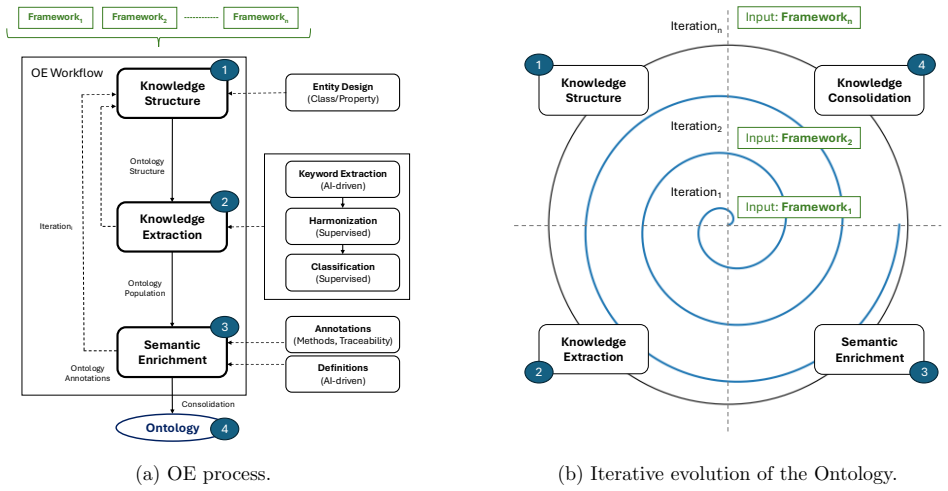
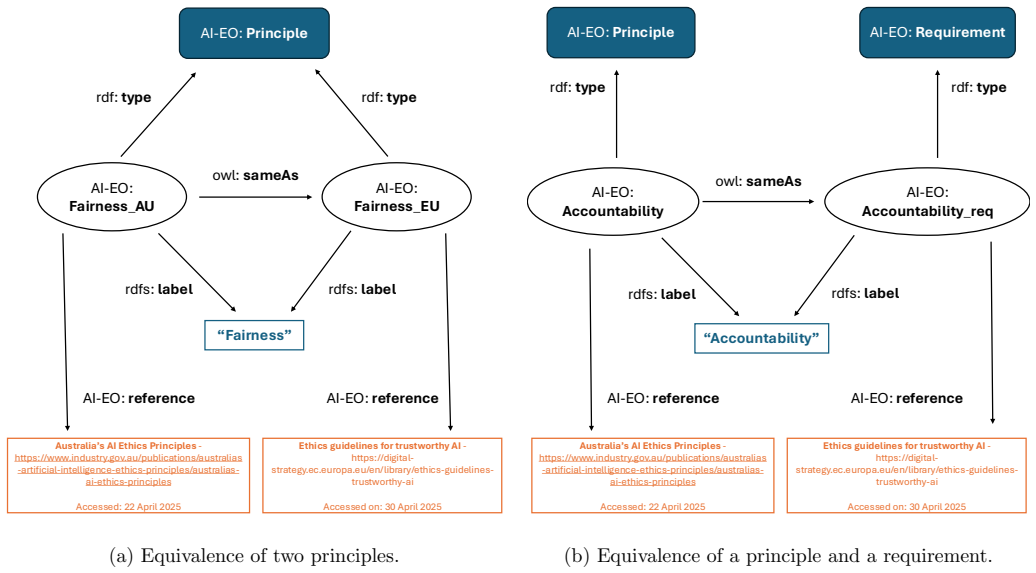
AI systems are consistently evolving in terms of both capability and autonomy with an holistic social impact. In this context of proliferation and fast technological evolution, the scientific community is actively engaged to assure Trustworthy AI. However, in general terms, AI safety research is significantly slower and is facing critical challenges in terms of strategy, consensus and operationalisation. This paper presents AI-Ethics Ontology (AI-EO) which, by leveraging Semantic Technologies on the Web infrastructure and ontology-based knowledge representations, provides an abstracted semantic infrastructure to foster the convergence, interoperability and operationalization of the different frameworks for Trustworthy AI. The current implementation results from the analysis of two relevant case studies to establish a dynamic development process in fact, as well as to enable its iterative evolution according to a formally-defined methodology. The version 1.0 of the Ontology is freely available and has been designed to be conceptually close to target applications, in a context of interoperability, adaptability as a natural response to change and usability.
Editorial analysis
A structured set of objections, weighed in public.
Referee Report
Summary. The manuscript presents the AI-Ethics Ontology (AI-EO), derived from analysis of two case studies on Trustworthy AI frameworks. It claims that this ontology, leveraging semantic web technologies and knowledge representations, supplies an abstracted semantic infrastructure to foster convergence, interoperability, and operationalization of diverse Trustworthy AI frameworks. Version 1.0 is released publicly and designed for conceptual closeness to applications, with support for interoperability, adaptability, and usability via a formally-defined iterative methodology.
Significance. If the ontology were shown to deliver measurable interoperability gains and operationalization support across frameworks, the work could aid standardization efforts in AI ethics by offering a reusable, extensible semantic layer on web infrastructure. The public release of v1.0 is a positive step toward community adoption and testing.
major comments (2)
- [Abstract] Abstract: the claim that AI-EO 'provides an abstracted semantic infrastructure to foster the convergence, interoperability and operationalization' is unsupported; the manuscript supplies neither explicit mappings or conflict-resolution examples with frameworks beyond the two case studies, nor any quantitative/qualitative evaluation of interoperability or operationalization outcomes.
- [Case studies / methodology] Case studies and methodology sections: the assertion that analysis of two case studies 'establish[es] a dynamic development process' and 'enable[s] its iterative evolution according to a formally-defined methodology' lacks a reproducible description of that methodology, construction details, validation metrics, or error-handling procedures, rendering the generalization to broader convergence unverified.
Simulated Author's Rebuttal
We thank the referee for the constructive comments, which help clarify the scope and presentation of our work. We address each major comment below and indicate the revisions we will make.
read point-by-point responses
-
Referee: [Abstract] Abstract: the claim that AI-EO 'provides an abstracted semantic infrastructure to foster the convergence, interoperability and operationalization' is unsupported; the manuscript supplies neither explicit mappings or conflict-resolution examples with frameworks beyond the two case studies, nor any quantitative/qualitative evaluation of interoperability or operationalization outcomes.
Authors: We agree that the abstract claim would be stronger with additional support. The ontology was constructed from analysis of the two case studies, which illustrate initial semantic alignment and operationalization within those specific frameworks. To address the concern, we will revise the abstract to more precisely reflect the current scope and add a dedicated subsection with explicit mappings to at least one additional Trustworthy AI framework outside the case studies, including qualitative examples of how conflicts in ethical principles are resolved via the ontology and how interoperability is achieved. This will provide concrete substantiation without overstating current results. revision: yes
-
Referee: [Case studies / methodology] Case studies and methodology sections: the assertion that analysis of two case studies 'establish[es] a dynamic development process' and 'enable[s] its iterative evolution according to a formally-defined methodology' lacks a reproducible description of that methodology, construction details, validation metrics, or error-handling procedures, rendering the generalization to broader convergence unverified.
Authors: The manuscript outlines the process derived from the two case studies and references a formally-defined iterative methodology, but we acknowledge that the description is not sufficiently detailed for full reproducibility. In the revised version, we will expand the relevant sections to include: (1) a step-by-step account of the ontology construction process, (2) the specific validation metrics applied (e.g., logical consistency via reasoners, coverage of core ethical dimensions, and alignment checks), and (3) procedures for identifying and resolving conflicts or errors during iteration. These additions will make the methodology transparent and allow readers to assess its applicability to broader frameworks. revision: yes
Circularity Check
No circularity in the claimed derivation; ontology construction is presented as an independent contribution
full rationale
The paper's main contribution is the development of the AI-Ethics Ontology (AI-EO) derived from analyzing two case studies of Trustworthy AI frameworks. This construction process does not involve any 'prediction' or first-principles result that is equivalent to its inputs by construction. The claim of fostering convergence and interoperability is an assertion about the ontology's utility rather than a derived quantity that reduces to the case studies. No self-citation chains or ansatzes are invoked in a load-bearing manner within the provided text. The derivation chain is self-contained as a descriptive and constructive effort.
Axiom & Free-Parameter Ledger
axioms (1)
- domain assumption Semantic technologies and ontology-based knowledge representations can foster convergence, interoperability and operationalization of Trustworthy AI frameworks
invented entities (1)
-
AI-Ethics Ontology (AI-EO)
no independent evidence
Reference graph
Works this paper leans on
-
[1]
Agentic ai: Autonomous intelligence for complex goals–a comprehensive survey.IEEE Access, 2025
Deepak Bhaskar Acharya, Karthigeyan Kuppan, and B Divya. Agentic ai: Autonomous intelligence for complex goals–a comprehensive survey.IEEE Access, 2025
work page 2025
-
[2]
The expressive power of sparql
Renzo Angles and Claudio Gutierrez. The expressive power of sparql. InInternational Semantic Web Conference, pages 114–129. Springer, 2008
work page 2008
-
[3]
Australia’s AI Ethics Principles
Science Australian Government Department of Industry and Resources. Australia’s AI Ethics Principles. https://www.industry.gov.au/publications/australias-artificial-intelligence-ethics- principles/australias-ai-ethics-principles. Accessed: 12 May 2025
work page 2025
-
[4]
Managing extreme ai risks amid rapid progress.Science, 384(6698):842–845, 2024
Yoshua Bengio, Geoffrey Hinton, Andrew Yao, Dawn Song, Pieter Abbeel, Trevor Darrell, Yuval Noah Harari, Ya-Qin Zhang, Lan Xue, Shai Shalev-Shwartz, et al. Managing extreme ai risks amid rapid progress.Science, 384(6698):842–845, 2024
work page 2024
-
[5]
Raja Chatila, Kay Firth-Butterflied, John C Havens, and Konstantinos Karachalios. The ieee global initiative for ethical considerations in artificial intelligence and autonomous systems.IEEE Robotics and Automation Magazine, 24(1):110, 2017
work page 2017
-
[6]
Soumyadeb Chowdhury, Prasanta Dey, Sian Joel-Edgar, Sudeshna Bhattacharya, Oscar Rodriguez- Espindola, Amelie Abadie, and Linh Truong. Unlocking the value of artificial intelligence in human resource management through ai capability framework.Human resource management review, 33(1):100899, 2023
work page 2023
-
[7]
European Commission. AI Act. https://digital-strategy.ec.europa.eu/en/policies/regulatory-framework- ai. Accessed: 3 June 2025
work page 2025
-
[8]
Ethics guidelines for trustworthy AI
European Commission. Ethics guidelines for trustworthy AI. https://digital- strategy.ec.europa.eu/en/library/ethics-guidelines-trustworthy-ai. Accessed: 3 June 2025
work page 2025
-
[9]
Nanyi Fei, Zhiwu Lu, Yizhao Gao, Guoxing Yang, Yuqi Huo, Jingyuan Wen, Haoyu Lu, Ruihua Song, Xin Gao, Tao Xiang, et al. Towards artificial general intelligence via a multimodal foundation model.Nature Communications, 13(1):3094, 2022
work page 2022
-
[10]
Generative ai and chatgpt: Applications, challenges, and ai-human collaboration, 2023
Fiona Fui-Hoon Nah, Ruilin Zheng, Jingyuan Cai, Keng Siau, and Langtao Chen. Generative ai and chatgpt: Applications, challenges, and ai-human collaboration, 2023
work page 2023
-
[11]
John H Gennari, Mark A Musen, Ray W Fergerson, William E Grosso, Monica Crub´ ezy, Henrik Eriksson, Natalya F Noy, and Samson W Tu. The evolution of prot´ eg´ e: an environment for knowledge-based systems development.International Journal of Human-computer studies, 58(1):89–123, 2003
work page 2003
-
[12]
Birte Glimm, Ian Horrocks, Boris Motik, Giorgos Stoilos, and Zhe Wang. Hermit: an owl 2 reasoner. Journal of automated reasoning, 53:245–269, 2014
work page 2014
-
[13]
Delaram Golpayegani, Harshvardhan J Pandit, and Dave Lewis. Airo: an ontology for representing ai risks based on the proposed eu ai act and iso risk management standards. InTowards a Knowledge-Aware AI, pages 51–65. IOS Press, 2022
work page 2022
-
[14]
What is an ontology?Handbook on ontologies, pages 1–17, 2009
Nicola Guarino, Daniel Oberle, and Steffen Staab. What is an ontology?Handbook on ontologies, pages 1–17, 2009
work page 2009
-
[15]
Renata Guizzardi, Glenda Amaral, Giancarlo Guizzardi, and John Mylopoulos. An ontology-based ap- proach to engineering ethicality requirements.Software and Systems Modeling, 22(6):1897–1923, 2023
work page 1923
-
[16]
Using i* to analyze ethicality requirements following ontology-based requirements engineering
Renata Guizzardi, Glenda Amaral, Giancarlo Guizzardi, and John Mylopoulos. Using i* to analyze ethicality requirements following ontology-based requirements engineering. InSocial Modeling Using the i* Framework: Essays in Honour of Eric Yu, pages 183–204. Springer, 2024
work page 2024
-
[17]
An ontology for ethical ai principles.Semantic Web Journal, 2021
Andrew Harrison, Dayana Spagnuelo, and Ilaria Tiddi. An ontology for ethical ai principles.Semantic Web Journal, 2021
work page 2021
-
[18]
Semantic interoperability.ACM Computing Surveys (CSUR), 27(2):271–273, 1995
Sandra Heiler. Semantic interoperability.ACM Computing Surveys (CSUR), 27(2):271–273, 1995. 9
work page 1995
-
[19]
Julio Hernandez, Delaram Golpayegani, and David Lewis. Ontology-based approach for mapping concepts and requirements from regulations and standards: The case of the eu ai act and international standards. InLegal Knowledge and Information Systems, pages 295–300. IOS Press, 2024
work page 2024
-
[20]
Owl 2 web ontology language primer.W3C recommendation, 27(1):123, 2009
Pascal Hitzler, Markus Kr¨ otzsch, Bijan Parsia, Peter F Patel-Schneider, Sebastian Rudolph, et al. Owl 2 web ontology language primer.W3C recommendation, 27(1):123, 2009
work page 2009
-
[21]
Aidan Hogan, Eva Blomqvist, Michael Cochez, Claudia d’Amato, Gerard De Melo, Claudio Gutierrez, Sabrina Kirrane, Jos´ e Emilio Labra Gayo, Roberto Navigli, Sebastian Neumaier, et al. Knowledge graphs. ACM Computing Surveys (Csur), 54(4):1–37, 2021
work page 2021
-
[22]
Michael A Houghtaling, Sandro Rama Fiorini, Nicola Fabiano, Paulo JS Gon¸ calves, Ozlem Ulgen, Tam´ as Haidegger, Joel Lu´ ıs Carbonera, Joanna Isabelle Olszewska, Brian Page, Zvikomborero Murahwi, et al. Standardizing an ontology for ethically aligned robotic and autonomous systems.IEEE Transactions on Systems, Man, and Cybernetics: Systems, 54(3):1791–1...
work page 2023
-
[23]
Shaoxiong Ji, Shirui Pan, Erik Cambria, Pekka Marttinen, and Philip S Yu. A survey on knowledge graphs: Representation, acquisition, and applications.IEEE transactions on neural networks and learning systems, 33(2):494–514, 2021
work page 2021
-
[24]
Methodologies for ontology development
Dean Jones, Trevor Bench-Capon, and Pepijn Visser. Methodologies for ontology development. 1998
work page 1998
-
[25]
Human-centered ontology engineering: The hcome methodology
Konstantinos Kotis and George A Vouros. Human-centered ontology engineering: The hcome methodology. Knowledge and Information Systems, 10:109–131, 2006
work page 2006
-
[26]
The semantic web.Scientific american, 284(5):34–43, 2001
Ora Lassila, J Hendler, and T Berners-Lee. The semantic web.Scientific american, 284(5):34–43, 2001
work page 2001
-
[27]
An ontology for standardising trustworthy ai
Dave Lewis, David Filip, and Harshvardhan J Pandit. An ontology for standardising trustworthy ai. Factoring Ethics in Technology, Policy Making, Regulation and AI, 65, 2021
work page 2021
-
[28]
Trustworthy ai: From principles to practices.ACM Computing Surveys, 55(9):1–46, 2023
Bo Li, Peng Qi, Bo Liu, Shuai Di, Jingen Liu, Jiquan Pei, Jinfeng Yi, and Bowen Zhou. Trustworthy ai: From principles to practices.ACM Computing Surveys, 55(9):1–46, 2023
work page 2023
-
[29]
Weixin Liang, Girmaw Abebe Tadesse, Daniel Ho, Li Fei-Fei, Matei Zaharia, Ce Zhang, and James Zou. Advances, challenges and opportunities in creating data for trustworthy ai.Nature Machine Intelligence, 4(8):669–677, 2022
work page 2022
-
[30]
Patrick Mikalef and Manjul Gupta. Artificial intelligence capability: Conceptualization, measurement cal- ibration, and empirical study on its impact on organizational creativity and firm performance.Information & management, 58(3):103434, 2021
work page 2021
-
[31]
OECD.AI. OECD AI Principles overview. https://oecd.ai/en/ai-principles. Accessed: 19 May 2025
work page 2025
-
[32]
Present and future of semantic web technologies: a research statement
Archana Patel and Sarika Jain. Present and future of semantic web technologies: a research statement. International Journal of Computers and Applications, 43(5):413–422, 2021
work page 2021
-
[33]
A simplified agile methodology for ontology development
Silvio Peroni. A simplified agile methodology for ontology development. InInternational Experiences and Directions Workshop on OWL, pages 55–69. Springer, 2016
work page 2016
-
[34]
Web of similarity.Journal of Computational Science, 36:100578, 2019
Salvatore F Pileggi. Web of similarity.Journal of Computational Science, 36:100578, 2019
work page 2019
-
[35]
Salvatore Flavio Pileggi. Getting formal ontologies closer to final users through knowledge graph visu- alization: interpretation and misinterpretation. InInternational Conference on Computational Science, pages 611–622. Springer, 2022
work page 2022
-
[36]
Edson Prestes, Michael A Houghtaling, Paulo JS Gon¸ calves, Nicola Fabiano, Ozlem Ulgen, Sandro Rama Fiorini, Zvikomborero Murahwi, Joanna Isabelle Olszewska, and Tam´ as Haidegger. The first global on- tological standard for ethically driven robotics and automation systems [standards].IEEE Robotics & Automation Magazine, 28(4):120–124, 2021
work page 2021
-
[37]
What does it mean to be a responsible ai practitioner: An ontology of roles and skills
Shalaleh Rismani and AJung Moon. What does it mean to be a responsible ai practitioner: An ontology of roles and skills. InProceedings of the 2023 AAAI/ACM Conference on AI, Ethics, and Society, pages 584–595, 2023. 10
work page 2023
-
[38]
Towards a comprehensive ontology for requirements en- gineering for ai-powered systems
Eran Sadovski, Itzhak Aviv, and Irit Hadar. Towards a comprehensive ontology for requirements en- gineering for ai-powered systems. InInternational Working Conference on Requirements Engineering: Foundation for Software Quality, pages 219–230. Springer, 2024
work page 2024
-
[39]
Zhou Shao, Ruoyan Zhao, Sha Yuan, Ming Ding, and Yongli Wang. Tracing the evolution of ai in the past decade and forecasting the emerging trends.Expert Systems with Applications, 209:118221, 2022
work page 2022
-
[40]
Collaborative ontology engineering: a survey.The Knowledge Engineering Review, 29(1):101–131, 2014
Elena Simperl and Markus Luczak-R¨ osch. Collaborative ontology engineering: a survey.The Knowledge Engineering Review, 29(1):101–131, 2014
work page 2014
-
[41]
Pellet: A practical owl-dl reasoner.Journal of Web Semantics, 5(2):51–53, 2007
Evren Sirin, Bijan Parsia, Bernardo Cuenca Grau, Aditya Kalyanpur, and Yarden Katz. Pellet: A practical owl-dl reasoner.Journal of Web Semantics, 5(2):51–53, 2007
work page 2007
-
[42]
Data modelling versus ontology engineering.ACM SIGMod Record, 31(4):12–17, 2002
Peter Spyns, Robert Meersman, and Mustafa Jarrar. Data modelling versus ontology engineering.ACM SIGMod Record, 31(4):12–17, 2002
work page 2002
-
[43]
Introduction: Ontology engineering in a networked world
Mari Carmen Su´ arez-Figueroa, Asunci´ on G´ omez-P´ erez, Enrico Motta, and Aldo Gangemi. Introduction: Ontology engineering in a networked world. InOntology engineering in a networked world, pages 1–6. Springer, 2011
work page 2011
-
[44]
Tania Tudorache. Ontology engineering: Current state, challenges, and future directions.Semantic Web, 11(1):125–138, 2020
work page 2020
-
[45]
Colin Van Noordt and Luca Tangi. The dynamics of ai capability and its influence on public value creation of ai within public administration.Government Information Quarterly, 40(4):101860, 2023
work page 2023
-
[46]
W3C. Semantic Web Standards. https://www.w3.org/2001/sw/wiki/Main Page. Accessed: 19 May 2025
work page 2001
-
[47]
W3C. RDF Schema 1.1. https://www.w3.org/TR/rdf-schema/, 2014. Accessed: 12 May 2025
work page 2014
-
[48]
Karen Yeung. Recommendation of the council on artificial intelligence (oecd).International legal materials, 59(1):27–34, 2020. Declarations •This research did not receive any specific grant from funding agencies in the public, commercial, or not-for-profit sectors. •The authors declare that they have no known competing financial interests or personal rela...
work page 2020
discussion (0)
Sign in with ORCID, Apple, or X to comment. Anyone can read and Pith papers without signing in.