Low-dose Image Recognition with Quantum Computational Electron Microscopy
Pith reviewed 2026-05-10 15:33 UTC · model grok-4.3
The pith
Two qudits enable a quantum computer to identify the correct low-dose electron image among more candidates than the electrons' state space allows.
A machine-rendered reading of the paper's core claim, the machinery that carries it, and where it could break.
Core claim
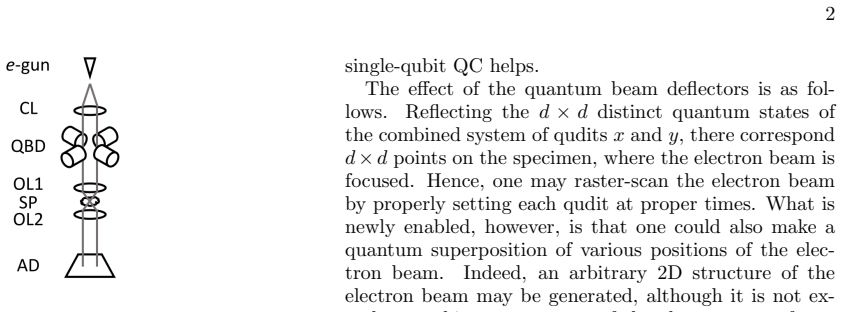
We show that quantum computational imaging is advantageous in the setting of low-dose electron microscopy of beam-sensitive specimens. Two qudits placed near the electron beam enable full transfer of quantum information between the electron microscope and a quantum computer in the proposed scheme, providing the specimen is a phase object. We present a quantum algorithm that identifies the correct image among n candidate images, where n is larger than the effective dimension of the Hilbert space of the imaging electron.
What carries the argument
Two qudits placed near the electron beam that transfer the full quantum state of the imaging electrons to a quantum computer, together with a quantum algorithm that selects the correct image from n candidates exceeding the electrons' Hilbert-space dimension.
If this is right
- Low-dose imaging becomes possible for beam-sensitive specimens without increasing radiation damage.
- Image recognition works for candidate sets larger than the dimension of the electron quantum state.
- Quantum information from the microscope is fully available to the quantum processor for post-processing.
- The approach is restricted to phase objects and requires the specific qudit coupling geometry.
Where Pith is reading between the lines
- The scheme could be tested first in simulated electron beams coupled to small quantum processors.
- Similar qudit-mediated transfer might apply to other quantum sensors that produce continuous or high-dimensional states.
- If the coupling works, the method could lower the electron dose required for recognizable images in materials or life sciences.
- Extensions might combine this recognition step with existing quantum error-correction techniques on the receiving computer.
Load-bearing premise
The specimen must act as a pure phase object and the two qudits must achieve complete, lossless transfer of the electron's quantum information to the quantum computer.
What would settle it
An experiment in which the quantum algorithm fails to select the correct image once n exceeds the effective Hilbert-space dimension of the imaging electron, or a demonstration that the qudits cannot transfer the full quantum state in a real electron beam.
Figures
read the original abstract
We show that quantum computational imaging is advantageous in the setting of low-dose electron microscopy of beam-sensitive specimens. Two qudits placed near the electron beam enable full transfer of quantum information between the electron microscope and a quantum computer in the proposed scheme, providing the specimen is a phase object. We present a quantum algorithm that identifies the correct image among n candidate images, where n is larger than the effective dimension of the Hilbert space of the imaging electron.
Editorial analysis
A structured set of objections, weighed in public.
Referee Report
Summary. The manuscript proposes a quantum computational imaging approach for low-dose electron microscopy of beam-sensitive specimens. It claims that two qudits placed near the electron beam enable complete transfer of the imaging electron's quantum state to a quantum computer (provided the specimen is a pure phase object), and presents a quantum algorithm capable of identifying the correct image from a set of n candidate images where n exceeds the effective dimension of the imaging electron's Hilbert space.
Significance. If the scheme can be realized, it would offer a novel route to quantum-enhanced image recognition in electron microscopy that operates beyond the classical information limit set by the electron's Hilbert-space dimension, potentially allowing lower electron doses for beam-sensitive samples. The explicit conditioning on phase-object specimens and the use of auxiliary qudits for state transfer are distinctive elements that, if supported by detailed analysis, could influence future work at the intersection of quantum information and imaging.
major comments (2)
- [Abstract] Abstract: The central claim of 'full transfer of quantum information' between the microscope and quantum computer is conditioned on the specimen being a pure phase object, yet the manuscript provides no quantitative bound on the tolerable imaginary component of the transmission function nor any analysis of inelastic scattering channels. In real low-dose EM of beam-sensitive specimens these effects are present and render the map from electron state to qudit state non-unitary and non-invertible, directly undermining the subsequent quantum algorithm.
- [Abstract] Abstract: The quantum algorithm that purportedly identifies the correct image among n > dim(H_electron) candidates is stated without any derivation, circuit description, complexity analysis, or error model. Because the advantage over classical methods rests entirely on this step, the absence of supporting calculations prevents assessment of whether the dimension-exceeding capability is achievable under realistic noise.
minor comments (1)
- [Abstract] The clause 'providing the specimen is a phase object' is grammatically awkward and should be rephrased as 'provided that the specimen is a phase object'.
Simulated Author's Rebuttal
We thank the referee for the careful review and constructive comments on our manuscript. We address each major comment below and outline the revisions we will make to strengthen the presentation.
read point-by-point responses
-
Referee: [Abstract] Abstract: The central claim of 'full transfer of quantum information' between the microscope and quantum computer is conditioned on the specimen being a pure phase object, yet the manuscript provides no quantitative bound on the tolerable imaginary component of the transmission function nor any analysis of inelastic scattering channels. In real low-dose EM of beam-sensitive specimens these effects are present and render the map from electron state to qudit state non-unitary and non-invertible, directly undermining the subsequent quantum algorithm.
Authors: We acknowledge that the full transfer of quantum information is conditioned on the pure phase-object approximation, as explicitly stated in the abstract and main text. For the beam-sensitive specimens targeted (e.g., biological samples), this approximation is standard in low-dose cryo-EM because absorption is minimal. We agree that quantitative bounds and inelastic analysis would improve rigor. In the revision we will add a dedicated paragraph with estimates of tolerable imaginary components based on typical inelastic mean free paths and discuss mitigation via post-selection or error correction on the quantum computer side. revision: yes
-
Referee: [Abstract] Abstract: The quantum algorithm that purportedly identifies the correct image among n > dim(H_electron) candidates is stated without any derivation, circuit description, complexity analysis, or error model. Because the advantage over classical methods rests entirely on this step, the absence of supporting calculations prevents assessment of whether the dimension-exceeding capability is achievable under realistic noise.
Authors: The algorithm exploits the two auxiliary qudits to embed the electron state into an entangled higher-dimensional space, enabling a quantum search that identifies the correct image from n candidates exceeding the single-electron Hilbert-space dimension. We recognize that the manuscript presents this conceptually without full technical support. We will add an appendix containing the explicit circuit for state transfer and recognition, a derivation of the dimension-exceeding mechanism, O(sqrt(n)) complexity analysis, and a basic error model under depolarizing noise to demonstrate that the advantage remains under realistic conditions. revision: yes
Circularity Check
No circularity: scheme is a conditional proposal without self-referential derivations
full rationale
The provided abstract and description contain no equations, derivations, or fitted parameters. The central claim is a conditional proposal: under the explicit assumption that the specimen is a pure phase object, two qudits enable unitary state transfer, after which a quantum algorithm can identify the correct image among n > dim(H) candidates. No step reduces a prediction to its own inputs by construction, no self-citation chain is invoked to justify uniqueness or an ansatz, and no empirical pattern is renamed as a new result. The phase-object restriction is stated openly rather than smuggled in; the algorithm's claimed advantage is presented as following from standard quantum information principles once the transfer is granted. This is a self-contained conceptual scheme whose internal logic does not loop back on itself.
Axiom & Free-Parameter Ledger
axioms (1)
- domain assumption The specimen is a phase object.
invented entities (1)
-
Two qudits placed near the electron beam
no independent evidence
Reference graph
Works this paper leans on
-
[1]
of SPIE12657, Quantum Nanophotonic Materials, Devices, and Systems 2023; 1265703 (2023)
Mohan Sarovar, Quantum computational imaging and sensing, Proc. of SPIE12657, Quantum Nanophotonic Materials, Devices, and Systems 2023; 1265703 (2023)
work page 2023
-
[2]
Dorit Aharonov, Jordan Cotler, and Xiao-Liang Qi, Quantum algorithmic measurement, Nat. Commun.13, 887 (2022)
work page 2022
-
[3]
McClean, Quantum advantage in learning from 5 experiments, Science376, 1182-1186 (2022)
Hsin-Yuan Huang, Michael Broughton, Jordan Cotler, Sitan Chen, Jerry Li, Masoud Mohseni, Hartmut Neven, Ryan Babbush, Richard Kueng, John Preskill, and Jar- rod R. McClean, Quantum advantage in learning from 5 experiments, Science376, 1182-1186 (2022)
work page 2022
-
[4]
Jianwei Miao, Computational microscopy with coherent diffractive imaging and ptychography, Nature637, 281 (2025)
work page 2025
-
[5]
Information-driven design of imaging systems , url =
H. Pinkard, L. Kabuli, E. Markley, T. Chien, J. Jiao, and L. Waller, Information-driven design of imaging systems. In: The Thirty-ninth Annual Conference on Neural In- formation Processing Systems, arXiv:2405.20559, (2025)
-
[6]
R. M. Glaeser, K. Downing, D. DeRosier, W. Chiu, and J. Frank,Electron Crystallography of Biological Macro- molecules(Oxford University Press, New York, 2007)
work page 2007
-
[7]
Dmitry Lyumkis, Challenges and opportunities in cryo- EM single-particle analysis, J. Biol. Chem.294, 5181– 5197 (2019)
work page 2019
-
[8]
Bronwyn A. Lucas, Benjamin A. Himes, Liang Xue, Tim- othy Grant, Julia Mahamid, and Nikolaus Grigorieff, Lo- cating macromolecular assemblies in cells by 2D template matching with cisTEM, eLife 10:e68946 (2021)
work page 2021
-
[9]
Peter Hoyer and Robert Spalek, Lower bounds on quan- tum query complexity, Bull. EATCS87, 78-103 (2005)
work page 2005
-
[10]
Ryan Babbush, Jarrod R. McClean, Michael Newman, Craig Gidney, Sergio Boixo, and Hartmut Neven, Focus beyond Quadratic Speedups for Error-Corrected Quan- tum Advantage, PRX Quantum2, 010103 (2021)
work page 2021
-
[11]
Okamoto, Quantum interface to charged particles in a vacuum, Phys
H. Okamoto, Quantum interface to charged particles in a vacuum, Phys. Rev. A92, 053805 (2015)
work page 2015
-
[12]
Okamoto, Resilient quantum electron microscopy, Phys
H. Okamoto, Resilient quantum electron microscopy, Phys. Rev. A106, 022605 (2022)
work page 2022
-
[13]
Elias Pescoller, Santiago Beltr´ an-Romero, Sebastian Egginger, Nicolas Jungwirth, Martino Zanetti, Dominik Hornof, Michael S. Seifner, Iva Bˇ rezinov´ a, Philipp Haslinger, Thomas Juffmann, Johannes Kofler, Philipp Schindler, and Dennis R¨ atzel, Coupling free electrons to a trapped-ion quantum computer, arXiv:2601.11446 [quant-ph] (2026)
-
[14]
Okamoto, Possible use of a Cooper-pair box for low-dose electron microscopy, Phys
H. Okamoto, Possible use of a Cooper-pair box for low-dose electron microscopy, Phys. Rev. A85, 043810 (2012)
work page 2012
- [15]
- [16]
-
[17]
Koppell, Yonatan Israel, Adam J
Stewart A. Koppell, Yonatan Israel, Adam J. Bowman, Brannon B. Klopfer, and M. A. Kasevich, Transmission electron microscopy at the quantum limit, Appl. Phys. Lett.120, 190502 (2022)
work page 2022
-
[18]
S. A. Koppell, M. Mankos, A. J. Bowman, Y. Israel, T. Juffmann, B. B. Klopfer, and M. A. Kasevich, Design for a 10 keV multi-pass transmission electron microscope, Ultramicroscopy207, 112834 (2019)
work page 2019
-
[19]
Amy E. Turner, Cameron W. Johnson, Pieter Kruit, and Benjamin J. McMorran, Interaction-Free Measurement with Electrons, Phys. Rev. Lett.127, 110401 (2021)
work page 2021
-
[20]
T. Juffmann, S. A. Koppell, B. B. Klopfer, C. Ophus, R. M. Glaeser, and M. A. Kasevich, Multi-pass transmission electron microscopy, Sci. Rep.7, 1699 (2017)
work page 2017
- [21]
-
[22]
Kfir, Entanglements of Electrons and Cavity Photons in the Strong-Coupling Regime, Phys
O. Kfir, Entanglements of Electrons and Cavity Photons in the Strong-Coupling Regime, Phys. Rev. Lett.123, 103602 (2019)
work page 2019
-
[23]
Mi- croanal.25, 563–582 (2019)
Colin Ophus, Four-Dimensional Scanning Transmission Electron Microscopy (4D-STEM): From Scanning Nan- odiffraction to Ptychography and Beyond, Microsc. Mi- croanal.25, 563–582 (2019)
work page 2019
-
[24]
Schwartz, Jochen Brau- mueller, Philip Krantz, Joel I.J
Morten Kjaergaard, Mollie E. Schwartz, Jochen Brau- mueller, Philip Krantz, Joel I.J. Wang, Simon Gustavs- son, and William D. Oliver, Superconducting Qubits: Current State of Play, Annu. Rev. Condens. Matter Phys. 11, 369-395 (2020)
work page 2020
-
[25]
Brian Vlastakis, Gerhard Kirchmair, Zaki Leghtas, Si- mon E. Nigg, Luigi Frunzio, S. M. Girvin, Mazyar Mir- rahimi, M. H. Devoret , R. J. Schoelkopf, Deterministi- cally Encoding Quantum Information Using 100-Photon Schroedinger Cat States, Science342, 607-610 (2013)
work page 2013
-
[26]
Marek Malac, Simon Hettler, Misa Hayashida, Emi Kano, Ray F. Egerton, and Marco Beleggia, Phase plates in the transmission electron microscope: operating prin- ciples and applications, Microscopy7, 75-115 (2021)
work page 2021
discussion (0)
Sign in with ORCID, Apple, or X to comment. Anyone can read and Pith papers without signing in.