Subordinated Wright-Fisher Priors
Pith reviewed 2026-05-10 16:26 UTC · model grok-4.3
The pith
A random time-change of the Wright-Fisher diffusion yields a new class of Dirichlet priors that allow jumps and non-Markovian memory while preserving exact conjugacy.
A machine-rendered reading of the paper's core claim, the machinery that carries it, and where it could break.
Core claim
By subordinating a Wright-Fisher diffusion with an independent stochastic time-change interpreted as a hyper-prior on the operational clock, one obtains a class of time-dependent Dirichlet priors that accommodate discontinuous trajectories and non-Markovian memory. Explicit representations and exact sampling algorithms are derived for the prior and posterior distributions of both the process and the clock when the data are partially exchangeable and observed at discrete time points. Computability and conjugacy are achieved through a novel class of discrete dual processes that generalise earlier duality results for Wright-Fisher models.
What carries the argument
Stochastic subordination that replaces deterministic time with a random clock in the Wright-Fisher diffusion, made tractable by a new family of discrete dual processes that preserve conjugacy under partial exchangeability.
If this is right
- Exact sampling algorithms become available for both the subordinated process and its driving clock under discrete-time partially exchangeable data.
- Trajectories may contain discontinuities while all finite-dimensional distributions remain Dirichlet.
- Non-Markovian memory effects can be introduced without sacrificing posterior conjugacy or computability.
- The framework extends classical Wright-Fisher conjugacy results to a broader class of time-inhomogeneous priors.
Where Pith is reading between the lines
- Such priors could be applied to model sudden population shifts or allele-frequency jumps induced by environmental events.
- The discrete dual processes may generalise to other neutral diffusions such as the Moran model.
- One could examine whether inferred clocks on real genetic time series reveal interpretable patterns of memory or jump clustering.
Load-bearing premise
The chosen stochastic time-change together with the new discrete dual processes must preserve the Dirichlet marginals and conjugacy structure for partially exchangeable discrete-time observations.
What would settle it
A dataset of partially exchangeable discrete-time observations for which the posterior of the frequency process and clock cannot be sampled exactly from the dual-process representations, or whose finite-dimensional distributions deviate from the claimed Dirichlet form.
Figures




read the original abstract
A new class of time-dependent Dirichlet priors is introduced as a generalisation of the Wright-Fisher diffusion, allowing discontinuities in the trajectories, as well as non-Markovian memory. This class is obtained as a simple stochastic time-change (subordination), interpreted as a hyper-prior assigned to the operational time-clock of a Wright-Fisher diffusion. Explicit representations and exact sampling algorithms are obtained for prior and posterior distributions of the process and of its clock, given partially exchangeable data sampled at discrete time-points. Computability and conjugacy rely on a novel class of discrete dual processes, generalising existing results on duality and computable filters.
Editorial analysis
A structured set of objections, weighed in public.
Referee Report
Summary. The paper introduces a new class of time-dependent Dirichlet priors obtained by subordinating the Wright-Fisher diffusion via a stochastic time-change, interpreted as a hyper-prior on the operational clock. This construction yields processes with discontinuous trajectories and non-Markovian memory. Explicit representations and exact sampling algorithms are claimed for the prior and posterior distributions of both the process and the clock, given partially exchangeable data observed at discrete time points. Conjugacy and computability are achieved through a novel class of discrete dual processes that generalize existing duality results for diffusions.
Significance. If the central claims on explicit representations and exact algorithms hold, the work would meaningfully extend duality-based filtering techniques to subordinated, non-Markovian processes. This could provide tractable Bayesian nonparametric priors for time-varying population models or exchangeable data with temporal dependence, building directly on known conjugacy properties of the Wright-Fisher diffusion while adding flexibility through the random time change.
minor comments (2)
- The abstract asserts 'explicit representations' and 'exact sampling algorithms' without indicating where in the manuscript the derivations or pseudocode appear; adding forward references to the relevant sections or theorems would improve readability.
- Notation for the subordinating process and the dual discrete process should be introduced with a clear table or diagram early in the paper to distinguish the operational time from the calendar time.
Simulated Author's Rebuttal
We thank the referee for their positive assessment of the manuscript, including the accurate summary of the contributions and the encouraging evaluation of its significance. We appreciate the recommendation for minor revision and will incorporate improvements to enhance clarity, presentation, and any minor issues in the next version.
Circularity Check
Derivation self-contained; no circular reductions identified
full rationale
The paper constructs a subordinated Wright-Fisher process via stochastic time-change and obtains explicit prior/posterior representations through a novel discrete dual that generalizes known duality techniques. No equation equates a derived quantity to its input by construction, no fitted parameter is relabeled as a prediction, and no load-bearing step reduces to an unverified self-citation chain. The central claims of conjugacy and computability rest on the mathematical properties of the subordination and dual rather than tautological redefinition or renaming of known results.
Axiom & Free-Parameter Ledger
Reference graph
Works this paper leans on
- [1]
-
[2]
Levy processes and stochastic calculus.Cambridge Studies in Advanced Mathematics, 116, 2009
D Applebaum. Levy processes and stochastic calculus.Cambridge Studies in Advanced Mathematics, 116, 2009
work page 2009
-
[3]
Cede˜ no-Gir´ on, and Bruno Toaldo
Ivan Bioˇ ci´ c, Daniel E. Cede˜ no-Gir´ on, and Bruno Toaldo. Sampling inverse subordinators and subdiffusions, 2025
work page 2025
-
[4]
S. Bochner. Diffusion equation and stochastic processes.Proceedings of the National Academy of Sciences, 35(7):368–370, 1949. 25
work page 1949
-
[5]
N. Bouleau. Quelques resultats probabilistes sur la subordination au sens de bochner. In Francis Hirsch and Gabriel Mokobodzki, editors,S´ eminaire de Th´ eorie du Potentiel Paris, No. 7, pages 54–81, Berlin, Heidelberg, 1984. Springer Berlin Heidelberg
work page 1984
-
[6]
Inference in hidden Markov models
Olivier Capp´ e, ´Eric Moulines, and Tobias Ryd´ en. Inference in hidden Markov models. InSpringer series in statistics, 2005
work page 2005
-
[7]
Amin, Alex Ali, Joshua Rollins, Sebastian W
Nuria Alina Chandra, Yucen Lily Li, Alan N. Amin, Alex Ali, Joshua Rollins, Sebastian W. Ober, Aniruddh Raghu, and Andrew Gordon Wilson. A unification of discrete, gaussian, and simplicial diffusion, 2025
work page 2025
-
[8]
Angelos Dassios, Jia Lim, and Yan Qu. Exact Simulation of Truncated L´ evy Subordinator.ACM Transactions on Modeling and Computer Simulation, 30, 10 2019
work page 2019
-
[9]
New York: Springer-Verlag, 1986
Luc Devroye.Non-Uniform Random Variate Generation. New York: Springer-Verlag, 1986
work page 1986
-
[10]
The Ja- cobi diffusion process as a neuronal model.Chaos, 28, 10 2018
Giuseppe D’Onofrio, Massimiliano Tamborrino, and Petr Lansky. The Ja- cobi diffusion process as a neuronal model.Chaos, 28, 10 2018
work page 2018
-
[11]
Etheridge.Some Mathematical Models from Population Genetics, vol- ume 2012
A. Etheridge.Some Mathematical Models from Population Genetics, vol- ume 2012. Springer, 2011
work page 2012
-
[12]
A. Etheridge and R. Griffiths. A coalescent dual process in a Moran model with genic selection.Theoretical population biology, 75:320–30, 2009
work page 2009
-
[13]
S. N. Ethier and R. C. Griffiths. The Transition Function of a Fleming-Viot Process.The Annals of Probability, 21(3):1571–1590, 1993
work page 1993
-
[14]
Ewens.Mathematical population genetics / Warren J
Warren John. Ewens.Mathematical population genetics / Warren J. Ewens.Biomathematics ; Vol.9. Springer-Verlag, Berlin ;, 1979
work page 1979
-
[15]
New York: John Wiley & Sons, 2nd edition, 1971
William Feller.An Introduction to Probability Theory and its Applications, volume II. New York: John Wiley & Sons, 2nd edition, 1971
work page 1971
-
[16]
A non-linear explicit filter.Statistics & Proba- bility Letters, 61(2):145–154, 2003
Valentine Genon-Catalot. A non-linear explicit filter.Statistics & Proba- bility Letters, 61(2):145–154, 2003
work page 2003
-
[17]
Fast exact simulation of the first-passage event of a subordinator, 06 2023
Jorge Ignacio Gonz´ alez C´ azares, Feng Lin, and Aleksandar Mijatovic. Fast exact simulation of the first-passage event of a subordinator, 06 2023
work page 2023
-
[18]
Christian Gourieroux and Joann Jasiak. Multivariate jacobi process with application to smooth transitions.Journal of Econometrics, 131(1):475– 505, 2006
work page 2006
- [19]
- [20]
-
[21]
R. Griffiths and D. Span` o. Orthogonal polynomial kernels and canonical correlations for Dirichlet measures.Bernoulli, 19(2):548–598, 2013
work page 2013
-
[22]
R. C. Griffiths and D. Span` o.Diffusion processes and coalescent trees, page 358–379. London Mathematical Society Lecture Note Series. Cambridge University Press, 2010
work page 2010
-
[23]
Robert C. Griffiths and Wen-Hsiung Li. Simulating allele frequencies in a population and the genetic differentiation of populations under mutation pressure.Theoretical Population Biology, 23(1):19–33, 1983
work page 1983
-
[24]
Dual process in the two-parameter poisson-dirichlet diffusion.arXiv preprint arXiv:2102.08520, 2021
Robert C Griffiths, Matteo Ruggiero, Dario Span` o, and Youzhou Zhou. Dual process in the two-parameter poisson-dirichlet diffusion.arXiv preprint arXiv:2102.08520, 2021
- [25]
-
[26]
Alan G. Hawkes. Spectra of some self-exciting and mutually exciting point processes.Biometrika, 58(1):83–90, 1971
work page 1971
-
[27]
Alan G. Hawkes. Hawkes processes and their applications to finance: a review.Quantitative Finance, 18(2):193–198, 2018
work page 2018
-
[28]
Paul A. Jenkins and Dario Span` o . Exact simulation of the Wright–Fisher diffusion.The Annals of Applied Probability, 27(3), jun 2017
work page 2017
-
[29]
Panki Kim, Renming Song, and Zoran Vondraˇ cek.Potential Theory of Subordinate Brownian Motions Revisited, pages 243–290. World Scientific Pub., 2012
work page 2012
-
[30]
Exact inference for a class of hidden Markov models on general state spaces
Guillaume Kon Kam King, Omiros Papaspiliopoulos, and Matteo Ruggiero. Exact inference for a class of hidden Markov models on general state spaces. Electronic Journal of Statistics, 15(1):2832 – 2875, 2021
work page 2021
-
[31]
V. N. Kolokoltsov. Generalized continuous-time random walks, subordina- tion by hitting times, and fractional dynamics.Theory of Probability & Its Applications, 53(4):594–609, 2009
work page 2009
-
[32]
Nikolai N. Leonenko, Mark M. Meerschaert, and Alla Sikorskii. Fractional Pearson diffusions.Journal of Mathematical Analysis and Applications, 403(2):532–546, 2013
work page 2013
-
[33]
Francesco Mainardi.Fractional calculus and waves in linear viscoelasticity. Imperial College Press, 2010
work page 2010
-
[34]
Tina Marquardt. Fractional l´ evy processes with an application to long memory moving average processes.Bernoulli, 12(6):1099–1126, 2006. 27
work page 2006
-
[35]
De Gruyter, Berlin/Boston, 2012
Mark M Meerschaert and Alla Sikorskii.Stochastic Models for Fractional Calculus, volume 43 ofDe Gruyter Studies in Mathematics. De Gruyter, Berlin/Boston, 2012
work page 2012
-
[36]
Yosihiko Ogata. Statistical models for earthquake occurrences and residual analysis for point processes.Journal of the American Statistical Associa- tion, 83(401):9–27, 1988
work page 1988
-
[37]
O. Papaspiliopoulos, M. Ruggiero, and D. Span` o. Conjugacy properties of time-evolving Dirichlet and gamma random measures.Electronic Journal of Statistics, 10(2):3452–3489, 2016
work page 2016
-
[38]
Optimal filtering and the dual process.Bernoulli, 20(4):1999–2019, 2014
Omiros Papaspiliopoulos and Matteo Ruggiero. Optimal filtering and the dual process.Bernoulli, 20(4):1999–2019, 2014
work page 1999
-
[39]
A. Saichev and George Zaslavsky. Fractional kinetic equations: Solutions and applications.Chaos (Woodbury, N.Y.), 7:753–764, 01 1998
work page 1998
-
[40]
Springer Series in Operations Research and Financial Engineering
Gennady Samorodnitsky.Stochastic Processes and Long Range Depen- dence. Springer Series in Operations Research and Financial Engineering. Springer, Cham, Switzerland, 2016
work page 2016
-
[41]
Ewf: simulating exact paths of the wright–fisher diffusion.Bioinformatics, 39(1):btad017, 01 2023
Jaromir Sant, Paul A Jenkins, Jere Koskela, and Dario Span` o. Ewf: simulating exact paths of the wright–fisher diffusion.Bioinformatics, 39(1):btad017, 01 2023
work page 2023
-
[42]
Sato.L´ evy Processes and Infinitely Divisible Distributions
K. Sato.L´ evy Processes and Infinitely Divisible Distributions. Cambridge University Press, 1999
work page 1999
-
[43]
Simon Tavar´ e. Line-of-descent and genealogical processes, and their ap- plications in population genetics models.Theoretical Population Biology, 26(2):119–164, 1984
work page 1984
-
[44]
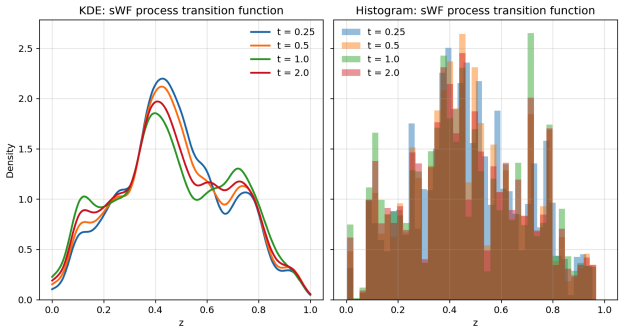
B. Toaldo. Convolution-Type Derivatives, Hitting-Times of Subordinators and Time-ChangedC 0-Semigroups.Potential Analysis, 42:115–140, 2015. 28 Appendix. Subordinated Wright-Fisher priors A-1 Additional plots Figure 1: Laplace transform mapst→E[e −λnC(t)] across the ranget∈[0,2] and for a selection of (n, θ) and subordinators: (a)α-Stable withα= 0.5;(b) P...
work page 2015
-
[45]
It extends the known analogous result on smoothing for WF diffusions, given by Theorem 4 in [30], with the only difference that role of the WF diffusion’s dualZis replaced by the subordinated dual eZ Corollary A-2.The model(41)admits a computable smoothing filter. We omit the proof and instead refer to the proof of Theorem 4 in [30], of which it follows e...
discussion (0)
Sign in with ORCID, Apple, or X to comment. Anyone can read and Pith papers without signing in.