Recognition: no theorem link
Impact of Effective Nucleon Mass and Multineutron States on the Equation of State for Core-Collapse Supernovae
Pith reviewed 2026-05-10 15:29 UTC · model grok-4.3
The pith
Multineutron states lower the free energy in supernova equations of state by favoring heavier nuclei at high densities.
A machine-rendered reading of the paper's core claim, the machinery that carries it, and where it could break.
Core claim
The central claim is that multineutron states become prominent at high densities in neutron-rich environments, leading to a substantial reduction in the unbound neutron fraction. This depletion lowers the chemical potential of unbound neutrons, which in turn reduces the abundance of neutron-rich nuclei. Consequently, the number of unbound protons increases, leading to a corresponding rise in proton chemical potential. These shifts in chemical potentials promote the formation of heavy nuclei with larger mass and atomic numbers. Ultimately, this compositional shift results in a lower free energy, primarily driven by the emergence of these heavy nuclei. The impact of a larger effective nucleon
What carries the argument
Equations of state that add dineutron and tetraneutron as explicit nuclear species while allowing the effective nucleon mass to vary.
If this is right
- Larger effective nucleon mass increases the mass fractions of unbound neutrons, protons, and heavy nuclei in neutron-rich conditions.
- Multineutron states substantially reduce the unbound neutron fraction at high densities.
- Neutron chemical potential decreases while proton chemical potential increases.
- Heavy nuclei form with larger mass and atomic numbers.
- The net result is a lower free energy for the system.
Where Pith is reading between the lines
- The altered chemical potentials and composition could change neutrino transport and heating rates inside the supernova core.
- A stiffer or softer equation of state from these effects might shift the boundary between neutron-star and black-hole formation.
- If multineutron states prove real, similar cluster treatments could be added for other light nuclei whose binding remains uncertain.
- Supernova simulations using these equations of state would be needed to quantify changes in explosion energy or nucleosynthesis yields.
Load-bearing premise
The dineutron and tetraneutron states exist with definite binding energies and can be treated as thermodynamic components in dense neutron-rich matter at supernova temperatures and densities.
What would settle it
An experimental bound or ab initio calculation showing that the tetraneutron has zero or negligible binding energy and population fraction under the densities and temperatures reached in supernova cores would eliminate the reported drop in free energy and the associated shift toward heavier nuclei.
Figures


read the original abstract
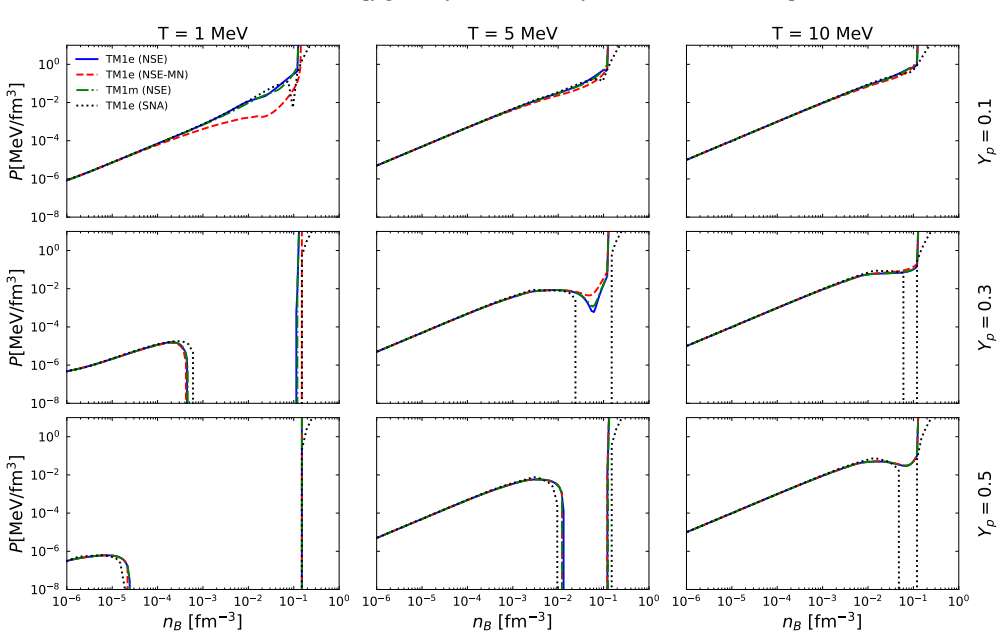
In this study, we investigate the impact of effective nucleon mass and the existence of the dineutron $(\mathrm{^{2}n})$ and the tetraneutron $(\mathrm{^{4}n})$ on the thermodynamic properties and nuclear compositions by constructing new equations of state. Our results indicate that the model with a larger effective nucleon mass slightly alters the nuclear composition in neutron-rich environments primarily due to differences in the symmetry energy: the mass fractions of unbound neutrons, protons, and heavy nuclei increase. The impact on the thermodynamic properties is negligible, except for the chemical potentials. On the other hand, multineutron states become prominent at high densities in neutron-rich environments, leading to a substantial reduction in the unbound neutron fraction. This depletion lowers the chemical potential of unbound neutrons, which in turn reduces the abundance of neutron-rich nuclei. Consequently, the number of unbound protons increases, leading to a corresponding rise in proton chemical potential. These shifts in chemical potentials promote the formation of heavy nuclei with larger mass and atomic numbers. Ultimately, this compositional shift results in a lower free energy, primarily driven by the emergence of these heavy nuclei.
Editorial analysis
A structured set of objections, weighed in public.
Referee Report
Summary. The paper constructs new equations of state for core-collapse supernovae to study the effects of varying the effective nucleon mass and including dineutron (^{2}n) and tetraneutron (^{4}n) states. It reports that a larger effective nucleon mass slightly increases the mass fractions of unbound neutrons, protons, and heavy nuclei due to symmetry-energy differences, with negligible changes to thermodynamic properties except chemical potentials. Inclusion of multineutron states at high densities reduces the unbound-neutron fraction, lowers the neutron chemical potential, raises the proton chemical potential, favors heavier nuclei, and ultimately lowers the total free energy.
Significance. If the assumed binding energies and thermodynamic treatment of the multineutron states prove physically realistic, the work would demonstrate how exotic light clusters can drive substantial compositional changes and free-energy reductions in neutron-rich supernova matter, with potential consequences for supernova dynamics and neutrino signals. The study supplies new model variants rather than machine-checked proofs or parameter-free derivations, so its significance hinges on future validation against data or ab-initio calculations.
major comments (3)
- [Abstract] Abstract: the central claim that multineutron states 'become prominent at high densities' and produce a lower free energy rests on unspecified binding energies and an ideal-gas thermodynamic treatment for ^{2}n and ^{4}n; without these values or their derivation, the reported reduction in unbound-neutron fraction and the subsequent shift to heavier nuclei cannot be assessed for robustness.
- [Model construction] Model-construction section (inferred from abstract description): the effective nucleon mass and multineutron-state parameters are treated as free inputs that are varied or assumed; the qualitative trends in chemical potentials and heavy-nucleus abundances therefore trace directly to these choices rather than emerging from independent constraints, weakening the assertion that the compositional shift is a general prediction.
- [Results] Results discussion: no quantitative error bars, comparison to experimental binding data, or cross-check against established EOS tables (e.g., Shen or Lattimer-Swesty) are mentioned; this absence is load-bearing because the headline result (lower free energy driven by heavy nuclei) is obtained only after inserting the multineutron species.
minor comments (2)
- [Abstract] Abstract: the phrase 'primarily driven by the emergence of these heavy nuclei' would be clearer if the relative contribution of the multineutron states versus the effective-mass change were quantified.
- [Notation] Notation: the symbols for effective nucleon mass and the binding energies of the multineutron states should be defined explicitly at first use.
Simulated Author's Rebuttal
We thank the referee for the constructive comments. We address each major point below and indicate the revisions planned for the manuscript.
read point-by-point responses
-
Referee: [Abstract] Abstract: the central claim that multineutron states 'become prominent at high densities' and produce a lower free energy rests on unspecified binding energies and an ideal-gas thermodynamic treatment for ^{2}n and ^{4}n; without these values or their derivation, the reported reduction in unbound-neutron fraction and the subsequent shift to heavier nuclei cannot be assessed for robustness.
Authors: We agree that the abstract would be clearer with explicit binding energies. These values are taken from recent theoretical calculations and are stated in the model-construction section; the ideal-gas treatment is the standard approximation used for dilute light clusters in supernova EOS models. We will revise the abstract to quote the binding energies and add a brief note on the thermodynamic treatment. revision: yes
-
Referee: [Model construction] Model-construction section (inferred from abstract description): the effective nucleon mass and multineutron-state parameters are treated as free inputs that are varied or assumed; the qualitative trends in chemical potentials and heavy-nucleus abundances therefore trace directly to these choices rather than emerging from independent constraints, weakening the assertion that the compositional shift is a general prediction.
Authors: The manuscript is a parametric exploration of the effects of these quantities, which remain poorly constrained. We do not claim the trends are independent of the chosen inputs. We will revise the introduction and conclusions to emphasize the exploratory character of the study and to avoid any implication that the shifts constitute parameter-free predictions. revision: yes
-
Referee: [Results] Results discussion: no quantitative error bars, comparison to experimental binding data, or cross-check against established EOS tables (e.g., Shen or Lattimer-Swesty) are mentioned; this absence is load-bearing because the headline result (lower free energy driven by heavy nuclei) is obtained only after inserting the multineutron species.
Authors: We will add direct comparisons with the Shen and Lattimer-Swesty EOS tables in the results section. Available theoretical and experimental information on multineutron binding will also be referenced. Because the work is a model study with prescribed parameters, formal error bars are not defined; we will instead expand the discussion of sensitivity to the input parameters. revision: yes
Circularity Check
No circularity detected; explicit parametric sensitivity study
full rationale
The paper constructs new EOS tables by adding dineutron and tetraneutron species with externally chosen binding energies and by varying the effective nucleon mass (which affects symmetry energy). It then computes and reports the resulting shifts in composition, chemical potentials, and free energy. No equation or claim derives the input binding energies, masses, or thermodynamic treatment from the computed outputs; the reported impacts are direct numerical consequences of the inserted assumptions, presented as such. No self-citation chain, self-definitional loop, or fitted parameter renamed as prediction appears in the derivation. The work is self-contained as a model-variation exercise against standard supernova EOS benchmarks.
Axiom & Free-Parameter Ledger
free parameters (2)
- effective nucleon mass
- multineutron state parameters
axioms (1)
- domain assumption Standard relativistic mean-field or similar nuclear models remain valid under supernova density and temperature conditions
invented entities (1)
-
dineutron (^{2}n) and tetraneutron (^{4}n) states
no independent evidence
Reference graph
Works this paper leans on
-
[1]
Equations of state for supernovae and compact stars
M. Oertel, M. Hempel, T. Kl¨ ahn, and S. Typel, Equa- tions of state for supernovae and compact stars, Rev. Mod. Phys.89, 015007 (2017), arXiv:1610.03361 [astro- ph.HE]
work page Pith review arXiv 2017
-
[2]
S. Furusawa and H. Nagakura, Nuclei in core-collapse supernovae engine, Prog. Part. Nucl. Phys.129, 104018 (2023), arXiv:2211.01050 [nucl-th]
-
[3]
Sumiyoshi and H
K. Sumiyoshi and H. Toki, Relativistic Equation of State of Nuclear Matter for the Supernova Explosion and the Birth of Neutron Stars, Astrophys. J.422, 700 (1994)
1994
- [4]
- [5]
- [6]
- [7]
- [8]
- [9]
-
[10]
G. Shen, C. J. Horowitz, and E. O’Connor, Second rela- tivistic mean field and virial equation of state for astro- physical simulations, Phys. Rev. C83, 065808 (2011)
2011
-
[11]
H. Togashi, K. Nakazato, Y. Takehara, S. Yamamuro, H. Suzuki, and M. Takano, Nuclear equation of state for core-collapse supernova simulations with realistic nuclear forces, Nucl. Phys. A961, 78 (2017), arXiv:1702.05324 [nucl-th]
-
[12]
K. Sumiyoshi, S. Furusawa, H. Nagakura, A. Harada, H. Togashi, K. Nakazato, and H. Suzuki, Effects of nu- clear matter and composition in core-collapse supernovae and long-term proto-neutron star cooling, PTEP2023, 013 (2022), arXiv:2209.02474 [astro-ph.HE]
-
[13]
M. Hempel and J. Schaffner-Bielich, Statistical Model for a Complete Supernova Equation of State, Nucl. Phys. A 837, 210 (2010), arXiv:0911.4073 [nucl-th]
-
[14]
S. Furusawa, K. Sumiyoshi, S. Yamada, and H. Suzuki, Supernova equations of state including full nuclear en- semble with in-medium effects, Nucl. Phys. A957, 188 (2017), arXiv:1612.01852 [nucl-th]
-
[15]
N. Ohnishi, K. Kotake, and S. Yamada, Inelastic Neutrino-Helium Scatterings and Standing Accretion Shock Instability in Core-Collapse Supernovae, Astro- phys. J.667, 375 (2007), arXiv:astro-ph/0606187
-
[16]
S. Furusawa, H. Nagakura, K. Sumiyoshi, and S. Ya- mada, The influence of inelastic neutrino reactions with light nuclei on the standing accretion shock instability in core-collapse supernovae, Astrophys. J.774, 78 (2013), arXiv:1305.1510 [astro-ph.HE]
-
[17]
T. Fischer, G. Mart´ ınez-Pinedo, M. Hempel, L. Huther, G. R¨ opke, S. Typel, and A. Lohs, Expected impact from weak reactions with light nuclei in corecollapse super- nova simulations, EPJ Web Conf.109, 06002 (2016), arXiv:1512.00193 [astro-ph.HE]
-
[18]
T. Fischer, S. Typel, G. R¨ opke, N.-U. F. Bastian, and G. Mart´ ınez-Pinedo, Medium modifications for light and heavy nuclear clusters in simulations of core col- lapse supernovae – Impact on equation of state and weak interactions, Phys. Rev. C102, 055807 (2020), arXiv:2008.13608 [astro-ph.HE]
-
[19]
A. Harada, H. Nagakura, W. Iwakami, H. Okawa, S. Fu- rusawa, K. Sumiyoshi, H. Matsufuru, and S. Yamada, The Boltzmann-radiation-hydrodynamics Simulations of Core-collapse Supernovae with Different Equations of State: The Role of Nuclear Composition and the Be- havior of Neutrinos, Astrophys. J.902, 150 (2020), arXiv:2003.08630 [astro-ph.HE]
- [20]
-
[21]
Huang and Z
S. Huang and Z. Yang, Neutron clusters in nuclear sys- tems, Frontiers in Physics11, 1233175 (2023)
2023
-
[22]
Spyrouet al., First Observation of Ground State Dineutron Decay: Be-16, Phys
A. Spyrouet al., First Observation of Ground State Dineutron Decay: Be-16, Phys. Rev. Lett.108, 102501 (2012)
2012
-
[23]
Dueret al., Observation of a correlated free four- neutron system, Nature606, 678 (2022)
M. Dueret al., Observation of a correlated free four- neutron system, Nature606, 678 (2022)
2022
-
[24]
O. Ivanytskyi, M. ´Angeles P´ erez-Garc´ ıa, and C. Albertus, Tetraneutron condensation in neutron rich matter, Eur. Phys. J. A55, 184 (2019), arXiv:1904.11512 [nucl-th]
- [25]
- [26]
-
[27]
T. Matsuki, S. Furusawa, and K. Suzuki, Impact of dineu- trons on nuclear compositions of a core-collapse super- nova, Phys. Rev. C112, 045805 (2025), arXiv:2412.19521 [nucl-th]
-
[28]
M. Wang, W. J. Huang, F. G. Kondev, G. Audi, and S. Naimi, The AME 2020 atomic mass evaluation (II). Tables, graphs and references, Chin. Phys. C45, 030003 (2021)
2020
- [29]
-
[30]
Rauscher, Nuclear partition functions at tempera- tures exceeding 10**10 K, Astrophys
T. Rauscher, Nuclear partition functions at tempera- tures exceeding 10**10 K, Astrophys. J. Suppl.147, 403 (2003), arXiv:astro-ph/0304047
-
[31]
Typel, G
S. Typel, G. R¨ opke, T. Kl¨ ahn, D. Blaschke, and H. H. Wolter, Composition and thermodynamics of nuclear matter with light clusters, Phys. Rev. C81, 015803 (2010). 13
2010
-
[32]
S. Furusawa, Sensitivity of nuclear statistical equilibrium to nuclear uncertainties during stellar core collapse, Phys. Rev. C98, 065802 (2018), arXiv:1811.10198 [nucl-th]
- [33]
-
[34]
G. R¨ opke, Nuclear matter equation of state including two-, three-, and four-nucleon correlations, Phys. Rev. C92, 054001 (2015), arXiv:1411.4593 [nucl-th]
discussion (0)
Sign in with ORCID, Apple, or X to comment. Anyone can read and Pith papers without signing in.