Recognition: unknown
Frustration-Induced Expressibility Limitations in Variational Quantum Algorithms
Pith reviewed 2026-05-10 15:01 UTC · model grok-4.3
The pith
Geometric frustration creates expressibility limits for standard variational quantum ansatze, raising required circuit depth in the intermediate regime.
A machine-rendered reading of the paper's core claim, the machinery that carries it, and where it could break.
Core claim
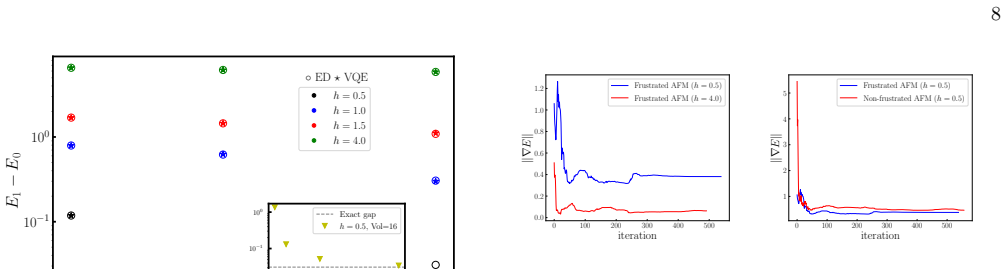
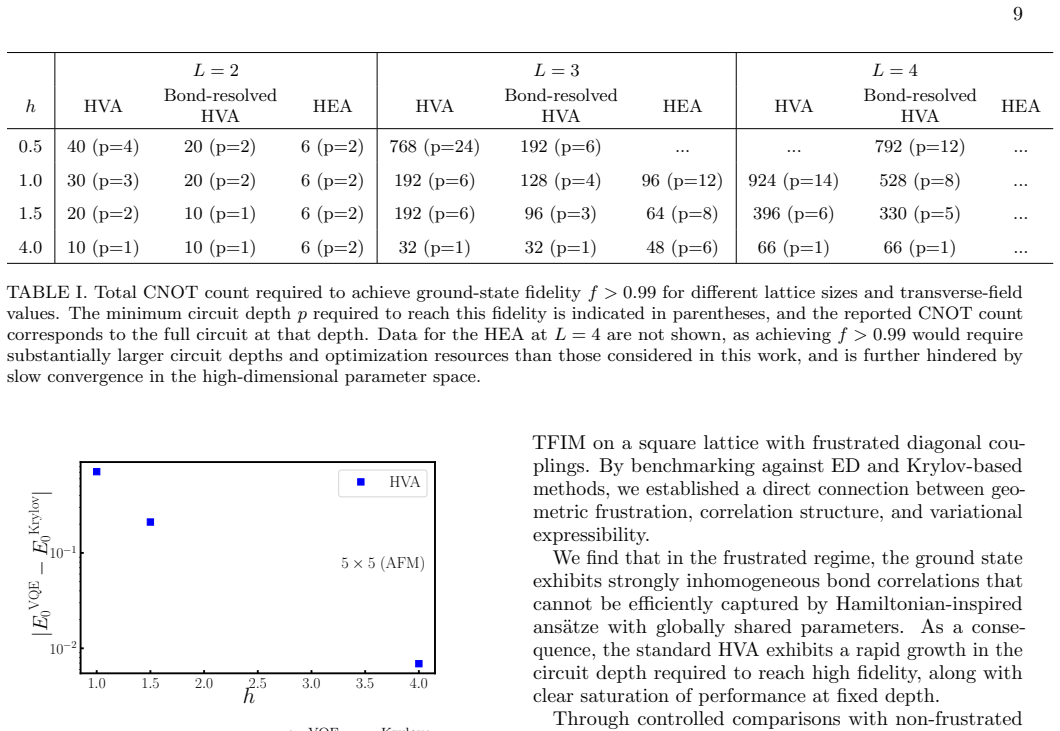
In the transverse-field Ising model on a square lattice with frustrated diagonal coupling, geometric frustration induces strongly inhomogeneous spin correlations that standard Hamiltonian-inspired ansatze with only global variational parameters cannot capture, causing required circuit depth to increase markedly in the intermediate-field regime; the limitation is one of expressibility, confirmed by the lack of barren plateaus and by performance recovery when bond-resolved parameters are introduced.
What carries the argument
Bond-resolved variational parameters that locally adapt to the inhomogeneous correlations generated by geometric frustration.
If this is right
- Global-parameter ansatze require significantly deeper circuits for accurate approximation in the intermediate transverse-field regime.
- Near-degenerate low-energy spectra in frustrated regimes add further difficulties for variational ground-state preparation.
- Bond-resolved parameters recover accurate results at reduced circuit depth by accommodating local inhomogeneity.
- The expressibility barrier appears where frustration produces strong spatial variation in correlations.
Where Pith is reading between the lines
- Ansatz construction for quantum simulation of frustrated materials should prioritize locality in variational parameters to match competing interactions.
- Comparable depth increases may occur in other frustrated lattices whose geometry produces analogous correlation inhomogeneity.
- Pre-identifying frustrated bonds classically before parameter assignment could be tested as a hybrid mitigation strategy.
Load-bearing premise
Numerical evidence on this specific model cleanly isolates expressibility shortfalls from optimization difficulties such as barren plateaus, and the chosen frustrated Ising instance represents essential features of wider frustrated many-body systems.
What would settle it
An explicit optimization run or expressivity calculation showing that the global-parameter ansatz reaches the same accuracy as the bond-resolved version at shallow depth without further circuit resources would falsify the expressibility-limitation claim.
Figures





read the original abstract
Geometric frustration, arising from competing interactions that prevent simultaneous energy minimization, presents a fundamental challenge for variational quantum algorithms applied to quantum many-body systems. We investigate the transverse-field Ising model on a square lattice with frustrated diagonal coupling and show that geometric frustration leads to strongly inhomogeneous correlations that are difficult to capture using standard Hamiltonian-inspired ans\"atze with global parameters. As a result, the required circuit depth increases significantly in the intermediate-field regime. We demonstrate that this limitation is not caused by optimization difficulties such as barren plateaus, but instead arises from insufficient expressibility of the ansatz. By introducing bond-resolved variational parameters, we recover accurate results at reduced circuit depth. We also study low-energy excitations and find that near-degenerate spectra in the frustrated regime further challenge variational methods. Our results provide a clear physical explanation for the limitations of variational quantum algorithms in frustrated systems and suggest improved ansatz design strategies for quantum simulation.
Editorial analysis
A structured set of objections, weighed in public.
Referee Report
Summary. The paper claims that geometric frustration in the transverse-field Ising model on a square lattice with added diagonal couplings produces strongly inhomogeneous correlations that standard Hamiltonian-inspired variational ansatze (with globally shared parameters) cannot efficiently represent. This forces a substantial increase in circuit depth in the intermediate-field regime. The authors assert that the limitation is one of expressibility rather than optimization (e.g., barren plateaus), because introducing bond-resolved variational parameters recovers accurate ground-state energies at shallower depths. They additionally examine low-energy excitations and note that near-degenerate spectra in the frustrated regime pose further challenges for variational methods.
Significance. If the separation between expressibility and optimization difficulties is convincingly demonstrated, the work supplies a concrete physical mechanism for the known difficulties of VQAs on frustrated Hamiltonians and a practical ansatz-design heuristic (bond-resolved parameters). The numerical study on a specific lattice model is a useful data point; however, the generality of the conclusion would be strengthened by additional models or an analytic argument. The paper does not claim machine-checked proofs or parameter-free derivations.
major comments (2)
- [Abstract and §4] Abstract and §4 (or the section presenting the bond-resolved ansatz): the claim that the observed depth requirement is due to expressibility rather than optimization is not yet load-bearing. Increasing the number of variational parameters per layer simultaneously enlarges the representable manifold and changes the loss landscape; without an independent expressibility diagnostic (e.g., rank of the quantum Fisher information matrix for the global-parameter ansatz or the minimal fidelity achievable by exhaustive search over its parameters), the performance gap between global and bond-resolved ansatze could still contain an optimization component. Explicit checks that the global ansatz reaches its theoretical minimum under multiple optimizers would be required to isolate the effect.
- [§3] §3 (numerical results on the frustrated TFIM): the statement that the transverse-field Ising model with frustrated diagonal coupling is representative of broader frustrated many-body systems is asserted but not tested. A second, qualitatively different frustrated Hamiltonian (e.g., the J1-J2 Heisenberg model or a triangular-lattice Ising model) should be examined to establish that the inhomogeneous-correlation mechanism and the bond-resolved fix are not model-specific.
minor comments (2)
- [Figures] Figure captions and axis labels should explicitly state the system size, the precise definition of the frustration parameter, and whether error bars represent statistical or optimization uncertainty.
- [Methods] The notation for the bond-resolved parameters (e.g., whether each bond type receives an independent angle or a small set of angles) should be defined once in the main text rather than only in the supplementary material.
Simulated Author's Rebuttal
We thank the referee for the careful reading of our manuscript and the constructive feedback. We address each major comment below, indicating where revisions will be made to strengthen the presentation.
read point-by-point responses
-
Referee: [Abstract and §4] Abstract and §4 (or the section presenting the bond-resolved ansatz): the claim that the observed depth requirement is due to expressibility rather than optimization is not yet load-bearing. Increasing the number of variational parameters per layer simultaneously enlarges the representable manifold and changes the loss landscape; without an independent expressibility diagnostic (e.g., rank of the quantum Fisher information matrix for the global-parameter ansatz or the minimal fidelity achievable by exhaustive search over its parameters), the performance gap between global and bond-resolved ansatze could still contain an optimization component. Explicit checks that the global ansatz reaches its theoretical minimum under multiple optimizers would be required to isolate the effect.
Authors: We agree that the separation between expressibility limitations and optimization challenges requires stronger supporting evidence. In the revised version we will add, in §4, the rank of the quantum Fisher information matrix evaluated for the global-parameter ansatz across the intermediate-field regime; this will show that the effective dimension of the representable manifold is substantially reduced relative to the bond-resolved case. We will also report the lowest energies obtained by the global ansatz under three distinct optimizers (Adam, L-BFGS, and natural gradient) with multiple random initializations, confirming that the ansatz consistently fails to reach the energies attained by the bond-resolved ansatz even when optimization is exhaustive. These additions will make the expressibility argument load-bearing without altering the original numerical results. revision: partial
-
Referee: [§3] §3 (numerical results on the frustrated TFIM): the statement that the transverse-field Ising model with frustrated diagonal coupling is representative of broader frustrated many-body systems is asserted but not tested. A second, qualitatively different frustrated Hamiltonian (e.g., the J1-J2 Heisenberg model or a triangular-lattice Ising model) should be examined to establish that the inhomogeneous-correlation mechanism and the bond-resolved fix are not model-specific.
Authors: We selected the square-lattice TFIM with diagonal frustration because it permits exact diagonalization benchmarks while clearly isolating the effect of geometric frustration on bond-dependent correlations. The physical mechanism—competing interactions that produce strongly inhomogeneous two-point functions—is expected to be generic to geometrically frustrated lattices. We will expand the concluding section to articulate this generality and reference analogous behavior reported for other frustrated models in the literature. A complete numerical investigation of an additional Hamiltonian such as the J1-J2 Heisenberg model, however, lies outside the scope of the present study. revision: no
- Full numerical examination of a second, qualitatively different frustrated Hamiltonian (e.g., J1-J2 Heisenberg) to demonstrate that the inhomogeneous-correlation mechanism is not model-specific.
Circularity Check
No significant circularity detected
full rationale
The paper's arguments rest on numerical simulations of the transverse-field Ising model with added diagonal frustration, comparing global-parameter ansätze against bond-resolved variants to argue for expressibility limits rather than optimization issues. No derivation chain reduces a claimed result to its own inputs by construction, no parameters are fitted to a subset and then relabeled as predictions, and no load-bearing uniqueness theorems or ansätze are imported via self-citation. The central separation of expressibility from barren-plateaus effects is asserted via direct comparison of circuit depths and accuracies on concrete Hamiltonians, which remains an empirical claim rather than a self-referential definition.
Axiom & Free-Parameter Ledger
axioms (2)
- standard math Standard assumptions of quantum mechanics and the variational principle for ground-state approximation
- domain assumption The chosen square-lattice Ising model with frustrated diagonal coupling adequately represents geometric frustration effects
Reference graph
Works this paper leans on
-
[1]
Quantum Computing in the NISQ era and beyond.Quantum, 2:79, August 2018
J. Preskill, Quantum Computing in the NISQ era and beyond, Quantum2, 79 (2018), arXiv:1801.00862 [quant- ph]
work page internal anchor Pith review Pith/arXiv arXiv 2018
-
[2]
A. Peruzzo, J. McClean, P. Shadbolt, M.-H. Yung, X.-Q. Zhou, P. J. Love, A. Aspuru-Guzik, and J. L. O’Brien, A variational eigenvalue solver on a photonic quantum pro- cessor, Nature Commun.5, 4213 (2014), arXiv:1304.3061 [quant-ph]
-
[3]
Tillyet al., The Variational Quantum Eigensolver: A review of methods and best practices, Phys
J. Tillyet al., The Variational Quantum Eigensolver: A review of methods and best practices, Phys. Rept.986, 1 (2022), arXiv:2111.05176 [quant-ph]
-
[4]
A Quantum Approximate Optimization Algorithm
E. Farhi, J. Goldstone, and S. Gutmann, A quantum ap- proximate optimization algorithm (2014), arXiv:1411.4028 [quant-ph]
work page internal anchor Pith review Pith/arXiv arXiv 2014
-
[5]
L. Zhou, S.-T. Wang, S. Choi, H. Pichler, and M. D. Lukin, Quantum Approximate Optimization Al- gorithm: Performance, Mechanism, and Implementation on Near-Term Devices, Phys. Rev. X10, 021067 (2020), arXiv:1812.01041 [quant-ph]
- [6]
- [7]
- [8]
-
[9]
A. Kirmani, E. Pelofske, A. B¨ artschi, S. Eidenbenz, and J.-X. Zhu, Variational quantum simulations of a two-dimensional frustrated transverse-field ising model on a trapped-ion quantum computer, arXiv (2025), arXiv:2505.22932
- [10]
-
[11]
O. Higgott, D. Wang, and S. Brierley, Variational Quan- tum Computation of Excited States, Quantum3, 156 (2019), arXiv:1805.08138 [quant-ph]
-
[12]
G. H. Wannier, Antiferromagnetism. the triangular ising net, Phys. Rev.79, 357 (1950)
1950
-
[13]
Moessner, S
R. Moessner, S. L. Sondhi, and P. Chandra, Two- dimensional periodic frustrated ising models in a trans- verse field, Phys. Rev. Lett.84, 4457 (2000)
2000
-
[14]
Moessner and S
R. Moessner and S. L. Sondhi, Ising models of quantum frustration, Phys. Rev. B63, 224401 (2001)
2001
-
[15]
S. V. Isakov and R. Moessner, Interplay of quantum and thermal fluctuations in a frustrated magnet, Phys. Rev. B68, 104409 (2003)
2003
-
[16]
Hamer and W
C. Hamer and W. Zheng,Series expansion methods for strongly interacting lattice models(Cambridge University Press, 2011)
2011
-
[17]
A. Kandala, A. Mezzacapo, K. Temme, M. Takita, M. Brink, J. M. Chow, and J. M. Gambetta, Hardware- efficient variational quantum eigensolver for small molecules and quantum magnets, Nature549, 242 (2017), arXiv:1704.05018 [quant-ph]
- [18]
- [19]
-
[20]
M. Schuld and N. Killoran, Quantum Machine Learning in Feature Hilbert Spaces, Phys. Rev. Lett.122, 040504 (2019), arXiv:1803.07128 [quant-ph]
-
[21]
J. Yu, J. R. Moreno, J. T. Iosue, L. Bertels, D. Claudino, B. Fuller, P. Groszkowski, T. S. Humble, P. Jurce- vic, W. Kirby, T. A. Maier, M. Motta, B. Pokharel, A. Seif, A. Shehata, K. J. Sung, M. C. Tran, V. Tri- pathi, A. Mezzacapo, and K. Sharma, Quantum-centric algorithm for sample-based krylov diagonalization (2025), arXiv:2501.09702 [quant-ph]. Appe...
discussion (0)
Sign in with ORCID, Apple, or X to comment. Anyone can read and Pith papers without signing in.