Sub-nanosecond control for spin-defect quantum memories with a low-cost, compact FPGA platform
Pith reviewed 2026-05-10 16:33 UTC · model grok-4.3
The pith
Low-cost FPGA achieves 200 ps timing resolution for NV center control without hardware changes
A machine-rendered reading of the paper's core claim, the machinery that carries it, and where it could break.
Core claim
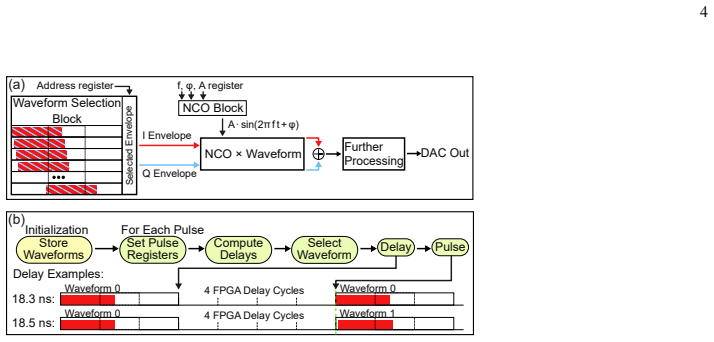
By extending the QICK framework with a waveform-offset method, the authors achieve an effective timing resolution of 200 ps on an RF system-on-chip FPGA device without any hardware modification. This capability supports dynamical decoupling spectroscopy on NV centers that resolves hyperfine interactions with individual 13C nuclear spins, features that remain undersampled at coarser timing granularities.
What carries the argument
The waveform-offset method, which shifts pulse start times relative to the FPGA clock to achieve finer effective timing resolution in pulse sequences
If this is right
- Enables precise extraction of hyperfine couplings of individual 13C nuclear spins
- Resolves spectral features that are otherwise undersampled with standard timing granularity
- Supports high-resolution device-level characterization of spin-based quantum memories
- Offers a scalable, inexpensive alternative to commercial arbitrary waveform generators
Where Pith is reading between the lines
- The same offset technique could be tested on other spin defects or superconducting qubits that need fine timing control
- Wider adoption might let smaller labs perform nanoscale sensing experiments previously limited by hardware cost
- Integration with real-time feedback loops on the same FPGA platform could enable adaptive pulse sequences
Load-bearing premise
The waveform-offset method produces artifact-free pulse sequences at the claimed sub-nanosecond resolution when applied to dynamical decoupling on NV centers
What would settle it
Repeating the dynamical decoupling measurements on the same NV-13C pair and obtaining hyperfine coupling values that differ by more than the reported uncertainty from literature values would indicate the effective resolution does not reach 200 ps
Figures


read the original abstract
Dynamical decoupling techniques are widely used to characterize and control the environments of solid-state quantum defects, enabling solid-state quantum memories and nanoscale quantum sensors. However, resolution is often limited by the timing granularity of control hardware, which can undersample narrow spectral features and distort extracted parameters. Here, we demonstrate sub-nanosecond timing control on an inexpensive FPGA-based platform by extending the open-source QICK (Quantum Instrumentation Control Kit) framework using a waveform-offset method. This approach achieves an effective timing resolution of 200~ps on an RF system-on-chip device without modification to the underlying hardware. We apply this capability to dynamical decoupling spectroscopy of nitrogen-vacancy centers in diamond, enabling precise extraction of hyperfine couplings of individual $^{13}\mathrm{C}$ nuclear spins and resolving spectral features that are otherwise undersampled. These results demonstrate that high-resolution, device-level characterization of spin-based quantum memories can be achieved using flexible, inexpensive control hardware, providing a scalable alternative to commercial arbitrary waveform generators.
Editorial analysis
A structured set of objections, weighed in public.
Referee Report
Summary. The manuscript describes an extension of the open-source QICK framework implementing a waveform-offset method to achieve 200 ps effective timing resolution on an unmodified RF system-on-chip FPGA. This capability is demonstrated through dynamical decoupling spectroscopy on NV centers in diamond, enabling resolution of hyperfine couplings to individual 13C nuclear spins that were previously limited by hardware timing granularity.
Significance. If the central claim holds, the result provides a practical, low-cost route to sub-nanosecond control for spin-defect experiments, reducing reliance on expensive arbitrary waveform generators while maintaining flexibility through open-source software. The experimental demonstration on real NV-center DD spectra and the emphasis on scalable hardware are clear strengths that could broaden access to high-resolution quantum memory characterization and nanoscale sensing.
major comments (1)
- [§3.2] §3.2 (Waveform-Offset Implementation and Validation): The central claim that the offset method delivers artifact-free 200 ps timing steps for DD pulse sequences rests on the assumption that residual amplitude, phase, or jitter distortions are negligible compared with 13C nuclear-spin linewidths. However, the manuscript provides no oscilloscope-captured waveforms, rise-time measurements, or quantitative fidelity metrics (e.g., integrated pulse error) at the offset granularity; the supporting evidence is limited to the resulting spectra. This validation gap is load-bearing because uncharacterized hardware response could contribute to the observed spectral sharpening.
minor comments (2)
- [Figure 4] Figure 4 (DD spectra): Error bars or uncertainty estimates are absent from the data points, preventing quantitative assessment of whether the resolved hyperfine features exceed the noise floor or linewidth.
- [§4.1] §4.1 (Hyperfine Extraction): The fitting procedure for the 13C couplings is described only at a high level; explicit values of the fit parameters, covariance matrix, or comparison to literature values would strengthen the claim of 'precise extraction'.
Simulated Author's Rebuttal
We thank the referee for the positive assessment of the work's significance and for the detailed comment regarding validation of the waveform-offset method. We address the concern point by point below.
read point-by-point responses
-
Referee: [§3.2] §3.2 (Waveform-Offset Implementation and Validation): The central claim that the offset method delivers artifact-free 200 ps timing steps for DD pulse sequences rests on the assumption that residual amplitude, phase, or jitter distortions are negligible compared with 13C nuclear-spin linewidths. However, the manuscript provides no oscilloscope-captured waveforms, rise-time measurements, or quantitative fidelity metrics (e.g., integrated pulse error) at the offset granularity; the supporting evidence is limited to the resulting spectra. This validation gap is load-bearing because uncharacterized hardware response could contribute to the observed spectral sharpening.
Authors: We agree that direct hardware characterization at the 200 ps granularity would provide stronger support for the claim of artifact-free operation. While the dynamical decoupling spectra demonstrate the practical utility of the timing resolution through the clear resolution of individual 13C hyperfine couplings, this indirect evidence does leave open the possibility that hardware effects contribute to the observed sharpening. In the revised manuscript we will add oscilloscope-captured waveforms for representative offset values, together with rise-time measurements and quantitative fidelity metrics (including integrated amplitude and phase errors). These additions will confirm that residual distortions remain negligible relative to the nuclear-spin linewidths. revision: yes
Circularity Check
No circularity: direct hardware implementation and empirical test on NV centers
full rationale
The paper presents a waveform-offset extension to the open-source QICK framework that achieves 200 ps effective timing resolution on an unmodified RF SoC. This is applied to dynamical-decoupling spectroscopy of NV centers to resolve 13C hyperfine couplings. No equations, fitted parameters, or self-citations are shown to reduce the central claim to its own inputs by construction. The result is an empirical demonstration of improved spectral resolution whose validity rests on physical measurements rather than definitional loops or renamed fits.
Axiom & Free-Parameter Ledger
axioms (1)
- domain assumption Standard assumptions of quantum mechanics for spin-1/2 systems and dynamical decoupling sequences in solid-state defects
Reference graph
Works this paper leans on
-
[1]
Long-distance quantum communication with atomic ensembles and linear optics,
L.-M. Duan, M. D. Lukin, J. I. Cirac, and P. Zoller, “Long-distance quantum communication with atomic ensembles and linear optics,”Nature, vol. 414, no. 6862, pp. 413–418, Nov. 2001. [Online]. Available: https://www.nature.com/articles/35106500
-
[2]
Quantum memories: emerging applications and recent advances,
K. Heshami, D. G. England, P. C. Humphreys, P. J. Bustard, V . M. Acosta, J. Nunn, and B. J. Sussman, “Quantum memories: emerging applications and recent advances,”Journal of Modern Optics, vol. 63, no. 20, pp. 2005–2028, Nov
work page 2005
-
[3]
[Online]. Available: https://doi.org/10.1080/09500340.2016.1148212
-
[4]
Quantum repeaters: From quantum networks to the quantum internet,
K. Azuma, S. E. Economou, D. Elkouss, P. Hilaire, L. Jiang, H.-K. Lo, and I. Tzitrin, “Quantum repeaters: From quantum networks to the quantum internet,”Reviews of Modern Physics, vol. 95, no. 4, p. 045006, Dec. 2023. [Online]. Available: https://link.aps.org/doi/10.1103/RevModPhys.95.045006
-
[5]
Detection and Control of Individual Nuclear Spins Using a Weakly Coupled Electron Spin,
T. H. Taminiau, J. J. T. Wagenaar, T. van der Sar, F. Jelezko, V . V . Dobrovitski, and R. Hanson, “Detection and Control of Individual Nuclear Spins Using a Weakly Coupled Electron Spin,”Physical Review Letters, vol. 109, no. 13, p. 137602, Sep. 2012. [Online]. Available: https://link.aps.org/doi/10.1103/PhysRevLett.109.137602
-
[6]
Precise Control of Entanglement in Multinuclear Spin Registers Coupled to Defects,
E. Takou, E. Barnes, and S. E. Economou, “Precise Control of Entanglement in Multinuclear Spin Registers Coupled to Defects,”Physical Review X, vol. 13, no. 1, p. 011004, Jan. 2023. [Online]. Available: https://link.aps.org/doi/10.1103/PhysRevX.13.011004 14
-
[7]
Quantifying electron-nuclear spin entanglement dynamics in central-spin systems using one-tangles,
I. Gnasso, K. Sarguroh, D. Gangloff, S. E. Economou, and E. Barnes, “Quantifying electron-nuclear spin entanglement dynamics in central-spin systems using one-tangles,”Physical Review B, vol. 113, no. 13, p. 134301, Apr. 2026. [Online]. Available: https://doi.org/10.1103/nh1j-kv5k
-
[8]
Single-gate, multipartite entanglement on a room-temperature quantum register,
J. D. Minnella, M. Ouellet, A. R. Klein, and L. C. Bassett, “Single-gate, multipartite entanglement on a room-temperature quantum register,” Feb. 2026, arXiv:2508.08465 [quant-ph]. [Online]. Available: http://arxiv.org/abs/2508.08465
-
[9]
Sensing single remote nuclear spins,
N. Zhao, J. Honert, B. Schmid, M. Klas, J. Isoya, M. Markham, D. Twitchen, F. Jelezko, R.-B. Liu, H. Fedder, and J. Wrachtrup, “Sensing single remote nuclear spins,”Nature Nanotechnology, vol. 7, no. 10, pp. 657–662, Oct. 2012. [Online]. Available: https://www.nature.com/articles/nnano.2012.152
work page 2012
-
[10]
Dynamical decoupling sequence construction as a filter-design problem,
M. J. Biercuk, A. C. Doherty, and H. Uys, “Dynamical decoupling sequence construction as a filter-design problem,” Journal of Physics B: Atomic, Molecular and Optical Physics, vol. 44, no. 15, p. 154002, Jul. 2011. [Online]. Available: https://doi.org/10.1088/0953-4075/44/15/154002
-
[11]
Noise spectroscopy of a quantum-classical environment with a diamond qubit,
S. Hern ´andez-G´omez, “Noise spectroscopy of a quantum-classical environment with a diamond qubit,”Physical Review B, vol. 98, no. 21, 2018
work page 2018
-
[12]
C. Ding, M. D. Federico, M. Hatridge, A. Houck, S. Leger, J. Martinez, C. Miao, D. I. Schuster, L. Stefanazzi, C. Stoughton, S. Sussman, K. Treptow, S. Uemura, N. Wilcer, H. Zhang, C. Zhou, and G. Cancelo, “Experimental advances with the QICK (Quantum Instrumentation Control Kit) for superconducting quantum hardware,”Physical Review Research, vol. 6, no. ...
-
[13]
E. G. Riendeau, L. Basso, J. J. Mah, R. Cong, M. A. Sadi, J. Henshaw, K. M. Azizur-Rahman, A. Jones, G. Joshi, M. P. Lilly, and A. A. Mounce, “Quantum Instrumentation Control Kit – Defect Arbitrary Waveform Generator (QICK-DAWG): A Quantum Sensing Control Framework for Quantum Defects,” Nov. 2023, arXiv:2311.18253 [quant-ph]. [Online]. Available: http://a...
-
[14]
ARTIQ and Sinara: Open Software and Hardware Stacks for Quantum Physics,
G. Kasprowicz, P. Kulik, M. Gaska, T. Przywozki, K. Pozniak, J. Jarosinski, J. W. Britton, T. Harty, C. Balance, W. Zhang, D. Nadlinger, D. Slichter, D. Allcock, S. Bourdeauducq, R. J ¨ordens, and K. Pozniak, “ARTIQ and Sinara: Open Software and Hardware Stacks for Quantum Physics,” inOSA Quantum 2.0 Conference (2020), paper QTu8B.14. Optica Publishing Gr...
work page 2020
-
[15]
Entanglement of nanophotonic quantum memory nodes in a telecom network,
C. M. Knaut, A. Suleymanzade, Y .-C. Wei, D. R. Assumpcao, P.-J. Stas, Y . Q. Huan, B. Machielse, E. N. Knall, M. Sutula, G. Baranes, N. Sinclair, C. De-Eknamkul, D. S. Levonian, M. K. Bhaskar, H. Park, M. Lon ˇcar, and M. D. Lukin, “Entanglement of nanophotonic quantum memory nodes in a telecom network,”Nature, vol. 629, no. 8012, pp. 573–578, May 2024. ...
work page 2024
-
[16]
P. Gundlapalli, P. J. Vetter, G. Genov, M. Olney-Fraser, P. Wang, M. M. M ¨uller, K. Senkalla, and F. Jelezko, “High-Fidelity Single-Shot Readout and Selective Nuclear Spin Control for a Spin-1/2 Quantum Register in Diamond,” Nov. 2025, arXiv:2510.09164 [quant-ph]. [Online]. Available: http://arxiv.org/abs/2510.09164
-
[17]
Control of Solid-State Nuclear Spin Qubits Using an Electron Spin-1/2,
H. K. C. Beukers, C. Waas, M. Pasini, H. B. van Ommen, Z. Ademi, M. Iuliano, N. Codreanu, J. M. Brevoord, T. Turan, T. H. Taminiau, and R. Hanson, “Control of Solid-State Nuclear Spin Qubits Using an Electron Spin-1/2,”Physical Review X, vol. 15, no. 2, p. 021011, Apr. 2025. [Online]. Available: https://link.aps.org/doi/10.1103/PhysRevX.15.021011
-
[18]
Nuclear spin quantum memory in silicon carbide,
B. Tissot, M. Trupke, P. Koller, T. Astner, and G. Burkard, “Nuclear spin quantum memory in silicon carbide,”Physical Review Research, vol. 4, no. 3, p. 033107, Aug. 2022. [Online]. Available: https://link.aps.org/doi/10.1103/PhysRevResearch.4.033107
-
[19]
Entanglement of a nuclear spin qubit register in silicon photonics,
H. Song, X. Zhang, L. Komza, N. Fiaschi, Y . Xiong, Y . Zhi, S. Dhuey, A. Schwartzberg, T. Schenkel, G. Hautier, Z.-H. Zhang, and A. Sipahigil, “Entanglement of a nuclear spin qubit register in silicon photonics,”Nature Nanotechnology, vol. 21, no. 1, pp. 53–57, Jan. 2026. [Online]. Available: https://www.nature.com/articles/s41565-025-02066-0
work page 2026
-
[20]
K. Li, V . D. Dergachev, I. D. Dergachev, S. Zhang, S. A. Varganov, and Y . Ping, “Excited-state dynamics and optically 15 detected magnetic resonance of solid-state spin defects from first principles,”Physical Review B, vol. 110, no. 18, p. 184302, Nov. 2024. [Online]. Available: https://link.aps.org/doi/10.1103/PhysRevB.110.184302
-
[21]
Dynamic 14Nnuclear spin polarization in nitrogen-vacancy centers in diamond,
L. Busaite, R. Lazda, A. Berzins, M. Auzinsh, R. Ferber, and F. Gahbauer, “Dynamic 14Nnuclear spin polarization in nitrogen-vacancy centers in diamond,”Physical Review B, vol. 102, no. 22, p. 224101, Dec. 2020. [Online]. Available: https://link.aps.org/doi/10.1103/PhysRevB.102.224101
-
[22]
Algorithmic decomposition for efficient multiple nuclear spin detection in diamond,
H. Oh, J. Yun, M. H. Abobeih, K.-H. Jung, K. Kim, T. H. Taminiau, and D. Kim, “Algorithmic decomposition for efficient multiple nuclear spin detection in diamond,”Scientific Reports, vol. 10, no. 1, p. 14884, Sep. 2020. [Online]. Available: https://www.nature.com/articles/s41598-020-71339-6
work page 2020
-
[23]
High-fidelity projective read-out of a solid-state spin quantum register,
L. Robledo, L. Childress, H. Bernien, B. Hensen, P. F. A. Alkemade, and R. Hanson, “High-fidelity projective read-out of a solid-state spin quantum register,”Nature, vol. 477, no. 7366, pp. 574–578, Sep. 2011. [Online]. Available: https://www.nature.com/articles/nature10401
work page 2011
-
[24]
Automatic Detection of Nuclear Spins at Arbitrary Magnetic Fields via Signal-to-Image AI Model,
B. Varona-Uriarte, “Automatic Detection of Nuclear Spins at Arbitrary Magnetic Fields via Signal-to-Image AI Model,” Physical Review Letters, vol. 132, no. 15, 2024
work page 2024
discussion (0)
Sign in with ORCID, Apple, or X to comment. Anyone can read and Pith papers without signing in.