Diffusing diffusivity model with dichotomous noise
Pith reviewed 2026-05-10 15:53 UTC · model grok-4.3
The pith
Modeling diffusivity as an Ornstein-Uhlenbeck process driven by symmetric dichotomous noise yields exact short-time displacement PDFs with logarithmic origin divergence and power-law modulated Gaussian tails.
A machine-rendered reading of the paper's core claim, the machinery that carries it, and where it could break.
Core claim
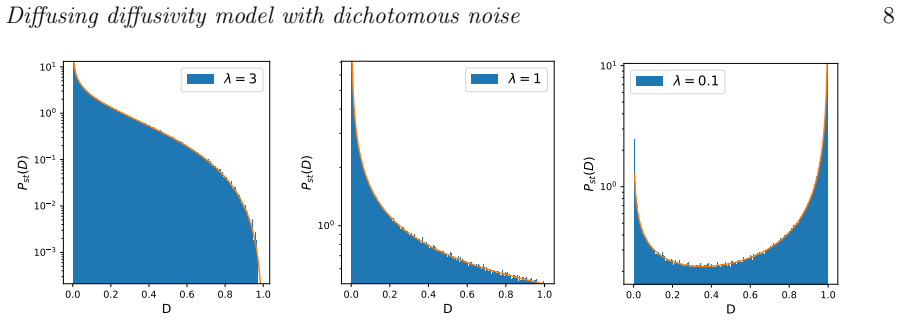
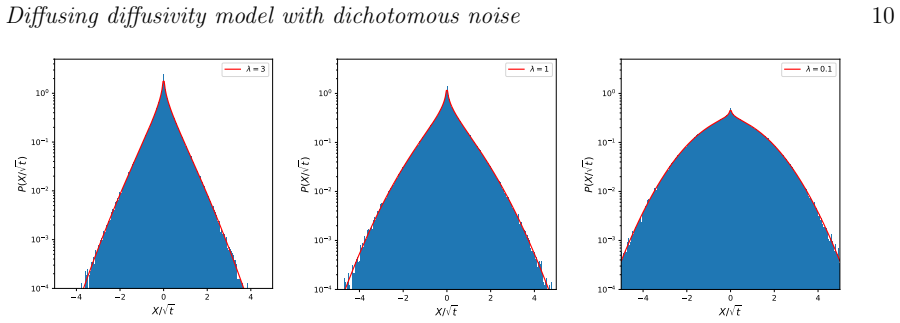
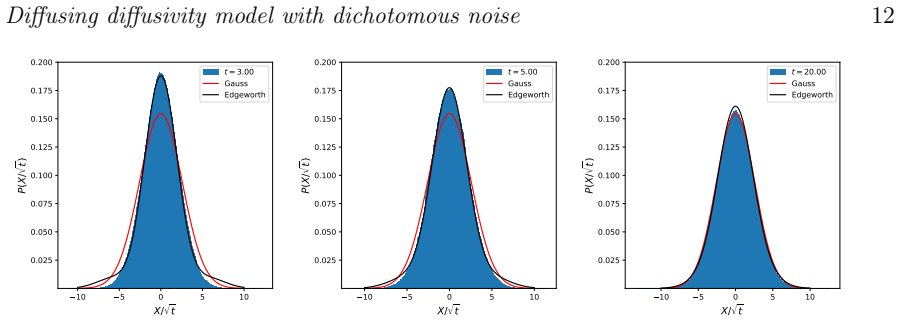
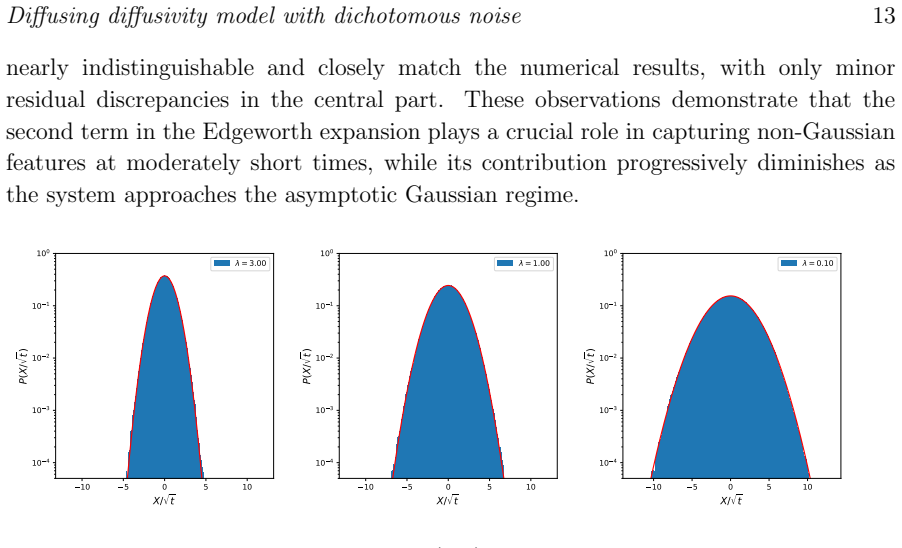
We derive analytical expressions for the short-time probability density function (PDF) of the particle displacement and analyse its asymptotic behaviour. While the PDF retains the characteristic logarithmic divergence at the origin, its tails differ from the Gaussian white-noise case: exponential tails are replaced by Gaussian ones modulated by a power-law with a switching-rate-dependent exponent. At long times, the dynamics converges to ordinary Gaussian diffusion. We determine the variance and covariance of the time-averaged stochastic diffusivity and show that it is self-averaging.
What carries the argument
The Ornstein-Uhlenbeck process for diffusivity driven by symmetric dichotomous noise, which confines diffusivity to a finite interval and enables analytical tractability.
If this is right
- Exact closed-form short-time PDFs are available for this bounded-diffusivity class of models.
- The tail exponent varies explicitly with the dichotomous switching rate, providing a direct experimental signature.
- Long-time dynamics recovers standard Gaussian diffusion with self-averaging statistics.
- The time-averaged diffusivity possesses finite variance and covariance.
Where Pith is reading between the lines
- The model offers a baseline for comparing against unbounded diffusivity fluctuations in heterogeneous media.
- Single-particle tracking experiments with abrupt environmental switches could detect the predicted power-law prefactors in displacement tails.
- Replacing the symmetric dichotomous driver with asymmetric or multi-state noise might generate further analytically solvable diffusion cases.
Load-bearing premise
The diffusivity is modeled as an Ornstein-Uhlenbeck process driven by symmetric dichotomous noise that confines it to a finite interval.
What would settle it
Measuring short-time particle displacement distributions in a system whose diffusivity switches between two bounded values and finding pure exponential tails rather than Gaussian tails multiplied by a power law would contradict the model's analytical predictions.
Figures
read the original abstract
We study Langevin dynamics with stochastic diffusivity arising from fluctuations of the surrounding medium. The diffusivity is modeled as Ornstein-Uhlenbeck process driven by symmetric dichotomous noise, which confines it to a finite interval. We derive analytical expressions for the short-time probability density function (PDF) of the particle displacement and analyse its asymptotic behaviour. While the PDF retains the characteristic logarithmic divergence at the origin, its tails differ from the Gaussian white-noise case: exponential tails are replaced by Gaussian ones modulated by a power-law with a switching-rate-dependent exponent. At long times, the dynamics converges to ordinary Gaussian diffusion. We determine the variance and covariance of the time-averaged stochastic diffusivity and show that it is self-averaging. The model provides a minimal analytically tractable framework for stochastic transport in environments with bounded or switching fluctuations.
Editorial analysis
A structured set of objections, weighed in public.
Referee Report
Summary. The manuscript studies Langevin dynamics with stochastic diffusivity modeled as an Ornstein-Uhlenbeck process driven by symmetric dichotomous noise that confines the diffusivity to a finite interval. It derives analytical expressions for the short-time PDF of particle displacement, analyzes the asymptotics (retaining logarithmic divergence at the origin but replacing exponential tails with Gaussian ones modulated by a switching-rate-dependent power law), shows convergence to ordinary Gaussian diffusion at long times, and proves self-averaging of the time-averaged diffusivity via variance and covariance calculations.
Significance. If the derivations hold, the work supplies a minimal, exactly solvable model for stochastic transport under bounded or switching fluctuations. The explicit short-time PDF asymptotics and the analytical demonstration of self-averaging constitute concrete, falsifiable advances over generic diffusing-diffusivity phenomenology.
minor comments (3)
- [Abstract and §3] The abstract and introduction state that analytical expressions and asymptotic analysis were derived, yet the main text should explicitly display the key steps of the coupled Fokker-Planck solution for the joint (position, diffusivity-state) process at short times, even if relegated to an appendix, to allow direct verification of the tail exponent.
- [Throughout] Notation for the switching rate and the diffusivity bounds should be introduced once with a single symbol table or consistent definition list; repeated re-definition of the same parameters across sections reduces readability.
- [§4] The long-time self-averaging proof relies on ergodicity of the two-state Markov chain; a brief remark on the mixing time relative to the observation window would clarify the regime of validity.
Simulated Author's Rebuttal
We thank the referee for the careful summary of our manuscript and the positive assessment of its significance. The recommendation for minor revision is noted. However, the report lists no specific major comments, so we have no individual points requiring point-by-point rebuttal or revision.
Circularity Check
Derivation follows directly from model equations with no circular reductions
full rationale
The paper solves the joint Markov process (particle position coupled to the two-state dichotomous driver of the OU diffusivity) via coupled Fokker-Planck equations to obtain exact short-time PDFs and their asymptotics, then invokes ergodicity of the finite-state Markov chain to establish long-time Gaussian diffusion and self-averaging of the time-averaged diffusivity. These steps are direct consequences of the stochastic process definition and do not reduce to pre-fitted parameters, self-citations, or ansatzes; the modeling choice is stated as enabling tractability rather than being justified by prior results from the same authors.
Axiom & Free-Parameter Ledger
free parameters (2)
- switching rate
- diffusivity bounds
axioms (2)
- domain assumption Particle obeys overdamped Langevin dynamics with stochastic diffusivity D(t)
- domain assumption D(t) is an Ornstein-Uhlenbeck process driven by symmetric dichotomous noise
Reference graph
Works this paper leans on
-
[1]
Wang B, Anthony S M, Bae S C and Granick S 2009PNAS10615160–15164
-
[2]
Jeon J H, Javanainen M, Martinez-Seara H, Metzler R and Vattulainen I 2016Phys. Rev. X6 021006
-
[3]
Guan J, Wang B and Granick S 2014ACS Nano83331–3336
-
[4]
Matse M, Chubynsky M V and Bechhoefer J 2017Phys. Rev. E96042604
-
[5]
Ciarlo A, Pastore R, Greco F, Sasso A and Pesce G 2023Sci Rep137408
-
[6]
Slezak J and Burov S 2021Sci Rep115101
-
[7]
Brizioli M, Sentjabrskaja T, Egelhaaf S U, Laurati M, Cerbino R and Giavazzi F 2022Front. Phys. 10
-
[8]
Kwon G, Sung B J and Yethiraj A 2014J. Phys. Chem. B1188128–8134
-
[9]
Akimoto T, Jeon J H, Metzler R, Miyaguchi T, Uneyama T and Yamamoto E 2026Rep. Prog. Phys.89014602
-
[10]
Chubynsky M V and Slater G W 2014Phys. Rev. Lett.113098302
-
[11]
Chechkin A V, Seno F, Metzler R and Sokolov I M 2017Phys. Rev. X7021002
-
[12]
Lanoisel´ ee Y and Grebenkov D S 2018J. Phys. A: Math. Theor.51145602
-
[13]
Sposini V, Chechkin A V, Seno F, Pagnini G and Metzler R 2018New J. Phys.20043044
-
[14]
Lanoisel´ ee Y, Moutal N and Grebenkov D S 2018Nat Commun94398
-
[15]
Sposini V, Grebenkov D S, Metzler R, Oshanin G and Seno F 2020New J. Phys.22063056
-
[16]
Jain R and Sebastian K L 2018Phys. Rev. E98052138
-
[17]
Grebenkov D S, Sposini V, Metzler R, Oshanin G and Seno F 2021J. Phys. A: Math. Theor.54 04LT01
-
[18]
Grebenkov D S, Sposini V, Metzler R, Oshanin G and Seno F 2021New J. Phys.23023014
-
[19]
Hidalgo-Soria M, Barkai E and Burov S 2021Entropy23231
-
[20]
Dean D S, Majumdar S N and Sabhapandit S 2025J. Phys. A: Math. Theor.58235002
-
[21]
Weron A, Burnecki K, Akin E J, Sol´ e L, Balcerek M, Tamkun M M and Krapf D 2017Sci Rep7 5404
-
[22]
Bressloff P C 2017J. Phys. A: Math. Theor.50133001
- [23]
- [24]
-
[25]
Hachiya Y, Uneyama T, Kaneko T and Akimoto T 2019J. Chem. Phys.151034502
-
[26]
Pastore R, Coniglio A and Ciamarra M P 2015Sci Rep511770
-
[27]
Miyaguchi T, Akimoto T and Yamamoto E 2016Phys. Rev. E94012109
-
[28]
Grebenkov D S 2019J. Phys. A: Math. Theor.52174001
-
[29]
Horsthemke W and Lefever R 2006Noise-Induced Transitions: Theory and Applications in Physics, Chemistry, and Biology(Springer Science & Business Media)
-
[30]
H¨ aunggi P and Jung P 1994 Colored Noise in Dynamical SystemsAdvances in Chemical Physics (John Wiley & Sons, Ltd) pp 239–326 ISBN 978-0-470-14148-9
work page 1994
-
[31]
Bena I 2006Int. J. Mod. Phys. B202825–2888
-
[32]
Gardiner C 2009Stochastic Methods: A Handbook for the Natural and Social Sciences(Springer Berlin Heidelberg)
-
[33]
Um J, Song T and Jeon J H 2019Front. Phys.7
-
[34]
Cox J C, Ingersoll J E and Ross S A 1985Econometrica53385–407
-
[35]
Stein E M and Stein J C 1991The Review of Financial Studies4727–752
-
[36]
Heston S L 1993Rev Financ Stud6327–343
-
[37]
Black F and Scholes M 1972The Journal of Finance27399–417
-
[38]
Black F and Scholes M 1973Journal of Political Economy81637–654
-
[39]
Bouchaud J P and Potters M 2003Theory of Financial Risk and Derivative Pricing: From Statistical Physics to Risk Management2nd ed (Cambridge: Cambridge University Press) Diffusing diffusivity model with dichotomous noise16
-
[40]
Tailleur J and Cates M E 2008Phys. Rev. Lett.100218103
-
[41]
Gu´ eneau M, Majumdar S N and Schehr G 2023J. Phys. A: Math. Theor.56475002
-
[42]
Sancho J M 1984J. Math. Phys.25354–359
-
[43]
Herbeau T, Pastur L, Viot P and Oshanin G 2026J. Stat. Mech.2026013205
-
[44]
Beck C and Cohen E G D 2003Physica A: Statistical Mechanics and its Applications322267–275
-
[45]
Bateman H 1955Higher Transcendental Functions
-
[46]
Feller W 1968An Introduction to Probability Theory and Its Applications, Volume 1(Wiley)
-
[47]
Kloeden P E and Platen E 1992Numerical Solution of Stochastic Differential Equations(Berlin, Heidelberg: Springer)
-
[48]
Higham D J 2001SIAM Rev.43525–546
-
[49]
Devroye L 1986Non-Uniform Random Variate Generation(New York, NY: Springer)
-
[50]
Brent R P 2013Algorithms for Minimization Without Derivatives(Courier Corporation)
-
[51]
Press W H 2007Numerical Recipes 3rd Edition: The Art of Scientific Computing(Cambridge University Press)
-
[52]
Shapiro V E and Loginov V M 1978Physica A: Statistical Mechanics and its Applications91 563–574 Appendix A. Numerical simulations In this appendix, we describe the numerical procedures used to simulate the stochastic dynamics and to evaluate the statistical properties of the position probability density function. Numerical simulations are performed using ...
discussion (0)
Sign in with ORCID, Apple, or X to comment. Anyone can read and Pith papers without signing in.