Finite temperature effects on g-modes of inviscid neutron stars
Pith reviewed 2026-05-10 16:49 UTC · model grok-4.3
The pith
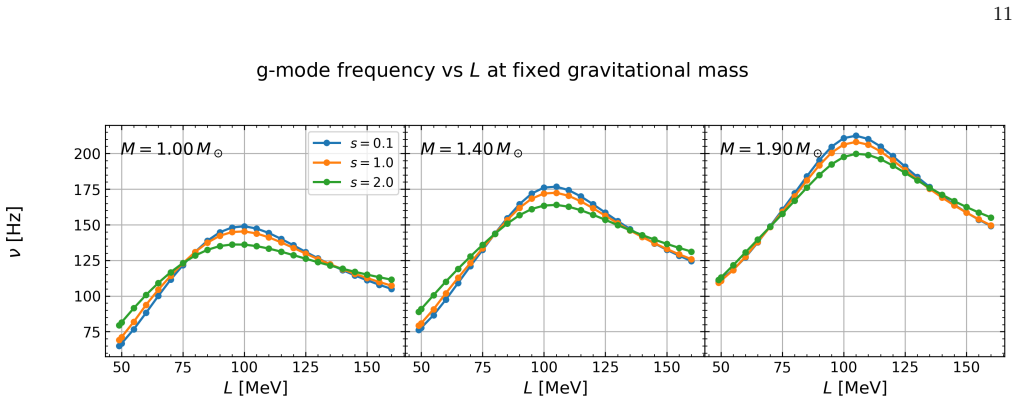
The temperature dependence of neutron star core g-mode frequencies is controlled by the symmetry energy slope L.
A machine-rendered reading of the paper's core claim, the machinery that carries it, and where it could break.
Core claim
The frequency of the global core g-mode's dependence on temperature is governed by the nuclear symmetry energy slope parameter L. As a result, the g-mode frequency of a warm neutron star can be either higher or lower than that of its cold counterpart, depending on L.
What carries the argument
The nuclear symmetry energy slope parameter L, which determines the sign of the temperature-induced shift in g-mode frequency through its effect on composition gradients in isentropic profiles.
If this is right
- G-mode observations of neutron stars at different temperatures could bound the density dependence of the symmetry energy.
- The sign of the frequency shift with temperature flips at a critical value of L, providing a diagnostic for the nuclear equation of state.
- Thermal effects on composition gradients must be included when modeling g-modes in hot or newly formed neutron stars.
Where Pith is reading between the lines
- If L can be extracted from g-mode data, it would tighten constraints on neutron-star cooling curves that also depend on the symmetry energy.
- The same L-controlled mechanism might appear in related oscillation modes or in the thermal evolution after neutron-star mergers.
Load-bearing premise
The isentropic temperature profiles from the chiral SU(2)_f sigma model accurately capture the thermal and compositional structure of real neutron-star cores at the relevant densities.
What would settle it
A direct measurement or upper limit on the g-mode frequency of a warm neutron star (for example in a young supernova remnant) that lies outside the range predicted for any reasonable L would contradict the claimed temperature dependence.
Figures



read the original abstract
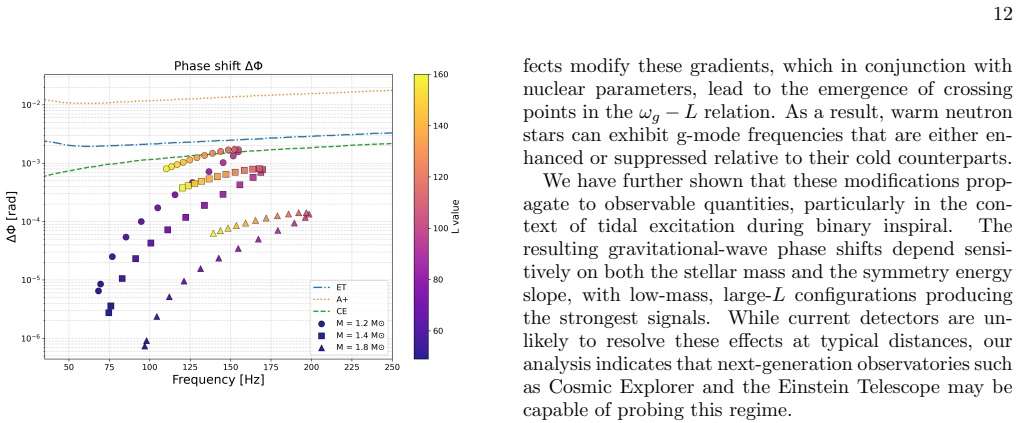
We study the effect of temperature on secular, compositional $g$-modes in the core of inviscid neutron stars. Using a chiral $SU(2)_f$ sigma model, we construct isentropic temperature profiles for hot and dense matter and find that the frequency of the global core $g$-mode's dependence on temperature is governed by the nuclear symmetry energy slope parameter $L$. As a result, the $g$-mode frequency of a warm neutron star can be either higher or lower than that of its cold counterpart, depending on $L$. Our results highlight the interplay of thermal effects and composition gradients, and demonstrate the potential of neutron star $g$-mode observations to constrain the density dependence of the symmetry energy.
Editorial analysis
A structured set of objections, weighed in public.
Referee Report
Summary. The manuscript examines finite-temperature effects on secular compositional g-modes in the cores of inviscid neutron stars. Using isentropic temperature profiles generated from a chiral SU(2)_f sigma model, it concludes that the temperature dependence of the global core g-mode frequency is governed by the nuclear symmetry energy slope parameter L, such that the g-mode frequency of a warm neutron star can be either higher or lower than its cold counterpart depending on the value of L. The work emphasizes the role of thermal effects on composition gradients and suggests that g-mode observations could help constrain the density dependence of the symmetry energy.
Significance. If the reported L-dependent sign flip in the g-mode frequency shift is robust, the result would illustrate a concrete link between nuclear symmetry energy and observable oscillation properties of warm neutron stars, offering a potential new constraint on the EOS at supranuclear densities. The consistent use of a single chiral effective model for both cold and finite-T matter is a methodological strength that avoids patchwork EOS constructions. However, the absence of cross-checks against other finite-temperature EOS families limits the generality of the claim that the sign of the shift is universally controlled by L.
major comments (2)
- [Results section (g-mode frequency calculations)] The central claim that the sign of the temperature-induced change in g-mode frequency is governed by L rests on the specific isentropic entropy-per-baryon profiles and resulting composition gradients (proton fraction, muons) produced by the chiral SU(2)_f sigma model. No comparison calculations with alternative finite-T EOS families (e.g., Skyrme or relativistic mean-field models) are presented, so it remains unclear whether the reported sign flip is a general feature or tied to model-specific thermal corrections to entropy and effective masses.
- [Abstract and Section 3] The abstract and main text state a clear dependence of the g-mode frequency on temperature via L but provide no explicit equations for the frequency shift, no error estimates on the sign change, and no validation against known zero-temperature limits or analytic expectations for the Brunt-Väisälä frequency integral. This makes independent verification of the load-bearing result difficult.
minor comments (1)
- [Methods] Notation for the symmetry energy slope L and its relation to the beta-equilibrium composition should be defined explicitly in the methods section for readers unfamiliar with the chiral model parameterization.
Simulated Author's Rebuttal
We thank the referee for their careful reading and valuable comments on our manuscript. We provide point-by-point responses to the major comments below and outline the revisions we plan to make.
read point-by-point responses
-
Referee: [Results section (g-mode frequency calculations)] The central claim that the sign of the temperature-induced change in g-mode frequency is governed by L rests on the specific isentropic entropy-per-baryon profiles and resulting composition gradients (proton fraction, muons) produced by the chiral SU(2)_f sigma model. No comparison calculations with alternative finite-T EOS families (e.g., Skyrme or relativistic mean-field models) are presented, so it remains unclear whether the reported sign flip is a general feature or tied to model-specific thermal corrections to entropy and effective masses.
Authors: We chose the chiral SU(2)_f sigma model to maintain a consistent description of both cold and finite-temperature matter within the same framework, avoiding inconsistencies that can arise from combining different EOS models. The dependence on L emerges from the way the symmetry energy influences the thermal evolution of the composition gradients in isentropic profiles. While this demonstrates the effect within a well-motivated model, we agree that the generality of the sign flip should be tested with other finite-temperature EOS. We will revise the manuscript to include a dedicated paragraph in the discussion section acknowledging this limitation and calling for future comparative studies with Skyrme and RMF models. revision: partial
-
Referee: [Abstract and Section 3] The abstract and main text state a clear dependence of the g-mode frequency on temperature via L but provide no explicit equations for the frequency shift, no error estimates on the sign change, and no validation against known zero-temperature limits or analytic expectations for the Brunt-Väisälä frequency integral. This makes independent verification of the load-bearing result difficult.
Authors: We appreciate this suggestion for improving clarity and verifiability. In the revised version, we will add the explicit formula for the g-mode frequency, which is the integral of the Brunt-Väisälä frequency over the stellar core as per the standard expression for the fundamental g-mode in the Cowling approximation. We will also include a direct comparison showing that our finite-temperature calculations reduce to the known zero-temperature g-mode frequencies when the entropy is set to zero. Additionally, we will provide numerical error estimates derived from convergence tests with respect to the number of radial grid points and variations in the entropy-per-baryon value. These additions will be incorporated into Section 3 and referenced in the abstract if space permits. revision: yes
Circularity Check
No significant circularity; parameter sensitivity study on L
full rationale
The paper constructs isentropic temperature profiles via the chiral SU(2)_f sigma model, then computes global core g-mode frequencies for hot versus cold stars while varying the input parameter L (nuclear symmetry energy slope). The reported result—that the sign of the temperature-induced frequency shift depends on L—is the direct numerical outcome of this variation and the resulting changes in composition gradients and Brunt-Väisälä frequency. No step reduces a claimed prediction to a fitted quantity by construction, nor does any central premise rest on a self-citation chain, imported uniqueness theorem, or smuggled ansatz. The derivation chain is self-contained: standard g-mode equations are applied to EOS tables generated from the model at different L values. This is a conventional sensitivity analysis, not a circular reduction.
Axiom & Free-Parameter Ledger
free parameters (1)
- L (symmetry energy slope)
axioms (2)
- domain assumption Isentropic temperature profiles accurately represent thermal structure in neutron-star cores
- domain assumption The chiral SU(2)_f sigma model provides a reliable equation of state for hot, dense, beta-equilibrated matter
Reference graph
Works this paper leans on
-
[1]
F. Gittins and N. Andersson, Neutron-star seismology with realistic, finite-temperature nuclear matter, Physi- cal Review D111, 10.1103/physrevd.111.083024 (2025)
- [2]
-
[3]
J. A. Font, Gravitational Waves from Neutron Stars: De- tection Prospects and Inferences for Two Distinct Types of Remnants, Acta Physica Polonica B56, 1 (2025)
work page 2025
-
[4]
W. Dong and A. Melatos, Gravitational waves from non-radial oscillations of stochastically accreting neutron stars, Monthly Notices of the Royal Astronomical Society530, 2822 (2024), https://academic.oup.com/mnras/article- 13 pdf/530/3/2822/57369954/stae1028.pdf
work page 2024
-
[5]
H. H.-Y. Ng, P. C.-K. Cheong, L.-M. Lin, and T. G. F. Li, Gravitational-wave asteroseismology with f-modes from neutron star binaries at the merger phase, The Astro- physical Journal915, 108 (2021)
work page 2021
-
[6]
N. Andersson and K. D. Kokkotas, Towards gravitational wave asteroseismology, Living Reviews in Relativity1, 1 (1998)
work page 1998
-
[7]
N. Andersson, A new class of unstable modes of rotat- ing relativistic stars, The Astrophysical Journal502, 708 (1998)
work page 1998
-
[8]
V. Paschalidis and N. Stergioulas, Rotating stars in rel- ativity, Living Reviews in Relativity20, 7 (2017)
work page 2017
-
[9]
F. Gittins and N. Andersson, Gravitational-wave astero- seismology of neutron stars, Physical Review D (2025), accepted
work page 2025
-
[10]
A. Reisenegger and P. Goldreich, A new class of g-modes of neutron stars, The Astrophysical Journal395, 240 (1992)
work page 1992
-
[11]
LIGO Scientific Collaboration, Virgo Collaboration, and KAGRA Collaboration, Gwtc-3: Compact binary coales- cences observed by ligo and virgo during the second part of the third observing run, Physical Review X13, 041039 (2023)
work page 2023
-
[12]
H. Y. Yu and N. N. Weinberg, Resonant tidal excitation of neutron star oscillation modes in coalescing binaries, Monthly Notices of the Royal Astronomical Society464, 2622 (2017)
work page 2017
- [13]
-
[14]
V. Ferrari, L. Gualtieri, and J. A. Pons, Unsta- ble g-modes in proto-neutron stars, Monthly Notices of the Royal Astronomical Society382, 1264 (2007), arXiv:0709.0403
-
[15]
A. Torres-Forn´ e, E. Cuoco, J. A. Font, and J. A. Pons, Gravitational wave asteroseismology of proto-neutron stars, Monthly Notices of the Royal Astronomical Society 482, 3967 (2019)
work page 2019
-
[16]
A. Bauswein and H.-T. Janka, Measuring neutron-star properties via gravitational waves from neutron-star mergers, Physical Review Letters108, 011101 (2012)
work page 2012
-
[17]
S. Reyes and D. A. Brown, Constraints on nonlinear tides due top-gmode coupling from the neutron-star merger gw170817, Physical Review D98, 063016 (2018), arXiv:1808.07013
-
[18]
N. Andersson and P. Pnigouras, The g-modes of neutron stars with composition gradients, Monthly Notices of the Royal Astronomical Society489, 4043 (2019)
work page 2019
-
[19]
D. Lai, Resonant oscillations and tidal heating in coa- lescing binary neutron stars, The Astrophysical Journal 437, 742 (1994)
work page 1994
-
[20]
P. N. McDermott, H. M. van Horn, and C. J. Hansen, Nonradial oscillations of neutron stars, The Astrophysi- cal Journal325, 725 (1988)
work page 1988
-
[21]
C. J. Xiaet al., Probing neutron star inner crust with g- mode oscillations, Physical Review D111, 103019 (2025)
work page 2025
-
[22]
V. Ferrari, G. Miniutti, and J. A. Pons, Gravitational waves from newly born, hot neutron stars, Monthly No- tices of the Royal Astronomical Society342, 629 (2003), arXiv:astro-ph/0210581 [astro-ph]
- [23]
-
[24]
T. Zhao, P. B. Rau, A. Haber, S. P. Harris, C. Constanti- nou, and S. Han, Suppression of composition g-modes in chemically equilibrating warm neutron stars, The Astro- physical Journal993, 161 (2025)
work page 2025
-
[25]
A. Semposki, P. Jaikumar, M. Prakash, and C. Con- stantinou, g-mode oscillations in hybrid stars: A tale of two sounds, Physical Review D103, 123009 (2021)
work page 2021
-
[26]
A. R. Counsell, F. Gittins, N. Andersson, and P. Pnigouras, Neutron star g modes in the relativistic cowling approximation, Monthly Notices of the Royal As- tronomical Society536, 1967 (2025)
work page 1967
-
[27]
V. Tran, S. Ghosh, N. Lozano, D. Chatterjee, and P. Jaikumar, g-mode oscillations in neutron stars with hyperons, Physical Review C108, 015803 (2023)
work page 2023
-
[28]
A. Guha, D. Sen, and C. H. Hyun, Non-radial oscillations of hadronic neutron stars, quark stars, and hybrid stars: calculation of f, p, and g mode frequencies, European Physical Journal C85, 442 (2025)
work page 2025
-
[29]
T. Zhao and J. M. Lattimer, Universal relations for neu- tron star f- and g-mode oscillations, Physical Review D 106, 123002 (2022)
work page 2022
-
[30]
P. K. Sahu and A. Ohnishi, Su(2) chiral sigma model and properties of neutron stars, Prog. Theor. Phys.104, 1163 (2000)
work page 2000
-
[31]
P. K. Sahu, R. Basu, and B. Datta, High-density matter in the chiral sigma model, Astrophysical Journal416, 267 (1993)
work page 1993
-
[32]
P. K. Sahu, T. K. Jha, K. C. Panda, and S. K. Patra, Hot nuclear matter in asymmetry chiral sigma model, Nucl. Phys. A733, 169 (2004)
work page 2004
- [33]
- [34]
-
[35]
S. Kunkel, S. Wystub, and J. Schaffner-Bielich, Deter- mining the minimal mass of a proto-neutron star with chirally constrained nuclear equations of state, Physical Review C111, 10.1103/physrevc.111.035807 (2025)
-
[36]
Prakash, Composition and structure of protoneutron stars, Physics Reports280, 1–77 (1997)
M. Prakash, Composition and structure of protoneutron stars, Physics Reports280, 1–77 (1997)
work page 1997
-
[37]
A. Steiner, M. Prakash, and J. Lattimer, Quark-hadron phase transitions in young and old neutron stars, Physics Letters B486, 239 (2000)
work page 2000
-
[38]
M. Mariani, M. Orsaria, and H. Vucetich, Constant en- tropy hybrid stars: a first approximation of cooling evo- lution, Astronomy & Astrophysics601, A21 (2017)
work page 2017
-
[39]
H. Shen, H. Toki, K. Oyamatsu, and K. Sumiyoshi, Relativistic equation of state of nuclear matter for su- pernova explosion, Progress of Theoretical Physics100, 1013–1031 (1998)
work page 1998
-
[40]
U. Garg and G. Col` o, The compression-mode giant reso- nances and nuclear incompressibility, Progress in Particle and Nuclear Physics101, 55–95 (2018)
work page 2018
- [41]
-
[42]
2017, Equations of state for supernovae and compact stars, Rev
M. Oertel, M. Hempel, T. Kl¨ ahn, and S. Typel, Equa- tions of state for supernovae and compact stars, Reviews of Modern Physics89, 10.1103/revmodphys.89.015007 (2017)
-
[43]
G. B. M. Baldo, Progress in Particle and Nuclear Physics 91, 203 (2016)
work page 2016
-
[44]
C. Drischler, R. Furnstahl, J. Melendez, and D. Phillips, How well do we know the neutron-matter equation of state at the densities inside neutron stars? a bayesian approach with correlated uncertainties, Physical Review Letters125, 10.1103/physrevlett.125.202702 (2020)
-
[45]
M. Y. Shingo Tagami, Tomotsugu Wakasa, Slope param- eters determined from crex and prex2, Results in Physics 43, 106037 (2022)
work page 2022
-
[46]
J. M. Lattimer, Constraints on the nuclear symmetry en- ergy from experiments, theory and observations, Journal of Physics: Conference Series2536, 012009 (2023)
work page 2023
- [47]
-
[48]
A. R. Raduta, M. Oertel, and A. Sedrakian, Proto- neutron stars with heavy baryons and universal relations, Monthly Notices of the Royal Astronomical Society499, 914–931 (2020)
work page 2020
-
[49]
E. Fonseca, H. T. Cromartie, T. T. Pennucci,et al., Re- fined mass and geometric measurements of the high-mass psr j0740+6620, The Astrophysical Journal Letters915, L12 (2021)
work page 2021
-
[50]
T. E. Riley, A. L. Watts, P. S. Ray, S. Bogdanov,et al., A nicer view of the massive pulsar psr j0740+6620 in- formed by radio timing and xmm-newton spectroscopy, The Astrophysical Journal Letters918, L27 (2021)
work page 2021
-
[51]
P. B. Demorest, T. Pennucci, S. M. Ransom, M. S. E. Roberts, and J. W. T. Hessels, A two-solar-mass neu- tron star measured using shapiro delay, Nature467, 1081 (2010)
work page 2010
-
[52]
A. Majid and M. Sharif, Quark stars in massive brans–dicke gravity with tolman–kuchowicz spacetime, Universe6, 124 (2020)
work page 2020
-
[53]
T. E. Riley, A. L. Watts, S. Bogdanov, P. S. Ray, R. M. Ludlam, S. Guillot, Z. Arzoumanian, C. L. Baker, A. V. Bilous, D. Chakrabarty, K. C. Gendreau, A. K. Harding, W. C. G. Ho, J. M. Lattimer, S. M. Morsink, and T. E. Strohmayer, A nicer view of psr j0030+0451: Millisecond pulsar parameter estimation, The Astrophysical Journal Letters887, L21 (2019)
work page 2019
-
[54]
M. C. Miller, F. K. Lamb, A. J. Dittmann, S. Bog- danov, Z. Arzoumanian, K. C. Gendreau, S. Guillot, A. K. Harding, W. C. G. Ho, J. M. Lattimer, R. M. Lud- lam, S. Mahmoodifar, S. M. Morsink, P. S. Ray, T. E. Strohmayer, K. S. Wood, T. Enoto, R. Foster, T. Oka- jima, G. Prigozhin, and Y. Soong, Psr j0030+0451 mass and radius from nicer data and implicatio...
work page 2019
-
[55]
LIGO Scientific Collaboration and Virgo Collaboration, Gw170817: Observation of gravitational waves from a bi- nary neutron star inspiral, Physical Review Letters119, 10.1103/physrevlett.119.161101 (2017)
-
[56]
B. P. Abbott, R. Abbott, T. D. Abbott,et al., Gw190425: Observation of a compact binary coalescence with total mass∼3.4m ⊙, The Astrophysical Journal Letters892, L3 (2020)
work page 2020
-
[57]
LIGO Scientific Collaboration and Virgo Collaboration, Gw170817: Measurements of neutron star radii and equation of state, Physical Review Letters121, 161101 (2018)
work page 2018
-
[58]
Chatziioannou, General Relativity and Gravitation 52 (2020), 10.1007/s10714-020-02754-3
K. Chatziioannou, Neutron-star tidal deformability and equation-of-state constraints, General Relativity and Gravitation52, 10.1007/s10714-020-02754-3 (2020)
-
[59]
T. Zhao, C. Constantinou, P. Jaikumar, and M. Prakash, Quasinormal g- modes of neutron stars with quarks, Physical Review D105, 10.1103/physrevd.105.103025 (2022)
-
[60]
P. Jaikumar, A. Semposki, M. Prakash, and C. Con- stantinou,g-mode oscillations in hybrid stars: A tale of two sounds, Phys. Rev. D103, 123009 (2021)
work page 2021
-
[61]
C. Constantinou, S. Han, P. Jaikumar, and M. Prakash, g modes of neutron stars with hadron-to-quark crossover transitions, Physical Review D104, 10.1103/phys- revd.104.123032 (2021)
-
[62]
W. Wei, M. Salinas, T. Kl¨ ahn, P. Jaikumar, and M. Barry, Lifting the veil on quark matter in compact stars with core g-mode oscillations, The Astrophysical Journal904, 58 (2020)
work page 2020
-
[63]
ATOMS: ALMA Three-millimeter Observations of Massive Star-forming Regions - IX
S. Shirke, D. Chatterjee, and P. Jaikumar, g-mode oscil- lations of dark matter admixed neutron stars, Monthly Notices of the Royal Astronomical Society 10.1093/mn- ras/staf1859 (2025)
work page doi:10.1093/mn- 2025
-
[64]
H. Sun, J.-X. Niu, H.-B. Li, C.-J. Xia, E. Zhou, Y. Ma, and Y.-X. Zhang, Effects of inner crusts on g-mode oscillations in neutron stars, Physical Review D111, 10.1103/physrevd.111.103019 (2025)
-
[65]
D. Lai, Resonant oscillations and tidal heating in coalesc- ing binary neutron stars, Monthly Notices of the Royal Astronomical Society270, 611–629 (1994)
work page 1994
-
[66]
A. R. Counsell, F. Gittins, N. Andersson, and P. Pnigouras, Neutron star g modes in the relativistic cowling approximation, Monthly Notices of the Royal As- tronomical Society536, 1967–1979 (2024)
work page 1967
-
[67]
A. Counsell, F. Gittins, N. Andersson, and I. Tews, Inter- face modes in inspiralling neutron stars: A gravitational- wave probe of first-order phase transitions, Physical Re- view Letters135, 10.1103/8hvq-6dy7 (2025)
-
[68]
F. Ma, W. Guo, and C. Wu, Kaon meson condensate in neutron star matter including hyperons, Physical Review C105, 10.1103/physrevc.105.015807 (2022)
-
[69]
E. Annala, T. Gorda, J. Hirvonen, O. Komoltsev, A. Kurkela, J. N¨ attil¨ a, and A. Vuorinen, Strongly interacting matter exhibits deconfined behavior in massive neutron stars, Nature Communications14, 10.1038/s41467-023-44051-y (2023)
-
[70]
M. G. Alford and S. P. Harris, Beta equilibrium in neutron-star mergers, Physical Review C98, 10.1103/physrevc.98.065806 (2018)
discussion (0)
Sign in with ORCID, Apple, or X to comment. Anyone can read and Pith papers without signing in.