How leaky? A large parameter study of leaky dust traps to quantify the transport of pebbles and ice in protoplanetary discs
Pith reviewed 2026-05-10 15:38 UTC · model grok-4.3
The pith
Dust traps in protoplanetary discs are leakier than earlier models assumed, so most outer traps sustain oxygen-rich inner discs with gas-phase C/O below 1.
A machine-rendered reading of the paper's core claim, the machinery that carries it, and where it could break.
Core claim
We find that dust traps are leakier than previously thought, on a broader parameter space, such that most outer traps (r > 5 au) will result in a long-lived O-rich inner disc with gas-phase C/O < 1. In similar conditions (e.g., carved by the same planet mass), we find inner traps are much leakier than outer traps, though their relative efficiency in reducing the pebble flux is time-dependent. Highly blocking traps altering the inner disc composition dramatically (leading, e.g., to C/O > 1) are possible to set up but necessitate low viscosity and weak turbulence, along with efficient planetesimal formation by the streaming instability. In that case, we find that it is the formation of planets
What carries the argument
The DustPy one-dimensional code that evolves the full dust size distribution via coagulation and fragmentation while computing radial transport to quantify the fraction of pebbles and ice that leak past planetary dust traps.
If this is right
- Most outer dust traps beyond 5 au permit enough pebble and ice transport to maintain oxygen-rich inner discs with gas-phase C/O < 1 over long timescales.
- Inner dust traps carved by planets are leakier than outer traps under comparable conditions, with their blocking efficiency varying over time.
- Dramatically raising inner-disc C/O above 1 requires low viscosity, weak turbulence, and high planetesimal formation efficiency.
- In cases where inner-disc composition changes strongly, planetesimal formation rather than the dust trap itself drives the alteration.
- The reduction in pebble flux by traps is time-dependent for inner locations.
Where Pith is reading between the lines
- Models linking outer planets to inner-disc chemistry may need to incorporate higher leakage rates across wider turbulence and viscosity ranges.
- The time dependence of inner-trap leakage implies that chemical signatures could differ between early and late disc stages.
- JWST measurements of inner C/O ratios could serve as indirect probes of planetesimal formation efficiency in outer disc regions.
Load-bearing premise
The one-dimensional model with its chosen rules for particle sticking and breaking, together with the selected ranges of disc conditions, accurately captures real three-dimensional disc physics and that planetesimal formation efficiency can be varied independently.
What would settle it
Direct observation or higher-dimensional simulation showing that outer traps at r > 5 au block more than half the incoming pebble and ice flux under typical turbulence strengths, or JWST spectra indicating many inner discs with gas-phase C/O > 1 despite the presence of outer planets.
Figures




read the original abstract
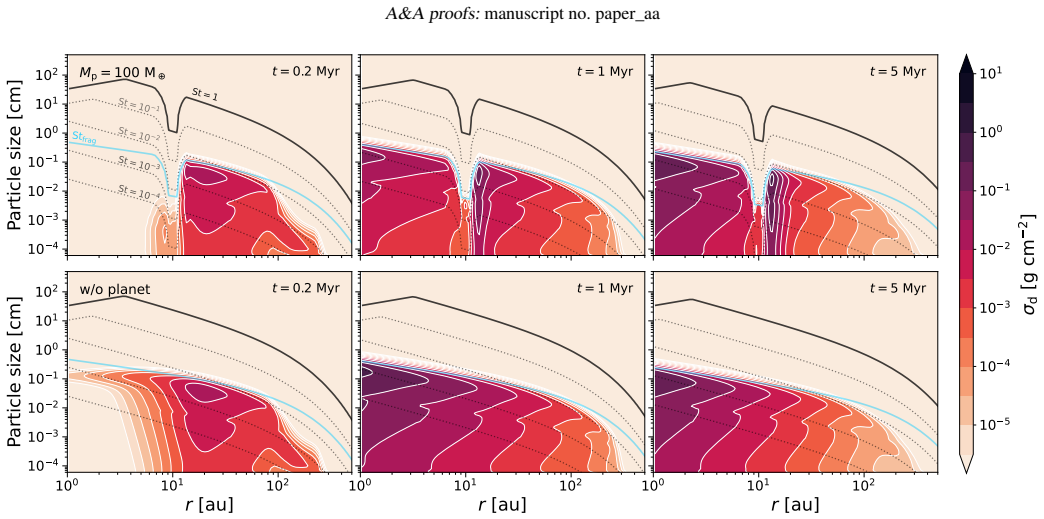
In protoplanetary discs, the presence of dust traps can significantly alter the transport of solids from the outer to the inner regions, and hence they are often invoked as an explanation for the chemical diversity of inner discs observed with JWST (e.g., varying oxygen abundances and C/O ratios). As a detailed treatment of dust transport around dust traps is computationally expensive, earlier works investigating the impact of outer traps on the inner disc composition have often used simplified dust models representing the size distribution with a single effective size and drift speed. In this paper, we revisit the impact of outer traps on dust transport using the state-of-the-art one-dimensional dust evolution code \texttt{DustPy}, which simulates the transport and evolution of dust particles including detailed coagulation and fragmentation. We quantify and map the leakiness of dust traps across a broad parameter space, performing over 300 simulations while varying the disc viscosity, turbulence strength, planet mass and location, and dust fragmentation velocity. We find that dust traps are leakier than previously thought, on a broader parameter space, such that most outer traps (r > 5 au) will result in a long-lived O-rich inner disc with gas-phase C/O < 1. In similar conditions (e.g., carved by the same planet mass), we find inner traps are much leakier than outer traps, though their relative efficiency in reducing the pebble flux is time-dependent. Highly blocking traps altering the inner disc composition dramatically (leading, e.g., to C/O > 1) are possible to set up but necessitate low viscosity and weak turbulence, along with efficient planetesimal formation by the streaming instability. In that case, we find that is the formation of planetesimals, rather than the dust traps themselves, that is capable of significantly altering the inner disc composition.
Editorial analysis
A structured set of objections, weighed in public.
Referee Report
Summary. The paper claims that by running over 300 DustPy simulations of dust evolution in discs with planet-carved traps, varying viscosity, turbulence, planet parameters, and fragmentation velocity, dust traps are found to be leakier than in prior simplified models. Consequently, most outer traps at r > 5 au permit enough pebble/ice transport to sustain O-rich inner discs with C/O < 1 over long times. Dramatic blocking leading to C/O > 1 requires low viscosity, weak turbulence, and efficient planetesimal formation, which the authors treat as an independent parameter. Inner traps are leakier than outer ones in comparable setups.
Significance. If the 1D results are representative, this work significantly revises our understanding of how outer dust traps influence inner disc chemistry, suggesting that traps alone rarely produce the high C/O ratios sometimes invoked to explain observations. The extensive parameter study using detailed coagulation physics is a clear strength, providing a quantitative map of leakiness that can guide future work. However, the translation from 1D to 3D disc physics remains an open question for the robustness of the 'most traps are leaky' conclusion.
major comments (2)
- [§5 (Discussion)] The assertion that 'most outer traps (r > 5 au) will result in a long-lived O-rich inner disc with gas-phase C/O < 1' is based on the leakiness thresholds mapped in the simulation grid. This claim's applicability to real discs is load-bearing on the fidelity of the 1D radial advection-diffusion treatment. The skeptic's note correctly identifies that 3D meridional flows and azimuthal structures could alter the net flux; the manuscript should include a dedicated paragraph estimating the magnitude of this uncertainty or referencing 3D simulations that bound it.
- [§3.2 (Model parameters)] Treating planetesimal formation efficiency as an independent input (varied separately from trap properties) is reasonable for exploration but may not reflect the coupled physics, as higher dust concentrations in traps promote streaming instability. This could narrow the parameter space for highly blocking traps. A brief sensitivity analysis coupling these would be appropriate.
minor comments (1)
- [Abstract] The number of simulations is given as 'over 300'; a precise count and breakdown by parameter combinations in the methods section would enhance transparency.
Simulated Author's Rebuttal
We thank the referee for their constructive and positive report, which highlights both the strengths of our broad parameter study and important caveats regarding the 1D framework. We address each major comment below and have prepared revisions to strengthen the manuscript.
read point-by-point responses
-
Referee: [§5 (Discussion)] The assertion that 'most outer traps (r > 5 au) will result in a long-lived O-rich inner disc with gas-phase C/O < 1' is based on the leakiness thresholds mapped in the simulation grid. This claim's applicability to real discs is load-bearing on the fidelity of the 1D radial advection-diffusion treatment. The skeptic's note correctly identifies that 3D meridional flows and azimuthal structures could alter the net flux; the manuscript should include a dedicated paragraph estimating the magnitude of this uncertainty or referencing 3D simulations that bound it.
Authors: We agree that the translation from 1D to 3D remains an important open question for the robustness of our conclusions. Our existing skeptic's note already flags this issue, but we will expand it into a dedicated paragraph in §5. This paragraph will discuss the potential effects of meridional flows and azimuthal structures on net pebble flux, reference relevant 3D hydrodynamical studies that quantify gap leakage (e.g., those examining meridional circulation in planet-carved gaps), and provide a qualitative estimate of the uncertainty. We will qualify our claims accordingly while preserving the quantitative 1D results. revision: yes
-
Referee: [§3.2 (Model parameters)] Treating planetesimal formation efficiency as an independent input (varied separately from trap properties) is reasonable for exploration but may not reflect the coupled physics, as higher dust concentrations in traps promote streaming instability. This could narrow the parameter space for highly blocking traps. A brief sensitivity analysis coupling these would be appropriate.
Authors: We acknowledge that planetesimal formation efficiency is physically coupled to local dust density via the streaming instability. Our choice to vary it independently was made to systematically map its influence across the large grid. For the revision, we will add a brief sensitivity discussion in §3.2 and §5, exploring how a density-dependent efficiency (e.g., via a simple threshold model) would affect the parameter space for strong blocking. A full dynamical coupling is beyond the scope of this 1D study, but the added text will note that such coupling would likely make highly efficient blocking even rarer. revision: partial
Circularity Check
Numerical parameter study derives leakiness from direct DustPy integrations with no reduction to self-defined inputs
full rationale
The paper executes over 300 independent DustPy simulations varying viscosity, turbulence, planet mass/location, and fragmentation velocity to map trap leakiness and resulting inner-disc C/O ratios. All reported findings (most outer traps leaky, inner traps leakier, dramatic blocking requires planetesimal formation) are direct outputs of these integrations of the advection-diffusion-coagulation equations. No step renames a fitted parameter as a prediction, imports a uniqueness theorem from the authors' prior work, or reduces the central claim to a self-citation chain. The derivation chain is therefore self-contained and non-circular.
Axiom & Free-Parameter Ledger
free parameters (4)
- disc viscosity
- turbulence strength
- planet mass and location
- dust fragmentation velocity
axioms (2)
- domain assumption DustPy's coagulation and fragmentation kernels accurately represent collisional outcomes in protoplanetary discs.
- domain assumption 1D radial averaging suffices to capture net pebble flux past traps.
Reference graph
Works this paper leans on
-
[1]
, " * write output.state after.block = add.period write newline
ENTRY address archiveprefix author booktitle chapter edition editor howpublished institution eprint journal key month note number organization pages publisher school series title type volume year label extra.label sort.label short.list INTEGERS output.state before.all mid.sentence after.sentence after.block FUNCTION init.state.consts #0 'before.all := #1 ...
-
[2]
" write newline "" before.all 'output.state := FUNCTION n.dashify 't := "" t empty not t #1 #1 substring "-" = t #1 #2 substring "--" = not "--" * t #2 global.max substring 't := t #1 #1 substring "-" = "-" * t #2 global.max substring 't := while if t #1 #1 substring * t #2 global.max substring 't := if while FUNCTION word.in bbl.in " " * FUNCTION format....
-
[3]
, " * write output.state after.block = add.period write newline
ENTRY address archivePrefix author booktitle chapter doi edition editor eprint howpublished institution journal key month note number organization pages publisher school series title misctitle type volume year version url label extra.label sort.label short.list INTEGERS output.state before.all mid.sentence after.sentence after.block FUNCTION init.state.co...
-
[4]
" write newline "" before.all 'output.state := FUNCTION format.doi doi empty "" "doi:" doi * if FUNCTION format.url url empty "" new.block "" url * "" * if FUNCTION format.eprint eprint empty "" archivePrefix empty "" archivePrefix ":" * if eprint field.or.null * if FUNCTION format.pid eprint empty format.doi format.eprint if FUNCTION n.dashify 't := "" t...
discussion (0)
Sign in with ORCID, Apple, or X to comment. Anyone can read and Pith papers without signing in.