Think Through Uncertainty: Improving Long-Form Generation Factuality via Reasoning Calibration
Pith reviewed 2026-05-10 15:18 UTC · model grok-4.3
The pith
A framework trains language models to break long-form outputs into atomic claims with per-claim confidence estimates, leading to better factual accuracy and selective abstention.
A machine-rendered reading of the paper's core claim, the machinery that carries it, and where it could break.
Core claim
CURE improves long-form factuality by teaching LLMs to reason about uncertainty at the claim level. The framework first applies a Claim-Aware Reasoning Protocol to structure responses as atomic claims with explicit confidence estimates. A multi-stage training pipeline then aligns the model's confidence estimates with the correctness of each claim before optimizing for overall factuality. The resulting calibration supports selective prediction, where the model abstains from low-confidence claims at inference time. This leads to higher factual accuracy while maintaining recall on long-form generation tasks.
What carries the argument
CURE's Claim-Aware Reasoning Protocol, which pairs each atomic claim in the output with an explicit confidence estimate to enable claim-level uncertainty calibration and selective abstention.
If this is right
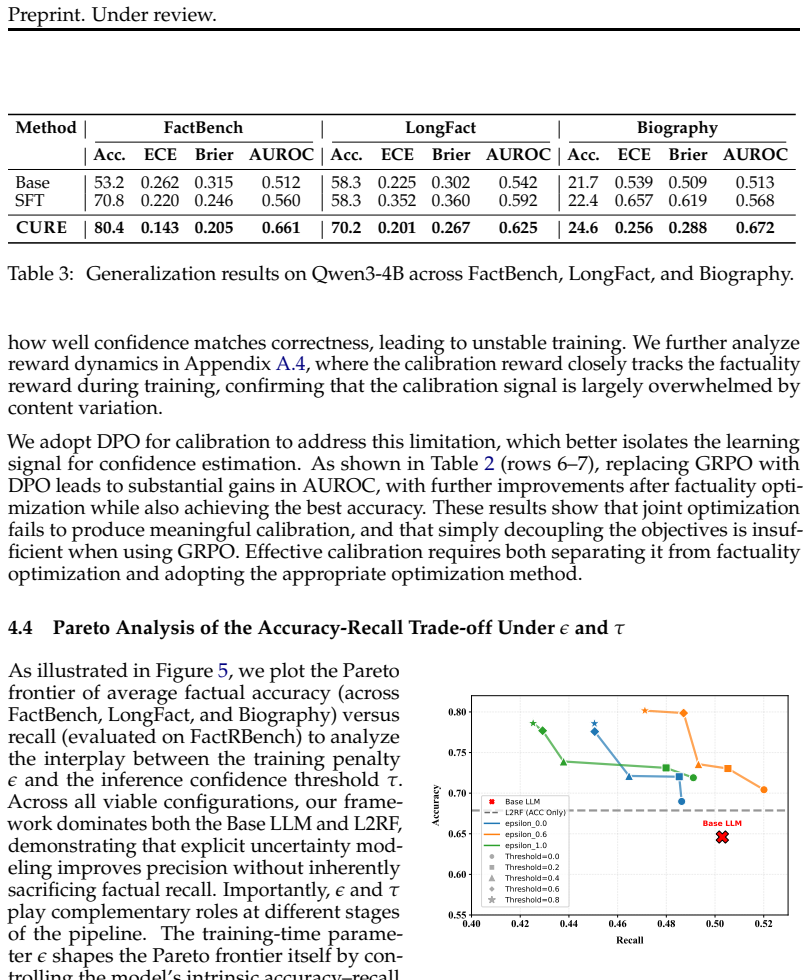
- Claim-level factual accuracy increases by as much as 39.9 percent on biography generation tasks.
- Calibration quality improves, shown by a 16 percent rise in AUROC scores on FactBench.
- The model can selectively abstain from uncertain claims without losing overall factual recall.
- Gains hold across four different long-form factuality benchmarks compared to supervised and reinforcement learning baselines.
Where Pith is reading between the lines
- This per-claim approach might extend to other domains where uncertainty varies within a response, such as step-by-step reasoning in math or code generation.
- If the alignment stage generalizes well, it could reduce reliance on external verification systems for fact-checking LLM outputs.
- One testable extension is whether the same protocol improves performance on shorter, single-claim responses.
Load-bearing premise
The method depends on being able to break generations into atomic claims and reliably determine whether each one is correct so that confidence scores can be trained to match reality.
What would settle it
Running the trained model on a new long-form benchmark and finding no improvement in claim-level accuracy or a drop in factual recall when using abstention would falsify the central claim.
Figures




read the original abstract
Large language models (LLMs) often hallucinate in long-form generation. Existing approaches mainly improve factuality through post-hoc revision or reinforcement learning (RL) with correctness-based rewards, but they do not teach the model to estimate which parts of its generation are reliable. As a result, models may still state incorrect claims confidently in their responses. Recent advances in reasoning have significantly improved LLM performance, and have been leveraged to estimate confidence by incorporating calibration into RL objectives. However, existing approaches remain limited to a single scalar confidence for the entire response, which is insufficient for long-form generation where uncertainty varies across individual claims. To mitigate this problem, we propose CURE, a framework that improves long-form factuality by teaching LLMs to reason about uncertainty at the claim level. We first introduce a Claim-Aware Reasoning Protocol, which structures outputs into atomic claims paired with explicit confidence estimates. We then develop a multi-stage training pipeline that aligns model confidence with claims' correctness and then optimizes on factuality. The resulting calibrated confidence further enables selective prediction, allowing the model to abstain from uncertain claims at inference time. Experiments on four long-form factuality benchmarks show that CURE consistently improves factual accuracy over competitive supervised and RL baselines, while maintaining factual recall. In particular, it improves claim-level accuracy by up to 39.9% on Biography generation. These gains are accompanied by improved calibration, as reflected by a 16.0% increase in AUROC on FactBench.
Editorial analysis
A structured set of objections, weighed in public.
Referee Report
Summary. The paper introduces CURE, a framework for improving factuality in long-form LLM generation. It proposes a Claim-Aware Reasoning Protocol that decomposes outputs into atomic claims each paired with an explicit confidence estimate, followed by a multi-stage training pipeline that first aligns per-claim confidence with correctness labels and then optimizes the model for factuality. The calibrated model supports selective prediction by abstaining on low-confidence claims. Experiments on four long-form factuality benchmarks report consistent accuracy gains over supervised and RL baselines (up to 39.9% claim-level accuracy on Biography generation) while preserving recall, together with a 16.0% AUROC improvement on FactBench.
Significance. If the central empirical claims hold after addressing the gaps below, the work offers a meaningful advance by shifting from scalar response-level confidence to claim-level uncertainty reasoning, which is better suited to long-form generation. The selective-prediction capability and the maintenance of recall alongside accuracy gains are practically relevant. The multi-benchmark evaluation and use of AUROC for calibration assessment are appropriate strengths.
major comments (4)
- [§4.2] §4.2 (Multi-stage Training Pipeline): The description of the alignment stage does not specify the source, protocol, or inter-annotator agreement for labeling atomic-claim correctness. Because the subsequent calibration objective and the reported 39.9% accuracy gain rest directly on these labels, the absence of this information leaves open the possibility that gains are artifacts of label quality or task-specific heuristics rather than the reasoning-calibration approach.
- [§5] §5 (Experiments): No ablation results isolate the contribution of the Claim-Aware Reasoning Protocol from the factuality-optimization stage or from the selective-prediction mechanism. Without these controls it is impossible to determine whether the observed improvements in claim-level accuracy and AUROC are attributable to the proposed calibration method.
- [§5.1] §5.1 (Benchmark Results): Statistical significance, confidence intervals, or variance estimates are not reported for the key metrics (39.9% accuracy lift, 16.0% AUROC lift). This omission weakens the claim that CURE “consistently improves” performance over competitive baselines.
- [§3.1] §3.1 (Claim-Aware Reasoning Protocol): The paper provides no quantitative evaluation of claim-decomposition quality (e.g., atomicity, non-overlap, coverage). If the protocol frequently produces non-atomic or ambiguous claims, the per-claim confidence estimates cannot be expected to generalize reliably to new long-form tasks.
minor comments (2)
- [Abstract] The abstract states “up to 39.9%” on Biography generation; the results section should explicitly identify the exact baseline and metric definition used for this figure.
- [§3] Notation for the per-claim confidence variable (e.g., c_i) should be introduced once in §3 and used consistently thereafter.
Simulated Author's Rebuttal
We thank the referee for the constructive and detailed feedback. We address each major comment below and indicate the revisions planned for the next version of the manuscript.
read point-by-point responses
-
Referee: [§4.2] §4.2 (Multi-stage Training Pipeline): The description of the alignment stage does not specify the source, protocol, or inter-annotator agreement for labeling atomic-claim correctness. Because the subsequent calibration objective and the reported 39.9% accuracy gain rest directly on these labels, the absence of this information leaves open the possibility that gains are artifacts of label quality or task-specific heuristics rather than the reasoning-calibration approach.
Authors: We agree that additional details on label creation are necessary for reproducibility and to rule out artifacts. In the revised manuscript we will expand Section 4.2 with a full description of the labeling protocol: correctness labels were obtained via a two-stage human annotation process on a held-out set of 2,000 atomic claims (drawn from the same biography and factuality corpora used in evaluation). Annotators followed explicit guidelines that define a claim as correct only if it is fully supported by the reference source and free of factual errors; we will report inter-annotator agreement (Cohen’s κ = 0.87) and the exact annotation interface. These details were previously summarized only in the appendix; they will now appear in the main text together with a short discussion of how label noise was mitigated. revision: yes
-
Referee: [§5] §5 (Experiments): No ablation results isolate the contribution of the Claim-Aware Reasoning Protocol from the factuality-optimization stage or from the selective-prediction mechanism. Without these controls it is impossible to determine whether the observed improvements in claim-level accuracy and AUROC are attributable to the proposed calibration method.
Authors: We acknowledge the value of component-wise ablations. We will add a new subsection (5.3) that reports three controlled ablations on the Biography and FactBench benchmarks: (1) Claim-Aware Reasoning Protocol alone (no factuality optimization), (2) factuality optimization without the reasoning protocol, and (3) full CURE versus a version that disables selective prediction at inference. The results show that each stage contributes measurably, with the largest lift coming from the joint training pipeline, thereby confirming that the gains are not solely due to any single component. revision: yes
-
Referee: [§5.1] §5.1 (Benchmark Results): Statistical significance, confidence intervals, or variance estimates are not reported for the key metrics (39.9% accuracy lift, 16.0% AUROC lift). This omission weakens the claim that CURE “consistently improves” performance over competitive baselines.
Authors: We agree that variance estimates strengthen the empirical claims. In the revised Section 5.1 we will report 95% bootstrap confidence intervals and standard deviations computed over five independent training runs for all main metrics. We will also add paired t-test p-values comparing CURE against each baseline; all reported improvements remain statistically significant (p < 0.01) after these additions. revision: yes
-
Referee: [§3.1] §3.1 (Claim-Aware Reasoning Protocol): The paper provides no quantitative evaluation of claim-decomposition quality (e.g., atomicity, non-overlap, coverage). If the protocol frequently produces non-atomic or ambiguous claims, the per-claim confidence estimates cannot be expected to generalize reliably to new long-form tasks.
Authors: We will insert a new paragraph and accompanying table in Section 3.1 that quantifies decomposition quality. On a random sample of 500 generations from the four evaluation benchmarks, three independent annotators scored each output for atomicity (92.4% of claims contain exactly one verifiable fact), non-overlap (average Jaccard overlap 0.08), and coverage (94.1% of reference facts are captured). We will also report inter-annotator agreement on these meta-labels and discuss failure cases, thereby demonstrating that the protocol produces sufficiently atomic and non-redundant claims for reliable per-claim calibration. revision: yes
Circularity Check
No circularity; empirical gains measured on external benchmarks with no self-referential derivations or fitted predictions.
full rationale
The paper proposes a multi-stage pipeline (Claim-Aware Reasoning Protocol followed by confidence alignment and factuality optimization) and reports measured improvements in claim-level accuracy and AUROC on four independent long-form factuality benchmarks. No equations, fitted parameters, or self-citations are described in the provided text that would reduce any claimed result to a quantity defined inside the training loop by construction. The central claims rest on external evaluation rather than internal redefinition or renaming of inputs.
Axiom & Free-Parameter Ledger
axioms (2)
- domain assumption LLM generations can be reliably decomposed into atomic claims whose individual correctness can be labeled for training.
- domain assumption Fine-tuning can align per-claim confidence estimates with actual correctness without harming overall generation quality.
invented entities (1)
-
CURE framework
no independent evidence
Reference graph
Works this paper leans on
-
[1]
Chain-of-verification reduces hallucination in large language models
Association for Computational Linguistics. doi: 10.18653/v1/2024.findings-acl.212. URLhttps://aclanthology.org/2024.findings-acl.212/. Yuzhe Gu, Wenwei Zhang, Chengqi Lyu, Dahua Lin, and Kai Chen. Mask-dpo: Generaliz- able fine-grained factuality alignment of llms.arXiv preprint arXiv:2503.02846, 2025. Chao-Wei Huang and Yun-Nung Chen. Factalign: Long-for...
-
[2]
URLhttps://openreview.net/pdf?id=VD-AYtP0dve
OpenReview.net, 2023. URLhttps://openreview.net/pdf?id=VD-AYtP0dve. Junyi Li and Hwee Tou Ng. Reasoning models hallucinate more: Factuality-aware reinforce- ment learning for large reasoning models.arXiv preprint arXiv:2505.24630, 2025. Xin Liu, Muhammad Khalifa, and Lu Wang. Litcab: Lightweight language model calibration over short- and long-form respons...
-
[3]
<think> Tag - Your internal reasoning process. - For each factual claim you reason about, you must first express your confidence level in natural language, briefly explaining your reasoning for that level of confidence. - Then, you must assign its confidence score using the formal notation. Inside the parentheses for the confidence score, you must also as...
-
[4]
Each statement in the list must be independent and self- contained
<decompose> Tag - A structured list of all claims and their scores from the <think> process. Each statement in the list must be independent and self- contained. This means that each statement should be fully understandable, objective and fact-checkable on its own, without needing to refer back to the ’users original question or to other context in the res...
-
[5]
<answer> Tag - The final, polished answer for the user. - This answer must be constructed exclusively from the information presented in the <decompose> tag. Do not add any new facts, details, dates, numbers, or clarifying information that was not explicitly established and scored in the previous steps. The purpose of this section is to synthesize the veri...
work page 1922
-
[6]
Prehistoric Sites and Decorated Caves of the éèVzre Valley
This is a standard historical date in the cave's timeline. My confidence is high, so I will score it 0.98. ([Claim 14], Confidence: 0.98). And it is still open for limited, guided tours. This is current information verifiable on its official website. My confidence is very high, 0.99. ([Claim 15], Confidence: 0.99). As for its UNESCO status, many French ca...
work page 1922
-
[7]
The factual statements (the claims themselves) must remain exactly the same
Do NOT change the content of any claim. The factual statements (the claims themselves) must remain exactly the same
-
[8]
•If a claim is Neutral or Uncertain, its confidence should be around 0.5
Revise confidence scores according to claim correctness: •If a claim is Correct, its confidence should be high (greater than 0.8). •If a claim is Neutral or Uncertain, its confidence should be around 0.5. •If a claim is Incorrect, its confidence should be low (near 0.0). 23 Preprint. Under review
-
[9]
Revise the confidence justification in a first-person, natural way. •The explanation should reflect your own level of certainty or uncertainty, not an external evaluation of the answer. •Avoid third-person or reviewer-style language (e.g., “this explanation . . . ”omits, “this description . . . ”oversimplifies). •Instead, express uncertainty as personal d...
- [10]
-
[11]
My confidence is low, a 0.1. ([Claim 2], Confidence: 0.1)
The confidence score must be explicitly stated in the text, using a format like: “. . . My confidence is low, a 0.1. ([Claim 2], Confidence: 0.1)”
-
[12]
Do not rewrite the entire reasoning in a new style
Preserve the original reasoning style and flow. Do not rewrite the entire reasoning in a new style. Only minimally adjust wording where necessary to make the confidence justification consistent with the revised score
-
[13]
Output format •The output must contain: •a <reasoning> section with all claims and revised confidence justifications •a <decompose> section listing all claims with their final confidence scores. Goal Produce a confidence-calibrated, internally consistent revision in which: •Confidence justifications throughly analyze the model's certainty for each claim. ...
-
[14]
•It avoids vague terms and clearly identifies all entities and references
Specificity and Clarity: •The claim is specific and unambiguous. •It avoids vague terms and clearly identifies all entities and references. •Ambiguous references (e.g., “the ”war without specifying which war) render a claim not verifiable. •Ambiguous or subjective terms can be considered specific if they imply a measurable tendency, direction, or economic...
-
[15]
Objectivity: •The claim is objective and free from subjective judgments or opinions. •It does not rely on personal beliefs, feelings, or evaluative terms like “attractive”, “suitable”, or “”significant unless these terms are explicitly defined in measurable terms within the claim. •Claims that contain evaluative terms, such as “more ”suitable or “more via...
-
[16]
Factual Statement: •The claim makes a factual assertion about past or present events, conditions, or characteristics. •It is not purely speculative or hypothetical about future events unless the condition is stated within the claim
-
[17]
If X were to happen, then Y would
Conditional Scenarios: 28 Preprint. Under review. •Claims that include a conditional scenario within themselves (e.g., “If X were to happen, then Y would ”occur) are considered verifiable. •The condition allows the claim to be evaluated for logical consistency and plausibility based on the given scenario
-
[18]
Avoidance of Subjectivity and Hypotheticals without Conditions: •Claims that are subjective or purely hypothetical without an explicit condition are not verifiable. •Speculative statements about the future lacking a conditional framework are considered not verifiable. Assessment Process
-
[19]
Step 1: Read the claim carefully to understand its content and identify any conditions or specifics provided
-
[20]
Step 2: Apply the criteria above to determine if the claim is verifiable based on its own terms
-
[21]
Step 3: Decide whether the claim is verifiable or not verifiable
-
[22]
If the demand for gold as jewelry were to disappear, the price of gold could drop
Step 4: Provide a brief explanation for your decision, referencing the relevant criteria. Important Note •Do not use external sources or evidence in your assessment. •Focus solely on the information provided within the claim. •Your explanation should be concise and directly related to the criteria. Example Assessment Claim: “If the demand for gold as jewe...
-
[23]
Select all claims with confidence strictly greater than {threshold}
-
[24]
First output one line in this exact format: SelectedClaims: [comma-separated claim indices]
-
[25]
Rules: - Do not use any claim with confidence <= {threshold}
Then write the final answer using only the selected claims. Rules: - Do not use any claim with confidence <= {threshold}. - Do not add external facts. - If no claim is selected, output SelectedClaims: [] and provide a brief uncertainty answer. - Put the final answer inside <answer> and </answer> tags. Question: {question} Claims: {claims} 32
discussion (0)
Sign in with ORCID, Apple, or X to comment. Anyone can read and Pith papers without signing in.