Nonlinear Stochastic Optimal Control and Optimal Stopping using the Fokker-Planck Transformation
Pith reviewed 2026-05-10 16:43 UTC · model grok-4.3
The pith
A Fokker-Planck transformation converts nonlinear stochastic optimal control with stopping into deterministic density dynamics.
A machine-rendered reading of the paper's core claim, the machinery that carries it, and where it could break.
Core claim
For state-independent diffusion, the controlled Fokker-Planck equation can be rewritten as a continuity equation driven by a score-corrected velocity field, yielding deterministic characteristic dynamics that reproduce the marginal law of the stochastic system. Leveraging Stein-type identities, the associated distributional dynamic programming equation admits the same second-order differential operator as the distributional stochastic Hamilton-Jacobi-Bellman formulation. This representation is used to formulate an optimal control problem with state-dependent terminal-time assignment and terminal distributional constraints, from which first-order necessary conditions are derived via variat
What carries the argument
The Fokker-Planck transformation to a continuity equation with score-corrected velocity field, which produces deterministic dynamics whose marginal laws match those of the controlled stochastic diffusion.
If this is right
- First-order necessary conditions follow for optimal control problems that include both a common terminal time and state-dependent stopping.
- The same second-order operator appears in the distributional dynamic programming equation and the stochastic Hamilton-Jacobi-Bellman equation.
- Terminal distributional constraints can be imposed directly on the deterministic density evolution.
- Variational analysis yields the optimality conditions without requiring explicit solution of the underlying stochastic trajectories.
Where Pith is reading between the lines
- The deterministic reformulation could support numerical schemes that evolve densities rather than sample paths.
- If the score correction generalizes, the approach might extend to state-dependent diffusion coefficients.
- The necessary conditions may be checked on low-dimensional linear-quadratic examples where closed-form stochastic solutions are known.
Load-bearing premise
The derivation assumes state-independent diffusion to rewrite the Fokker-Planck equation as a continuity equation with score-corrected velocity.
What would settle it
Direct numerical comparison showing that the marginal distributions generated by the deterministic continuity equation exactly match the empirical marginals obtained from Monte Carlo simulation of the original controlled stochastic process.
Figures
read the original abstract
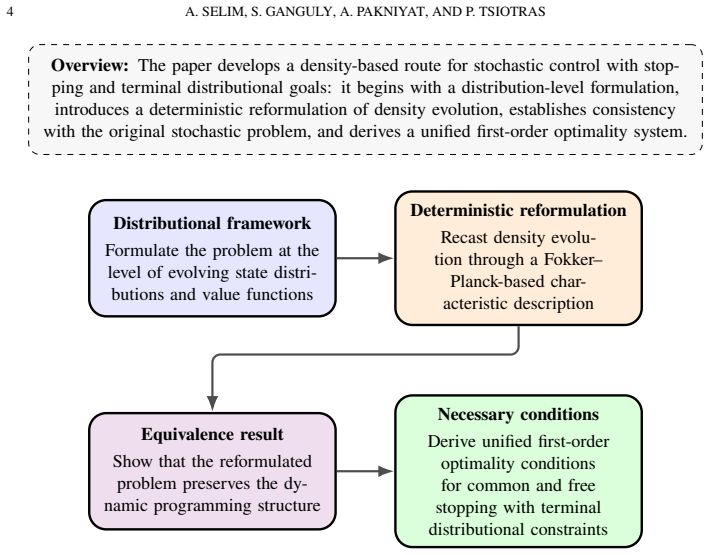
In this paper, we develop a theoretical framework for nonlinear stochastic optimal control problems with optimal stopping by establishing a density-based deterministic representation of the underlying diffusion. For state-independent diffusion, we rewrite the controlled Fokker-Planck equation as a continuity equation driven by a score-corrected velocity field, yielding a deterministic characteristic dynamics that reproduces the marginal law of the stochastic system. Leveraging Stein-type identities, we show that the associated distributional dynamic programming equation admits the same second-order differential operator as the distributional stochastic Hamilton-Jacobi-Bellman formulation. Building on this representation, we formulate an optimal control problem with state-dependent terminal-time assignment and terminal distributional constraints and derive the first-order necessary conditions using variational analysis. We present the conditions both for a common terminal time and for the general case of state-dependent stopping.
Editorial analysis
A structured set of objections, weighed in public.
Referee Report
Summary. The manuscript develops a theoretical framework for nonlinear stochastic optimal control problems with optimal stopping by transforming the controlled Fokker-Planck equation into a deterministic continuity equation representation of the diffusion process. For state-independent diffusion coefficients, a score-corrected velocity field is introduced to recover the marginal laws via characteristic dynamics. Stein-type identities are used to establish that the distributional dynamic programming equation shares the same second-order operator as the distributional stochastic Hamilton-Jacobi-Bellman equation. The paper then poses an optimal control problem with state-dependent terminal times and terminal distributional constraints, deriving first-order necessary conditions via variational analysis for both fixed and state-dependent stopping.
Significance. If the central derivations are correct, the work provides a deterministic density-based route to stochastic control and stopping problems, which could aid analysis and computation by shifting focus from sample paths to continuity equations and variational conditions. The explicit invocation of Stein identities to equate operators and the variational treatment of state-dependent stopping times are strengths that offer a clean, non-stochastic derivation path under the stated assumptions. The restriction to state-independent diffusion is acknowledged in the claims and does not undermine the internal logic for the cases treated.
major comments (1)
- [§3] §3 (Stein-identity equivalence): the claim that the distributional DP and HJB share the identical second-order operator rests on the Stein identity holding in the chosen function space; the manuscript should explicitly state the regularity assumptions on the densities and test functions that guarantee this identity applies without additional boundary terms.
minor comments (3)
- [§2] The transition from the Fokker-Planck equation to the continuity equation (around Eq. (8)) would benefit from an explicit statement of the score function's definition and its dependence on the control.
- [§4] Notation for the state-dependent terminal time and the associated terminal distributional constraint should be introduced earlier and used consistently in the variational analysis section.
- [Introduction] A brief comparison to existing density-based or measure-valued control approaches would help situate the contribution, even if only in the introduction.
Simulated Author's Rebuttal
We thank the referee for the positive evaluation of the manuscript and the constructive comment. We address the single major comment below and will incorporate the requested clarification in the revised version.
read point-by-point responses
-
Referee: [§3] §3 (Stein-identity equivalence): the claim that the distributional DP and HJB share the identical second-order operator rests on the Stein identity holding in the chosen function space; the manuscript should explicitly state the regularity assumptions on the densities and test functions that guarantee this identity applies without additional boundary terms.
Authors: We agree that the regularity assumptions underlying the Stein identity should be stated explicitly to ensure the absence of boundary terms. In the revised manuscript we will add a remark in §3 specifying the required conditions: the probability densities are assumed to belong to C^2 with sufficient decay at infinity (e.g., integrable first and second derivatives with Gaussian-type tails), and the test functions are taken from a dense subspace of H^1 such that integration by parts is justified without residual boundary integrals. This addition will make the equivalence between the distributional dynamic programming equation and the distributional stochastic Hamilton-Jacobi-Bellman equation fully rigorous under the stated hypotheses. revision: yes
Circularity Check
No significant circularity in derivation chain
full rationale
The paper establishes a density-based representation by rewriting the controlled Fokker-Planck equation (for state-independent diffusion) as a continuity equation with score-corrected velocity, then invokes Stein-type identities to equate the second-order operators between the distributional dynamic programming equation and the stochastic HJB formulation, and applies variational analysis to obtain first-order necessary conditions for the optimal stopping problem. These steps draw on standard external mathematical tools (Stein identities, continuity equations, variational calculus) rather than reducing any claimed result to a self-definition, a fitted parameter renamed as prediction, or a load-bearing self-citation chain. No equations or claims in the provided text exhibit the enumerated circular patterns; the derivation remains self-contained against external benchmarks.
Axiom & Free-Parameter Ledger
axioms (2)
- domain assumption Stein-type identities hold for the chosen test functions and densities arising from the controlled diffusion
- domain assumption The controlled Fokker-Planck equation can be rewritten as a continuity equation for state-independent diffusion
Reference graph
Works this paper leans on
-
[1]
6, 1191–1244, doi: https://doi.org/10.1017/S0308210513000085,
[AC14] L.AmbrosioandG.Crippa,ContinuityequationsandODEflowswithnon-smoothvelocity,Proceed- ings of the Royal Society of Edinburgh: Section A Mathematics144(2014), no. 6, 1191–1244, doi: https://doi.org/10.1017/S0308210513000085,. [ADM+08] L. Ambrosio, B. Dacorogna, E. Mascolo, P. Marcellini, L.A. Caffarelli, M.G. Crandall, L.C. Evans, and N. Fusco,Calculu...
-
[2]
3, 470–514, doi: https://doi.org/10.1017/S0956792521000073
[BCJW21] S.Becker,P.Cheridito,A.Jentzen,andT.Welti,Solvinghigh-dimensionaloptimalstoppingproblems using deep learning, European Journal of Applied Mathematics32(2021), no. 3, 470–514, doi: https://doi.org/10.1017/S0956792521000073. [BF21] B. Bonnet and H. Frankowska,Differential inclusions in Wasserstein spaces: The Cauchy-Lipschitz framework, Journal of ...
-
[3]
12, 1985, doi:https://doi.org/10.1007/978-1-4684-6748-2_12, pp
Progress in Probability and Statistics, vol. 12, 1985, doi:https://doi.org/10.1007/978-1-4684-6748-2_12, pp. 172–223. [Pes99] G. Peskir,Designing options given the risk: the optimal Skorokhod-embedding problem, Sto- chastic Processes and their Applications81(1999), 25–38, doi:https://doi.org/10.1016/ S0304-4149(98)00097-0. [PP01] J. L. Pedersen and G. Pes...
-
[4]
[Sko17] ,Studies in the Theory of Random Processes, Dover Books on Mathematics, 2017, URL: https://tinyurl.com/4xjsemch. [STBT21] A. Saravanos, A. Tsolovikos, E. Bakolas, and E. Theodorou,Distributed covariance steering with consensus ADMM for stochastic multi-agent systems, Robotics: Science and Systems 2021, 2021, doi:https://doi.org/10.15607/RSS.2021.X...
discussion (0)
Sign in with ORCID, Apple, or X to comment. Anyone can read and Pith papers without signing in.