Thought-Retriever: Don't Just Retrieve Raw Data, Retrieve Thoughts for Memory-Augmented Agentic Systems
Pith reviewed 2026-05-10 16:29 UTC · model grok-4.3
The pith
Retrieving thoughts from past queries lets LLMs handle arbitrarily long external data.
A machine-rendered reading of the paper's core claim, the machinery that carries it, and where it could break.
Core claim
By letting LLMs store and retrieve their own processed thoughts from previous tasks, Thought-Retriever creates a self-evolving memory that grows with use. This memory replaces direct retrieval of raw data chunks, allowing the model to condition its answers on far more external information than its context window permits. The process involves an LLM filtering and organizing thoughts, then selecting the right ones for each new query.
What carries the argument
The thought memory, built from filtered intermediate responses generated while solving past queries, which the LLM retrieves to inform answers on new tasks.
If this is right
- LLM agents can draw on arbitrarily large external knowledge bases without context length constraints.
- The memory system improves its effectiveness as the agent solves more queries over time.
- Answers benefit from deeper prior thoughts when dealing with abstract questions.
- Results improve on tasks that require using information from very long documents.
Where Pith is reading between the lines
- Agents using this approach might develop expertise in specific areas through repeated interactions without additional training.
- The method could extend to other types of AI systems that generate intermediate reasoning steps.
- Future work could explore adding mechanisms to verify the accuracy of stored thoughts.
Load-bearing premise
An LLM can reliably identify and filter out meaningless or redundant thoughts while preserving all critical information during organization and retrieval.
What would settle it
A drop in performance or loss of key information when the number of stored thoughts grows large, or when the system fails to improve after processing additional queries.
Figures




read the original abstract
Large language models (LLMs) have transformed AI research thanks to their powerful internal capabilities and knowledge. However, existing LLMs still fail to effectively incorporate the massive external knowledge when interacting with the world. Although retrieval-augmented LLMs are proposed to mitigate the issue, they are still fundamentally constrained by the context length of LLMs, as they can only retrieve top-K raw data chunks from the external knowledge base which often consists of millions of data chunks. Here we propose Thought-Retriever, a novel model-agnostic algorithm that helps LLMs generate output conditioned on arbitrarily long external data, without being constrained by the context length or number of retrieved data chunks. Our key insight is to let an LLM fully leverage its intermediate responses generated when solving past user queries (thoughts), filtering meaningless and redundant thoughts, organizing them in thought memory, and retrieving the relevant thoughts when addressing new queries. This effectively equips LLM-based agents with a self-evolving long-term memory that grows more capable through continuous interaction. Besides algorithmic innovation, we further meticulously prepare a novel benchmark, AcademicEval, which requires an LLM to faithfully leverage ultra-long context to answer queries based on real-world academic papers. Extensive experiments on AcademicEval and two other public datasets validate that Thought-Retriever remarkably outperforms state-of-the-art baselines, achieving an average increase of at least 7.6% in F1 score and 16% in win rate across various tasks. More importantly, we further demonstrate two exciting findings: (1) Thought-Retriever can indeed help LLM self-evolve after solving more user queries; (2) Thought-Retriever learns to leverage deeper thoughts to answer more abstract user queries.
Editorial analysis
A structured set of objections, weighed in public.
Referee Report
Summary. The manuscript proposes Thought-Retriever, a model-agnostic algorithm for LLM agents that generates intermediate 'thoughts' while solving past queries, filters out meaningless or redundant ones, organizes the remainder into a self-evolving thought memory, and retrieves relevant thoughts to condition responses on new queries. This is claimed to enable faithful use of arbitrarily long external data without being limited by LLM context length or top-K chunk retrieval. The authors introduce the AcademicEval benchmark requiring ultra-long context use on real academic papers, report average gains of at least 7.6% F1 and 16% win rate over baselines on AcademicEval plus two public datasets, and present two findings on self-evolution and deeper-thought usage for abstract queries.
Significance. If the filtering and organization steps can be shown to preserve necessary information without systematic omissions or distortions, the approach would represent a meaningful step toward scalable, evolving memory for agentic systems that operate over unbounded external corpora. The creation of AcademicEval as a faithfulness-oriented benchmark for long academic documents is a constructive contribution, and the reported self-evolution results, if rigorously supported, would be of interest for continual-learning research in LLMs.
major comments (3)
- [Experiments section (AcademicEval results)] Experiments section (AcademicEval results): the reported F1 and win-rate improvements are presented without any information-retention metric (e.g., fact-level recall or span coverage between original paper content and the filtered thought set actually retrieved at inference time). This leaves open the possibility that gains arise from selective retention rather than faithful conditioning on the full ultra-long source.
- [Method description (Thought-Retriever pipeline)] Method description (Thought-Retriever pipeline): the central assumption that the same LLM can reliably filter redundant/meaningless thoughts while preserving all query-relevant facts is load-bearing for the 'arbitrarily long external data' claim, yet no ablation or error-propagation analysis is provided on how filtering omissions or hallucinations affect downstream answer quality.
- [Results on self-evolution] Results on self-evolution: the claim that the system 'self-evolves' after processing more queries lacks controls for confounding factors such as simply accumulating more raw thoughts or changes in retrieval hyperparameters, making it difficult to attribute improvements specifically to the thought-memory mechanism.
minor comments (3)
- [Abstract] Abstract: the statement 'at least 7.6% in F1 score and 16% in win rate' would be clearer if the exact per-task averages, standard deviations, and number of runs were reported.
- The manuscript would benefit from a diagram or pseudocode explicitly showing the data flow among thought generation, filtering criteria, memory organization, and retrieval steps.
- Notation for the thought memory structure (e.g., whether it is flat, hierarchical, or indexed by query type) is introduced informally and could be formalized in a dedicated subsection.
Simulated Author's Rebuttal
We thank the referee for the constructive feedback, which identifies key areas where additional evidence can strengthen our claims regarding faithfulness and self-evolution. We address each major comment below and outline the revisions we will incorporate.
read point-by-point responses
-
Referee: Experiments section (AcademicEval results): the reported F1 and win-rate improvements are presented without any information-retention metric (e.g., fact-level recall or span coverage between original paper content and the filtered thought set actually retrieved at inference time). This leaves open the possibility that gains arise from selective retention rather than faithful conditioning on the full ultra-long source.
Authors: We agree that an explicit information-retention metric would provide stronger support for the claim of faithful conditioning on ultra-long sources. In the revised manuscript, we will add a fact-level recall metric (and optionally span coverage) computed between the original paper content and the filtered thought set retrieved at inference time on AcademicEval. This analysis will quantify preservation of necessary information and rule out systematic selective retention as the source of gains. revision: yes
-
Referee: Method description (Thought-Retriever pipeline): the central assumption that the same LLM can reliably filter redundant/meaningless thoughts while preserving all query-relevant facts is load-bearing for the 'arbitrarily long external data' claim, yet no ablation or error-propagation analysis is provided on how filtering omissions or hallucinations affect downstream answer quality.
Authors: The filtering assumption is indeed central. While the end-to-end results demonstrate net benefits, we acknowledge the absence of targeted ablation on error propagation. In the revision, we will include an error-propagation analysis: we will introduce controlled synthetic omissions and hallucinations into the thought set on a subset of AcademicEval queries and measure the resulting degradation in answer quality, thereby quantifying sensitivity to filtering imperfections. revision: yes
-
Referee: Results on self-evolution: the claim that the system 'self-evolves' after processing more queries lacks controls for confounding factors such as simply accumulating more raw thoughts or changes in retrieval hyperparameters, making it difficult to attribute improvements specifically to the thought-memory mechanism.
Authors: Our self-evolution experiments compare the full Thought-Retriever pipeline against a raw-thought accumulation baseline while holding retrieval hyperparameters fixed; however, we agree that explicit controls and clearer exposition would reduce ambiguity. In the revised version, we will add a dedicated subsection that (i) fixes all retrieval hyperparameters across conditions, (ii) reports performance curves for both the organized thought memory and an unfiltered raw-thought accumulator, and (iii) includes statistical tests isolating the contribution of the filtering/organization steps. revision: partial
Circularity Check
No significant circularity detected
full rationale
The paper describes an algorithmic pipeline for thought generation, filtering, organization, and retrieval rather than any mathematical derivation or first-principles proof. Claims of improved performance rest on empirical results across AcademicEval (a benchmark prepared by the authors) and two public datasets, with no equations, fitted parameters renamed as predictions, or load-bearing self-citations that reduce the central result to its own inputs by construction. The method is presented as model-agnostic and self-evolving through interaction, but its validity is treated as an empirical question rather than a definitional tautology. No steps match the enumerated circularity patterns.
Axiom & Free-Parameter Ledger
Reference graph
Works this paper leans on
-
[1]
SMART-LLM: Smart Multi-Agent Robot Task Planning Using Large Language Mod- els,
Check specifically for SE track proceedings. 14 Published in Transactions on Machine Learning Research (04/2026) Shyam Sundar Kannan, Vishnunandan LN Venkatesh, and Byung-Cheol Min. Smart-llm: Smart multi-agent robot task planning using large language models.arXiv preprint arXiv:2309.10062, 2023. Jared Kaplan, Sam McCandlish, Tom Henighan, Tom B Brown, Be...
-
[2]
What are the practical applications of the research in ’title’?
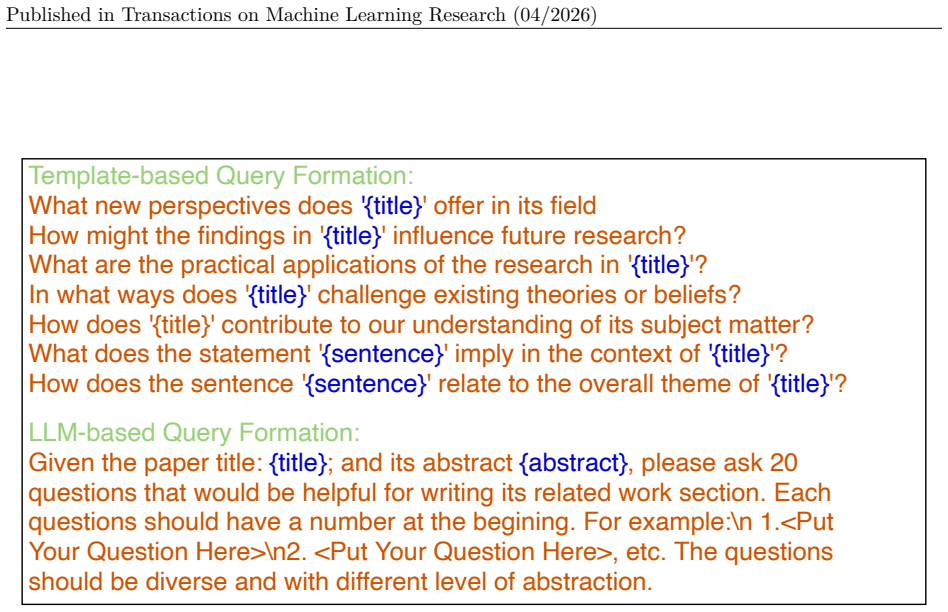
template-based query formation, and 2) LLM-based query formation. The prompts are shown in Figure 13 Template-based Query Formation.We construct general and broadly applicable templates for all papers. For example,"What are the practical applications of the research in ’title’?"and"What new per- spectives does ’title’ offer in its field?". During experime...
work page 2023
-
[3]
Data Collection.We initiated our data pool by sourcing raw research papers from arXiv, specifically targeting the Computer Science domain (e.g., cs. CL, cs. LG, cs.AI). To align with the capabilities of modern LLMs, we focused on recent high-quality publications to serve as the external knowledge source
-
[4]
Preprocessing and Parsing.Since raw PDFs contain noise (headers, footers, citation indices) that can disrupt LLM ingestion, we employed a parsing pipeline to convert PDF documents into a structured text format. This step allows us to cleanly separate themain body(used as external knowledge context) from theabstract(used as ground truth), while effectively...
-
[5]
This ensures that the retrieval and reasoning challenge is non-trivial
Filtering Criteria.From the parsed corpus, we applied strict filtering criteria to select the final test set for AcademicEval: •Length Constraint:To strictly evaluate long-context capabilities (a core motivation of Thought- Retriever), we filtered for papers that exceed a substantial token threshold. This ensures that the retrieval and reasoning challenge...
-
[6]
Utility is in the Eye of the User: A Critique of NLP Leaderboards
Test Set Sampling.Crucially, consistent with our analysis in Section 4.4, we performedstratified samplingbased on the abstract’s abstraction level. This strategy ensures a balanced representation of difficulty levels across the benchmark, allowing us to evaluate the model’s performance on both fact-based and reasoning-heavy queries. 35 Published in Transa...
work page 2026
discussion (0)
Sign in with ORCID, Apple, or X to comment. Anyone can read and Pith papers without signing in.