Geometric phase-assisted simple phase compensation enabling quantum key distribution using phase-shifted Bell states
Pith reviewed 2026-05-10 15:44 UTC · model grok-4.3
The pith
Geometric phase compensation removes unwanted relative phases from Bell states to restore high-fidelity entanglement for secure QKD.
A machine-rendered reading of the paper's core claim, the machinery that carries it, and where it could break.
Core claim
Unwanted relative phases convert ideal Bell states into phase-shifted states that degrade interference visibility and raise QBER; geometric-phase control eliminates these phases at either the source or receiver, restoring entanglement quality so that the BBM92 protocol yields secure keys, as shown by a fidelity exceeding 95 percent and QBER below the 11 percent security threshold in a nondegenerate polarization experiment.
What carries the argument
Geometric-phase control that accumulates a path-dependent phase shift to cancel arbitrary relative phases between the two photons of a Bell state without adding dynamic phase noise.
If this is right
- QBER falls below the 11 percent threshold, enabling secure key generation in the BBM92 protocol.
- The same compensation works whether placed at the source or at the receiver.
- The method extends directly to time-bin QKD by mapping time and polarization degrees of freedom.
- Practical phase control becomes possible in entangled-photon systems without complex stabilization hardware.
Where Pith is reading between the lines
- Field deployments of entanglement QKD could avoid bulky active feedback loops if the geometric-phase element is made compact and stable.
- The same principle might correct phase drifts in other interference-based quantum tasks such as quantum teleportation or entanglement swapping.
- If the compensation remains effective over long fiber links, it could simplify the design of entanglement-based quantum networks.
Load-bearing premise
Geometric-phase control can be applied at the source or receiver without introducing new errors or practical limitations when the photons travel through real channels.
What would settle it
A measurement in which the compensated Bell state still produces QBER above 11 percent in the BBM92 protocol or fidelity below 95 percent would show the compensation fails to restore usable entanglement.
Figures


read the original abstract
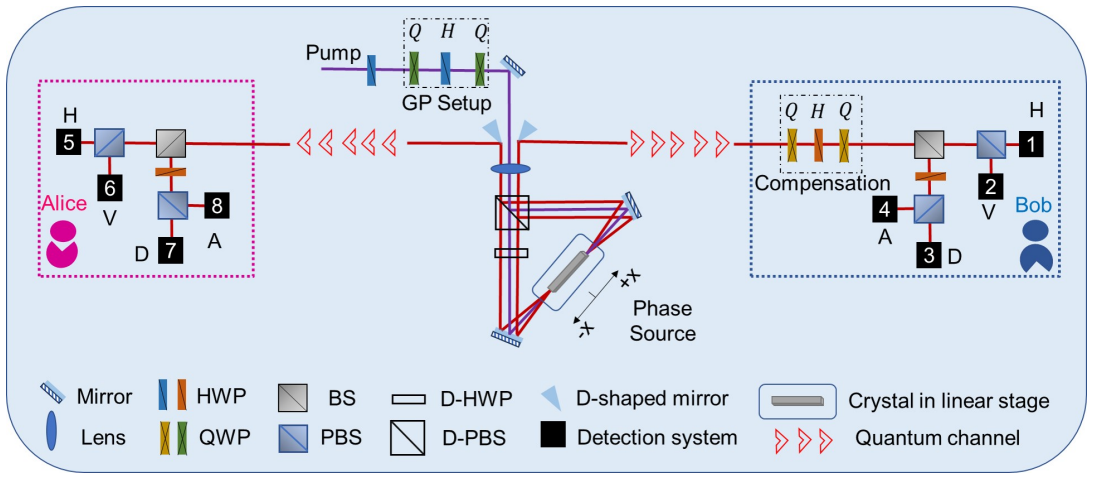
Entanglement-based quantum key distribution (QKD) relies on the distribution of high-fidelity maximally entangled Bell states, typically generated via spontaneous parametric down-conversion (SPDC). In practical systems, unwanted relative phases arise from birefringence, pump-beam contributions, imperfect photon-pair generation, transmission through physical channels, and collection, transforming Bell states into phase-shifted states. This degrades interference visibility, increases the quantum bit error rate (QBER), and limits secure key generation. Conventional compensation techniques, such as birefringent crystals, interferometric stabilization, and spatial light modulators, are often impractical in real-world deployments. Here, we demonstrate a simple and versatile phase-compensation scheme that can be implemented at either the source or the receiver to eliminate arbitrary relative phases in Bell states. We theoretically and experimentally quantify the dependence of QBER in the BBM92 protocol on the relative phase and show that geometric-phase-based control can effectively restore entanglement quality. In a proof-of-concept experiment using a nondegenerate polarization Bell state, we achieve a fidelity exceeding 95% and reduce QBER below the 11% security threshold required for secure QKD. This robust approach enables practical phase control in entangled-photon systems and can be extended to time-bin QKD via time-polarization mapping, offering a promising route toward stable, low-QBER quantum communication.
Editorial analysis
A structured set of objections, weighed in public.
Referee Report
Summary. The manuscript proposes a geometric phase-assisted phase compensation technique for entanglement-based QKD with phase-shifted Bell states. It theoretically models QBER dependence on relative phase in the BBM92 protocol and reports a proof-of-concept experiment on a nondegenerate polarization Bell state that achieves fidelity >95% and QBER <11% (below the security threshold), with the method implementable at source or receiver and potentially extensible to time-bin encoding.
Significance. If the experimental claims are substantiated, the approach offers a simple, versatile alternative to conventional phase compensation methods (e.g., birefringent crystals or SLMs), addressing a practical barrier to stable, low-error entanglement-based QKD deployments.
major comments (1)
- The central experimental claim (fidelity >95% and QBER <11% in the BBM92 protocol) is load-bearing for the paper's contribution, yet the manuscript provides no methods details, error bars, controls, statistical analysis, or description of how the geometric-phase control is realized in the setup. This prevents assessment of whether the reported numbers are reproducible or free of systematic artifacts.
minor comments (1)
- Abstract: the statement that the method 'can be extended to time-bin QKD via time-polarization mapping' is presented without any supporting derivation or reference, leaving the extension claim unsubstantiated.
Simulated Author's Rebuttal
We thank the referee for their constructive feedback and positive evaluation of the potential significance of our geometric phase-assisted compensation technique for entanglement-based QKD. We address the single major comment below and will revise the manuscript to strengthen the experimental reporting.
read point-by-point responses
-
Referee: The central experimental claim (fidelity >95% and QBER <11% in the BBM92 protocol) is load-bearing for the paper's contribution, yet the manuscript provides no methods details, error bars, controls, statistical analysis, or description of how the geometric-phase control is realized in the setup. This prevents assessment of whether the reported numbers are reproducible or free of systematic artifacts.
Authors: We agree that the experimental section was insufficiently detailed for independent assessment. In the revised manuscript we will add a dedicated Methods section that fully describes the experimental setup, the specific implementation of geometric-phase control (including the wave-plate orientations and alignment procedure used to impart the compensating phase), the data collection protocol, the coincidence counting electronics, and the post-selection criteria. We will also report error bars on all measured fidelities and QBER values, describe the control measurements performed (e.g., visibility without compensation, background subtraction, and polarization calibration checks), and provide the statistical analysis (including the number of coincidence events, uncertainty estimation, and how the 95 % fidelity and sub-11 % QBER thresholds were evaluated). These additions will allow readers to judge reproducibility and rule out systematic artifacts. revision: yes
Circularity Check
No significant circularity detected
full rationale
The paper's claims rest on a proof-of-concept experiment demonstrating fidelity exceeding 95% and QBER below the 11% threshold for a nondegenerate polarization Bell state in BBM92, combined with theoretical quantification of QBER dependence on relative phase. No load-bearing steps reduce by construction to self-defined inputs, fitted parameters renamed as predictions, or self-citation chains; the geometric-phase compensation is presented as an applied technique using standard quantum optics, with results stated as measured outcomes rather than derived tautologically from the method itself.
Axiom & Free-Parameter Ledger
Reference graph
Works this paper leans on
-
[1]
Quantum cryptography based on bell’s theorem,
A. K. Ekert, “Quantum cryptography based on bell’s theorem,”Physical review letters, vol. 67, no. 6, p. 661, 1991
work page 1991
-
[2]
Quantum cryptography without bell’s theo- rem,
C. H. Bennett, G. Brassard, and N. D. Mermin, “Quantum cryptography without bell’s theo- rem,”Physical review letters, vol. 68, no. 5, p. 557, 1992
work page 1992
-
[3]
Quantum communi- cation technology,
N. Gisin and R. T. Thew, “Quantum communi- cation technology,”Electronics letters, vol. 46, no. 14, pp. 965–967, 2010
work page 2010
-
[4]
Ultrabright source of polarization-entangled photons,
P. G. Kwiat, E. Waks, A. G. White, I. Appel- baum, and P. H. Eberhard, “Ultrabright source of polarization-entangled photons,”Phys. Rev. A, vol. 60, pp. R773–R776, Aug 1999
work page 1999
-
[5]
V. Kumar, C. Kaushik, M. Ebrahim-Zadeh, C. Chandrashekar, and G. Samanta, “Classical- to-quantum transfer of geometric phase for non- interferometric phase measurement and ma- nipulation of quantum state,”arXiv preprint arXiv:2505.20108, 2025
-
[6]
Phase-stable source of polarization-entangled photons using a polarization sagnac interferom- eter,
T. Kim, M. Fiorentino, and F. N. Wong, “Phase-stable source of polarization-entangled photons using a polarization sagnac interferom- eter,”Physical Review A—Atomic, Molecular, and Optical Physics, vol. 73, no. 1, p. 012316, 2006
work page 2006
-
[7]
Pulsed sagnac source of polarization-entangled photon pairs in telecommunication band,
H. Kim, O. Kwon, and H. S. Moon, “Pulsed sagnac source of polarization-entangled photon pairs in telecommunication band,”Scientific re- ports, vol. 9, no. 1, p. 5031, 2019
work page 2019
-
[8]
De- gree of polarization for single-photon beam in a turbulent atmosphere,
Y. Wang, Y. Zhang, J. Wang, and J. Jia, “De- gree of polarization for single-photon beam in a turbulent atmosphere,”Optics Communica- tions, vol. 284, no. 13, pp. 3221–3226, 2011
work page 2011
-
[9]
Pre- and post-compensation to suppress birefringent walk-off effects of entangled photons,
T. Feng, R. Fan, R. Fan, C. Wang, C. Huang, A. Li, H. Zhang, Y. Cao, and L. Li, “Pre- and post-compensation to suppress birefringent walk-off effects of entangled photons,”Optics Express, vol. 32, no. 23, pp. 40 283–40 292, 2024
work page 2024
-
[10]
Z.-Y. Zhou, Y.-K. Jiang, D.-S. Ding, and B.-S. Shi, “An ultra-broadband continuously-tunable polarization-entangled photon-pair source cov- ering the c+ l telecom bands based on a single type-ii ppktp crystal,”Journal of Modern Op- tics, vol. 60, no. 9, pp. 720–725, 2013
work page 2013
-
[11]
Nonlocal compensation of pure phase ob- jects with entangled photons,
S. Cialdi, D. Brivio, E. Tesio, and M. G. Paris, “Nonlocal compensation of pure phase ob- jects with entangled photons,”Physical Review A—Atomic, Molecular, and Optical Physics, vol. 84, no. 4, p. 043817, 2011
work page 2011
-
[12]
Phase-stable source of polarization-entangled photons in a lin- ear double-pass configuration,
F. Steinlechner, S. Ramelow, M. Jofre, M. Gi- laberte, T. Jennewein, J. P. Torres, M. W. Mitchell, and V. Pruneri, “Phase-stable source of polarization-entangled photons in a lin- ear double-pass configuration,”Optics express, vol. 21, no. 10, pp. 11 943–11 951, 2013
work page 2013
-
[13]
New high-intensity source of polarization- entangled photon pairs,
P. G. Kwiat, K. Mattle, H. Weinfurter, A. Zeilinger, A. V. Sergienko, and Y. Shih, “New high-intensity source of polarization- entangled photon pairs,”Physical Review Let- ters, vol. 75, no. 24, p. 4337, 1995
work page 1995
-
[14]
Phase-compensated ultra-bright source of entangled photons,
J. B. Altepeter, E. R. Jeffrey, and P. G. Kwiat, “Phase-compensated ultra-bright source of entangled photons,”Optics Express, vol. 13, no. 22, pp. 8951–8959, 2005
work page 2005
-
[15]
Entangled photon-pair source using a wedge- shaped nonlinear crystal,
T. Feng, S. Zhang, T. Wu, Z. Song, and L. Li, “Entangled photon-pair source using a wedge- shaped nonlinear crystal,”Optical Materials, vol. 145, p. 114441, 2023
work page 2023
-
[16]
Faraday–michelson system for quantum cryptography,
X.-F. Mo, B. Zhu, Z.-F. Han, Y.-Z. Gui, and G.-C. Guo, “Faraday–michelson system for quantum cryptography,”Optics letters, vol. 30, no. 19, pp. 2632–2634, 2005
work page 2005
-
[17]
Z.-Q. Zhou, C.-F. Li, G. Chen, J.-S. Tang, Y. Zou, M. Gong, and G.-C. Guo, “Phase com- pensation enhancement of photon pair entangle- ment generated from biexciton decay in quan- tum dots,”Physical Review A—Atomic, Molec- ular, and Optical Physics, vol. 81, no. 6, p. 064302, 2010
work page 2010
-
[18]
R. B. Patel, J. Ho, F. Ferreyrol, T. C. Ralph, and G. J. Pryde, “A quantum fredkin gate,”Sci- ence advances, vol. 2, no. 3, p. e1501531, 2016
work page 2016
-
[19]
Frequency-bin entanglement- based quantum key distribution,
N. Tagliavacche, M. Borghi, G. Guarda, D. Ribezzo, M. Liscidini, D. Bacco, M. Galli, and D. Bajoni, “Frequency-bin entanglement- based quantum key distribution,”npj Quantum Information, vol. 11, no. 1, p. 60, 2025
work page 2025
-
[20]
Active phase compensation of quan- tum key distribution system,
W. Chen, Z. Han, X. Mo, F. Xu, G. Wei, and G. Guo, “Active phase compensation of quan- tum key distribution system,”Chinese Science Bulletin, vol. 53, no. 9, pp. 1310–1314, 2008. 8
work page 2008
-
[21]
Generalized phase- shifting interferometry,
G. Lai and T. Yatagai, “Generalized phase- shifting interferometry,”J. Opt. Soc. Am. A, vol. 8, no. 5, pp. 822–827, May 1991
work page 1991
-
[22]
Phase-measuring interferome- try: new methods and error analysis,
C. Joenathan, “Phase-measuring interferome- try: new methods and error analysis,”Appl. Opt., vol. 33, no. 19, pp. 4147–4155, Jul 1994
work page 1994
-
[23]
J. C. Wyant, “Dynamic interferometry,”Optics and photonics news, vol. 14, no. 4, pp. 36–41, 2003
work page 2003
-
[24]
Generalized theory of inter- ference, and its applications: Part i. coherent pencils,
S. Pancharatnam, “Generalized theory of inter- ference, and its applications: Part i. coherent pencils,” inProceedings of the Indian Academy of Sciences-Section A, vol. 44, no. 5. Springer, 1956, pp. 247–262
work page 1956
-
[25]
The adiabatic phase and pan- charatnam’s phase for polarized light,
M. V. Berry, “The adiabatic phase and pan- charatnam’s phase for polarized light,”Journal of Modern Optics, vol. 34, no. 11, pp. 1401– 1407, 1987
work page 1987
-
[26]
R. Simon, H. Kimble, and E. Sudarshan, “Evolving geometric phase and its dynamical manifestation as a frequency shift: an optical experiment,”Physical review letters, vol. 61, no. 1, p. 19, 1988
work page 1988
-
[27]
A new phase in quantum compu- tation,
E. Sj¨ oqvist, “A new phase in quantum compu- tation,”Physics, vol. 1, p. 35, 2008
work page 2008
-
[28]
Geometric phase am- plification in a clock interferometer for enhanced metrology,
Z. Zhou, S. C. Carrasco, C. Sanner, V. S. Mali- novsky, and R. Folman, “Geometric phase am- plification in a clock interferometer for enhanced metrology,”Science advances, vol. 11, no. 18, p. eadr6893, 2025
work page 2025
-
[29]
L. Conrads, F. Bontke, A. Mathwieser, P. Buske, M. Wuttig, R. Schmitt, C. Holly, and T. Taubner, “Infrared beam-shaping on de- mand via tailored geometric phase metasurfaces employing the plasmonic phase-change mate- rial in3sbte2,”Nature Communications, vol. 16, no. 1, p. 3698, 2025
work page 2025
-
[30]
Universal su (2) gadget for polarization optics,
R. Simon and N. Mukunda, “Universal su (2) gadget for polarization optics,”Physics Letters A, vol. 138, no. 9, pp. 474–480, 1989
work page 1989
-
[31]
N. Gisin, G. Ribordy, W. Tittel, and H. Zbinden, “Quantum cryptography,”Reviews of modern physics, vol. 74, no. 1, p. 145, 2002
work page 2002
-
[32]
The security of practical quantum key distribu- tion,
V. Scarani, H. Bechmann-Pasquinucci, N. J. Cerf, M. Duˇ sek, N. L¨ utkenhaus, and M. Peev, “The security of practical quantum key distribu- tion,”Reviews of modern physics, vol. 81, no. 3, pp. 1301–1350, 2009
work page 2009
-
[33]
J. J. J. Davis, C. L. Jackman, R. Leonhardt, P. J. Werbos, and M. D. Hoogerland, “Phase- shifted bell states,”J. Opt. Soc. Am. B, vol. 42, no. 6, pp. 1227–1235, Jun 2025
work page 2025
-
[34]
Robust, high brightness, degenerate entangled photon source at room temperature,
M. Jabir, “Robust, high brightness, degenerate entangled photon source at room temperature,” Scientific reports, vol. 7, no. 1, p. 12613, 2017
work page 2017
-
[35]
Optimizing type-i polarization-entangled pho- tons,
R. Rangarajan, M. Goggin, and P. Kwiat, “Optimizing type-i polarization-entangled pho- tons,”Opt. Express, vol. 17, no. 21, pp. 18 920– 18 933, Oct 2009
work page 2009
-
[36]
Proposed experiment to test local hidden-variable theories,
J. F. Clauser, M. A. Horne, A. Shimony, and R. A. Holt, “Proposed experiment to test local hidden-variable theories,”Physical review let- ters, vol. 23, no. 15, p. 880, 1969
work page 1969
-
[37]
Violation of bell’s inequality under strict einstein locality condi- tions,
G. Weihs, T. Jennewein, C. Simon, H. We- infurter, and A. Zeilinger, “Violation of bell’s inequality under strict einstein locality condi- tions,”Physical Review Letters, vol. 81, no. 23, p. 5039, 1998
work page 1998
-
[38]
Feasibility of 300 km quantum key dis- tribution with entangled states,
T. Scheidl, R. Ursin, A. Fedrizzi, S. Ramelow, X.-S. Ma, T. Herbst, R. Prevedel, L. Ratschbacher, J. Kofler, T. Jennewein et al., “Feasibility of 300 km quantum key dis- tribution with entangled states,”New Journal of Physics, vol. 11, no. 8, p. 085002, 2009
work page 2009
-
[39]
Model for optimizing quantum key distribution with continuous-wave pumped entangled-photon sources,
S. P. Neumann, T. Scheidl, M. Selimovic, M. Pivoluska, B. Liu, M. Bohmann, and R. Ursin, “Model for optimizing quantum key distribution with continuous-wave pumped entangled-photon sources,”Physical review A, vol. 104, no. 2, p. 022406, 2021
work page 2021
-
[40]
A tolerance-enhanced spon- taneous parametric downconversion source of bright entangled photons,
S. Singh, V. Kumar, A. Ghosh, A. Forbes, and G. K. Samanta, “A tolerance-enhanced spon- taneous parametric downconversion source of bright entangled photons,”Advanced Quantum Technologies, vol. 6, no. 2, p. 2200121, 2023. 9
work page 2023
discussion (0)
Sign in with ORCID, Apple, or X to comment. Anyone can read and Pith papers without signing in.