Generalized BChS Model with Group Interactions: Shift in the Critical Point and Mean-Field Ising Universality
Pith reviewed 2026-05-10 14:33 UTC · model grok-4.3
The pith
Adding group interactions of size q to the BChS model shifts the critical noise upward while preserving the mean-field Ising universality class.
A machine-rendered reading of the paper's core claim, the machinery that carries it, and where it could break.
Core claim
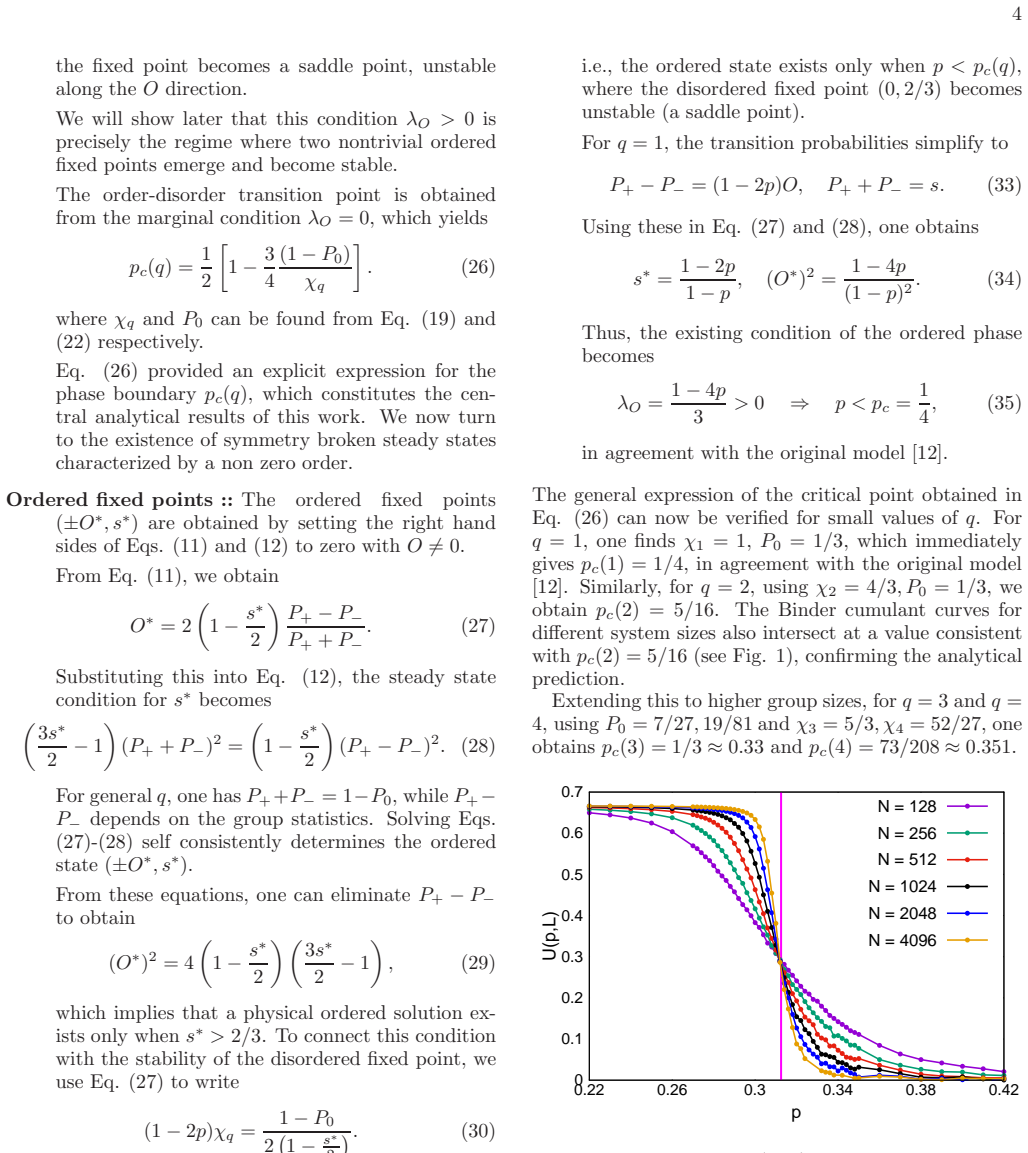
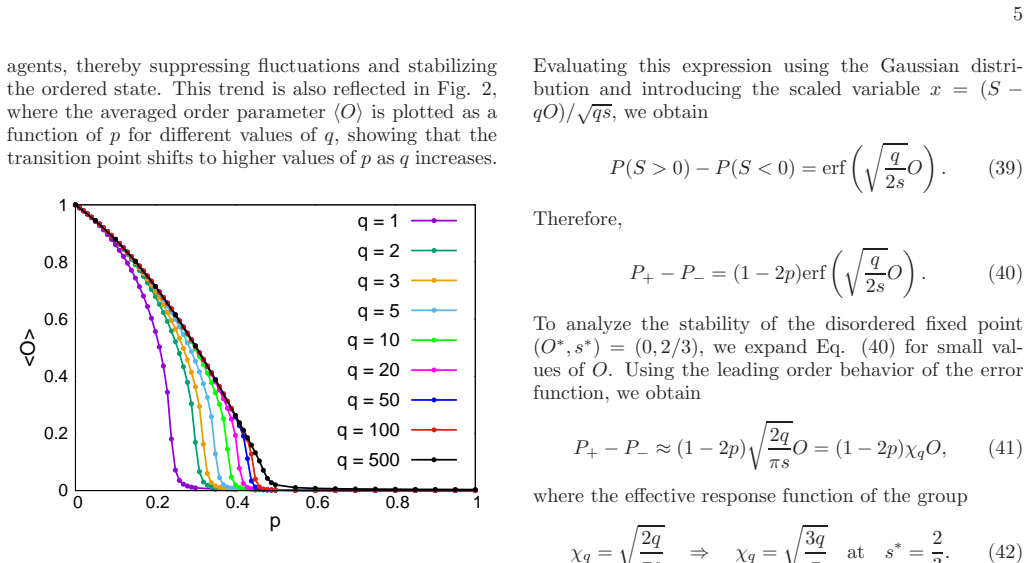
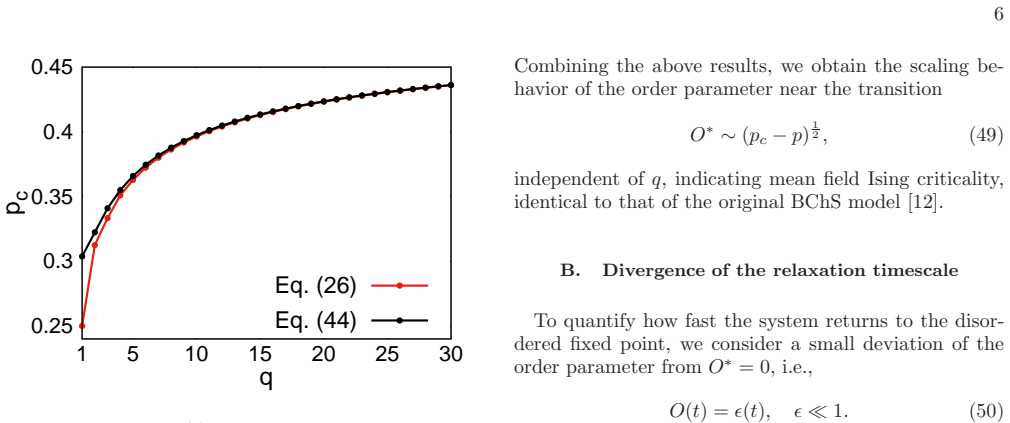
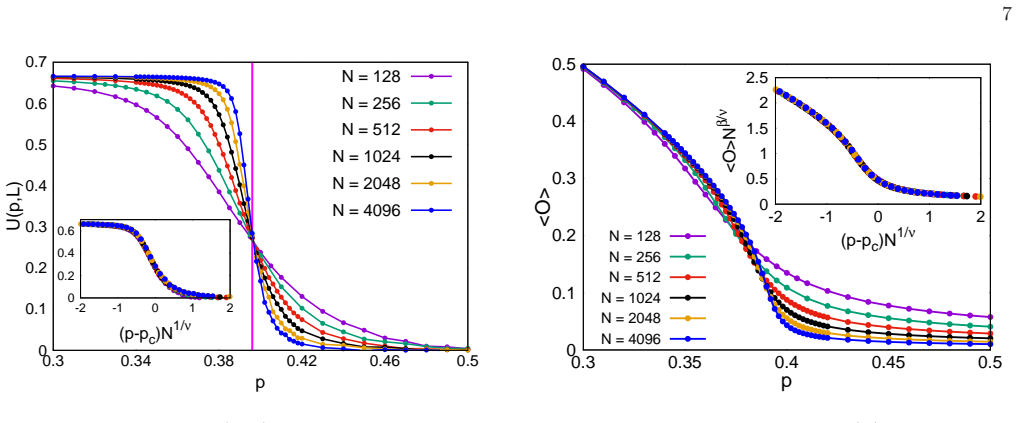
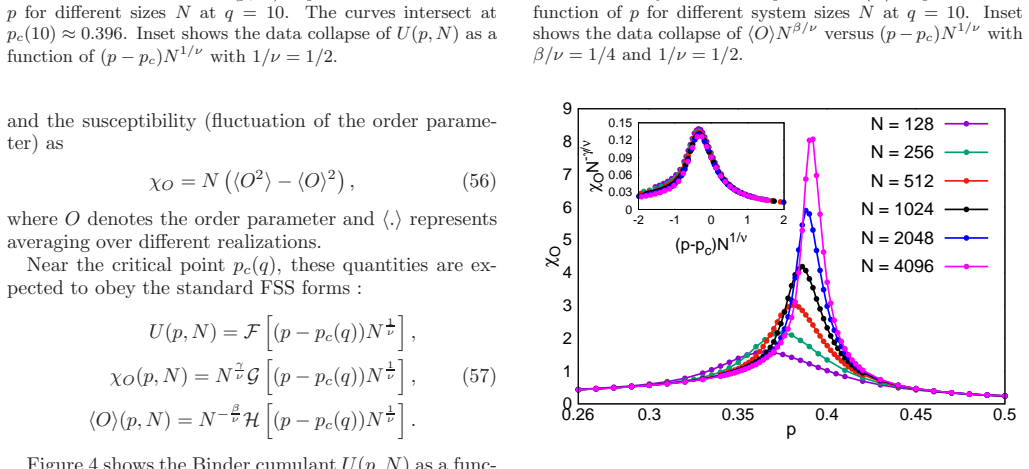
Within a mean-field framework, an exact expression for the critical noise p_c(q) is derived, showing that it increases monotonically with q and approaches 1/2 in the large-q limit. The order parameter scales as (p_c(q)-p)^{1/2}, and the relaxation timescale diverges as |p-p_c(q)|^{-1}. Finite-size scaling of the Binder cumulant, order parameter, and its fluctuations confirm that the system belongs to the mean-field Ising universality class for all q.
What carries the argument
Mean-field rate equation for the time evolution of the average opinion under noisy q-body updates.
If this is right
- The location of the phase transition moves to higher noise levels as the group size q is increased.
- The critical exponents beta = 1/2 and nu = 1 remain fixed, independent of q.
- For large q the critical noise saturates at p_c = 1/2, recovering the threshold for purely random dynamics.
- Data collapse for the Binder cumulant and order-parameter fluctuations occurs onto the same mean-field Ising curves for all q.
Where Pith is reading between the lines
- In social dynamics, larger discussion groups would require stronger external noise to disrupt consensus, but the sharpness of the transition would be unchanged.
- The shift in p_c can be viewed as an effective renormalization of the noise parameter induced by the higher-order interaction term.
- Lattice simulations with spatial structure could reveal whether the mean-field universality persists or crosses over to a different class when fluctuations are important.
Load-bearing premise
The mean-field approximation that ignores spatial fluctuations and correlations among agents.
What would settle it
A direct simulation on a finite-dimensional lattice that yields an order-parameter exponent different from 1/2 for some value of q.
Figures
read the original abstract
We introduce a generalized version of the Biswas-Chatterjee-Sen (BChS) model \cite{Biswas} with group interactions of size $q$, extending the original pairwise interaction dynamics. Within a mean-field framework, we derive an exact expression for the critical noise $p_c(q)$, showing that it increases monotonically with $q$ and approaches $1/2$ in the large-$q$ limit, consistent with a Gaussian approximation. Despite this shift in the phase boundary, the critical behavior remains unchanged across all $q$: the order parameter scales as $(p_c(q)-p)^{1/2}$, and the relaxation timescale diverges as $|p-p_c(q)|^{-1}$, identical to the original BChS model \cite{Biswas}. Finite-size scaling of the Binder cumulant, order parameter, and its fluctuations confirm that the system belongs to the mean-field Ising universality class for all $q$. Our results demonstrate that higher-order interactions modify the location of the transition without altering its universality class.
Editorial analysis
A structured set of objections, weighed in public.
Referee Report
Summary. The manuscript introduces a generalization of the Biswas-Chatterjee-Sen (BChS) model to group interactions of fixed size q. In a mean-field framework the authors derive an exact closed-form expression for the critical noise p_c(q), which increases monotonically with q and saturates at 1/2 for large q, consistent with a Gaussian approximation. They further show that the order parameter vanishes as (p_c(q) – p)^{1/2} and the relaxation time diverges as |p – p_c(q)|^{-1} for every q, and that finite-size scaling of the Binder cumulant, magnetization, and susceptibility collapses onto the mean-field Ising universality class independently of q.
Significance. If the mean-field derivation and the accompanying finite-size scaling hold, the result is significant: it demonstrates that higher-order group interactions shift only the location of the transition while leaving the mean-field Ising exponents and dynamic scaling unchanged. The exact, parameter-free expression for p_c(q) together with the explicit linear-stability analysis and Binder-cumulant crossings constitute reproducible analytic and numerical evidence that strengthens the claim of universality-class invariance.
major comments (2)
- [Mean-field derivation] Mean-field rate equation and linearization (section containing the derivation of p_c(q)): the explicit form of the update map for the magnetization m and the derivative evaluated at m = 0 must be displayed so that the reader can verify that the eigenvalue controlling the instability is independent of q. Without this step the assertion that the critical exponents remain exactly those of the Ising mean-field class for arbitrary q rests on an unshown algebraic cancellation.
- [Finite-size scaling] Finite-size scaling analysis (section or figure presenting Binder cumulant crossings and data collapse): the scaling variable used for the collapse must be stated explicitly (e.g., (p – p_c(q)) L^{1/2} for the order parameter with mean-field exponents). If the collapse is shown only for a subset of q values or without overlaying the analytic p_c(q), the claim that the universality class is unchanged for all q is not fully substantiated.
minor comments (2)
- [Large-q limit] The large-q Gaussian approximation is stated to be consistent with the exact p_c(q); a quantitative comparison (table or inset plot of the difference) would make this statement precise.
- [Model definition] The model definition should explicitly state how the noise probability p is applied when a group of q spins is selected, to avoid any ambiguity in the generalization from the original pairwise BChS rule.
Simulated Author's Rebuttal
We thank the referee for the positive assessment of our work and for the constructive comments that will improve the clarity of the manuscript. We address each major comment below and will incorporate the suggested revisions.
read point-by-point responses
-
Referee: [Mean-field derivation] Mean-field rate equation and linearization (section containing the derivation of p_c(q)): the explicit form of the update map for the magnetization m and the derivative evaluated at m = 0 must be displayed so that the reader can verify that the eigenvalue controlling the instability is independent of q. Without this step the assertion that the critical exponents remain exactly those of the Ising mean-field class for arbitrary q rests on an unshown algebraic cancellation.
Authors: We agree that explicitly displaying the update map and the linearization step will make the q-independence of the critical exponents transparent. In the revised manuscript we will present the full mean-field rate equation for the magnetization m, evaluate its derivative at m = 0, and show the algebraic cancellation that leaves the eigenvalue independent of q. This addition will directly address the referee's concern while preserving the existing analytic result for p_c(q). revision: yes
-
Referee: [Finite-size scaling] Finite-size scaling analysis (section or figure presenting Binder cumulant crossings and data collapse): the scaling variable used for the collapse must be stated explicitly (e.g., (p – p_c(q)) L^{1/2} for the order parameter with mean-field exponents). If the collapse is shown only for a subset of q values or without overlaying the analytic p_c(q), the claim that the universality class is unchanged for all q is not fully substantiated.
Authors: We will revise the finite-size scaling section to state the scaling variables explicitly (e.g., (p - p_c(q)) L^{1/2} for the order parameter, L^{1} for the susceptibility, etc.). The data collapses and Binder-cumulant crossings will be shown for several representative values of q, with the analytic p_c(q) overlaid on the plots, thereby confirming that the mean-field Ising universality holds for all q. revision: yes
Circularity Check
No significant circularity; derivation self-contained
full rationale
The paper performs an exact mean-field closure on the generalized q-group update rule to obtain a closed rate equation for the magnetization m. From this equation an explicit algebraic expression for p_c(q) is solved by setting the linear coefficient to zero; the same linearized dynamics then yields the eigenvalue whose sign change produces the standard mean-field exponents beta=1/2 and tau ~ |p-p_c|^{-1} independently of q. Finite-size scaling and Binder-cumulant crossings are presented only as numerical confirmation of the analytically derived mean-field class. No fitted parameters are relabeled as predictions, no ansatz is smuggled through self-citation, and the cited BChS reference supplies only the original pairwise model, not the load-bearing steps for the generalized case. The entire chain therefore remains independent of its own outputs.
Axiom & Free-Parameter Ledger
free parameters (1)
- q
axioms (1)
- domain assumption Mean-field approximation neglecting fluctuations and spatial correlations
Reference graph
Works this paper leans on
-
[1]
C. Castellano, S. Fortunato, and V. Loreto, Statistical physics of social dynamics , Rev. Mod. Phys. 81, 591-646 (2009)
work page 2009
-
[2]
S. Galam, Sociophysics, A Physicist’s Modeling of Psycho-political Phenomena , Springer New York, NY (2016)
work page 2016
- [3]
-
[4]
Perc, The social physics collective , Scientific Reports 9, 16549 (2019)
M. Perc, The social physics collective , Scientific Reports 9, 16549 (2019)
work page 2019
-
[5]
Jusup et al., Social physics , Physics Reports 948, 1–148 (2022)
M. Jusup et al., Social physics , Physics Reports 948, 1–148 (2022)
work page 2022
-
[6]
G. Toscani, P. Sen, S. Biswas, Kinetic exchange models of societies and economies , Philos Trans A 380, 20210170 (2022)
work page 2022
-
[7]
M. Lallouache, A. S. Chakrabarti, A. Chakraborti, and B. K. Chakrabarti, Opinion formation in kinetic ex- change models: Spontaneous symmetry-breaking transi- tion, Phys. Rev. E 82, 056112 (2010)
work page 2010
-
[8]
P. Sen, Phase transitions in a two-parameter model of opinion dynamics with random kinetic exchanges , Phys. Rev. E 83, 016108 (2011)
work page 2011
-
[9]
Biswas, Mean-field solutions of kinetic-exchange opin- ion models , Phys
S. Biswas, Mean-field solutions of kinetic-exchange opin- ion models , Phys. Rev. E 84, 056106 (2011)
work page 2011
- [10]
- [11]
- [12]
-
[13]
S. Mukherjee, S. Biswas, A. Chatterjee, and B. K. Chakrabarti, The Ising universality class of kinetic ex- change models of opinion dynamics , Physica A: Statisti- cal Mechanics and its Applications 567, 125692 (2021)
work page 2021
-
[14]
S. Mukherjee and A. Chatterjee, Disorder-induced phase transition in an opinion dynamics model: Results in two and three dimensions , Phys. Rev. E 94, 062317 (2016)
work page 2016
-
[15]
K. Biswas and P. Sen, Nonequilibrium dynamics in a three-state opinion-formation model with stochastic ex- treme switches, Phys. Rev. E 106, 054311 (2022)
work page 2022
-
[16]
K. Biswas and P. Sen, Opinion formation models with extreme switches and disorder: critical behavior and dy- namics, Phys. Rev. E 107, 054106 (2023)
work page 2023
-
[17]
K. Biswas and P. Sen, Virtual walks and phase tran- sitions in the two-dimensional Biswas-Chatterjee–Sen model with extreme switches , Phys. Rev. E 110, 024105 (2024)
work page 2024
-
[18]
S. Saha and P. Sen, Virtual walks inspired by a mean- field kinetic exchange model of opinion dynamics , Philos Trans A 380, 20210168 (2022)
work page 2022
-
[19]
K. Suchecki, K. Biswas, J. A. Holyst, and P. Sen, Biswas- Chatterjee-Sen kinetic exchange opinion model for two connected groups, Phys. Rev. E 112, 014304 (2025)
work page 2025
-
[20]
N. Crokidakis, Noise and disorder: Phase transitions and universality in a model of opinion formation , Interna- tional Journal of Modern Physics C 27, 1650060 (2016)
work page 2016
-
[21]
M. T. S. A. Raquel et al., Non-equilibrium ki- netic Biswas–Chatterjee–Sen model on complex networks , Physica A 603, 127825 (2022)
work page 2022
-
[22]
David S. M. Alencar wt al., Opinion Dynamics Systems on Barab´ asi–Albert Networks: Biswas–Chatterjee–Sen Model, Entropy 25(2), 183 (2023)
work page 2023
-
[23]
F. W. S. Lima, M. A. Sumour, A. A. Moreira, and A. D. Araujo, Non-equilibrium BCS model on Apollonian networks, Physica A: Statistical Mechanics and its Ap- plications 571, 125834 (2021)
work page 2021
-
[24]
G. S. Oliveira et al., Biswas–Chatterjee–Sen Model De- fined on Solomon Networks in 1 ≤ d ≤ 6-Dimensional Lattices, Entropy 27(3), 300 (2025)
work page 2025
-
[25]
G. S. Oliveira, T. A. Alves, G. A. Alves, F. W. Lima, and J. A. Plascak, Biswas–Chatterjee–Sen model on Solomon networks with two three-dimensional lattices , Entropy 26(7), 587 (2024)
work page 2024
-
[26]
P. Holme and J. Saram¨ aki, Temporal networks, Physics Reports 519, 97–125 (2012)
work page 2012
-
[27]
I. Iacopini, G. Petri, A. Barrat, and V. Latora, Simplicial models of social contagion , Nature Communications 10, 2485 (2019)
work page 2019
-
[28]
Ising model on a small world network
H. Hong, B. J. Kim, M. Y. Choi, Comment on “Ising model on a small world network” , Phys. Rev. E 66, 018101 (2002)
work page 2002
-
[29]
A. Chatterjee, P. Sen, Phase transitions in an Ising model on a Euclidean network , Phys. Rev. E 74, 036109 (2006)
work page 2006
discussion (0)
Sign in with ORCID, Apple, or X to comment. Anyone can read and Pith papers without signing in.