Utility of NISQ devices: optimizing experimental parameters for the fabrication of Au atomic junction using gate-based quantum computers
Pith reviewed 2026-05-10 15:17 UTC · model grok-4.3
The pith
A NISQ device optimizes experimental parameters for fabricating gold atomic junctions more accurately than a quantum annealer on large problems.
A machine-rendered reading of the paper's core claim, the machinery that carries it, and where it could break.
Core claim
By mapping the multi-parameter optimization of feedback-controlled electromigration to a combinatorial problem, the NISQ device produces approximate solutions with lower residual energies and higher quality than a previously used D-Wave quantum annealer, especially for large-scale instances. This establishes that gate-based NISQ hardware can be applied directly to experimental parameter search in nanoscale fabrication.
What carries the argument
The reduction of feedback-controlled electromigration parameter tuning to a combinatorial optimization problem solved approximately on a gate-based NISQ device.
If this is right
- Fabrication of Au atomic junctions can proceed with reduced reliance on manual parameter adjustment.
- NISQ hardware offers a practical advantage over annealing hardware for this class of experimental optimization when the problem size increases.
- Lower residual energies translate into tighter control over atomic migration rates during the electromigration process.
- The same mapping technique can be reused for other materials or junction geometries once the formulation is established.
Where Pith is reading between the lines
- Closed-loop systems that feed NISQ-optimized parameters back into live experiments could shorten iteration cycles in nanoscale device development.
- The observed NISQ advantage may change if future annealers improve or if better error mitigation becomes available on gate-based platforms.
- This application points to a broader near-term role for NISQ devices in guiding physical fabrication steps rather than purely numerical benchmarks.
Load-bearing premise
The experimental parameter search for feedback-controlled electromigration can be accurately expressed as a combinatorial optimization problem that present-day NISQ devices can solve without large mapping or noise errors.
What would settle it
Running the NISQ-chosen parameters in actual fabrication experiments and finding that the resulting gold junctions show higher failure rates, poorer conductance quantization, or lower stability than junctions made with parameters from classical solvers or the annealer.
Figures


read the original abstract
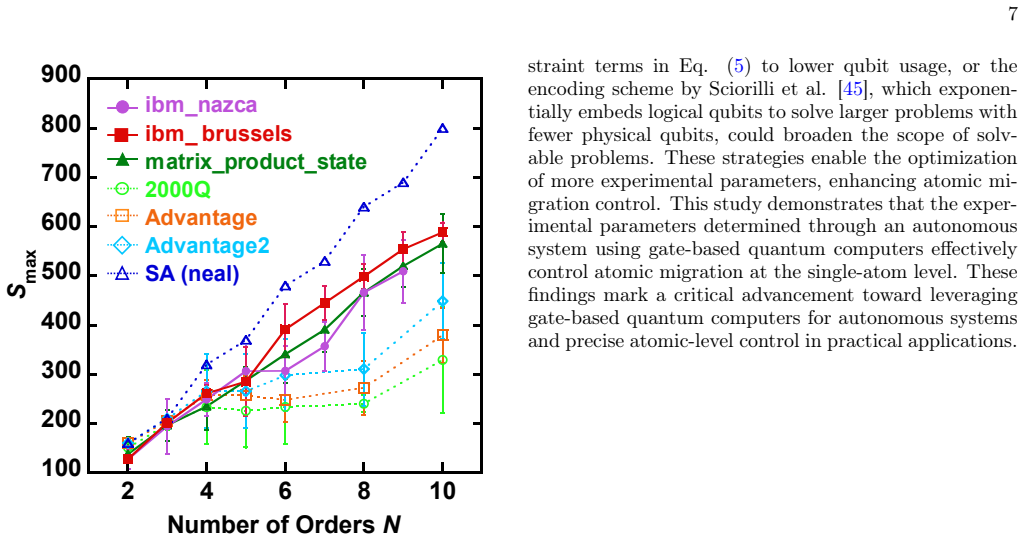
Feedback-controlled electromigration (FCE) enables precise regulation of atomic migration by carefully optimizing multiple experimental parameters. However, manually fine-tuning these parameters poses significant challenges. This study investigated the feasibility of autonomously fabricating Au atomic junctions through gate-based quantum computing using a noisy intermediate-scale quantum (NISQ) device, which effectively approximates solutions to combinatorial optimization problems. We compared the computational accuracy of the NISQ device against a previously reported D-Wave quantum annealer. The results indicate that the NISQ device achieved lower residual energies and produced higher-quality approximate solutions for large-scale problems than the quantum annealing system.
Editorial analysis
A structured set of objections, weighed in public.
Referee Report
Summary. The manuscript investigates the use of gate-based NISQ devices to autonomously optimize multiple experimental parameters for feedback-controlled electromigration (FCE) in fabricating Au atomic junctions. It formulates the task as a combinatorial optimization problem and compares the NISQ device's approximate solutions (via lower residual energies and higher-quality results on large instances) against those from a previously reported D-Wave quantum annealer.
Significance. If the comparison holds after proper validation, the result would indicate a concrete experimental application where NISQ hardware can outperform quantum annealing for parameter tuning in nanotechnology, supporting broader claims of NISQ utility beyond toy problems. The work attempts to connect quantum optimization directly to a physical fabrication process.
major comments (2)
- [Abstract] Abstract: The headline claim that the NISQ device 'achieved lower residual energies and produced higher-quality approximate solutions for large-scale problems' is unsupported because the abstract (and visible text) supplies no description of the QUBO/Ising encoding of the FCE parameters, the quantum algorithm (QAOA/VQE/etc.), variable count, embedding details, residual-energy normalization relative to the true minimum, or error-mitigation protocol. This directly undermines assessment of the NISQ vs. D-Wave comparison.
- [Abstract] Abstract/Results: The central performance advantage is load-bearing on the assumption that the same combinatorial objective is solved with identical ground-state energy scale on both platforms; without showing the mapping fidelity, chain-break handling, or post-processing, the reported lower residual energies could be an artifact of differing normalizations or noise models.
minor comments (1)
- [Abstract] The phrase 'large-scale problems' is undefined; adding the number of experimental parameters, qubits, or problem instances would clarify the scope.
Simulated Author's Rebuttal
We thank the referee for the constructive feedback on our manuscript. The comments highlight the need for greater clarity in the abstract and explicit validation of the NISQ-D-Wave comparison. We address each point below and will revise the manuscript to incorporate the suggested clarifications.
read point-by-point responses
-
Referee: [Abstract] Abstract: The headline claim that the NISQ device 'achieved lower residual energies and produced higher-quality approximate solutions for large-scale problems' is unsupported because the abstract (and visible text) supplies no description of the QUBO/Ising encoding of the FCE parameters, the quantum algorithm (QAOA/VQE/etc.), variable count, embedding details, residual-energy normalization relative to the true minimum, or error-mitigation protocol. This directly undermines assessment of the NISQ vs. D-Wave comparison.
Authors: We agree that the abstract is too concise and should be expanded to support the headline claims without requiring the reader to consult the full text. The manuscript details the QUBO encoding of the FCE parameters, employs QAOA on the NISQ hardware, reports problem sizes with up to 20 variables for the large instances, normalizes residual energy as (E_approx - E_exact)/E_exact using classically computed minima, and applies standard readout-error mitigation. We will revise the abstract to include a brief statement on the algorithm, problem scale, and normalization procedure. revision: yes
-
Referee: [Abstract] Abstract/Results: The central performance advantage is load-bearing on the assumption that the same combinatorial objective is solved with identical ground-state energy scale on both platforms; without showing the mapping fidelity, chain-break handling, or post-processing, the reported lower residual energies could be an artifact of differing normalizations or noise models.
Authors: The identical QUBO formulation is solved on both platforms, with the ground-state energy obtained from an exact classical solver and used for normalization in both cases. D-Wave results incorporate the chain-break handling and post-processing described in the referenced prior work. We will add an explicit paragraph in the Results section (and a short note in the abstract) confirming the shared objective function, identical normalization, and post-processing steps to remove any ambiguity in the comparison. revision: yes
Circularity Check
No circularity: external benchmark comparison to prior D-Wave study
full rationale
The paper formulates FCE parameter optimization as a combinatorial problem and reports NISQ results against an external, previously reported D-Wave benchmark. No self-definitional equations, fitted inputs renamed as predictions, or load-bearing self-citations appear in the abstract or described derivation. The comparison relies on independent platform outputs rather than internal renormalization or ansatz smuggling. This is the standard case of a self-contained empirical comparison.
Axiom & Free-Parameter Ledger
Reference graph
Works this paper leans on
-
[1]
H. Huntington and A. Grone, Journal of Physics and Chemistry of Solids20, 76 (1961)
work page 1961
- [2]
- [3]
- [4]
-
[5]
D. Strachan, D. Smith, D. Johnston, T.-H. Park, M. J. Therien, D. Bonnell, and A. Johnson, Applied Physics Letters86, 043109 (2005)
work page 2005
-
[6]
J.CampbellandR.Knobel,AppliedPhysicsLetters102, 023105 (2013)
work page 2013
-
[7]
Y. Kanamaru, M. Ando, and J.-i. Shirakashi, Journal of Vacuum Science & Technology B33, 02B106 (2015)
work page 2015
-
[8]
K. Bolotin, F. Kuemmeth, A. Pasupathy, and D. Ralph, Applied Physics Letters84, 3154 (2004)
work page 2004
-
[9]
L. Arzubiaga, F. Golmar, R. Llopis, F. Casanova, and L. E. Hueso, AIP Advances4, 117126 (2014)
work page 2014
-
[10]
I. Rattalino, V. Cauda, P. Motto, T. Limongi, G. Das, L. Razzari, F. Parenti, E. Di Fabrizio, A. Mucci, L. Sch- enetti,et al., RSC Advances2, 10985 (2012)
work page 2012
-
[11]
M. L. Perrin, E. Burzurí, and H. S. van der Zant, Chem- ical Society Reviews44, 902 (2015)
work page 2015
-
[12]
S. Johnson, A. Sundararajan, D. Hunley, and D. Stra- chan, Nanotechnology21, 125204 (2010)
work page 2010
-
[13]
Q. Wang, R. Liu, D. Xiang, M. Sun, Z. Zhao, L. Sun, T. Mei, P. Wu, H. Liu, X. Guo,et al., ACS Nano10, 9695 (2016)
work page 2016
- [14]
-
[15]
M. Ito, M. Yagi, M. Shimada, and J.-i. Shirakashi, AIP Advances8, 105005 (2018)
work page 2018
- [16]
-
[17]
Y. A. Pashkin, T. Yamamoto, O. Astafiev, Y. Nakamura, D. Averin, and J. Tsai, Nature421, 823 (2003)
work page 2003
- [18]
- [19]
- [20]
- [21]
- [22]
- [23]
- [24]
-
[25]
Y. Kim, A. Eddins, S. Anand, K. X. Wei, E. Van Den Berg, S. Rosenblatt, H. Nayfeh, Y. Wu, M. Zale- tel, K. Temme,et al., Nature618, 500 (2023)
work page 2023
- [26]
-
[27]
A. Peruzzo, J. McClean, P. Shadbolt, M.-H. Yung, X.-Q. Zhou, P. J. Love, A. Aspuru-Guzik, and J. L. O’brien, Nature Communications5, 4213 (2014)
work page 2014
-
[28]
J. R. McClean, J. Romero, R. Babbush, and A. Aspuru- Guzik, New Journal of Physics18, 023023 (2016)
work page 2016
-
[29]
A Quantum Approximate Optimization Algorithm
E. Farhi, J. Goldstone, and S. Gutmann, arXiv preprint arXiv:1411.4028 (2014)
work page internal anchor Pith review Pith/arXiv arXiv 2014
-
[30]
Quantum Algorithms for Fixed Qubit Architectures
E. Farhi, J. Goldstone, S. Gutmann, and H. Neven, arXiv preprint arXiv:1703.06199 (2017)
work page Pith review arXiv 2017
-
[31]
T. Miki, R. Okita, M. Shimada, D. Tsukayama, and J.-i. Shirakashi, AIP Advances12, 035247 (2022)
work page 2022
-
[32]
Nannicini, Physical Review E99, 013304 (2019)
G. Nannicini, Physical Review E99, 013304 (2019)
work page 2019
-
[33]
IBM Quantum,https://quantum-computing.ibm.com/
- [34]
-
[35]
A. Umeno and K. Hirakawa, Physica E: Low-dimensional Systems and Nanostructures42, 2826 (2010)
work page 2010
-
[36]
K. M. Nakanishi, K. Fujii, and S. Todo, Physical Review Research2, 043158 (2020)
work page 2020
-
[37]
Choi, Quantum Information Processing7, 193 (2008)
V. Choi, Quantum Information Processing7, 193 (2008)
work page 2008
-
[38]
Choi, Quantum Information Processing10, 343 (2011)
V. Choi, Quantum Information Processing10, 343 (2011)
work page 2011
- [39]
-
[40]
dwave-neal,https://github.com/dwavesystems/ dwave-neal
-
[41]
P. D. Nation, H. Kang, N. Sundaresan, and J. M. Gam- betta, PRX Quantum2, 040326 (2021)
work page 2021
-
[42]
P. K. Barkoutsos, G. Nannicini, A. Robert, I. Tavernelli, and S. Woerner, Quantum4, 256 (2020)
work page 2020
-
[43]
Y. Chai, L. Funcke, T. Hartung, K. Jansen, S. Kühn, P. Stornati, and T. Stollenwerk, Physical Review Applied 20, 064025 (2023)
work page 2023
-
[44]
A. Glos, A. Krawiec, and Z. Zimborás, npj Quantum In- formation8, 39 (2022)
work page 2022
-
[45]
M. Sciorilli, L. Borges, T. L. Patti, D. García-Martín, G. Camilo, A. Anandkumar, and L. Aolita, Nature Com- munications16, 476 (2025)
work page 2025
discussion (0)
Sign in with ORCID, Apple, or X to comment. Anyone can read and Pith papers without signing in.