Spatial-Spectral Adaptive Fidelity and Noise Prior Reduction Guided Hyperspectral Image Denoising
Pith reviewed 2026-05-10 14:46 UTC · model grok-4.3
The pith
A denoising framework for hyperspectral images uses an adaptive weight tensor to dynamically balance data fidelity against noise prior modeling.
A machine-rendered reading of the paper's core claim, the machinery that carries it, and where it could break.
Core claim
The paper establishes that integrating comprehensive noise prior reduction with fewer parameters and a spatial-spectral adaptive fidelity term, using an adaptive weight tensor to dynamically balance fidelity and prior regularization, enables a pixel-wise model with representative coefficient total variation to accurately remove mixed noise in hyperspectral images while preserving their spectral low-rank structure and local smoothness.
What carries the argument
The adaptive weight tensor that dynamically balances the fidelity and prior regularization terms, combined with the representative coefficient total variation regularizer in a pixel-wise model.
If this is right
- The method efficiently handles various types of mixed noise in hyperspectral images.
- It accurately captures the spectral low-rank structure and local smoothness of the images.
- The ADMM-based optimization algorithm ensures stable and fast convergence.
- Superior denoising performance is achieved on both simulated and real-world datasets.
- Competitive computational efficiency is maintained relative to other methods.
Where Pith is reading between the lines
- The dynamic balancing approach might reduce reliance on manual parameter tuning when noise statistics change across different sensors or scenes.
- If the noise prior reduction with fewer parameters holds, the framework could be tested as a drop-in preprocessor for downstream hyperspectral tasks such as classification or unmixing.
- The same adaptive fidelity idea could be examined in related domains that process multi-channel data under mixed noise, such as multispectral video or medical imaging stacks.
Load-bearing premise
The adaptive weight tensor can dynamically and appropriately balance the fidelity and prior regularization terms across diverse mixed-noise scenarios without introducing bias or requiring post-hoc adjustments.
What would settle it
New experiments on additional real-world hyperspectral datasets containing unseen combinations of mixed noise in which the method fails to exceed leading alternatives on standard metrics such as PSNR, SSIM, or visual quality would falsify the performance claims.
Figures



read the original abstract
The core challenge of hyperspectral image denoising is striking the right balance between data fidelity and noise prior modeling. Most existing methods place too much emphasis on the intrinsic priors of the image while overlooking diverse noise assumptions and the dynamic trade-off between fidelity and priors. To address these issues, we propose a denoising framework that integrates noise prior reduction and a spatial-spectral adaptive fidelity term. This framework considers comprehensive noise priors with fewer parameters and introduces an adaptive weight tensor to dynamically balance the fidelity and prior regularization terms. Within this framework, we further develop a fast and robust pixel-wise model combined with the representative coefficient total variation regularizer to accurately remove mixed noise in HSIs. The proposed method not only efficiently handles various types of noise but also accurately captures the spectral low-rank structure and local smoothness of HSIs. An efficient optimization algorithm based on the alternating direction method of multipliers is designed to ensure stable and fast convergence. Extensive experiments on simulated and real-world datasets demonstrate that the proposed model achieves superior denoising performance while maintaining competitive computational efficiency.
Editorial analysis
A structured set of objections, weighed in public.
Referee Report
Summary. The paper proposes a hyperspectral image denoising framework integrating noise prior reduction with a spatial-spectral adaptive fidelity term. An adaptive weight tensor dynamically balances fidelity and prior regularization terms, and a pixel-wise model using representative coefficient total variation (RCTV) regularizer is developed for mixed noise removal. An ADMM-based optimization algorithm ensures convergence, and experiments on simulated and real-world datasets claim superior denoising performance with competitive computational efficiency.
Significance. If the empirical results hold, the approach advances HSI denoising by addressing mixed noise types through adaptive balancing with a modest parameter count, which is relevant for remote sensing applications. Positive aspects include the detailed ADMM procedure with convergence analysis, quantitative metric comparisons to multiple baselines, and evaluation on both simulated and real datasets. These elements support the central claim of effective noise handling while preserving spectral low-rank structure and local smoothness.
major comments (1)
- [Experiments section, Table 1] Experiments section, Table 1 (simulated data): the reported PSNR/SSIM gains over the strongest baseline are modest (typically <1 dB) and lack standard deviations or statistical significance tests across repeated noise realizations; this weakens the unqualified claim of 'superior' performance for the central mixed-noise scenario.
minor comments (4)
- [Abstract and Section 3.1] Abstract and Section 3.1: the term 'representative coefficient total variation regularizer' is used before a clear definition or reference is provided; a brief inline explanation would improve readability.
- [Figure 4] Figure 4 (real-world results): zoomed insets on spectral bands would better illustrate the claimed preservation of fine details and low-rank structure.
- [Section 2] Section 2 (related work): the review of prior HSI denoising methods could explicitly contrast the parameter count of the proposed adaptive tensor against the cited deep-learning baselines.
- [Section 3] Notation: the adaptive weight tensor W is referenced in the optimization before its full construction (including dependence on noise estimates) is given; moving the definition earlier would reduce forward references.
Simulated Author's Rebuttal
We thank the referee for the constructive feedback and the recommendation for minor revision. We appreciate the recognition of the method's relevance for remote sensing and the positive aspects noted regarding the ADMM procedure and evaluations. We address the major comment on the experiments below.
read point-by-point responses
-
Referee: Experiments section, Table 1 (simulated data): the reported PSNR/SSIM gains over the strongest baseline are modest (typically <1 dB) and lack standard deviations or statistical significance tests across repeated noise realizations; this weakens the unqualified claim of 'superior' performance for the central mixed-noise scenario.
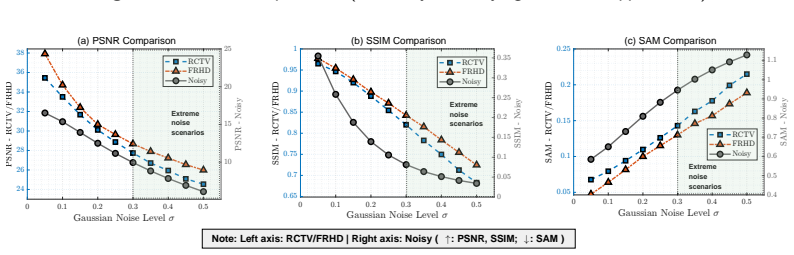
Authors: We acknowledge that the PSNR/SSIM improvements in Table 1 are often modest (typically below 1 dB) relative to the strongest baseline. Such incremental gains are common in HSI denoising, where competing methods already perform well on standard metrics, and our contributions lie in the adaptive framework's ability to handle mixed noise with fewer parameters, better preservation of spectral structure, and substantially improved runtime. The overall superiority is further evidenced by results on real-world data, additional metrics (e.g., SAM, ERGAS), and visual comparisons. To address the lack of variability reporting, we will update the revised manuscript to include standard deviations over multiple independent noise realizations for the simulated experiments in Table 1. We will also add a brief statistical analysis (e.g., paired t-tests) to confirm consistency of the improvements. revision: partial
Circularity Check
No significant circularity in derivation chain
full rationale
The paper introduces a spatial-spectral adaptive fidelity term and noise prior reduction framework, with an adaptive weight tensor presented as a model component balanced via ADMM optimization and convergence analysis. Experiments on simulated and real-world datasets provide external validation through quantitative metrics and baseline comparisons. No quoted step reduces a claimed prediction or uniqueness result to a fitted input by construction, nor does any load-bearing premise collapse to self-citation or definitional equivalence. The adaptive tensor is part of the proposed model design rather than a renamed fit, and the overall argument remains self-contained against the reported benchmarks.
Axiom & Free-Parameter Ledger
free parameters (2)
- adaptive weight tensor parameters
- regularization parameters
axioms (1)
- domain assumption Hyperspectral images possess spectral low-rank structure and local smoothness
Reference graph
Works this paper leans on
-
[1]
Q. Zhang, Q. Yuan, M. Song, H. Yu, L. Zhang, Cooperated spectral low-rankness prior and deep spatial prior for hsi unsupervised denoising, IEEE Transactions on Image Processing 31 (2022) 6356–6368.doi:10.1109/TIP.2022.3211471
-
[2]
IEEE Access9, 143661–143676 (2021) https://doi.org/10.1109/access.2021.3121762
B. Rasti, Y. Chang, E. Dalsasso, L. Denis, P. Ghamisi, Image restoration for remote sensing: Overview and toolbox, IEEE Geoscience and Remote Sensing Magazine 10 (2) (2021) 201–230.doi:10.1109/MGRS.2021.3121761
-
[3]
C.Li,S.Li,X.Chen,H.Zheng,Deepbidirectionalhierarchicalmatrixfactorizationmodelforhyperspectralunmixing,AppliedMathematical Modelling 137 (2025) 115736
work page 2025
-
[4]
V. Dremin, Z. Marcinkevics, E. Zherebtsov, A. Popov, A. Grabovskis, H. Kronberga, K. Geldnere, A. Doronin, I. Meglinski, A. Bykov, Skin complicationsofdiabetesmellitusrevealedbypolarizedhyperspectralimagingandmachinelearning,IEEETransactionsonMedicalImaging 40 (4) (2021) 1207–1216
work page 2021
-
[5]
M. Wang, Y. Xu, Z. Wang, C. Xing, Deep margin cosine autoencoder-based medical hyperspectral image classification for tumor diagnosis, IEEE Transactions on Instrumentation and Measurement 72 (2023) 1–12.doi:10.1109/TIM.2023.3293548
- [6]
-
[7]
A. Okujeni, C. Jänicke, S. Cooper, D. Frantz, P. Hostert, M. Clark, K. Segl, S. van der Linden, Multi-season unmixing of vegetation class fractions across diverse californian ecoregions using simulated spaceborne imaging spectroscopy data, Remote Sensing of Environment 264 (2021) 112558
work page 2021
-
[8]
J. Peng, W. Sun, H.-C. Li, W. Li, X. Meng, C. Ge, Q. Du, Low-rank and sparse representation for hyperspectral image processing: A review, IEEE Geoscience and Remote Sensing Magazine 10 (1) (2021) 10–43
work page 2021
-
[9]
W. He, Q. Yao, C. Li, N. Yokoya, Q. Zhao, H. Zhang, L. Zhang, Non-local meets global: An iterative paradigm for hyperspectral image restoration, IEEE Transactions on Pattern Analysis and Machine Intelligence 44 (4) (2022) 2089–2107.doi:10.1109/TPAMI.2020. 3027563
-
[10]
Y. Chen, H. Zhang, Y. Wang, Y. Yang, J. Wu, Flex-dld: Deep low-rank decomposition model with flexible priors for hyperspectral image denoising and restoration, IEEE Transactions on Image Processing 33 (2024) 1211–1226.doi:10.1109/TIP.2024.3360902
-
[11]
Q.Zhang,Y.Zheng,Q.Yuan,M.Song,H.Yu,Y.Xiao,Hyperspectralimagedenoising:Frommodel-driven,data-driven,tomodel-data-driven, IEEE Transactions on Neural Networks and Learning Systems 35 (10) (2024) 13143–13163.doi:10.1109/TNNLS.2023.3278866
-
[12]
A.Maffei,J.M.Haut,M.E.Paoletti,J.Plaza,L.Bruzzone,A.Plaza,Asinglemodelcnnforhyperspectralimagedenoising,IEEETransactions on Geoscience and Remote Sensing 58 (4) (2020) 2516–2529.doi:10.1109/TGRS.2019.2952062
-
[13]
L.Zhuang,M.K.Ng,L.Gao,Z.Wang,Eigen-cnn:Eigenimagespluseigennoiselevelmapsguidednetworkforhyperspectralimagedenoising, IEEE Transactions on Geoscience and Remote Sensing 62 (2024) 1–18.doi:10.1109/TGRS.2024.3379199
-
[14]
Q. Zhang, Y. Dong, Y. Zheng, H. Yu, M. Song, L. Zhang, Q. Yuan, Three-dimension spatial–spectral attention transformer for hyperspectral image denoising, IEEE Transactions on Geoscience and Remote Sensing 62 (2024) 1–13.doi:10.1109/TGRS.2024.3458174
-
[15]
M. Li, J. Liu, Y. Fu, Y. Zhang, D. Dou, Spectral enhanced rectangle transformer for hyperspectral image denoising, in: Proceedings of the IEEE/CVF Conference on Computer Vision and Pattern Recognition, 2023, pp. 5805–5814
work page 2023
-
[16]
Y.Chang,L.Yan,H.Fang,S.Zhong,W.Liao,Hsi-denet:Hyperspectralimagerestorationviaconvolutionalneuralnetwork,IEEETransactions on Geoscience and Remote Sensing 57 (2) (2018) 667–682
work page 2018
-
[17]
Q. Shi, X. Tang, T. Yang, R. Liu, L. Zhang, Hyperspectral image denoising using a 3-d attention denoising network, IEEE Transactions on Geoscience and Remote Sensing 59 (12) (2021) 10348–10363
work page 2021
- [18]
-
[19]
J. Li, W. Zhao, T. Xu, Region-based spectral-spatial mutual induction network for hyperspectral image reconstruction, IEEE Transactions on Computational Imaging 10 (2024) 1139–1151.doi:10.1109/TCI.2024.3430478
- [20]
-
[21]
L. Zhuang, M. K. Ng, Fasthymix: Fast and parameter-free hyperspectral image mixed noise removal, IEEE Transactions on Neural Networks and Learning Systems 34 (8) (2023) 4702–4716.doi:10.1109/TNNLS.2021.3112577
-
[22]
X.Xie,X.Zhang,J.Shen,K.Du,Poplar’swaterloggingresistancemodelingandevaluating:exploringandperfectingthefeasibilityofmachine learning methods in plant science, Frontiers in Plant Science 13 (2022) 821365
work page 2022
-
[23]
Q. Yuan, L. Zhang, H. Shen, Hyperspectral image denoising employing a spectral–spatial adaptive total variation model, IEEE Transactions on Geoscience and Remote Sensing 50 (10) (2012) 3660–3677
work page 2012
-
[24]
H. Tao, Z. Li, An alternative minimization method for tv-image deblurring in tensor space, Applied Mathematical Modelling 145 (2025) 116102
work page 2025
-
[25]
K. Dabov, A. Foi, V. Katkovnik, K. Egiazarian, Image denoising by sparse 3-d transform-domain collaborative filtering, IEEE Transactions on Image Processing 16 (8) (2007) 2080–2095.doi:10.1109/TIP.2007.901238
- [26]
-
[27]
J. Zhao, J. Wang, T. Zhang, J. Gao, Y. Wan, Tensor low-tubal-rank and sparse representations via dual-learnable transforms for multidimen- sional image recovery, Applied Mathematical Modelling (2025) 116406
work page 2025
- [28]
-
[29]
Z.-Y.Zhu,T.-Z.Huang,J.Huang,Projectionsubspacebasedlow-rankrepresentationforsparsehyperspectralunmixing,AppliedMathematical Modelling 125 (2024) 463–481
work page 2024
-
[30]
J. Peng, H. Wang, X. Cao, X. Liu, X. Rui, D. Meng, Fast noise removal in hyperspectral images via representative coefficient total variation, IEEE Transactions on Geoscience and Remote Sensing 60 (2022) 1–17
work page 2022
-
[31]
Y. Chen, W. Cao, L. Pang, X. Cao, Hyperspectral image denoising with weighted nonlocal low-rank model and adaptive total variation regularization, IEEE Transactions on Geoscience and Remote Sensing 60 (2022) 1–15
work page 2022
-
[32]
Y.Chen,W.Cao,L.Pang,J.Peng,X.Cao,Hyperspectralimagedenoisingviatexture-preservedtotalvariationregularizer,IEEETransactions on Geoscience and Remote Sensing 61 (2023) 1–14
work page 2023
-
[33]
J. Peng, H. Wang, X. Cao, X. Jia, H. Zhang, D. Meng, Stable local-smooth principal component pursuit, SIAM Journal on Imaging Sciences 17 (2) (2024) 1182–1205
work page 2024
-
[34]
Y. Su, H. Zhu, K.-C. Wong, Y. Chang, X. Li, Hyperspectral image denoising via weighted multidirectional low-rank tensor recovery, IEEE Transactions on Cybernetics 53 (5) (2023) 2753–2766
work page 2023
-
[35]
W. He, H. Zhang, L. Zhang, H. Shen, Total-variation-regularized low-rank matrix factorization for hyperspectral image restoration, IEEE transactions on geoscience and remote sensing 54 (1) (2015) 178–188
work page 2015
-
[36]
L.Zhuang,J.M.Bioucas-Dias,Fasthyperspectralimagedenoisingandinpaintingbasedonlow-rankandsparserepresentations,IEEEJournal of Selected Topics in Applied Earth Observations and Remote Sensing 11 (3) (2018) 730–742
work page 2018
-
[37]
Q. Wang, Z. Wu, J. Jin, T. Wang, Y. Shen, Low rank constraint and spatial spectral total variation for hyperspectral image mixed denoising, Signal Processing 142 (2018) 11–26
work page 2018
-
[38]
S. Xu, X. Cao, J. Peng, Q. Ke, C. Ma, D. Meng, Hyperspectral image denoising by asymmetric noise modeling, IEEE Transactions on Geoscience and Remote Sensing 60 (2022) 1–14.doi:10.1109/TGRS.2022.3227735
-
[39]
T.Zhang,J.Zhao,S.Fang,Z.Li,Q.Zhang,M.Gong,Hyperspectralimagerestorationviathecollaborationoflow-ranktensordenoisingand completion, Pattern Recognition 165 (2025) 111629
work page 2025
-
[40]
X. Xie, X. Lu, Theta-regularized kriging: Modeling and algorithms, Applied Mathematical Modelling 136 (2024) 115627
work page 2024
-
[41]
X. Rui, X. Cao, Q. Xie, Z. Yue, Q. Zhao, D. Meng, Learning an explicit weighting scheme for adapting complex hsi noise, in: Proceedings of the IEEE/CVF Conference on Computer Vision and Pattern Recognition, 2021, pp. 6739–6748
work page 2021
-
[42]
D. L. Donoho, De-noising by soft-thresholding, IEEE transactions on information theory 41 (3) (1995) 613–627
work page 1995
-
[43]
D. Krishnan, R. Fergus, Fast image deconvolution using hyper-laplacian priors, in: Y. Bengio, D. Schuurmans, J. Lafferty, C. Williams, A. Culotta (Eds.), Advances in Neural Information Processing Systems, Vol. 22, Curran Associates, Inc., 2009
work page 2009
-
[44]
G.Liu,Z.Lin,S.Yan,J.Sun,Y.Yu,Y.Ma,Robustrecoveryofsubspacestructuresbylow-rankrepresentation,IEEETransactionsonPattern Analysis and Machine Intelligence 35 (1) (2013) 171–184.doi:10.1109/TPAMI.2012.88
-
[45]
S.Boyd,N.Parikh,E.Chu,B.Peleato,J.Eckstein,etal.,Distributedoptimizationandstatisticallearningviathealternatingdirectionmethod of multipliers, Foundations and Trends® in Machine learning 3 (1) (2011) 1–122
work page 2011
-
[46]
W.Liang,Z.Tu,J.Lu,K.Tu,M.K.Ng,C.Xu,Fixed-pointconvergenceofmulti-blockpnpadmmanditsapplicationtohyperspectralimage restoration, IEEE Transactions on Computational Imaging 10 (2024) 1571–1587.doi:10.1109/TCI.2024.3485467
-
[47]
Y.Chen,J.Zeng,W.He,X.-L.Zhao,T.-X.Jiang,Q.Huang,Fastlarge-scalehyperspectralimagedenoisingvianoniterativelow-ranksubspace representation, IEEE Transactions on Geoscience and Remote Sensing 62 (2024) 1–14.doi:10.1109/TGRS.2024.3458395
-
[48]
Y.Luo,X.-L.Zhao,D.Meng,T.-X.Jiang,Hlrtf:Hierarchicallow-ranktensorfactorizationforinverseproblemsinmulti-dimensionalimaging, in: Proceedings of the IEEE/CVF Conference on Computer Vision and Pattern Recognition, 2022, pp. 19303–19312
work page 2022
-
[49]
B. He, X. Yuan, On the o(1/n) convergence rate of the douglas–rachford alternating direction method, SIAM Journal on Numerical Analysis 50 (2) (2012) 700–709
work page 2012
-
[50]
Xuelin Xie et al.:Preprint submitted to Applied Mathematical Modelling Page 24 of 24
M.Hong,Z.-Q.Luo,M.Razaviyayn,Convergenceanalysisofalternatingdirectionmethodofmultipliersforafamilyofnonconvexproblems, SIAM Journal on Optimization 26 (1) (2016) 337–364. Xuelin Xie et al.:Preprint submitted to Applied Mathematical Modelling Page 24 of 24
work page 2016
discussion (0)
Sign in with ORCID, Apple, or X to comment. Anyone can read and Pith papers without signing in.