Recognition: unknown
Operator Identification in Charged Lepton-Flavor Violation: Global EFT Analysis with RG Evolution, Polarization Observables, and Bayesian Model Discrimination at Future Colliders
Pith reviewed 2026-05-10 14:34 UTC · model grok-4.3
The pith
A global effective field theory analysis with renormalization-group running and polarization data can identify specific operators behind charged lepton-flavor violation at future colliders.
A machine-rendered reading of the paper's core claim, the machinery that carries it, and where it could break.
Core claim
By mapping ultraviolet-matched Wilson coefficients through one-loop renormalization-group running to the collider measurement scale, incorporating polarization asymmetries in e+e- and muon-collider channels, and performing a global profile-likelihood fit that also includes Dalitz-level μ→3e information, the analysis demonstrates that operator directions can be resolved and that Bayes factors can discriminate between representative leptoquark and heavy-neutral-lepton ultraviolet completions.
What carries the argument
The global profile-likelihood framework that evolves operator coefficients via one-loop renormalization-group running and uses polarization asymmetries to separate operator directions.
If this is right
- Renormalization-group evolution produces 10-30 percent shifts in selected operator-correlation entries when multi-TeV matching scales are used.
- Polarization asymmetries cleanly separate the c_Hℓ and c_He operator directions.
- Bayes factors provide quantitative discrimination between leptoquark and heavy-neutral-lepton ultraviolet hypotheses.
- Event-level generation and detector simulation for hadron and muon colliders yield realistic projections for operator identification.
Where Pith is reading between the lines
- If an operator is identified, the measured coefficient would translate into a preferred range for the mass scale of the underlying new physics.
- The same global framework could be applied to other rare processes such as τ→3μ or μ-e conversion to test consistency across channels.
- Absence of a signal would still tighten operator bounds beyond what exclusion limits alone provide, because the fit exploits correlations among observables.
Load-bearing premise
The effective field theory remains valid up to the multi-TeV scales of the colliders and the two chosen benchmark models capture the relevant new-physics effects.
What would settle it
A statistically significant sample of charged lepton-flavor violating events whose measured angular distributions or rates lie outside the bands predicted by the renormalization-group-evolved operator set, or a data set in which the Bayes factor between the two benchmark ultraviolet models remains close to one despite high luminosity.
Figures
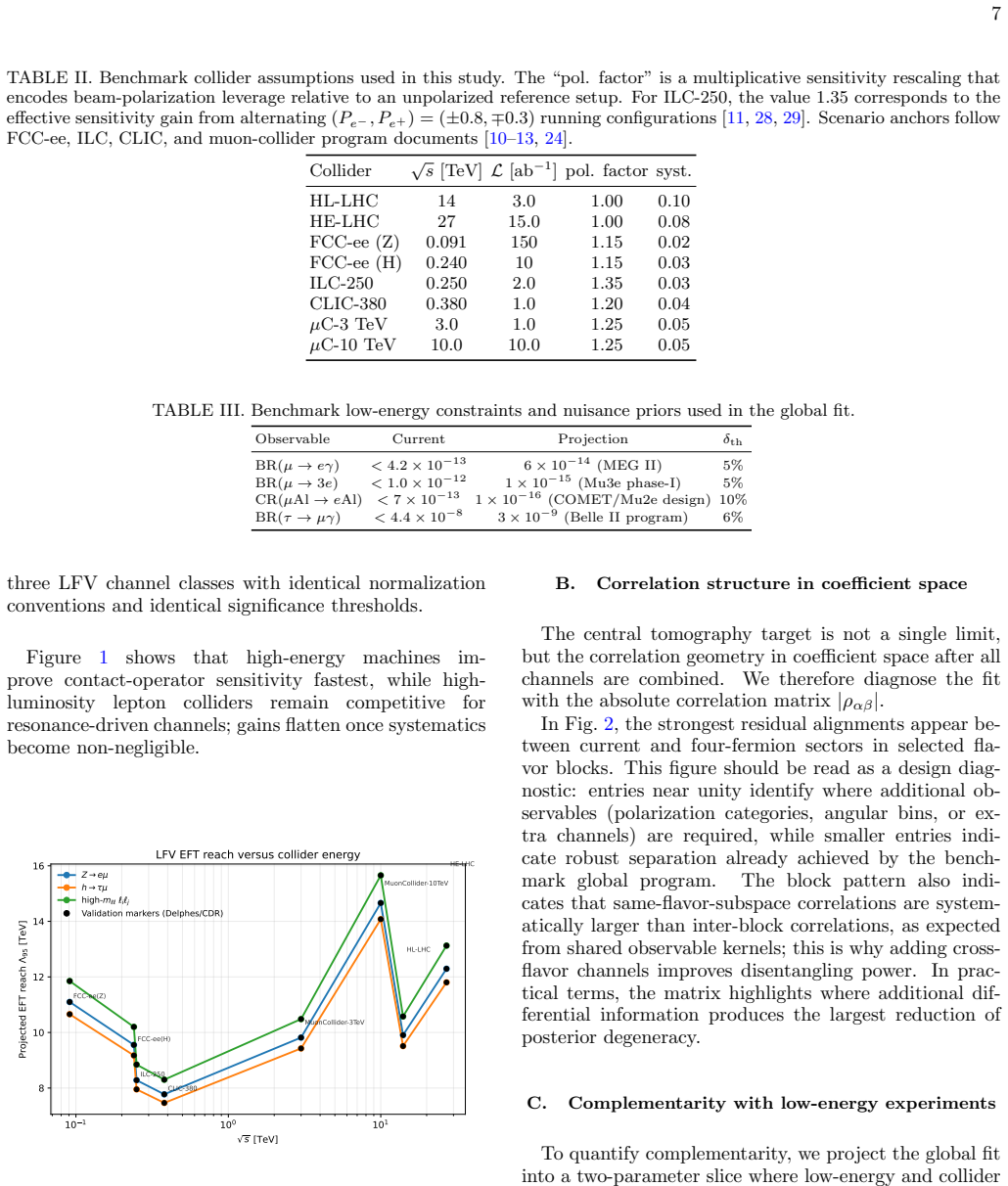





read the original abstract
Charged lepton-flavor violation is a null-test frontier of the Standard Model and a direct probe of physics beyond it. We present a global effective field theory (EFT) analysis across FCC-ee, ILC, CLIC, HL-LHC, HE-LHC, and muon colliders at 3 and 10 TeV, with operator identification as the primary target rather than exclusion reach alone. The analysis combines low-energy constraints, collider differential observables, and Dalitz-level $\mu\to 3e$ information in a common profile-likelihood framework. Key hadron-collider and muon-collider signal/background samples are generated at event level and propagated through Delphes detector simulation, while clean $e^+e^-$ benchmark channels are modeled with CDR-calibrated parametric response. We include one-loop renormalization-group (RG) running and operator mixing between UV matching and measurement scales, finding 10--30\% shifts in selected operator-correlation entries when comparing tree-level and RG-evolved coefficient mappings at multi-TeV matching scales. Polarization asymmetries are used to separate $c_{H\ell}$ and $c_{He}$ directions, and UV discrimination is quantified with Bayes factors for benchmark leptoquark and heavy-neutral-lepton hypotheses. The full code chain for event generation, detector response, inference, and figure reproduction is provided.
Editorial analysis
A structured set of objections, weighed in public.
Referee Report
Summary. The paper presents a global effective field theory analysis of charged lepton-flavor violation across future colliders (FCC-ee, ILC, CLIC, HL-LHC, HE-LHC, and muon colliders at 3 and 10 TeV). Operator identification is the primary goal, achieved via a profile-likelihood framework that combines low-energy constraints, collider differential observables, and Dalitz-level μ→3e information. The analysis incorporates one-loop RG running and operator mixing (reporting 10–30% shifts in selected operator correlations at multi-TeV matching scales), uses polarization asymmetries to separate c_{Hℓ} and c_{He} directions, and quantifies UV model discrimination via Bayes factors for benchmark leptoquark and heavy-neutral-lepton hypotheses. Event-level generation and Delphes simulation are used for hadron and muon colliders, with full code provided for reproducibility.
Significance. If the results hold, the work advances cLFV phenomenology by shifting focus from exclusion limits to concrete operator identification and UV discrimination in a multi-scale, multi-observable setting. The explicit inclusion of one-loop RG evolution with mixing, polarization observables for operator separation, and Bayesian quantification are useful additions. The provision of the complete code chain for event generation, detector response, inference, and figure reproduction is a clear strength that supports reproducibility and community follow-up.
minor comments (3)
- [Abstract and § on e⁺e⁻ modeling] The abstract refers to 'CDR-calibrated parametric response' for e⁺e⁻ channels; the main text should define CDR and provide explicit details on the calibration procedure and its validation against full simulation.
- [RG evolution section] While the operator basis and one-loop anomalous-dimension matrices are supplied, a dedicated table or figure directly comparing tree-level versus RG-evolved coefficient mappings (with numerical shifts) would strengthen the central 10–30% claim.
- [UV discrimination section] The benchmark UV models are described as illustrative; the text should explicitly state the operator mappings assumed for each (leptoquark and heavy neutral lepton) to allow readers to reproduce the Bayes-factor inputs.
Simulated Author's Rebuttal
We thank the referee for the positive assessment of our manuscript and for recommending minor revision. The referee's summary accurately reflects the scope of our global EFT analysis of charged lepton-flavor violation, including the incorporation of RG running, polarization observables, and Bayesian discrimination across multiple future colliders. No specific major comments were provided in the report.
Circularity Check
No significant circularity identified
full rationale
The manuscript supplies the operator basis, explicit one-loop anomalous-dimension matrices, profile-likelihood construction, and full event-generation plus Delphes pipeline. The reported 10-30% RG-induced shifts in operator correlations are obtained by direct application of the provided one-loop running and mixing between stated matching and measurement scales, not by fitting a parameter and relabeling the output as a prediction. Polarization asymmetries separate c_Hℓ and c_He directions via collider observables independent of the UV benchmarks. Bayesian discrimination is performed on illustrative leptoquark and heavy-neutral-lepton hypotheses presented as examples rather than exhaustive or self-fitted models. No self-citation chain, definitional equivalence, or fitted-input-renamed-as-prediction appears in the load-bearing steps; the derivation remains self-contained against external benchmarks.
Axiom & Free-Parameter Ledger
free parameters (1)
- EFT operator coefficients
axioms (1)
- domain assumption Effective field theory provides a valid description of new physics up to multi-TeV collider energies
Reference graph
Works this paper leans on
-
[1]
Kuno and Y
Y. Kuno and Y. Okada, Rev. Mod. Phys.73, 151 (2001)
2001
-
[2]
Calibbi and G
L. Calibbi and G. Signorelli, Riv. Nuovo Cim.41, 71 (2018)
2018
-
[3]
Particle Data Group, Prog. Theor. Exp. Phys.2024, 083C01 (2024)
2024
-
[4]
MEG Collaboration, Eur. Phys. J. C76, 434 (2016)
2016
-
[5]
MEG II Collaboration, Eur. Phys. J. C78, 380 (2018)
2018
-
[6]
Mu3e Collaboration, Nucl. Phys. B Proc. Suppl.248- 250, 35 (2014)
2014
- [7]
-
[8]
COMET Collaboration, PTEP2020, 033C01 (2020)
2020
-
[9]
Belle II Collaboration, PTEP2019, 123C01 (2019)
2019
-
[10]
FCC Collaboration, Eur. Phys. J. ST228, 261 (2019). 18
2019
-
[11]
The International Linear Collider: A Global Project
P. Bambadeet al., arXiv preprint arXiv:1903.01629 (2019)
-
[12]
Monogr.1802, 1 (2018)
CLIC Collaboration, CERN Yellow Rep. Monogr.1802, 1 (2018)
2018
- [13]
-
[14]
Abadaet al., Eur
A. Abadaet al., Eur. Phys. J. C79, 474 (2019)
2019
-
[15]
European Strategy Group, 2020 update of the european strategy for particle physics, CERN-ESU-015 (2020)
2020
-
[16]
J. Alwallet al., JHEP07, 079, 1405.0301
work page internal anchor Pith review arXiv
-
[17]
Sj¨ ostrand, S
T. Sj¨ ostrand, S. Mrenna, and P. Skands, Comput. Phys. Commun.178, 852 (2008)
2008
-
[18]
DELPHES 3, A modular framework for fast simulation of a generic collider experiment
J. de Favereauet al.(DELPHES 3), JHEP02, 057, 1307.6346
work page internal anchor Pith review arXiv
-
[19]
Brivio and M
I. Brivio and M. Trott, Phys. Rept.793, 1 (2019)
2019
-
[20]
E. E. Jenkins, A. V. Manohar, and M. Trott, JHEP2013 (10), 087
-
[21]
Alonso, E
R. Alonso, E. E. Jenkins, A. V. Manohar, and M. Trott, JHEP2014(04), 159
-
[22]
Kitano, M
R. Kitano, M. Koike, and Y. Okada, Phys. Rev. D66, 096002 (2002)
2002
-
[23]
Cirigliano, R
V. Cirigliano, R. Kitano, Y. Okada, and P. Tuzon, Phys. Rev. D80, 013002 (2009)
2009
- [24]
-
[25]
Brehmeret al., Phys
J. Brehmeret al., Phys. Rev. Lett.121, 111801 (2018)
2018
-
[26]
Radovicet al., Nature560, 41 (2018)
A. Radovicet al., Nature560, 41 (2018)
2018
-
[27]
Cowan, K
G. Cowan, K. Cranmer, E. Gross, and O. Vitells, Eur. Phys. J. C71, 1554 (2011)
2011
-
[28]
G. Moortgat-Picket al., Phys. Rept.460, 131 (2008), hep-ph/0507011
-
[29]
Fujiiet al., arXiv e-printsarXiv:1506.05992, 1 (2015)
K. Fujiiet al., arXiv e-printsarXiv:1506.05992, 1 (2015)
-
[30]
Bartolotta and M
A. Bartolotta and M. J. Ramsey-Musolf, Phys. Rev. D 98, 015003 (2018)
2018
-
[31]
Continoet al., JHEP2016(07), 144
R. Continoet al., JHEP2016(07), 144
-
[32]
Biekotter, J
A. Biekotter, J. Brehmer, and T. Plehn, Phys. Rev. D 91, 055004 (2015)
2015
-
[33]
Aebischeret al., Comput
J. Aebischeret al., Comput. Phys. Commun.232, 71 (2018)
2018
-
[34]
Aebischer and D
J. Aebischer and D. M. Straub, Eur. Phys. J. C78, 1026 (2018)
2018
-
[35]
Bahlet al., Eur
H. Bahlet al., Eur. Phys. J. C82, 454 (2022)
2022
-
[36]
Athronet al., Eur
P. Athronet al., Eur. Phys. J. C79, 38 (2019)
2019
- [37]
-
[38]
Research Proposal for an Experiment to Search for the Decay µ→eee,
A. Blondelet al., Phys. Lett. B808, 135611 (2020), 1301.6113
-
[39]
Cranmeret al., CERN-OPEN-2012-0161, 1 (2012)
K. Cranmeret al., CERN-OPEN-2012-0161, 1 (2012)
2012
-
[40]
Monetaet al., PoS ACAT2010057, 1 (2010)
L. Monetaet al., PoS ACAT2010057, 1 (2010)
2010
-
[41]
Heinrichet al., J
L. Heinrichet al., J. Open Source Softw.6, 2823 (2021)
2021
-
[42]
Dorsneret al., Phys
I. Dorsneret al., Phys. Rept.641, 1 (2016)
2016
-
[43]
A. Atre, T. Han, S. Pascoli, and B. Zhang, JHEP2009 (05), 030
discussion (0)
Sign in with ORCID, Apple, or X to comment. Anyone can read and Pith papers without signing in.