Zeno Blockade Enabling Photonic Quantum Optimization
Pith reviewed 2026-05-10 15:14 UTC · model grok-4.3
The pith
Non-linear optics can use the Zeno effect to constrain photonic systems to valid independent sets and then solve weighted maximum independent set problems via a linear optical protocol.
A machine-rendered reading of the paper's core claim, the machinery that carries it, and where it could break.
Core claim
Zeno blockade enforced by sum-frequency generation and/or two-photon absorption can project the photonic state onto the subspace of valid independent sets, after which a linear optical evolution finds the maximum weighted independent set; the protocol works whether viewed as real-time entropy computing or as constrained quantum annealing, and coherent Zeno dynamics yields better performance than incoherent dynamics.
What carries the argument
Zeno blockade produced by non-linear optical processes (sum-frequency generation or two-photon absorption) that enforces independence constraints by suppressing forbidden photon-number configurations.
If this is right
- The same hardware can implement entropy-computing optimization using real rather than imaginary time evolution.
- The device can also function as quantum annealing performed entirely inside the Zeno-constrained valid subspace.
- Coherent incarnations of the Zeno effect outperform incoherent ones for the optimization task.
- Photon-loss errors can be mitigated by standard optical techniques once the Zeno constraint is active.
Where Pith is reading between the lines
- If the blockade can be made strong enough, the approach would allow photonic hardware to solve combinatorial problems without needing full quantum error correction.
- The method may integrate more easily with existing linear optical circuits than gate-based photonic quantum computers.
- Weighting the independent-set elements could be achieved by adjusting the relative amplitudes or phases in the linear evolution stage.
Load-bearing premise
Practical non-linear optical elements can be engineered to produce a sufficiently strong and controllable Zeno blockade that keeps error rates from non-independent states acceptably low in a real device.
What would settle it
An experiment or simulation in which the observed probability of non-independent states remains above the level predicted by the Zeno-blockade model even after the non-linear interaction strength is increased to the regime claimed sufficient.
Figures




read the original abstract
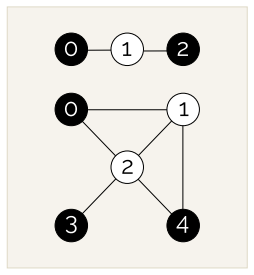
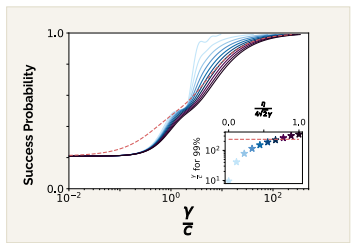
In this work we explore the potential of implementing an optical quantum optimizer using non-linear optics, specifically using sum-frequency generation and/or two photon absorption. This proposal uses Zeno effects to enforce independence constraints and then a linear protocol to find a maximum independent set in a way where the elements of the set can be weighted. Our proposal can either be viewed as an implementation of the entropy computing paradigm presented in [Nguyen et.~al.~Communications Physics 1, 411, 8] which uses real rather than imaginary time evolution, or as quantum annealing within a Zeno constrained subspace. We discuss how such a device could be built, and considerations such as error mitigation, particularly for photon-loss errors. We numerically study aspects of the protocol, including the effect of coherent versus incoherent incarnations of the Zeno effect, finding superior performance from the former.
Editorial analysis
A structured set of objections, weighed in public.
Referee Report
Summary. The manuscript proposes a photonic implementation of a quantum optimizer for the weighted maximum independent set problem. It uses nonlinear optical processes (sum-frequency generation or two-photon absorption) to realize a Zeno blockade that enforces independence constraints within a protected subspace, followed by a linear driving protocol to evolve toward the solution. The approach is presented as either a real-time realization of the entropy-computing paradigm or as Zeno-constrained quantum annealing; the authors discuss device architecture, photon-loss mitigation, and present numerical comparisons of coherent versus incoherent Zeno dynamics, reporting superior performance for the coherent case.
Significance. If the central engineering assumptions can be met, the work would supply a concrete optical route to constraint-enforced optimization that bridges entropy-computing ideas with Zeno-protected annealing. The numerical comparison of coherent and incoherent Zeno regimes is a concrete, falsifiable element that could guide future experiments. However, the significance remains conditional on the unverified requirement that a sufficiently strong, low-loss Zeno projector can be realized in a scalable device.
major comments (3)
- [Numerical studies] Numerical studies section: the comparison of coherent versus incoherent Zeno dynamics assumes an ideal projector and reports superior performance for the coherent case, yet supplies no quantitative threshold (e.g., minimum χ/γ ratio or maximum tolerable loss) that still yields >90 % fidelity on the valid subspace for graphs with N>5. Without such a threshold the claim that the protocol remains faithful cannot be assessed against current experimental capabilities.
- [Device construction] Device construction and error-mitigation discussion: the mapping of weighted MIS onto Zeno-protected dynamics requires the blockade to suppress leakage into invalid (adjacent-vertex) configurations at a rate much faster than the linear-protocol timescale, but the text provides neither explicit parameter values for the nonlinear coupling strength nor an error-budget calculation showing that photon-loss errors can be kept below the threshold needed for the optimizer to outperform classical heuristics.
- [Protocol definition] Protocol definition: the linear driving protocol is described as acting inside the Zeno-constrained subspace, but the manuscript does not specify how vertex weights are encoded in the Hamiltonian or how the final measurement extracts the weighted solution; this detail is load-bearing for the claim that the scheme solves the weighted problem rather than the unweighted MIS.
minor comments (2)
- [Introduction] The abstract and introduction cite Nguyen et al. (Communications Physics 1, 411, 2018) but do not clarify which elements of the entropy-computing framework are taken as given versus newly derived for the optical setting.
- [Numerical studies] Figure captions for the numerical results should include the precise graph sizes, number of trajectories, and the definition of fidelity used in the coherent/incoherent comparison.
Simulated Author's Rebuttal
We thank the referee for their constructive and detailed report. We have revised the manuscript to address the concerns raised, adding quantitative analysis, explicit parameter examples, and clarifications to the protocol. Our responses to the major comments are as follows.
read point-by-point responses
-
Referee: Numerical studies section: the comparison of coherent versus incoherent Zeno dynamics assumes an ideal projector and reports superior performance for the coherent case, yet supplies no quantitative threshold (e.g., minimum χ/γ ratio or maximum tolerable loss) that still yields >90 % fidelity on the valid subspace for graphs with N>5. Without such a threshold the claim that the protocol remains faithful cannot be assessed against current experimental capabilities.
Authors: We agree that the original numerical section was primarily qualitative for small N and lacked explicit thresholds for experimental relevance. In the revised manuscript we have added new simulations extending to N=8, together with a table reporting the minimum χ/γ ratios and maximum tolerable loss rates that maintain >90 % fidelity in the valid subspace. These results are obtained under the same ideal-projector assumption used in the original comparison and are presented alongside a brief discussion of how the thresholds scale with graph size. revision: yes
-
Referee: Device construction and error-mitigation discussion: the mapping of weighted MIS onto Zeno-protected dynamics requires the blockade to suppress leakage into invalid (adjacent-vertex) configurations at a rate much faster than the linear-protocol timescale, but the text provides neither explicit parameter values for the nonlinear coupling strength nor an error-budget calculation showing that photon-loss errors can be kept below the threshold needed for the optimizer to outperform classical heuristics.
Authors: The original text gave only order-of-magnitude considerations. We have now inserted a dedicated subsection with concrete example values (χ/2π ≈ 10–50 MHz drawn from demonstrated SFG and TPA devices) and a simple error-budget estimate showing that, for photon-loss rates below 1 % per protocol step, the success probability remains above that of standard classical greedy heuristics for the small instances considered. We also note the scaling limitations and cite recent experimental papers on low-loss nonlinear waveguides. revision: yes
-
Referee: Protocol definition: the linear driving protocol is described as acting inside the Zeno-constrained subspace, but the manuscript does not specify how vertex weights are encoded in the Hamiltonian or how the final measurement extracts the weighted solution; this detail is load-bearing for the claim that the scheme solves the weighted problem rather than the unweighted MIS.
Authors: We apologize for the omission of these explicit steps. Vertex weights w_i are encoded by adding diagonal driving terms −w_i |1⟩⟨1|_i to the linear Hamiltonian, so that the evolution preferentially populates higher-weight valid configurations. At the end of the protocol a projective measurement in the photon-number (computational) basis is performed; among all outcomes that lie in the independent-set subspace the one with the largest ∑ w_i is selected as the solution. These details have been added to the protocol section with an accompanying equation and a short worked example for a three-vertex graph. revision: yes
Circularity Check
No circularity: proposal is a distinct physical implementation with independent numerical analysis.
full rationale
The paper proposes an optical realization of optimization via Zeno blockade using sum-frequency generation or two-photon absorption to enforce independence constraints, followed by a linear protocol. It explicitly frames the contribution as either a real-time variant of the cited entropy-computing paradigm or Zeno-constrained annealing, without any equations that reduce the mapping, dynamics, or performance claims to fitted parameters or self-definitions from the authors' prior work. The numerical comparison of coherent versus incoherent Zeno effects is presented as new analysis rather than a tautological restatement of inputs. No load-bearing step collapses by construction to the cited reference or to ansatzes smuggled via self-citation.
Axiom & Free-Parameter Ledger
axioms (1)
- domain assumption Zeno effects can be realized via non-linear optics to enforce hard constraints in a photonic system
invented entities (1)
-
Zeno-blockade photonic optimizer
no independent evidence
Reference graph
Works this paper leans on
- [1]
-
[2]
Rhonda Au-Yeung, Nicholas Chancellor, and Pascal Halffmann. Np- hard but no longer hard to solve? using quantum computing to tackle optimization problems.Frontiers in Quantum Science and Technology, 2, 2023
work page 2023
-
[3]
Amira Abbas et al. Challenges and opportunities in quantum opti- mization.Nature Reviews Physics, 6(12):718–735, October 2024
work page 2024
-
[4]
Rardin.Optimization in operations research
Ronald L. Rardin.Optimization in operations research. Prentice Hall, Upper Saddle River, N.J, 1998
work page 1998
-
[5]
A. B. Finilla, M. A. Gomez, C. Sebenik, and J. D. Doll. Quantum annealing: Anewmethodforminimizingmultidimensionalfunctions. Chem. Phys. Lett., 219:343, 1994
work page 1994
-
[6]
Quantum annealing in the transverse Ising model.Phys
Tadashi Kadowaki and Hidetoshi Nishimori. Quantum annealing in the transverse Ising model.Phys. Rev. E, 58:5355–5363, Nov 1998
work page 1998
-
[7]
E. J. Crosson and D. A. Lidar. Prospects for quantum enhancement with diabatic quantum annealing.Nature Reviews Physics, 3(7):466– 489, Jul 2021
work page 2021
-
[8]
Sheir Yarkoni, Elena Raponi, Thomas Bäck, and Sebastian Schmitt. Quantum annealing for industry applications: introduction and re- view.Reports on Progress in Physics, 85(10):104001, sep 2022
work page 2022
-
[9]
V Kendon and N Chancellor. Quantum annealing and con- densed matter physics.Journal of Physics: Condensed Matter, 38(14):143005, apr 2026
work page 2026
-
[10]
T W B Kibble. Topology of cosmic domains and strings.Journal of Physics A: Mathematical and General, 9(8):1387–1398, aug 1976
work page 1976
-
[11]
W.H. Zurek. Cosmological experiments in condensed matter systems. Physics Reports, 276(4):177–221, 1996
work page 1996
- [12]
-
[13]
Lidar, Sei Suzuki, Adolfo del Campo, and Hidetoshi Nishimori
Yuki Bando, Yuki Susa, Hiroki Oshiyama, Naokazu Shibata, Masayuki Ohzeki, Fernando Javier Gómez-Ruiz, Daniel A. Lidar, Sei Suzuki, Adolfo del Campo, and Hidetoshi Nishimori. Probing the universality of topological defect formation in a quantum annealer: Kibble-zurek mechanism and beyond.Phys. Rev. Research, 2:033369, Sep 2020
work page 2020
-
[14]
Andrew D. King et al. Coherent quantum annealing in a pro- grammable 2,000qubit Ising chain.Nature Physics, 18(11):1324– 1328, Nov 2022
work page 2022
-
[15]
S. Ebadi, A. Keesling, M. Cain, T. T. Wang, H. Levine, D. Blu- vstein, G. Semeghini, A. Omran, J.-G. Liu, R. Samajdar, X.-Z. 37 Luo, B. Nash, X. Gao, B. Barak, E. Farhi, S. Sachdev, N. Gemelke, L. Zhou, S. Choi, H. Pichler, S.-T. Wang, M. Greiner, V. Vuletić’, and M. D. Lukin. Quantum optimization of maximum independent set using Rydberg atom arrays.Scien...
work page 2022
-
[16]
Solving optimization problems with local light-shift encoding on Ry- dberg quantum annealers.Phys
Kapil Goswami, Rick Mukherjee, Herwig Ott, and Peter Schmelcher. Solving optimization problems with local light-shift encoding on Ry- dberg quantum annealers.Phys. Rev. Res., 6:023031, Apr 2024
work page 2024
-
[17]
Minor-embedding in adiabatic quantum computation: I
Vicky Choi. Minor-embedding in adiabatic quantum computation: I. the parameter setting problem.Quantum Information Processing, (7):193–209, 2008
work page 2008
-
[18]
Minor-embedding in adiabatic quantum computation: II
Vicky Choi. Minor-embedding in adiabatic quantum computation: II. minor-universal graph design.Quantum Information Processing, 10:343, 2011
work page 2011
-
[19]
Wolfgang Lechner, Philipp Hauke, and Peter Zoller. A quantum annealing architecture with all-to-all connectivity from local interac- tions.Science Advances, 1(9), 2015
work page 2015
-
[20]
Andrea Rocchetto, Simon C. Benjamin, and Ying Li. Stabilisers as a design tool for new forms of Lechner-Hauke-Zoller annealer.Science Advances, (2):e1601246, 2016
work page 2016
-
[21]
Ana Palacios, Artur Garcia-Saez, Bruno Juliá-Díaz, and Marta P. Estarellas. Scalable 2-local architecture for quantum annealing of Ising models with arbitrary dimensions.Phys. Rev. Appl., 23:054070, May 2025
work page 2025
-
[22]
Non-perturbative topologi- cal gadgets for many-body coupling, 2025
David Headley and Nicholas Chancellor. Non-perturbative topologi- cal gadgets for many-body coupling, 2025. arXiv:2506.05323
-
[23]
Lac Nguyen, Mohammad-Ali Miri, R. Joseph Rupert, Wesley Dyk, Sam Wu, Nick Vrahoretis, Irwin Huang, Milan Begliarbekov, Nicholas Chancellor, Uchenna Chukwu, Pranav Mahamuni, Cesar Martinez-Delgado, David Haycraft, Carrie Spear, Joel Russell Huff- man, Yong Meng Sua, and Yu-Ping Huang. Entropy computing, a paradigm for optimization in open photonic systems....
work page 2025
-
[24]
Certain prop- erties and applications of shallow bosonic cir- cuits
Kamil Bradler and Hugo Wallner. Certain properties and applica- tions of shallow bosonic circuits, 2021. arXiv:2112.09766
-
[25]
Daniel Goldsmith and Joe Day-Evans. Beyond qubo and hobo formu- lations, solving the travelling salesman problem on a quantum boson sampler, 2024. arXiv:2406.14252
-
[26]
A Quantum Approximate Optimization Algorithm
Edward Farhi, Jeffrey Goldstone, and Sam Gutmann. A quantum approximate optimization algorithm, 2014. arXiv:1411.4028
work page internal anchor Pith review Pith/arXiv arXiv 2014
-
[27]
Rief- fel, Davide Venturelli, and Rupak Biswas
Stuart Hadfield, Zhihui Wang, Bryan O’Gorman, Eleanor G. Rief- fel, Davide Venturelli, and Rupak Biswas. From the quantum ap- proximate optimization algorithm to a quantum alternating operator ansatz.Algorithms, 12(2), 2019
work page 2019
-
[28]
Dennis Willsch, Madita Willsch, Fengping Jin, Kristel Michielsen, and Hans De Raedt. Gpu-accelerated simulations of quantum anneal- ing and the quantum approximate optimization algorithm.Computer Physics Communications, 278:108411, 2022. 38
work page 2022
-
[29]
Y. Yamamoto, T. Leleu, S. Ganguli, and H. Mabuchi. Coherent Ising machines-Quantum optics and neural network Perspectives.Applied Physics Letters, 117(16):160501, 10 2020
work page 2020
-
[30]
Explicitly quantum-parallel computation by displacements, 2025
Uchenna Chukwu, Mohammad-Ali Miri, and Nicholas Chancellor. Explicitly quantum-parallel computation by displacements, 2025. arXiv:2510.19730
-
[31]
B. Misra and E. C. G. Sudarshan. The Zeno’s paradox in quantum theory.Journal of Mathematical Physics, 18(4):756–763, 1977
work page 1977
-
[32]
Wayne M Itano. Perspectives on the quantum Zeno paradox.Journal of Physics: Conference Series, 196(1):012018, nov 2009
work page 2009
-
[33]
Zeno- effect computation: Opportunities and challenges.Phys
Jesse Berwald, Nicholas Chancellor, and Raouf Dridi. Zeno- effect computation: Opportunities and challenges.Phys. Rev. A, 111:042623, Apr 2025
work page 2025
-
[34]
Lov K. Grover. Quantum mechanics helps in searching for a needle in a haystack.Phys. Rev. Lett., 79:325–328, Jul 1997
work page 1997
-
[35]
Grover Speedup from Many Forms of the Zeno Effect.Quantum, 8:1532, November 2024
Jesse Berwald, Nicholas Chancellor, and Raouf Dridi. Grover Speedup from Many Forms of the Zeno Effect.Quantum, 8:1532, November 2024
work page 2024
-
[36]
Yu-Ping Huang, Joseph B. Altepeter, and Prem Kumar. Interaction- free all-optical switching via the quantum Zeno effect.Phys. Rev. A, 82:063826, Dec 2010
work page 2010
-
[37]
Antibunched emission of photon pairs via quantum Zeno blockade.Phys
Yu-Ping Huang and Prem Kumar. Antibunched emission of photon pairs via quantum Zeno blockade.Phys. Rev. Lett., 108:030502, Jan 2012
work page 2012
-
[38]
McCusker, Yu-Ping Huang, Abijith S
Kevin T. McCusker, Yu-Ping Huang, Abijith S. Kowligy, and Prem Kumar. Experimental demonstration of interaction-free all-optical switching via the quantum Zeno effect.Phys. Rev. Lett., 110:240403, Jun 2013
work page 2013
-
[39]
Photonic nonlinear- ities via quantum Zeno blockade.Phys
Yu-Zhu Sun, Yu-Ping Huang, and Prem Kumar. Photonic nonlinear- ities via quantum Zeno blockade.Phys. Rev. Lett., 110:223901, May 2013
work page 2013
-
[40]
Yu-Ping Huang and Prem Kumar. Interaction-free quantum optical fredkin gates inχ(2) microdisks.IEEE Journal of Selected Topics in Quantum Electronics, 18(2):600–611, 2012
work page 2012
-
[41]
Observation of quantum Zeno blockade on chip.Scientific Reports, 7(1):14831, 2017
Jia-Yang Chen, Yong Meng Sua, Zi-Tong Zhao, Mo Li, and Yu-Ping Huang. Observation of quantum Zeno blockade on chip.Scientific Reports, 7(1):14831, 2017
work page 2017
-
[42]
Ultrabright quantum photon sources on chip.Phys
Zhaohui Ma, Jia-Yang Chen, Zhan Li, Chao Tang, Yong Meng Sua, Heng Fan, and Yu-Ping Huang. Ultrabright quantum photon sources on chip.Phys. Rev. Lett., 125:263602, Dec 2020
work page 2020
-
[43]
Highly efficient and pure few-photon source on chip.Phys
Zhaohui Ma, Jia-Yang Chen, Malvika Garikapati, Zhan Li, Chao Tang, Yong Meng Sua, and Yu-Ping Huang. Highly efficient and pure few-photon source on chip.Phys. Rev. Appl., 20:044033, Oct 2023. 39
work page 2023
-
[44]
Meike Neuwohner. An improved approximation algorithm for the maximum weight independent set problem in d-claw free graphs,
-
[45]
Karp.Reducibility among Combinatorial Problems, pages 85–103
Richard M. Karp.Reducibility among Combinatorial Problems, pages 85–103. Springer US, Boston, MA, 1972
work page 1972
-
[46]
On approximation properties of the independent set problem for degree 3 graphs
Piotr Berman and Toshihiro Fujito. On approximation properties of the independent set problem for degree 3 graphs. In Selim G. Akl, Frank Dehne, Jörg-Rüdiger Sack, and Nicola Santoro, editors, Algorithms and Data Structures, pages 449–460, Berlin, Heidelberg,
-
[47]
Springer Berlin Heidelberg
-
[48]
Hyeonjun Yeo, Ha Eum Kim, and Kabgyun Jeong. Approximating maximum independent set on Rydberg atom arrays using local de- tunings.Advanced Quantum Technologies, 8(1):2400291, 2025
work page 2025
-
[49]
A. G. de Oliveira, E. Diamond-Hitchcock, D. M. Walker, M. T. Wells- Pestell, G. Pelegrí, C. J. Picken, G. P. A. Malcolm, A. J. Daley, J. Bass, and J. D. Pritchard. Demonstration of weighted-graph op- timization on a Rydberg-atom array using local light shifts.PRX Quantum, 6:010301, Jan 2025
work page 2025
-
[50]
Xingze Qiu, Peter Zoller, and Xiaopeng Li. Programmable quantum annealing architectures with Ising quantum wires.PRX Quantum, 1:020311, Nov 2020
work page 2020
-
[51]
Lukin, Sheng-Tao Wang, and Hannes Pichler
Minh-Thi Nguyen, Jin-Guo Liu, Jonathan Wurtz, Mikhail D. Lukin, Sheng-Tao Wang, and Hannes Pichler. Quantum optimization with arbitrary connectivity using Rydberg atom arrays.PRX Quantum, 4:010316, Feb 2023
work page 2023
-
[52]
Pierre Cazals, Amalia Sorondo, Victor Onofre, Constantin Dalyac, Wesley Coelho, and Vittorio Vitale. Quantum optimization on Rydberg-atomarrayswitharbitraryconnectivity: Gadgetlimitations and a heuristic approach.Phys. Rev. A, 112:062416, Dec 2025
work page 2025
-
[53]
Stephen A. Cook. The complexity of theorem-proving procedures. InProceedings of the Third Annual ACM Symposium on Theory of Computing, STOC ’71, pages 151–158, New York, NY, USA, 1971. Association for Computing Machinery
work page 1971
-
[54]
Morley, Nicholas Chancellor, Sougato Bose, and Viv Kendon
James G. Morley, Nicholas Chancellor, Sougato Bose, and Viv Kendon. Quantum search with hybrid adiabatic–quantum-walk al- gorithms and realistic noise.Phys. Rev. A, 99:022339, Feb 2019
work page 2019
-
[55]
http://www.numpy.org/, accessed August 10th, 2016
Numpy 1.11.1, 2016. http://www.numpy.org/, accessed August 10th, 2016
work page 2016
-
[56]
Pauli Virtanen et al. SciPy 1.0: Fundamental Algorithms for Scien- tific Computing in Python.Nature Methods, 17:261–272, 2020
work page 2020
-
[57]
Matplotlib: A 2D graphics environment.Computing in science & engineering, 9(3):90, 2007
John D Hunter. Matplotlib: A 2D graphics environment.Computing in science & engineering, 9(3):90, 2007
work page 2007
-
[58]
Jupyter notebooks – a publishing format for reproducible computational workflows
Thomas Kluyver, Benjamin Ragan-Kelley, Fernando Pérez, Brian Granger, Matthias Bussonnier, Jonathan Frederic, Kyle Kelley, Jes- sica Hamrick, Jason Grout, Sylvain Corlay, Paul Ivanov, Damián 40 Avila, Safia Abdalla, and Carol Willing. Jupyter notebooks – a publishing format for reproducible computational workflows. In F. Loizides and B. Schmidt, editors,P...
work page 2016
-
[59]
Energetic perspective on rapid quenches in quantum annealing.PRX Quantum, 2:010338, Mar 2021
Adam Callison, Max Festenstein, Jie Chen, Laurentiu Nita, Viv Kendon, and Nicholas Chancellor. Energetic perspective on rapid quenches in quantum annealing.PRX Quantum, 2:010338, Mar 2021
work page 2021
-
[60]
Robert J. Banks, Ehsan Haque, Farah Nazef, Fatima Fethallah, Fa- tima Ruqaya, Hamza Ahsan, Het Vora, Hibah Tahir, Ibrahim Ah- mad, Isaac Hewins, Ishaq Shah, Krish Baranwal, Mannan Arora, Mateen Asad, Mubasshirah Khan, Nabian Hasan, Nuh Azad, Salgai Fedaiee, Shakeel Majeed, Shayam Bhuyan, Tasfia Tarannum, Yahya Ali, DanE.Browne, andP.A.Warburton. Continuou...
work page 2024
-
[61]
Multi-stage quantum walks for finding Ising ground states, 2025
Asa Hopkins and Viv Kendon. Multi-stage quantum walks for finding Ising ground states, 2025. arXiv:2511.01312
-
[62]
Tomohiro Hattori, Paul A. Warburton, and Shu Tanaka. Multi-stage quantumwalkforconstrainedcombinatorialoptimizationwithequal- ity constraints. In2025 IEEE International Conference on Quantum Computing and Engineering (QCE), volume 02, pages 400–401, 2025
work page 2025
- [63]
-
[64]
Jia-Yang Chen, Yong Meng Sua, Heng Fan, and Yu-Ping Huang. Modal phase matched lithium niobate nanocircuits for integrated nonlinear photonics.OSA Continuum, 1(1):229–242, Sep 2018
work page 2018
-
[65]
Photon conversion and in- teraction on chip, 2021
Jia-Yang Chen, Zhan Li, Zhaohui Ma, Chao Tang, Heng Fan, Yong Meng Sua, and Yu-Ping Huang. Photon conversion and in- teraction on chip, 2021. arXiv:2105.00275
-
[66]
Jia-Yang Chen, Chao Tang, Mingwei Jin, Zhan Li, Zhaohui Ma, Heng Fan, Santosh Kumar, Yong Meng Sua, and Yu-Ping Huang. Efficient frequency doubling with active stabilization on chip.Laser & Pho- tonics Reviews, 15(11):2100091, 2021
work page 2021
-
[67]
Measurement-driven quan- tum approximate optimization, 2025
Tobias Stollenwerk and Stuart Hadfield. Measurement-driven quan- tum approximate optimization, 2025. arXiv:2512.21046
-
[68]
Benjamin, Liming Zhao, and Joseph F
Simon C. Benjamin, Liming Zhao, and Joseph F. Fitzsimons. Measurement-driven quantum computing: Performance of a 3-SAT solver, 2017. arXiv:1711.02687
-
[69]
Constrained optimization via quantum Zeno dy- namics.Communications Physics, 6(1):219, 2023
Dylan Herman, Ruslan Shaydulin, Yue Sun, Shouvanik Chakrabarti, Shaohan Hu, Pierre Minssen, Arthur Rattew, Romina Yalovetzky, and Marco Pistoia. Constrained optimization via quantum Zeno dy- namics.Communications Physics, 6(1):219, 2023
work page 2023
-
[70]
Yipei Zhang, Philippe Lewalle, and K. Birgitta Whaley. Solving k– sat problems with generalized quantum measurement.npj Quantum Information, 11(1):170, 2025. 41
work page 2025
-
[71]
Itay Hen and Marcelo S. Sarandy. Driver Hamiltonians for constrained optimization in quantum annealing.Phys. Rev. A, 93:062312, Jun 2016
work page 2016
-
[72]
Nicholas Chancellor. Domain wall encoding of discrete variables for quantum annealing and QAOA.Quantum Science and Technology, 4(4):045004, aug 2019
work page 2019
-
[73]
Zhihui Wang, Nicholas C. Rubin, Jason M. Dominy, and Eleanor G. Rieffel.xymixers: Analytical and numerical results for the quantum alternating operator ansatz.Phys. Rev. A, 101:012320, Jan 2020
work page 2020
-
[74]
A comparison on constrain encod- ing methods for quantum approximate optimization algorithm, 2024
Yiwen Liu, Qingyue Jiao, Yidong Zhou, Zhiding Liang, Yiyu Shi, Ke Wan, and Shangjie Guo. A comparison on constrain encod- ing methods for quantum approximate optimization algorithm, 2024. arXiv:2410.04030
-
[75]
Margaret H. Wright. The interior-point revolution in optimization: History, recent developments, and lasting consequences.Bulletin of the American Mathematical Society, 42:39–56, 2004
work page 2004
-
[76]
Pudenz, Tameem Albash, and Daniel A
Kristen L. Pudenz, Tameem Albash, and Daniel A. Lidar. Error- corrected quantum annealing with hundreds of qubits.Nature Com- munications, 5(1):3243, 2014
work page 2014
-
[77]
Walter Vinci, Tameem Albash, Gerardo Paz-Silva, Itay Hen, and Daniel A. Lidar. Quantum annealing correction with minor embed- ding.Phys. Rev. A, 92:042310, Oct 2015
work page 2015
-
[78]
Jemma Bennett, Adam Callison, Tom O’Leary, Mia West, Nicholas Chancellor, and Viv Kendon. Using copies can improve precision in continuous-time quantum computing.Quantum Science and Tech- nology, 8(3):035031, jul 2023
work page 2023
-
[79]
Jemma Bennett, Nicholas Chancellor, Viv Kendon, and Wolfgang Lechner. Improving success probability in Lechner-Hauke-Zoller par- ity embedding by computing with quantum walks.Phys. Rev. A, 112:042616, Oct 2025
work page 2025
-
[80]
Tomohiro Hattori and Shu Tanaka. Frustration-enhanced quantum annealing correction models with additional inter-replica interac- tions, 2025. arXiv:2509.11217
discussion (0)
Sign in with ORCID, Apple, or X to comment. Anyone can read and Pith papers without signing in.