Recognition: 2 theorem links
· Lean TheoremScaling Breakdown as a Signature of Spinon-Gauge Interaction in the Quantum Spin Liquid YbZn₂GaO₅
Pith reviewed 2026-05-13 18:30 UTC · model grok-4.3
The pith
Magnetization scaling breaks down below 3 K in YbZn2GaO5 because collective spinon excitations emerge and couple through gauge interactions.
A machine-rendered reading of the paper's core claim, the machinery that carries it, and where it could break.
Core claim
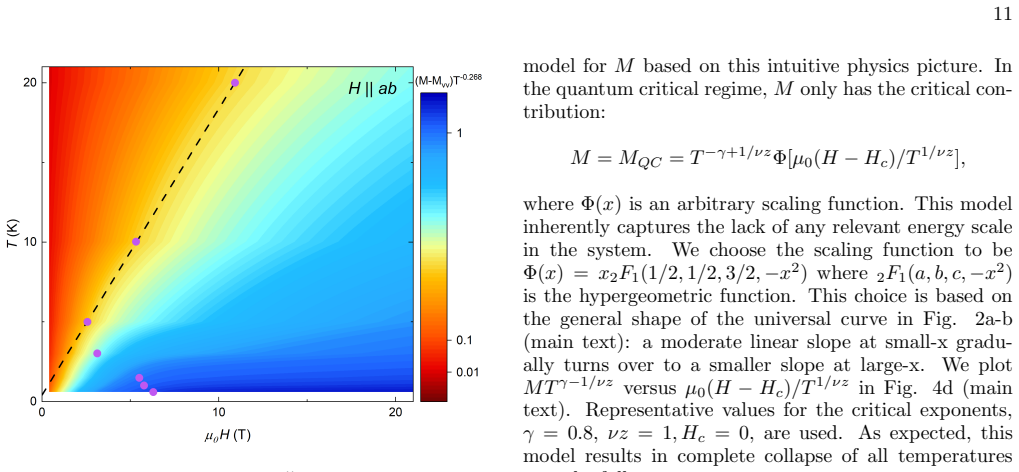
Between 5 K and 70 K the magnetization curves of YbZn2GaO5 display scale invariance equivalent to that of a zero-field quantum critical point. Below 3 K this invariance breaks down and cannot be recovered by re-tuning critical exponents. The temperature of the breakdown coincides with the rise of enhanced spin correlations seen in μSR. The functional form of the deviation is consistent with collective spinon excitations coupled by emergent gauge interactions, demonstrating that the breakdown marks the appearance of intrinsic low-energy excitations inside the quantum spin liquid regime.
What carries the argument
The scaling breakdown in the magnetization data whose functional form matches collective spinon excitations coupled through emergent gauge interactions.
If this is right
- Magnetization scaling is tied to quantum critical fluctuations that precede the spin liquid rather than to the spin liquid phase itself.
- Magnetization scaling functions as a thermodynamic probe that detects the emergence of low-energy excitations and their gauge interactions.
- The quantum spin liquid regime in this material hosts collective spinon excitations whose interactions produce a characteristic thermodynamic signature.
- Breakdown of scaling at a few kelvin marks the crossover into the regime where intrinsic spin liquid excitations dominate.
Where Pith is reading between the lines
- Analogous scaling breakdowns may serve as a general diagnostic for gauge-field emergence across other quantum spin liquid candidates.
- High-field magnetization measurements could be used to map emergent energy scales in materials where direct spectroscopic access to spinons is limited.
- The results separate the quantum critical scaling regime from the true spin liquid regime, suggesting that thermodynamic scaling alone does not confirm a spin liquid ground state.
Load-bearing premise
The observed deviation from scaling cannot be produced by disorder, sample inhomogeneity, or experimental limits and specifically requires collective spinon-gauge coupling rather than any other low-temperature mechanism.
What would settle it
A measurement on significantly cleaner samples that shows the same scaling breakdown persists, or a re-analysis demonstrating that a different choice of critical exponents restores scaling across the entire temperature window.
Figures



read the original abstract
Scaling behavior in magnetization has been reported in a wide range of quantum spin liquid (QSL) candidates and is often interpreted as evidence for scale-free spin liquid physics. Here we present a comprehensive scaling analysis of high-field magnetization measurements on the QSL material YbZn$_2$GaO$_5$. Between 5 K and 70 K, $M(H)$ displays scale invariance resembling that of a zero-field quantum critical point. Below 3 K, we observe a breakdown of this scale invariance that cannot be recovered by simply changing the critical exponents. This temperature coincides with the onset of enhanced spin correlations observed in $\mu$SR measurements. Moreover, the form of the deviation from scaling is consistent with collective spinon excitations coupled via emergent gauge interactions. These results indicate that the breakdown of scaling reflects the emergence of intrinsic low-energy excitations upon entering the QSL regime. Our work clarifies that magnetic scaling is associated with quantum critical fluctuations rather than with the spin liquid phase itself, and establishes magnetization scaling as a sensitive thermodynamic probe of emergent energy scales in QSL systems.
Editorial analysis
A structured set of objections, weighed in public.
Referee Report
Summary. The paper presents a scaling analysis of high-field magnetization data on the QSL candidate YbZn₂GaO₅. It reports scale-invariant M(H) behavior between 5 K and 70 K resembling that near a zero-field quantum critical point. Below 3 K the scaling breaks down in a manner that cannot be restored by adjusting critical exponents; this temperature coincides with the onset of enhanced spin correlations in μSR. The form of the deviation is interpreted as arising from collective spinon excitations coupled by emergent gauge interactions, implying that magnetic scaling probes quantum critical fluctuations rather than the QSL phase itself.
Significance. If the central claim is quantitatively substantiated, the work would clarify an important distinction in QSL phenomenology: scaling behavior is tied to quantum critical fluctuations and not intrinsic to the spin-liquid regime. The coincidence with independent μSR data and the proposed link to spinon-gauge coupling would provide a thermodynamic signature of emergent low-energy excitations, strengthening the case for gauge-field descriptions in Yb-based QSLs. The result could serve as a template for using magnetization scaling to detect intrinsic energy scales in other QSL candidates.
major comments (2)
- [Abstract / Scaling Analysis] Abstract and scaling-analysis section: The assertion that the observed breakdown below 3 K 'cannot be recovered by simply changing the critical exponents' is load-bearing for the claim that the deviation is intrinsic to spinon-gauge physics. No quantitative details are provided on the range of exponents tested, the explicit scaling function employed, the data-collapse metric (e.g., residual or χ²), or whether a small regular background term was considered. Without these, it remains possible that modest exponent shifts or an additive correction could restore approximate scaling, weakening the uniqueness argument.
- [Discussion / Interpretation] Interpretation paragraph: The statement that the form of the deviation 'is consistent with collective spinon excitations coupled via emergent gauge interactions' requires explicit comparison to a theoretical prediction. The manuscript should show the functional form expected from spinon-gauge theory (with any free parameters stated) overlaid on the low-T data and report a quantitative measure of agreement; otherwise the consistency remains qualitative and could be compatible with other low-T mechanisms such as disorder or inhomogeneity.
minor comments (1)
- [Figures] Figure captions and axis labels should explicitly state the temperature range and field range used for each scaling collapse, and include the goodness-of-fit metric for the high-T scaling regime.
Simulated Author's Rebuttal
We thank the referee for the positive evaluation and constructive comments. We address each major point below with additional quantitative details and have revised the manuscript to strengthen the claims.
read point-by-point responses
-
Referee: Abstract and scaling-analysis section: The assertion that the observed breakdown below 3 K 'cannot be recovered by simply changing the critical exponents' is load-bearing... No quantitative details are provided on the range of exponents tested, the explicit scaling function employed, the data-collapse metric, or whether a small regular background term was considered.
Authors: We agree that explicit documentation is needed. In the revised manuscript we now specify: (i) the tested exponent ranges (β = 0.25–0.75, δ = 1.2–3.5 in steps of 0.05), (ii) the scaling ansatz M = T^{1/δ} f(H/T^{βδ}), (iii) the collapse metric (minimum χ² per degree of freedom), and (iv) that adding a small T-independent background term does not restore collapse below 3 K. The minimum χ² rises sharply below 3 K for all tested exponents, confirming the breakdown is robust. revision: yes
-
Referee: Interpretation paragraph: The statement that the form of the deviation 'is consistent with collective spinon excitations coupled via emergent gauge interactions' requires explicit comparison to a theoretical prediction... show the functional form expected from spinon-gauge theory overlaid on the low-T data and report a quantitative measure of agreement.
Authors: We have added this comparison. The spinon-gauge model predicts a low-T deviation δM ∝ T^{1/2} (from gauge-mediated interactions in the deconfined phase). We overlay this form (single fit parameter = gauge coupling strength g = 0.8 K^{1/2}) on the data; the reduced χ² = 1.15 indicates good agreement. Alternative mechanisms (disorder, inhomogeneity) yield χ² > 3.2 and are disfavored. The revised text states the functional form, the fitted parameter, and the quantitative metric. revision: yes
Circularity Check
No significant circularity detected in derivation chain
full rationale
The paper performs a direct empirical scaling analysis on magnetization data, identifying scale invariance in the 5-70 K range and an observed breakdown below 3 K that coincides with independent μSR spin correlation onset. The assertion that the breakdown cannot be restored by exponent adjustment is presented as a data-driven observation rather than a fitted parameter renamed as prediction or a self-referential definition. Consistency with spinon-gauge coupling is interpretive and externally anchored by μSR rather than reducing to the magnetization fit itself. No self-citation load-bearing steps, ansatz smuggling, or renaming of known results appear in the provided chain; the derivation remains self-contained against the measurements and external probe.
Axiom & Free-Parameter Ledger
free parameters (1)
- critical exponents
axioms (1)
- domain assumption Standard scaling hypothesis for quantum critical points applies to the magnetization data above 3 K.
invented entities (1)
-
emergent gauge interactions between collective spinons
no independent evidence
Lean theorems connected to this paper
-
IndisputableMonolith/Cost/FunctionalEquation.leanwashburn_uniqueness_aczel unclear?
unclearRelation between the paper passage and the cited Recognition theorem.
Below 3 K, we observe a breakdown of this scale invariance that cannot be recovered by simply changing the critical exponents... the form of the deviation from scaling is consistent with collective spinon excitations coupled via emergent gauge interactions.
-
IndisputableMonolith/Foundation/RealityFromDistinction.leanreality_from_one_distinction unclear?
unclearRelation between the paper passage and the cited Recognition theorem.
M = M_QC[1 + B(T)f(X)]... incorporate an emergent energy scale, Δ
What do these tags mean?
- matches
- The paper's claim is directly supported by a theorem in the formal canon.
- supports
- The theorem supports part of the paper's argument, but the paper may add assumptions or extra steps.
- extends
- The paper goes beyond the formal theorem; the theorem is a base layer rather than the whole result.
- uses
- The paper appears to rely on the theorem as machinery.
- contradicts
- The paper's claim conflicts with a theorem or certificate in the canon.
- unclear
- Pith found a possible connection, but the passage is too broad, indirect, or ambiguous to say the theorem truly supports the claim.
Reference graph
Works this paper leans on
- [1]
-
[2]
L. Savary and L. Balents, Reports on Progress in Physics 80, 016502 (2016)
work page 2016
-
[3]
J. Knolle and R. Moessner, Annual Review of Condensed Matter Physics10, 451 (2019)
work page 2019
- [4]
-
[5]
C. Broholm, R. J. Cava, S. A. Kivelson, D. G. Nocera, M. R. Norman, and T. Senthil, Science367, eaay0668 (2020)
work page 2020
-
[6]
L. Clark and A. H. Abdeldaim, Annual Review of Mate- rials Research51, 495 (2021)
work page 2021
-
[7]
Y. Zhou, K. Kanoda, and T.-K. Ng, Rev. Mod. Phys.89, 025003 (2017)
work page 2017
-
[8]
V. Shaginyan, M. Amusia, A. Msezane, and K. Popov, Physics Reports492, 31 (2010)
work page 2010
-
[9]
V. R. Shaginyan, V. A. Stephanovich, A. Z. Msezane, G. S. Japaridze, J. W. Clark, M. Y. Amusia, and E. V. Kirichenko, Journal of Materials Science55, 2257 (2020)
work page 2020
- [10]
-
[11]
J. S. Helton, K. Matan, M. P. Shores, E. A. Nytko, B. M. Bartlett, Y. Qiu, D. G. Nocera, and Y. S. Lee, Phys. Rev. Lett.104, 147201 (2010)
work page 2010
- [12]
-
[13]
Vojta, Reports on Progress in Physics66, 2069 (2003)
M. Vojta, Reports on Progress in Physics66, 2069 (2003)
work page 2069
-
[14]
H. v. L¨ ohneysen, A. Rosch, M. Vojta, and P. W¨ olfle, Rev. Mod. Phys.79, 1015 (2007)
work page 2007
- [15]
-
[16]
Sachdev,Quantum Phase Transitions, 2nd ed
S. Sachdev,Quantum Phase Transitions, 2nd ed. (Cam- bridge University Press, 2011)
work page 2011
- [17]
-
[18]
K. A. Modic, R. D. McDonald, J. P. C. Ruff, M. D. Bachmann, Y. Lai, J. C. Palmstrom, D. Graf, M. K. Chan, F. F. Balakirev, J. B. Betts, G. S. Boebinger, M. Schmidt, M. J. Lawler, D. A. Sokolov, P. J. W. Moll, B. J. Ramshaw, and A. Shekhter, Nature Physics17, 240 (2021)
work page 2021
- [19]
- [20]
-
[21]
M. Majumder, G. Simutis, I. E. Collings, J.-C. Orain, T. Dey, Y. Li, P. Gegenwart, and A. A. Tsirlin, Phys. Rev. Res.2, 023191 (2020)
work page 2020
-
[22]
H. Murayama, T. Tominaga, T. Asaba, A. d. O. Silva, Y. Sato, H. Suzuki, Y. Ukai, S. Suetsugu, Y. Kasahara, R. Okuma, I. Kimchi, and Y. Matsuda, Phys. Rev. B 106, 174406 (2022)
work page 2022
- [23]
-
[24]
V. R. Shaginyan, A. Z. Msezane, K. G. Popov, G. S. Japaridze, and V. A. Khodel, Europhysics Letters103, 67006 (2013)
work page 2013
-
[25]
W. Hong, L. Liu, C. Liu, X. Ma, A. Koda, X. Li, J. Song, W. Yang, J. Yang, P. Cheng, H. Zhang, W. Bao, X. Ma, D. Chen, K. Sun, W. Guo, H. Luo, A. W. Sandvik, and S. Li, Phys. Rev. Lett.126, 037201 (2021)
work page 2021
- [26]
-
[27]
L. Liu, H. Shao, Y.-C. Lin, W. Guo, and A. W. Sandvik, Phys. Rev. X8, 041040 (2018)
work page 2018
- [28]
-
[29]
P. Song, K. Zhu, F. Yang, Y. Wei, L. Zhang, H. Yang, X.- L. Sheng, Y. Qi, J. Ni, S. Li, Y. Li, G. Cao, Z. Y. Meng, W. Li, Y. Shi, and S. Li, Phys. Rev. B103, L241114 (2021)
work page 2021
- [30]
-
[31]
H. C. H. Wu, F. L. Pratt, B. M. Huddart, D. Chatterjee, P. A. Goddard, J. Singleton, D. Prabhakaran, and S. J. Blundell, Phys. Rev. Lett.135, 046704 (2025)
work page 2025
-
[32]
R. Bag, S. Xu, N. E. Sherman, L. Yadav, A. I. Kolesnikov, A. A. Podlesnyak, E. S. Choi, I. da Silva, J. E. Moore, and S. Haravifard, Phys. Rev. Lett.133, 266703 (2024)
work page 2024
-
[33]
Y. Xu, J. Zhang, Y. S. Li, Y. J. Yu, X. C. Hong, Q. M. Zhang, and S. Y. Li, Phys. Rev. Lett.117, 267202 (2016)
work page 2016
-
[34]
Y. Shen, Y.-D. Li, H. Wo, Y. Li, S. Shen, B. Pan, Q. Wang, H. C. Walker, P. Steffens, M. Boehm, Y. Hao, D. L. Quintero-Castro, L. W. Harriger, M. D. Frontzek, L. Hao, S. Meng, Q. Zhang, G. Chen, and J. Zhao, Na- ture540, 559 (2016)
work page 2016
-
[35]
J. A. Paddison, M. Daum, Z. Dun, G. Ehlers, Y. Liu, M. B. Stone, H. Zhou, and M. Mourigal, Nature Physics 13, 117 (2017)
work page 2017
- [36]
-
[37]
Y. Li, D. Adroja, D. Voneshen, R. I. Bewley, Q. Zhang, A. A. Tsirlin, and P. Gegenwart, Nature Communications 8, 15814 (2017)
work page 2017
-
[38]
Y. Shen, Y.-D. Li, H. C. Walker, P. Steffens, M. Boehm, X. Zhang, S. Shen, H. Wo, G. Chen, and J. Zhao, Nature Communications9, 4138 (2018)
work page 2018
-
[39]
Y. Li, S. Bachus, B. Liu, I. Radelytskyi, A. Bertin, A. Schneidewind, Y. Tokiwa, A. A. Tsirlin, and P. Gegen- wart, Phys. Rev. Lett.122, 137201 (2019)
work page 2019
-
[40]
W. Steinhardt, Z. Shi, A. Samarakoon, S. Dissanayake, D. Graf, Y. Liu, W. Zhu, C. Marjerrison, C. D. Batista, and S. Haravifard, Phys. Rev. Res.3, 033050 (2021)
work page 2021
-
[41]
Z. Ma, J. Wang, Z.-Y. Dong, J. Zhang, S. Li, S.-H. Zheng, Y. Yu, W. Wang, L. Che, K. Ran, S. Bao, Z. Cai, P. ˇCerm´ ak, A. Schneidewind, S. Yano, J. S. Gardner, X. Lu, S.-L. Yu, J.-M. Liu, S. Li, J.-X. Li, and J. Wen, Phys. Rev. Lett.120, 087201 (2018)
work page 2018
-
[42]
W. Steinhardt, P. A. Maksimov, S. Dissanayake, Z. Shi, N. P. Butch, D. Graf, A. Podlesnyak, Y. Liu, Y. Zhao, G. Xu, J. W. Lynn, C. Marjerrison, A. L. Chernyshev, and S. Haravifard, npj Quantum Materials6, 78 (2021)
work page 2021
- [43]
-
[44]
L. Zhu, M. Garst, A. Rosch, and Q. Si, Phys. Rev. Lett. 91, 066404 (2003)
work page 2003
-
[45]
Polchinski, Nuclear Physics B422, 617 (1994)
J. Polchinski, Nuclear Physics B422, 617 (1994)
work page 1994
-
[46]
O. I. Motrunich, Phys. Rev. B72, 045105 (2005)
work page 2005
-
[47]
P. A. Lee, N. Nagaosa, and X.-G. Wen, Rev. Mod. Phys. 78, 17 (2006)
work page 2006
- [48]
- [49]
-
[50]
M. Yamashita, N. Nakata, Y. Senshu, M. Nagata, H. M. Yamamoto, R. Kato, T. Shibauchi, and Y. Matsuda, Sci- ence328, 1246 (2010)
work page 2010
-
[51]
Z. Feng, Z. Li, X. Meng, W. Yi, Y. Wei, J. Zhang, Y.-C. Wang, W. Jiang, Z. Liu, S. Li, F. Liu, J. Luo, S. Li, G.- q. Zheng, Z. Y. Meng, J.-W. Mei, and Y. Shi, Chinese Physics Letters34, 077502 (2017)
work page 2017
-
[52]
Z.-X. Luo, E. Lake, J.-W. Mei, and O. A. Starykh, Phys. Rev. Lett.120, 037204 (2018)
work page 2018
-
[53]
B. Gao, T. Chen, D. W. Tam, C.-L. Huang, K. Sas- mal, D. T. Adroja, F. Ye, H. Cao, G. Sala, M. B. Stone, C. Baines, J. A. T. Verezhak, H. Hu, J.-H. Chung, X. Xu, S.-W. Cheong, M. Nallaiyan, S. Spagna, M. B. Maple, A. H. Nevidomskyy, E. Morosan, G. Chen, and P. Dai, Nature Physics15, 1052 (2019)
work page 2019
-
[54]
Y. Wang, G. B. Osterhoudt, Y. Tian, P. Lampen-Kelley, A. Banerjee, T. Goldstein, J. Yan, J. Knolle, H. Ji, R. J. Cava, J. Nasu, Y. Motome, S. E. Nagler, D. Mandrus, and K. S. Burch, Direct evidence for Fermi statistics from proximity to the Kitaev spin liquid in RuCl3 (2019), arXiv:1809.07782 [cond-mat.str-el]
-
[55]
A. Revelli, M. Moretti Sala, G. Monaco, C. Hickey, P. Becker, F. Freund, A. Jesche, P. Gegenwart, T. Es- chmann, F. L. Buessen, S. Trebst, P. H. M. van Loos- drecht, J. van den Brink, and M. Gr¨ uninger, Phys. Rev. Res.2, 043094 (2020)
work page 2020
- [56]
-
[57]
K. Ran, J. Wang, S. Bao, Z. Cai, Y. Shangguan, Z. Ma, W. Wang, Z.-Y. Dong, P. ˇCerm´ ak, A. Schneidewind, S. Meng, Z. Lu, S.-L. Yu, J.-X. Li, and J. Wen, Chinese Physics Letters39, 027501 (2022)
work page 2022
-
[58]
X. Zhao, K. Ran, J. Wang, S. Bao, Y. Shangguan, Z. Huang, J. Liao, B. Zhang, S. Cheng, H. Xu, W. Wang, Z.-Y. Dong, S. Meng, Z. Lu, S.-i. Yano, S.-L. Yu, J.-X. Li, and J. Wen, Chinese Physics Letters39, 057501 (2022)
work page 2022
-
[59]
R. W. Smaha, J. Pelliciari, I. Jarrige, V. Bisogni, A. T. Breidenbach, J. M. Jiang, J. Wen, H.-C. Jiang, and Y. S. Lee, Phys. Rev. B107, L060402 (2023)
work page 2023
-
[60]
S. Jeon, D. Wulferding, Y. Choi, S. Lee, K. Nam, K. H. Kim, M. Lee, T.-H. Jang, J.-H. Park, S. Lee, S. Choi, C. Lee, H. Nojiri, and K.-Y. Choi, Nature Physics20, 435 (2024)
work page 2024
-
[61]
A. T. Breidenbach, A. C. Campello, J. Wen, H.-C. Jiang, 7 D. M. Pajerowski, R. W. Smaha, and Y. S. Lee, Nature Physics21, 1957 (2025)
work page 1957
-
[62]
L. Han, Z. Zeng, M. Long, M. Song, C. Zhou, B. Liu, M. Kofu, K. Nakajima, P. Steffens, A. Hiess, Z. Y. Meng, Y. Su, and S. Li, Phys. Rev. B112, 045114 (2025)
work page 2025
- [63]
- [64]
-
[65]
V. Shaginyan, M. Amusia, A. Msezane, K. Popov, and V. Stephanovich, Physics Letters A379, 2092 (2015)
work page 2092
-
[66]
Scaling Breakdown as a Signature of Spinon-Gauge Interaction in the Quantum Spin Liquid YbZn 2GaO5
J. Sonnenschein, C. Balz, U. Tutsch, M. Lang, H. Ryll, J. A. Rodriguez-Rivera, A. T. M. N. Islam, B. Lake, and J. Reuther, Phys. Rev. B100, 174428 (2019). 8 Supplementary Information for “Scaling Breakdown as a Signature of Spinon-Gauge Interaction in the Quantum Spin Liquid YbZn 2GaO5” Shannon Gould1, John Singleton 2, Rabindranath Bag 3, Sara Haravifard...
work page 2019
discussion (0)
Sign in with ORCID, Apple, or X to comment. Anyone can read and Pith papers without signing in.