Robust Covert Quantum Communication under Bounded Channel Uncertainty
Pith reviewed 2026-05-10 16:08 UTC · model grok-4.3
The pith
Uncertainty in transmissivity and noise forces a trade-off between covertness and reliability in quantum communication that cannot be resolved by single worst-case parameters.
A machine-rendered reading of the paper's core claim, the machinery that carries it, and where it could break.
Core claim
For compound quantum optical channels whose transmissivity and thermal-noise parameters lie in a known bounded uncertainty set, a robust certification framework yields both covertness and reliability guarantees that hold uniformly over the entire set; the adverse corners for the two requirements are distinct, so the minimal guaranteed covert-qubit payload is obtained from a derived closed-form expression whose feasibility region is bounded by a sharp zero-rate surface.
What carries the argument
The compound-channel model over a fixed bounded uncertainty set in transmissivity and thermal noise, from which uniform worst-case bounds on covert qubit rate are extracted.
If this is right
- A closed-form lower bound exists for the worst-case number of covert qubits transmissible with both reliability and covertness.
- A sharp boundary in the uncertainty set marks the transition to zero guaranteed payload.
- Uncertainty imposes an explicit, quantifiable reduction in achievable covert rate relative to the perfect-knowledge case.
- Bosonic four-mode simulations confirm the covertness term while the reliability bound remains analytic.
Where Pith is reading between the lines
- Designers must jointly optimize encoding parameters across the whole uncertainty rectangle rather than at independent worst-case corners.
- The same compound-channel approach could be applied to continuous-variable quantum key distribution to obtain robust key-rate certificates under bounded channel variation.
- Reducing the size of the uncertainty set through improved real-time estimation would directly enlarge the feasible payload region.
- Satellite quantum networks facing atmospheric scintillation could use these bounds to set conservative but certifiable transmission schedules.
Load-bearing premise
The ranges of possible transmissivity and thermal noise are known in advance and fixed, so every admissible channel can be treated as an element of a known compact set.
What would settle it
Measure the actual number of reliably decodable covert qubits over an optical link whose transmissivity and noise are swept through the assumed uncertainty set; if the observed minimum rate falls below the paper's closed-form lower bound for any interior point, the guarantee is refuted.
Figures





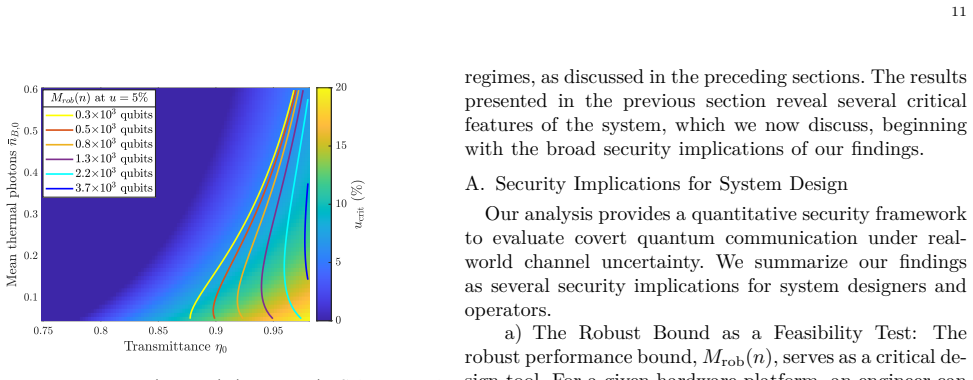
read the original abstract
Covert quantum communication is usually analyzed under idealized assumptions that channel parameters, such as transmissivity and background noise, are perfectly known and constant. In realistic optical links, including satellite, fiber, and free-space systems, these parameters vary because of environmental fluctuations, calibration noise, and estimation errors. We study covert quantum communication over compound quantum optical channels with bounded uncertainty in both transmissivity and thermal noise, and derive guarantees that hold for all admissible channel realizations. We develop a robust framework for certifying both covertness and reliability under uncertainty. A central finding is that robustness cannot be obtained by simply inserting worst-case parameter values into known-channel bounds: the channel realizations that are most adverse for covertness and reliability generally occur at different corners of the uncertainty set. This creates a fundamental trade-off in secure system design. We derive a closed-form lower bound on the worst-case guaranteed number of covert qubits that can be transmitted reliably, identify a sharp feasibility boundary beyond which the guaranteed payload drops to zero, and quantify the security penalty caused by uncertainty. We validate the covertness term with QuTiP simulations of a four-mode bosonic model and combine it with an analytical reliability bound to evaluate the robust payload. Our results move covert quantum communication from nominal perfect-knowledge analysis to certified worst-case operation under uncertainty.
Editorial analysis
A structured set of objections, weighed in public.
Referee Report
Summary. The paper claims to develop a robust framework for covert quantum communication over compound quantum optical channels with bounded uncertainty in transmissivity and thermal noise. It derives a closed-form lower bound on the worst-case guaranteed number of covert qubits that can be transmitted reliably, identifies a sharp feasibility boundary, and demonstrates that the most adverse channel realizations for covertness and reliability occur at different points in the uncertainty set, necessitating a dedicated approach rather than substituting worst-case parameters into known-channel bounds. The covertness term is validated via QuTiP simulations of a four-mode bosonic model, combined with an analytical reliability bound.
Significance. If the central results hold, this work is significant for advancing covert quantum communication towards practical deployment in uncertain environments such as satellite or free-space links. It provides quantifiable guarantees and highlights an important design trade-off. The combination of analytical bounds with numerical validation is a positive aspect, though the strength depends on the rigor of the achievability argument for the compound setting.
major comments (2)
- [Derivation of the closed-form lower bound] The lower bound on the worst-case covert payload appears to be obtained by taking the minimum of the covertness and reliability criteria evaluated at their respective worst-case corners of the uncertainty set. However, in the compound-channel model, a single fixed code must simultaneously satisfy the maximum error probability bound and the trace-distance covertness condition for every channel realization in the set. Without an explicit uniform achievability argument (e.g., via random coding over the compound set or a minimax theorem application), this min-of-worst-cases may not correspond to an achievable rate. This is central to the claimed lower bound.
- [QuTiP validation section] The four-mode bosonic simulation validates only the covertness term in isolation. It does not demonstrate that the combined reliability and covertness conditions can be met simultaneously by the same code across the uncertainty set, which is required for the robust payload claim.
minor comments (2)
- [Abstract] The abstract mentions 'QuTiP simulations' but does not specify the number of trials or the exact parameters used for validation, which would aid reproducibility.
- [Notation] Some notation for the uncertainty set and compound channel could be clarified with a dedicated diagram or table of parameters.
Simulated Author's Rebuttal
We thank the referee for the careful and constructive review of our manuscript. The comments highlight important aspects of the compound-channel setting and the validation approach, which we address below. We believe the core contributions remain valid but agree that additional clarifications will strengthen the presentation.
read point-by-point responses
-
Referee: [Derivation of the closed-form lower bound] The lower bound on the worst-case covert payload appears to be obtained by taking the minimum of the covertness and reliability criteria evaluated at their respective worst-case corners of the uncertainty set. However, in the compound-channel model, a single fixed code must simultaneously satisfy the maximum error probability bound and the trace-distance covertness condition for every channel realization in the set. Without an explicit uniform achievability argument (e.g., via random coding over the compound set or a minimax theorem application), this min-of-worst-cases may not correspond to an achievable rate. This is central to the claimed lower bound.
Authors: We agree that a uniform achievability argument is essential in the compound setting. Our derivation employs a channel-independent code construction (fixed coherent-state modulation with parameters chosen to satisfy the worst-case constraints simultaneously) together with a random-coding argument in which the error probability and trace-distance bounds are taken as suprema over the entire uncertainty set. This ensures the same code meets both criteria for every realization. The closed-form expression then follows by optimizing the payload subject to these uniform bounds. We will revise the manuscript to include an explicit lemma stating the uniform achievability result and clarifying the application of the minimax interchange for this finite-dimensional uncertainty set. revision: yes
-
Referee: [QuTiP validation section] The four-mode bosonic simulation validates only the covertness term in isolation. It does not demonstrate that the combined reliability and covertness conditions can be met simultaneously by the same code across the uncertainty set, which is required for the robust payload claim.
Authors: The QuTiP simulations numerically confirm the analytical covertness bound under the worst-case parameters for the trace-distance constraint. Reliability is controlled by a separate analytical upper bound on the maximum error probability that holds uniformly over the uncertainty set for the chosen code. Because the code is fixed and independent of any particular channel realization, the two conditions are satisfied simultaneously by construction. We acknowledge that a joint numerical demonstration across the full set would provide additional intuition; however, exhaustive simulation over the continuous uncertainty set is computationally prohibitive. In the revision we will add a paragraph explaining this separation of concerns and why the analytical reliability bound guarantees joint satisfaction. revision: partial
Circularity Check
No significant circularity; bounds derived from compound-channel model without reduction to inputs
full rationale
The paper derives a closed-form lower bound on worst-case guaranteed covert qubits and a sharp feasibility boundary by analyzing the compound quantum optical channel under bounded uncertainty in transmissivity and thermal noise. It combines an analytical reliability bound with a QuTiP-validated covertness term for the four-mode bosonic model. No self-definitional loops appear, no fitted parameters are renamed as predictions, and no load-bearing self-citations or ansatz smuggling via prior work are present. The central observation that adverse realizations for covertness and reliability occur at different corners follows directly from evaluating the uncertainty set, rather than being tautological. The framework is self-contained against the stated assumptions of known bounded uncertainty and does not reduce the result to its own inputs by construction.
Axiom & Free-Parameter Ledger
axioms (2)
- domain assumption Quantum optical channels can be modeled as compound channels with a known bounded uncertainty set on transmissivity and thermal noise.
- domain assumption Covertness and reliability can be certified separately and then combined into a joint worst-case bound.
Forward citations
Cited by 1 Pith paper
-
A Risk-Aware Framework for Covert Quantum Communication under Stochastic Channel Uncertainty
A risk-aware stochastic framework models uncertain quantum channels with chance constraints on covertness and reliability, yielding quantile reformulations and Monte Carlo results that expand feasible regions and impr...
Reference graph
Works this paper leans on
-
[1]
Limits of reliable communication with low probability of detection on A WGN channels,
B. A. Bash, D. Goeckel, and D. Towsley, “Limits of reliable communication with low probability of detection on A WGN channels,” IEEE Journal on Selected Areas in Communications, vol. 31, no. 9, pp. 1921–1930, September 2013
work page 1921
-
[2]
Covert outage minimiza- tion in the presence of multiple wardens,
A. Arghavani, S. Dey, and A. Ahlén, “Covert outage minimiza- tion in the presence of multiple wardens,” IEEE Transactions on Signal Processing, vol. 71, pp. 686–700, 2023
work page 2023
-
[3]
Covert quantum communication over optical channels,
E. J. D. Anderson, C. K. Eyre, I. M. Dailey, F. Rozpedek, and B. A. Bash, “Covert quantum communication over optical channels,” 2024
work page 2024
-
[4]
Square root law for covert quantum communication over optical channels,
——, “Square root law for covert quantum communication over optical channels,” in Proceedings of the 2024 IEEE International Conference on Quantum Computing and Engineering (QCE). Montreal, Canada: IEEE, 2024, pp. 1817–1823
work page 2024
-
[5]
Achiev- ability of covert quantum communication,
E. J. D. Anderson, M. S. Bullock, B. A. Bash et al., “Achiev- ability of covert quantum communication,” 2025
work page 2025
-
[6]
Signaling for covert quantum sensing,
M. Tahmasbi, B. A. Bash, S. Guha, and M. Bloch, “Signaling for covert quantum sensing,” in Proceedings of the IEEE Interna- tional Symposium on Information Theory (ISIT). Melbourne, Australia: IEEE, 2021, pp. 1041–1045
work page 2021
-
[7]
QuTiP 2: A Python framework for the dynamics of open quantum systems,
J. R. Johansson, P. D. Nation, and F. Nori, “QuTiP 2: A Python framework for the dynamics of open quantum systems,” Computer Physics Communications, vol. 184, no. 4, pp. 1234– 1240, 2013
work page 2013
-
[8]
A comprehensive design and performance analysis of low earth orbit satellite quantum communication,
J.-P. Bourgoin, E. Meyer-Scott, B. L. Higgins, B. Helou, C. Er- ven, H. Hübel, B. Kumar, D. Hudson, I. D’Souza, R. Girard, R. Laflamme, and T. Jennewein, “A comprehensive design and performance analysis of low earth orbit satellite quantum communication,” New Journal of Physics, vol. 15, no. 2, p. 023006, 2013
work page 2013
-
[9]
Fat tissue-based in-body covert communication,
M. Padmal, J. Engstrand, A. Arghavani, S. Dey, R. Au- gustine, R. Jäntti, and T. Voigt, “Fat tissue-based in-body covert communication,” in Proceedings of the 2025 IEEE 26th International Symposium on a World of Wireless, Mobile and Multimedia Networks (WoWMoM). Fort Worth, TX, USA: IEEE, 2025, pp. 61–71
work page 2025
-
[10]
Dynamic role-switching for cooperative covert communication,
A. Arghavani and E. Uhlemann, “Dynamic role-switching for cooperative covert communication,” in Proceedings of the IEEE 100th Vehicular Technology Conference (VTC2024-Fall). Washington, DC, USA: IEEE, 2024, pp. 1–5
work page 2024
-
[11]
A game- theoretic approach to covert communications in the presence of multiple colluding wardens,
A. Arghavani, A. Ahlén, A. Teixeira, and S. Dey, “A game- theoretic approach to covert communications in the presence of multiple colluding wardens,” in Proceedings of the IEEE Wire- less Communications and Networking Conference (WCNC). Nanjing, China: IEEE, 2021, pp. 1–7
work page 2021
-
[12]
Covert communication over classical–quantum chan- nels,
A. Sheikholeslami, B. A. Bash, D. Towsley, D. Goeckel, and S. Guha, “Covert communication over classical–quantum chan- nels,” in Proceedings of the IEEE International Symposium on Information Theory (ISIT). Barcelona, Spain: IEEE, 2016, pp. 2064–2068
work page 2016
-
[13]
Fundamental limits of covert communication over classical–quantum channels,
M. S. Bullock, A. Sheikholeslami, M. Tahmasbi, R. C. Mac- donald, S. Guha, and B. A. Bash, “Fundamental limits of covert communication over classical–quantum channels,” IEEE Transactions on Information Theory, 2025, early access
work page 2025
-
[14]
Robust transmission design for covert satellite communication systems with dual- csi uncertainty,
H. Jia, Y. Wang, W. Wu, and J. Yuan, “Robust transmission design for covert satellite communication systems with dual- csi uncertainty,” IEEE Internet of Things Journal, 2025, early access
work page 2025
-
[15]
Classical capacities of compound and averaged quantum channels,
I. Bjelaković and H. Boche, “Classical capacities of compound and averaged quantum channels,” IEEE Transactions on Infor- mation Theory, vol. 55, no. 7, pp. 3360–3374, July 2009
work page 2009
-
[16]
C. W. Helstrom, Quantum Detection and Estimation Theory, ser. Mathematics in Science and Engineering. New York, NY, USA: Academic Press, 1976, vol. 123, includes bibliographical references (pp. 297–303) and index
work page 1976
-
[17]
M. M. Wilde, Quantum Information Theory, 2nd ed. Cam- bridge, United Kingdom: Cambridge University Press, 2017
work page 2017
-
[18]
Channel measurement and markov modeling of an urban free-space optical link,
A. Mostafa and S. Hranilovic, “Channel measurement and markov modeling of an urban free-space optical link,” Journal of Optical Communications and Networking, vol. 4, no. 10, pp. 836–846, 2012
work page 2012
-
[19]
Free-space optical channel characterization and experimental validation in a coastal environment,
W. G. Alheadary, T. K. Ng, and B. S. Ooi, “Free-space optical channel characterization and experimental validation in a coastal environment,” Optics Express, vol. 26, no. 6, pp. 6614– 6628, 2018
work page 2018
-
[20]
Full daylight quantum key distribution at 1550 nm enabled by integrated silicon photonics,
M. A vesani, L. Calderaro, M. Schiavon, C. Agnesi, A. Stanco, A. Agnesi, D. Cozzolino, I. Ruo-Berchera, G. Carvacho, P. Vil- loresi, and G. Vallone, “Full daylight quantum key distribution at 1550 nm enabled by integrated silicon photonics,” npj Quan- tum Information, vol. 7, p. 93, 2021
work page 2021
-
[21]
I. A. Alimi, A. Teixeira, and P. Monteiro, “Revolutionizing Free- Space Optics: A survey of enabling technologies, challenges, trends, and prospects of beyond 5G Free-Space Optical (FSO) communication systems,” Sensors, vol. 24, no. 24, p. 8036, 2024
work page 2024
-
[22]
Long- distance quantum key distribution in optical fibre,
P. A. Hiskett, D. Rosenberg, C. G. Peterson, R. J. Hughes, S. W. Nam, A. E. Lita, A. J. Miller, and J. E. Nordholt, “Long- distance quantum key distribution in optical fibre,” New Journal of Physics, vol. 8, no. 9, p. 193, 2006
work page 2006
-
[23]
Quantum key distribution over multicore fiber,
J. F. Dynes, S. J. Kindness, S. W.-B. Tam, A. Plews, A. W. Sharpe, M. Lucamarini, B. Fröhlich, Z. L. Yuan, R. V. Penty, and A. J. Shields, “Quantum key distribution over multicore fiber,” Optics Express, vol. 24, no. 8, pp. 8081–8087, 2016
work page 2016
-
[24]
High-efficiency superconducting nanowire single-photon detectors fabricated from mosi thin-films,
V. B. Verma, B. Korzh, F. Bussieres, R. D. Horansky, S. D. Dyer, A. E. Lita, I. Vayshenker, F. Marsili, M. D. Shaw, H. Zbinden et al., “High-efficiency superconducting nanowire single-photon detectors fabricated from mosi thin-films,” Optics express, vol. 23, no. 26, pp. 33 792–33 801, 2015
work page 2015
-
[25]
S. Tripathy, P. K. Parida, R. Kar, P. Dash, S. Hazra, R. Singh, H. Mishra, D. K. Pradhan, and P. Nayak, “A comprehensive study of various superconductors for superconducting nanowire single-photon detector applications,” iScience, vol. 27, no. 10, p. 110779, 2024
work page 2024
discussion (0)
Sign in with ORCID, Apple, or X to comment. Anyone can read and Pith papers without signing in.