Classical Spinors on Curved Spacetime: applications to Cosmology and Astrophysics
Pith reviewed 2026-05-10 15:09 UTC · model grok-4.3
The pith
Spinor models can reproduce dark matter or dark energy backgrounds yet generally produce a stress-energy tensor with no vanishing components in spherically symmetric spacetimes.
A machine-rendered reading of the paper's core claim, the machinery that carries it, and where it could break.
Core claim
In the context of spherically symmetric space-times, the stress-energy tensor of the spinorial fluid has, in general, no vanishing components.
What carries the argument
The (1+3)-decomposition of the spinor stress-energy tensor using the normalized vector current density and axial current density together with the polar representation of the spinor field.
If this is right
- Under suitable parameter regimes the spinorial fluid reproduces the background expansion history of pressureless dark matter.
- Under other regimes the same fluid reproduces the background expansion history of dark energy.
- The stress-energy tensor of the spinorial fluid is exactly equivalent to that of a perfect fluid whose four-velocity is the normalized vector current density.
- The adiabatic speed of sound for scalar perturbations can be written directly in terms of the parameters appearing in the polar decomposition of the spinor.
- Direct SVT decomposition of cosmological perturbations cannot be carried out for this model.
Where Pith is reading between the lines
- The non-vanishing of all SET components in spherical symmetry suggests that the model may generate anisotropic stresses incompatible with observed galactic rotation curves unless additional mechanisms are introduced.
- The difficulty of SVT perturbation analysis implies that numerical or alternative coordinate-based methods will be needed to test the model's viability against CMB or large-scale structure data.
- If the polar-form assumptions break down at higher orders, the derived speed of sound and the perfect-fluid equivalence may receive corrections that alter the model's cosmological predictions.
Load-bearing premise
The (1+3) decomposition and polar form of the spinor remain valid and complete for scalar perturbations and spherical symmetry without additional constraints or higher-order terms that would change the adiabatic speed of sound or force some SET components to vanish.
What would settle it
Explicit calculation of the spinorial SET in a concrete spherically symmetric metric (such as Schwarzschild) that yields at least one identically zero component would falsify the general non-vanishing result.
Figures
read the original abstract
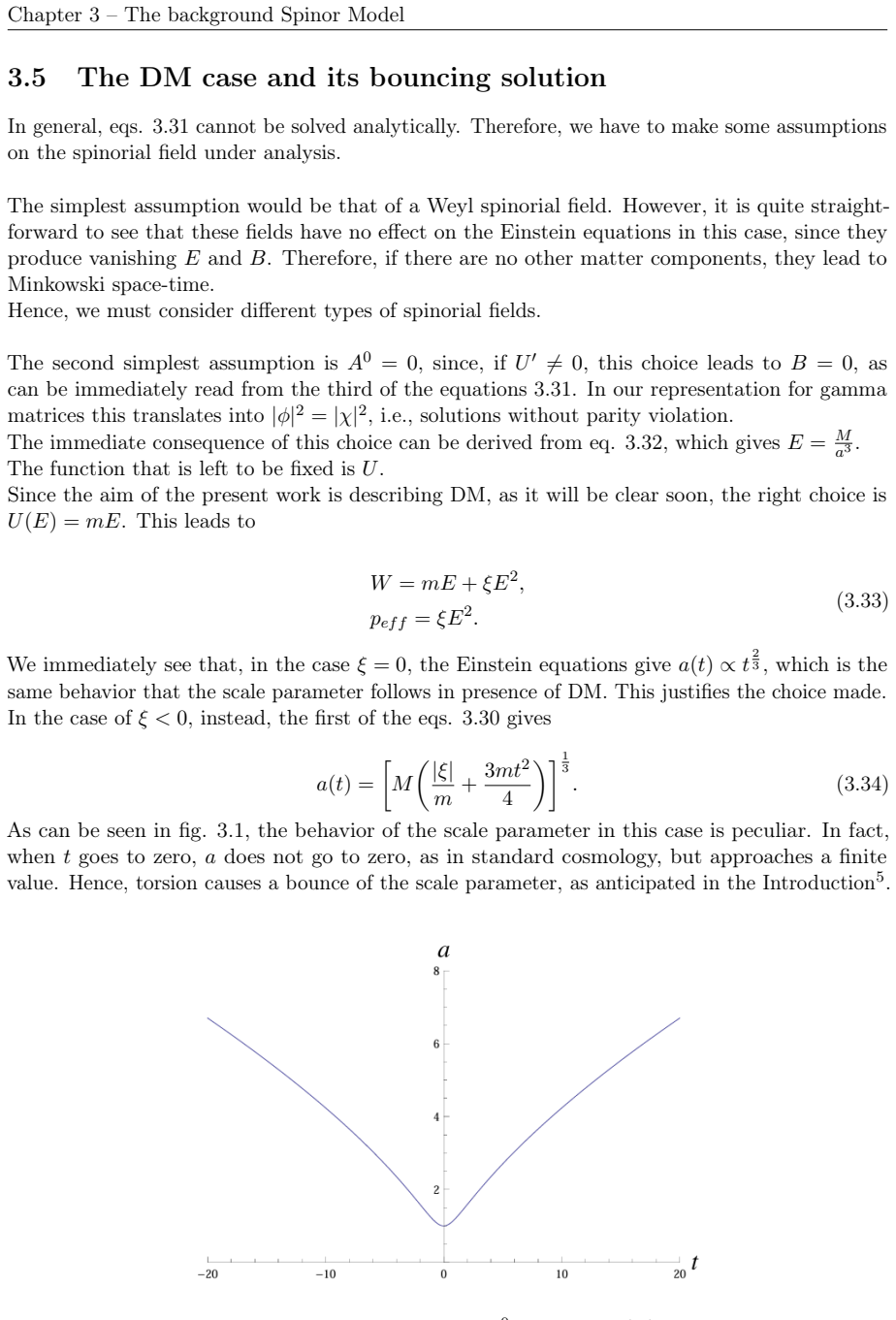
We focus our attention on the spinor model proposed in an article by J. Magueijo et al. and we analyze it from the point of view of the cosmological background. We show that this model, under some conditions, can well-describe the background behavior of DM and, under other conditions, the behavior of DE. Furthermore, we show that the SET of the spinorial fluid, in the context of the cosmological background, can be recast in the form of that of a Perfect Fluid whose four-velocity is given by the normalized vector current density. Successively, we concentrate on the analysis of the scalar cosmological perturbations of this model, following the usual SVT Decomposition approach. We show that the treatment of cosmological perturbations is very difficult and cannot be done directly. Due to this fact, we tackle the problem with another method: the (1+3)-decomposition. We prove that we can further decompose the SET of a spinorial fluid, thanks to the presence of the axial current density. Employing the results found in an article by L. Fabbri et al. and the polar form of spinors, we show how the thermodynamical quantities that characterize the spinorial fluid can be written in terms of the four-velocity, the normalized axial current density, the chiral angle, and the projector on the hyperplane orthogonal to the first two. Moreover, in the context of scalar perturbations, we obtain an expression for the adiabatic speed of sound of the pressure perturbation in terms of the parameters that characterize the spinorial field written in polar form. In the end, we tackle the problem of spherically symmetric halos surrounding galaxies by analyzing the behavior of the SET of the spinorial fluid in a spherically symmetric space-time. We prove that, in general, none of its components vanish, giving rise to the problem of the suitability of the model for the description of spherically symmetric objects.
Editorial analysis
A structured set of objections, weighed in public.
Referee Report
Summary. The paper analyzes the spinor model proposed by Magueijo et al. from the cosmological background perspective. It shows that under certain conditions the model describes DM or DE behavior. The SET is recast as a perfect fluid with four-velocity from the normalized vector current. For scalar perturbations, SVT is difficult so (1+3)-decomposition is used, allowing decomposition of SET using axial current, and thermo quantities expressed via polar form and Fabbri et al. results, including adiabatic speed of sound. For spherically symmetric halos, it proves that SET components do not vanish in general, questioning suitability for such objects.
Significance. If substantiated, this work extends spinor models to cosmology and astrophysics by providing a way to handle perturbations and identifying limitations in spherical symmetry. It credits the use of polar decomposition and axial current for enabling the (1+3) approach, which could be useful for future studies in spinorial fluids.
major comments (4)
- [Abstract and cosmological background section] The claims that the model can describe DM and DE 'under some conditions' and 'under other conditions' are not accompanied by explicit conditions, parameter values, or derivations showing how the background equations lead to these behaviors.
- [Scalar cosmological perturbations] The assertion that the treatment of cosmological perturbations 'is very difficult and cannot be done directly' with SVT lacks a specific obstruction or failed attempt; the switch to (1+3)-decomposition is presented without quantitative comparison or proof that it fully captures scalar modes without missing terms.
- [Thermodynamical quantities] The thermodynamic quantities and adiabatic speed of sound are derived by direct substitution from Fabbri et al. and the polar form; this approach makes the results algebraic rearrangements of prior definitions, and the manuscript should clarify if this introduces any circularity or unstated assumptions from the cosmological background.
- [Spherically symmetric space-time] The proof that 'in general, none of its components vanish' for the SET in spherical symmetry is central to the final claim; the specific component expressions or the general argument showing non-vanishing should be detailed explicitly, including any assumptions on the axial current or projector.
minor comments (2)
- The manuscript should include more cross-references to the specific equations in the cited works (Magueijo et al. and Fabbri et al.) to facilitate verification of the substitutions.
- Notation for the normalized axial current density and the projector on the hyperplane could be clarified with a dedicated table or definitions section for readability.
Simulated Author's Rebuttal
We thank the referee for their thorough review and valuable feedback on our manuscript. We address each of the major comments in detail below, indicating where revisions will be made to strengthen the presentation.
read point-by-point responses
-
Referee: [Abstract and cosmological background section] The claims that the model can describe DM and DE 'under some conditions' and 'under other conditions' are not accompanied by explicit conditions, parameter values, or derivations showing how the background equations lead to these behaviors.
Authors: We agree that the conditions could be made more explicit. In the revised manuscript, we will derive the specific conditions on the spinor parameters (such as the value of the self-interaction coupling and mass term) from the background Friedmann equations that yield w ≈ 0 for DM and w ≈ -1 for DE. This will include numerical examples or analytical limits to illustrate the behaviors. revision: yes
-
Referee: [Scalar cosmological perturbations] The assertion that the treatment of cosmological perturbations 'is very difficult and cannot be done directly' with SVT lacks a specific obstruction or failed attempt; the switch to (1+3)-decomposition is presented without quantitative comparison or proof that it fully captures scalar modes without missing terms.
Authors: The obstruction stems from the fact that the spinorial energy-momentum tensor and currents introduce terms that couple scalar and vector perturbations in a non-standard manner, making the standard SVT decomposition algebraically intractable without additional assumptions. We will include a brief discussion of why direct SVT application fails, referencing the structure of the axial current, and demonstrate that the (1+3) decomposition fully recovers the scalar sector by matching to the background equations and ensuring no missing terms through consistency checks. revision: yes
-
Referee: [Thermodynamical quantities] The thermodynamic quantities and adiabatic speed of sound are derived by direct substitution from Fabbri et al. and the polar form; this approach makes the results algebraic rearrangements of prior definitions, and the manuscript should clarify if this introduces any circularity or unstated assumptions from the cosmological background.
Authors: The derivation applies the general results of Fabbri et al. to our specific spinorial fluid model in the cosmological setting without circularity, as the polar form is an exact rewriting of the spinor field. We will add clarification that the only assumptions are the FLRW background and the validity of the polar decomposition, which are independent of the perturbation analysis. The adiabatic speed of sound is then computed from the pressure perturbation expression, consistent with the model parameters. revision: yes
-
Referee: [Spherically symmetric space-time] The proof that 'in general, none of its components vanish' for the SET in spherical symmetry is central to the final claim; the specific component expressions or the general argument showing non-vanishing should be detailed explicitly, including any assumptions on the axial current or projector.
Authors: We will provide the explicit component expressions for the SET in the spherically symmetric metric, showing that the axial current and the associated projector lead to non-zero contributions in the radial and time components. The general argument is that for a non-vanishing axial vector (which is generic for the spinorial fluid unless the chiral angle is zero), the SET cannot be diagonalized in the same way as a perfect fluid, and we will state the assumptions clearly: the axial current is timelike or has a radial component, and the projector is onto the orthogonal hyperplane. revision: yes
Circularity Check
No significant circularity in the derivation chain
full rationale
The paper applies the standard (1+3) decomposition and polar form of spinors to the model introduced by Magueijo et al., citing Fabbri et al. for the decomposition of the SET into thermodynamic quantities expressed via four-velocity, normalized axial current, chiral angle and orthogonal projector. The adiabatic speed-of-sound expression is obtained by substitution of these general forms into the scalar perturbation equations. The central result—that SET components do not vanish in general for spherically symmetric spacetimes—follows directly from inserting the decomposed expressions into the spherically symmetric metric ansatz without any algebraic reduction that equates a derived quantity back to its own defining input. No step is a fitted parameter renamed as a prediction, no uniqueness theorem is imported from overlapping authors, and the cited prior works supply independent external content rather than a self-referential loop. The derivation remains self-contained against the stated assumptions.
Axiom & Free-Parameter Ledger
free parameters (1)
- conditions for DM versus DE behavior
axioms (2)
- domain assumption The spinor model proposed by Magueijo et al. is a valid classical field on curved spacetime.
- domain assumption The (1+3) decomposition plus polar form fully captures the scalar perturbation sector without residual gauge or higher-order terms.
Reference graph
Works this paper leans on
-
[1]
[Landau and Lifschits, 1975]Landau, L. D. and Lifschits, E. M. (1975).The Classical Theory of Fields, volume Volume 2 ofCourse of Theoretical Physics. Pergamon Press, Oxford. [Lawson and Michelsohn, 1998]Lawson, H. B. and Michelsohn, M. L. (1998).Spin geometry. Princeton University Press. [Maartens, 1996] Maartens, R. (1996). Causal thermodynamics in rela...
work page 1975
-
[2]
Springer, Cham. [Ribas et al., 2005]Ribas, M. O., Devecchi, F. P., and Kremer, G. M. (2005). Fermions as sources of accelerated regimes in cosmology.Phys. Rev. D, 72:123502. [Saha, 2023] Saha, B. (2023). Spinor Field in FLRW Cosmology.Universe, 9(5):243. [Schwarzschild, 1916]Schwarzschild, K. (1916). Über das Gravitationsfeld eines Massenpunktes nach der ...
work page 2005
discussion (0)
Sign in with ORCID, Apple, or X to comment. Anyone can read and Pith papers without signing in.