Are Thalassa and Despina in Resonance Lock with Neptune's Oscillations?
Pith reviewed 2026-05-10 13:57 UTC · model grok-4.3
The pith
Neptune's moons Thalassa and Despina may lock to the planet's internal g-modes so their resonance with Naiad remains stable over long timescales.
A machine-rendered reading of the paper's core claim, the machinery that carries it, and where it could break.
Core claim
If both Despina and Thalassa are locked to two resonant oscillation modes within Neptune whose frequencies evolve approximately in parallel, the Naiad-Thalassa resonance can remain stable for much longer than the Myr instability timescale found in standard tidal-evolution simulations. Lindblad resonances with low-order l=m=1, n=1 g-modes are identified as plausible drivers for this resonant-lock tidal migration of Thalassa, Despina, and possibly Galatea.
What carries the argument
Resonant-lock tidal evolution driven by Lindblad resonances between the moons and low-order l=m=1, n=1 g-modes of Neptune.
If this is right
- The Naiad-Thalassa resonance can persist for several Gyr, allowing time for Naiad's inclination to grow to its present 4.7 degrees.
- Standard equilibrium-tide convergent migration is replaced by a slower, mode-locked process that avoids the rapid instability.
- The same mechanism can be applied to Galatea and other inner Neptunian moons.
- The moons' long-term orbital evolution depends on the existence and damping rates of specific g-modes inside Neptune.
Where Pith is reading between the lines
- Precise measurements of the moons' current semi-major axis drift rates could test whether migration is slower than equilibrium-tide predictions.
- The proposal links satellite resonance dynamics directly to the internal oscillation spectrum of an ice giant.
- Similar resonant-lock processes may operate among the inner moons of Uranus and should be checked with existing orbital data.
- If the g-modes exist, they impose new constraints on Neptune's density and rotation profile that can be compared with gravity-field measurements.
Load-bearing premise
Neptune possesses low-order g-modes whose frequencies can lock with Thalassa and Despina and change in parallel as the moons migrate outward.
What would settle it
Orbital observations or interior models showing that Thalassa and Despina are not migrating at rates that keep their frequencies aligned with any pair of Neptune g-modes.
Figures


read the original abstract
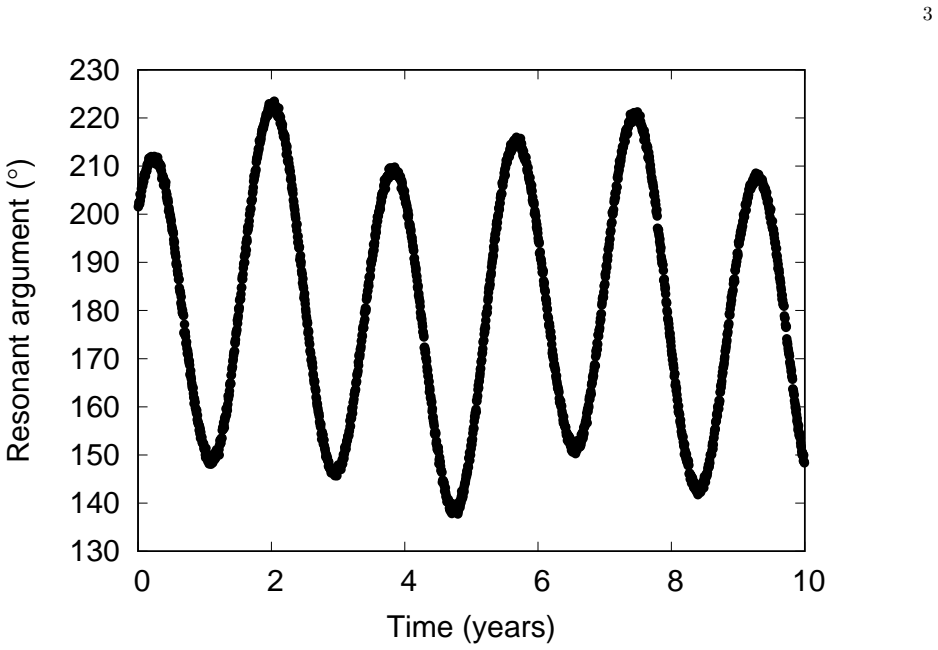
The two innermost moons of Neptune, Naiad and Thalassa, are currently in a 73:69 mean-motion resonance. This resonance relies on the large inclination of Naiad, and we estimate that Naiad requires multiple Gyr to reach its $4.7^{\circ}$ inclination through this resonance. However, we find through direct numerical simulations that the current Naiad-Thalassa resonance is unstable on Myr timescales due to perturbations from the neighboring moon Despina. As this instability is a product of convergent tidal evolution predicted by equilibrium tidal theory, we propose that the innermost moons of Neptune may migrate through resonant-lock tides. If both Despina and Thalassa are locked to two resonant oscillations modes within Neptune, the frequencies of which evolve approximately in parallel, Naiad-Thalassa resonance can be stable for much longer. We find that Lindblad resonances with low-order $l=m=1$, $n=1$ g-modes at Neptune may be suitable candidates for driving the resonant-lock evolution of Thalassa and Despina, and possibly even Galatea.
Editorial analysis
A structured set of objections, weighed in public.
Referee Report
Summary. The manuscript reports N-body simulations demonstrating that the Naiad-Thalassa 73:69 mean-motion resonance is unstable on Myr timescales due to perturbations from Despina, even though the resonance can excite Naiad's 4.7° inclination over Gyr timescales under equilibrium tides. To resolve the apparent contradiction with the moons' long-term survival, the authors propose that Thalassa and Despina are in resonant lock with two distinct low-order (l=m=1, n=1) g-modes inside Neptune whose frequencies evolve approximately in parallel during tidal migration, thereby stabilizing the Naiad-Thalassa resonance for much longer.
Significance. The direct N-body simulations constitute a clear, independent demonstration of resonance instability and are a solid contribution. If the resonant-lock hypothesis with Neptune's g-modes is quantitatively validated, it would supply a physically motivated mechanism reconciling short instability timescales with the observed configuration, with implications for tidal dissipation, internal mode coupling, and resonance dynamics in icy giant-planet satellite systems.
major comments (2)
- [g-mode proposal section] In the section proposing the resonant-lock mechanism (following the simulation results), the claim that l=m=1, n=1 g-modes are suitable candidates for driving parallel frequency evolution of Thalassa and Despina is unsupported: no eigenfrequency calculations for any Neptune interior model are presented, nor is there a comparison of those frequencies (or their derivatives) to the moons' mean motions and their rates of change under equilibrium tidal theory.
- [discussion of Lindblad resonances with g-modes] The central requirement that the two g-modes remain commensurate as semi-major axes change during convergent tidal migration is stated as an assumption without derivation or numerical demonstration that the frequency difference stays small enough to maintain the lock over Myr–Gyr timescales.
minor comments (2)
- [Abstract] The abstract states that Naiad requires multiple Gyr to reach its 4.7° inclination but does not cite the source of this inclination value or the tidal model parameters used for the estimate.
- [simulation results paragraph] Details of the N-body integrator, timestep, force model, and initial conditions for the instability simulations are not summarized, which limits immediate reproducibility of the Myr-timescale result.
Simulated Author's Rebuttal
We thank the referee for their careful reading of the manuscript, their positive assessment of the N-body simulations, and their constructive comments on the resonant-lock hypothesis. We address each major comment below and will revise the manuscript accordingly to clarify the speculative nature of the proposal while preserving its physical motivation.
read point-by-point responses
-
Referee: [g-mode proposal section] In the section proposing the resonant-lock mechanism (following the simulation results), the claim that l=m=1, n=1 g-modes are suitable candidates for driving parallel frequency evolution of Thalassa and Despina is unsupported: no eigenfrequency calculations for any Neptune interior model are presented, nor is there a comparison of those frequencies (or their derivatives) to the moons' mean motions and their rates of change under equilibrium tidal theory.
Authors: We agree that the manuscript does not contain explicit eigenfrequency calculations or direct numerical comparisons for specific Neptune interior models. The suggestion that l=m=1, n=1 g-modes are plausible candidates is based on their expected low frequencies being comparable to the orbital mean motions of the inner moons and on the general scaling of g-mode frequencies with planetary structure under tidal evolution. We acknowledge that this remains a hypothesis rather than a quantitatively validated claim. In the revised manuscript we will explicitly label the proposal as speculative, add a brief order-of-magnitude discussion of mode frequencies drawn from existing literature on Neptune oscillation modes, and state that detailed eigenmode computations and comparison to tidal migration rates are required for future work. revision: partial
-
Referee: [discussion of Lindblad resonances with g-modes] The central requirement that the two g-modes remain commensurate as semi-major axes change during convergent tidal migration is stated as an assumption without derivation or numerical demonstration that the frequency difference stays small enough to maintain the lock over Myr–Gyr timescales.
Authors: We accept that the maintenance of commensurability during migration is presented as a necessary condition without a formal derivation or numerical test in the current text. The assumption follows from the expectation that two modes of identical (l,m,n) quantum numbers will experience similar structural changes and therefore evolve their frequencies in parallel under the same tidal dissipation. In revision we will expand the relevant paragraph to include a qualitative scaling argument showing why the frequency difference is expected to remain small over the relevant timescales, while noting that a full demonstration would require coupled orbital-internal simulations that lie beyond the present study. We will also emphasize that the resonant-lock scenario is offered as one possible resolution of the instability timescale tension rather than a proven mechanism. revision: partial
Circularity Check
No significant circularity; instability from independent N-body simulations and resonance-lock proposal is an unverified hypothesis based on standard theory
full rationale
The paper obtains its core instability result for the Naiad-Thalassa resonance directly from N-body simulations that do not depend on the proposed g-mode locking. The suggestion that Despina and Thalassa could lock to l=m=1 n=1 g-modes whose frequencies evolve in parallel is presented as a hypothesis drawing on equilibrium tidal theory and existing g-mode literature, without any self-definitional equations, fitted parameters renamed as predictions, or load-bearing self-citations that reduce the claim to its own inputs by construction. No derivation step equates the parallel-evolution condition to a prior fit or redefinition within the paper itself, so the chain remains self-contained against external benchmarks.
Axiom & Free-Parameter Ledger
axioms (2)
- domain assumption Equilibrium tidal theory predicts convergent migration of the inner moons
- domain assumption Neptune possesses low-order l=m=1 n=1 g-modes capable of Lindblad resonance with the moons
invented entities (1)
-
Resonant lock between moons and Neptune g-modes
no independent evidence
Reference graph
Works this paper leans on
-
[1]
Agnor, C. B., & Hamilton, D. P. 2006, Nature, 441, 192, doi: 10.1038/nature04792
-
[2]
2025, in EPSC-DPS Joint Meeting 2025, Vol
Agrusa, H., ´Cuk, M., Nesvorny, D., & Marschall, R. 2025, in EPSC-DPS Joint Meeting 2025, Vol. 2025, EPSC–DPS2025–816, doi: 10.5194/epsc-dps2025-816 A’Hearn, J. A., Hedman, M. M., Mankovich, C. R.,
-
[3]
Aramona, H., & Marley, M. S. 2022, PSJ, 3, 194, doi: 10.3847/PSJ/ac82bb Banfield, D., & Murray, N. 1992, Icarus, 99, 390, doi: 10.1016/0019-1035(92)90155-Z Brozovi´ c, M., Showalter, M. R., Jacobson, R. A., et al. 2020, Icarus, 338, 113462, doi: 10.1016/j.icarus.2019.113462
-
[4]
Lissauer, J. J. 2002, Astronomical Journal, 123, 2884
2002
-
[5]
Chen, E. M. A., Nimmo, F., & Glatzmaier, G. A. 2014, Icarus, 229, 11, doi: 10.1016/j.icarus.2013.10.024 ´Cuk, M., Dones, L., & Nesvorn´ y, D. 2016, Astrophysical Journal, 820, 97, doi: 10.3847/0004-637X/820/2/97 ´Cuk, M., French, R. S., Showalter, M. R., Tiscareno, M. S., & El Moutamid, M. 2022, Astronomical Journal, 164, 38, doi: 10.3847/1538-3881/ac745d...
-
[6]
Davies, M. E., Rogers, P. G., & Colvin, T. R. 1991, JGR, 96, 15675, doi: 10.1029/91JE00976
-
[7]
2021, PSJ, 2, 198, doi: 10.3847/PSJ/ac0e2a
Xu, W. 2021, PSJ, 2, 198, doi: 10.3847/PSJ/ac0e2a
-
[8]
Duncan, M. J., & Lissauer, J. J. 1997, Icarus, 125, 1, doi: 10.1006/icar.1996.5568
-
[9]
Longaretti, P.-Y., & McGhee-French, C. A. 2024, Icarus, 411, 115957, doi: 10.1016/j.icarus.2024.115957
-
[10]
Hedman, M. M. 2019, Icarus, 319, 599, doi: 10.1016/j.icarus.2018.10.013
-
[11]
French, R. S., & Showalter, M. R. 2012, Icarus, 220, 911, doi: 10.1016/j.icarus.2012.06.031
-
[12]
2014, Icarus, 242, 283, doi: 10.1016/j.icarus.2014.08.006
Fuller, J. 2014, Icarus, 242, 283, doi: 10.1016/j.icarus.2014.08.006
-
[13]
2016, Montly Notices of the Royal Astronomical Society, 458, 3867, doi: 10.1093/mnras/stw609
Fuller, J., Luan, J., & Quataert, E. 2016, Montly Notices of the Royal Astronomical Society, 458, 3867, doi: 10.1093/mnras/stw609
-
[14]
Fuentes, J. R. 2026, arXiv e-prints, arXiv:2602.12348, doi: 10.48550/arXiv.2602.12348
-
[15]
Goldreich, P., Murray, N., Longaretti, P. Y., & Banfield, D. 1989, Science, 245, 500, doi: 10.1126/science.245.4917.500
-
[16]
Hedman, M. M. 2015, ApJL, 801, L33, doi: 10.1088/2041-8205/801/2/L33
-
[17]
Hedman, M. M., & Nicholson, P. D. 2013, AJ, 146, 12, doi: 10.1088/0004-6256/146/1/12
-
[18]
Hedman, M. M., & Nicholson, P. D. 2014, MNRAS, 444, 1369, doi: 10.1093/mnras/stu1503
-
[19]
Jacobson, R. A. 2009, AJ, 137, 4322, doi: 10.1088/0004-6256/137/5/4322
-
[20]
2003, Icarus, 162, 400, doi: 10.1016/S0019-1035(03)00002-2 11
Karkoschka, E. 2003, Icarus, 162, 400, doi: 10.1016/S0019-1035(03)00002-2 11
-
[21]
Lainey, V., Jacobson, R. A., Tajeddine, R., et al. 2017, Icarus, 281, 286, doi: 10.1016/j.icarus.2016.07.014
-
[22]
Lainey, V., Casajus, L. G., Fuller, J., et al. 2020, Nature Astronomy, 4, 1053, doi: 10.1038/s41550-020-1120-5
-
[23]
Mankovich, C. R., & Fuller, J. 2021, Nature Astronomy, 5, 1103, doi: 10.1038/s41550-021-01448-3
-
[24]
Marley, M. S., & Porco, C. C. 1993, Icarus, 106, 508, doi: 10.1006/icar.1993.1189
-
[25]
D., & Dermott, S
Murray, C. D., & Dermott, S. F. 1999, Solar System Dynamics (Cambridge University Press)
1999
-
[26]
Rufu, R., & Canup, R. M. 2017, AJ, 154, 208, doi: 10.3847/1538-3881/aa9184
-
[27]
Showalter, M. R., de Pater, I., Lissauer, J. J., & French, R. S. 2019, Nature, 566, 350, doi: 10.1038/s41586-019-0909-9
-
[28]
2013, ApJL, 765, L28, doi: 10.1088/2041-8205/765/2/L28
Castillo-Rogez, J. 2013, ApJL, 765, L28, doi: 10.1088/2041-8205/765/2/L28
-
[29]
2025, Solar System Research, 59, 6, doi: 10.1134/S0038094624601440
Wang, B., Xi, L., Jianguo, Y., et al. 2025, Solar System Research, 59, 6, doi: 10.1134/S0038094624601440
-
[30]
Zhang, K., & Hamilton, D. P. 2008, Icarus, 193, 267, doi: 10.1016/j.icarus.2007.08.024
discussion (0)
Sign in with ORCID, Apple, or X to comment. Anyone can read and Pith papers without signing in.