X-ray Absorption and Resonant X-ray Emission at the Carbon Edge of Li₂CO₃
Pith reviewed 2026-05-10 14:27 UTC · model grok-4.3
The pith
GW self-energy corrections and Bethe-Salpeter excitonic effects reproduce the carbon K-edge X-ray spectra of Li2CO3.
A machine-rendered reading of the paper's core claim, the machinery that carries it, and where it could break.
Core claim
While highly successful, density functional theory is known to have limitations owing to its neglect of many-body electron-electron interactions. This neglect leads to errors in the single-particle energies, leading to underestimated band gaps and band widths as well as errors in band alignment at interfaces. Many-body perturbation theory, in the form of the GW self-energy correction, has been widely used to improve upon these short-comings. Though less well studied, the same GW method is also able to predict the finite quasiparticle lifetime that is seen to cause anomalous broadening in the lowest-lying lines of valence emission spectra. Using near-edge x-ray absorption and emission, we 0.2
What carries the argument
GW self-energy corrections combined with the Bethe-Salpeter equation for excitonic effects, which provide improved single-particle energies, finite lifetimes, and electron-hole interactions.
Where Pith is reading between the lines
- Similar GW+BSE calculations could be applied to other carbonate materials or battery electrolytes to predict their spectroscopic signatures.
- The success here suggests that lifetime broadening is a general feature that GW can capture across a range of insulators.
- This validation supports using the approach for studying interfaces or defects where band alignment matters.
Load-bearing premise
The GW approximation plus Bethe-Salpeter equation captures the dominant many-body effects sufficiently to explain both peak positions and the observed lifetime broadening without needing higher-order diagrams or material-specific adjustments.
What would settle it
Observation of peak positions or line broadenings in the experimental spectra that deviate substantially from the GW+BSE predictions, especially if the broadening does not match the calculated quasiparticle lifetimes.
Figures
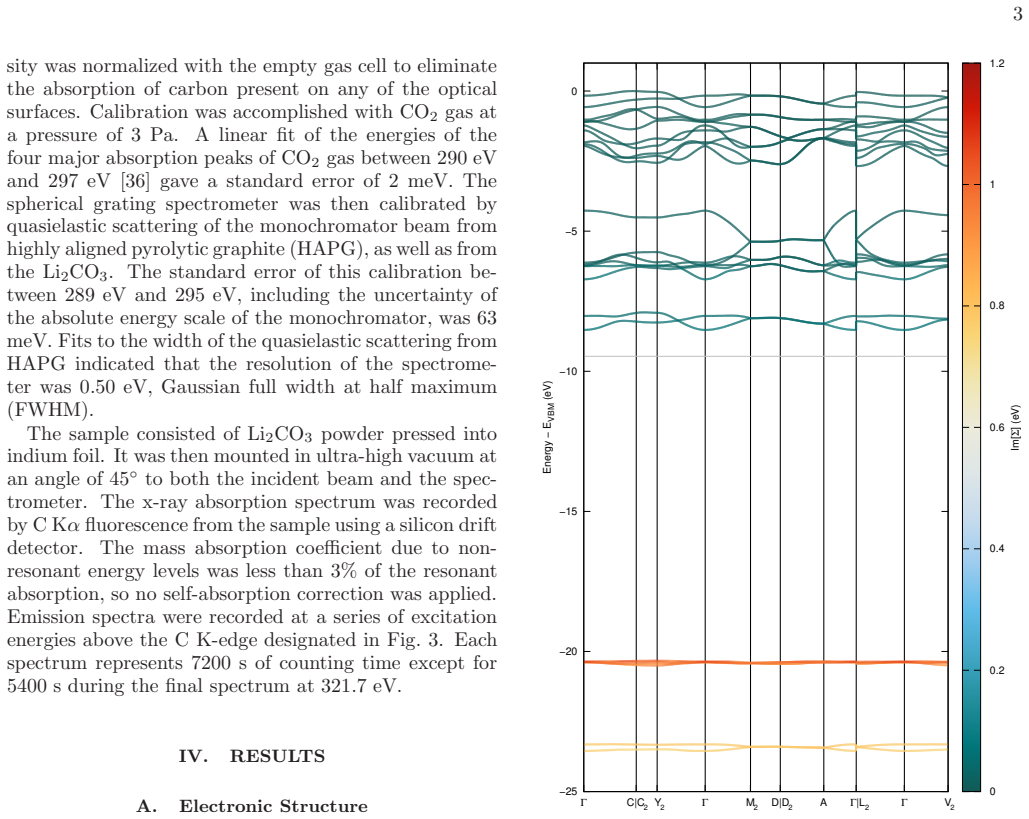


read the original abstract
While highly successful, density functional theory is known to have limitations owing to its neglect of many-body electron-electron interactions. This neglect leads to errors in the single-particle energies, leading to underestimated band gaps and band widths as well as errors in band alignment at interfaces. Many-body perturbation theory, in the form of the $GW$ self-energy correction, has been widely used to improve upon these short-comings. Though less well studied, the same $GW$ method is also able to predict the finite quasiparticle lifetime that is seen to cause anomalous broadening in the lowest-lying lines of valence emission spectra. Using near-edge x-ray absorption and emission, we probe the electronic structure of Li$_2$CO$_3$. Our measurements are compared to first-principles calculations, including $GW$ self-energy corrections to the single-particle energies and excitonic effects from the Bethe-Salpeter equation.
Editorial analysis
A structured set of objections, weighed in public.
Referee Report
Summary. The manuscript reports experimental near-edge X-ray absorption (XAS) and resonant X-ray emission (XES) spectra at the carbon K-edge of Li₂CO₃. These are compared to first-principles calculations that apply GW self-energy corrections to single-particle energies (including quasiparticle lifetimes from Im Σ) and incorporate excitonic effects via the Bethe-Salpeter equation.
Significance. If the comparison is robust, the work provides a useful benchmark for GW+BSE methods in core-level spectroscopy of carbonate materials relevant to battery electrolytes and CO₂ sequestration. The explicit treatment of lifetime broadening from the GW self-energy is a strength, as it addresses a feature often neglected in simpler calculations.
major comments (2)
- [Abstract and results section] Abstract and results section: The central claim that measurements are compared to GW+BSE calculations is stated, but no quantitative metrics of agreement (e.g., peak-position differences with uncertainties, integrated intensity ratios, or RMS residuals) are provided, nor is there discussion of experimental resolution, background subtraction, or possible artifacts such as self-absorption in XES. This leaves the degree of agreement unverified.
- [Calculations section] Calculations section: The procedure for folding the GW quasiparticle lifetimes (Im Σ) into the final XAS/XES line shapes is described at a high level but lacks explicit details on the broadening function, energy-dependent implementation, or convergence tests with respect to the number of bands or k-points used in the BSE kernel.
minor comments (2)
- [Figures and text] Figure captions and text: Ensure consistent use of subscripts in chemical formulas (Li₂CO₃) and clarify the energy reference (e.g., whether spectra are aligned to the calculated Fermi level or experimental onset).
- [Introduction] References: Add citations to prior GW+BSE studies on related carbonates or oxides to better contextualize the novelty of the lifetime-broadening analysis.
Simulated Author's Rebuttal
We thank the referee for their positive assessment of our work and the recommendation for minor revision. The comments highlight useful ways to strengthen the presentation of the experimental-theoretical comparison and the methodological details. We address each point below and will incorporate the suggested improvements in the revised manuscript.
read point-by-point responses
-
Referee: [Abstract and results section] Abstract and results section: The central claim that measurements are compared to GW+BSE calculations is stated, but no quantitative metrics of agreement (e.g., peak-position differences with uncertainties, integrated intensity ratios, or RMS residuals) are provided, nor is there discussion of experimental resolution, background subtraction, or possible artifacts such as self-absorption in XES. This leaves the degree of agreement unverified.
Authors: We agree that quantitative metrics and additional experimental details would make the degree of agreement more transparent. In the revised manuscript we will add a dedicated paragraph (and, if space permits, a supplementary table) reporting peak-position differences with estimated uncertainties, integrated intensity ratios for the principal features, and RMS residuals between normalized experimental and calculated spectra. We will also explicitly state the experimental energy resolutions, describe the background subtraction procedure applied to both XAS and XES data, and provide a brief assessment of self-absorption effects in the XES spectra, which we find to be negligible for the sample thicknesses employed. revision: yes
-
Referee: [Calculations section] Calculations section: The procedure for folding the GW quasiparticle lifetimes (Im Σ) into the final XAS/XES line shapes is described at a high level but lacks explicit details on the broadening function, energy-dependent implementation, or convergence tests with respect to the number of bands or k-points used in the BSE kernel.
Authors: We will revise the Calculations section to supply the requested details. The broadening will be specified as an energy-dependent Lorentzian convolution whose full width at half-maximum is twice the absolute value of Im Σ(ω) evaluated at each transition energy. We will also report explicit convergence tests: spectra obtained with 200 unoccupied bands and a 4×4×4 k-point grid differ by less than 0.1 eV in peak positions from those obtained with 300 bands and a 6×6×6 grid, confirming that the presented results are converged within the experimental resolution. revision: yes
Circularity Check
No significant circularity detected
full rationale
The paper reports experimental near-edge X-ray absorption and emission spectra for Li2CO3 and compares them directly to standard first-principles calculations that apply GW quasiparticle corrections to single-particle energies plus Bethe-Salpeter equation excitonic effects. These methods are invoked in their conventional form without any parameters fitted to the present spectra, without self-referential definitions of quantities, and without load-bearing reliance on prior self-citations that would reduce the central comparison to a tautology. Lifetime broadening is obtained from the imaginary part of the GW self-energy in the usual way. The derivation chain is therefore self-contained against external benchmarks and independent of the measured data.
Axiom & Free-Parameter Ledger
axioms (2)
- domain assumption GW self-energy correction improves single-particle energies and predicts finite quasiparticle lifetimes
- domain assumption Bethe-Salpeter equation accounts for excitonic effects in absorption spectra
Reference graph
Works this paper leans on
- [1]
- [2]
- [3]
-
[4]
T. Jach, J. Vinson, M. Woodcox, A. Jonas, K. Fren- zel, R. Unterumsberger, and B. Beckhoff, Universality of extreme-broadening mechanisms in some near-edge x-ray spectra, Phys. Rev. B 111, 125107 (2025)
work page 2025
-
[5]
A. L´ eon, A. Fiedler, M. Blum, A. Benkert, F. Meyer, W. Yang, M. B¨ ar, F. Scheiba, H. Ehrenberg, L. Wein- hardt, and C. Heske, Valence electronic structure of li2o2, li2o, li2co3, and lioh probed by soft x-ray emission spec- troscopy, The Journal of Physical Chemistry C 121, 5460 (2017)
work page 2017
-
[6]
R. Qiao, Y.-D. Chuang, S. Yan, and W. Yang, Soft x- ray irradiation effects of li2o2, li2co3 and li2o revealed by absorption spectroscopy, PLOS ONE 7, 1 (2012)
work page 2012
-
[7]
Z. Zhuo, C. D. Pemmaraju, J. Vinson, C. Jia, B. Moritz, I. Lee, S. Sallies, Q. Li, J. Wu, K. Dai, Y.-d. Chuang, Z. Hussain, F. Pan, T. P. Devereaux, and W. Yang, Spec- troscopic signature of oxidized oxygen states in perox- ides, The Journal of Physical Chemistry Letters 9, 6378 (2018)
work page 2018
-
[8]
T. A. Pascal, U. Boesenberg, R. Kostecki, T. J. Richard- son, T.-C. Weng, D. Sokaras, D. Nordlund, E. McDer- mott, A. Moewes, J. Cabana, and D. Prendergast, Fi- nite temperature effects on the x-ray absorption spec- tra of lithium compounds: First-principles interpretatio n of x-ray raman measurements, The Journal of Chemical Physics 140, 034107 (2014)
work page 2014
-
[9]
E. de Clermont Gallerande, D. Cabaret, G. Lelong, C. Brouder, M.-B. Attaiaa, L. Paulatto, K. Gilmore, C. J. Sahle, and G. Radtke, First-principles modeling of x-ray raman scattering spectra, Phys. Rev. B 98, 214104 (2018)
work page 2018
-
[10]
J. P. Perdew, K. Burke, and M. Ernzerhof, Generalized gradient approximation made simple, Phys. Rev. Lett. 77, 3865 (1996)
work page 1996
-
[11]
www.abinit.org v. 10.0.7
-
[12]
X. Gonze, F. Jollet, F. A. Araujo, D. Adams, B. Amadon, T. Applencourt, C. Audouze, J.-M. Beuken, J. Bieder, A. Bokhanchuk, E. Bousquet, F. Bruneval, D. Caliste, M. Cote, F. Dahm, F. D. Pieve, M. Delaveau, M. D. Gennar, B. Dorado, C. Espejo, G. Geneste, L. Genovese, A. Gerossier, M. Giantomassi, Y. Gillet, D. R. Hamann, L. He, G. Jomard, J. L. Janssen, S....
work page 2016
-
[13]
http://www.pseudo-dojo.org Scalar-relativstic v. 0.4
-
[14]
M. J. van Setten, M. Giantomassi, E. Bousquet, M. J. Verstraete, D. R. Hamann, X. Gonze, and G.-M. Rig- nanese, The pseudodojo: Training and grading a 85 ele- ment optimized norm-conserving pseudopotential table, Comput. Phys. Commun. 226, 39 (2018)
work page 2018
-
[15]
The open-source code oncvpsp is available at http://www.mat-simresearch.com v. 3.3.1
-
[16]
D. R. Hamann, Optimized norm-conserving vanderbilt pseudopotentials, Phys. Rev. B 88, 085117 (2013)
work page 2013
-
[17]
Y. Idemoto, J. W. Richardson, N. Koura, S. Kohara, and C.-K. Loong, Crystal structure of (lixk1 - x)2co3 (x = 0, 0.43, 0.5, 0.62, 1) by neutron powder diffraction analysis, Journal of Physics and Chemistry of Solids 59, 363 (1998)
work page 1998
-
[18]
H. Effenberger and J. Zemann, Verfeinerung der kristall - struktur des lithiumkarbonates, li 2co3, Z. Kristallogr. 150, 133–138 (1979)
work page 1979
-
[19]
Y. Duan and D. C. Sorescu, Density functional theory studies of the structural, electronic, and phonon proper- ties of li 2O and li 2co3: Application to co 2 capture reac- tion, Phys. Rev. B 79, 014301 (2009)
work page 2009
-
[20]
M. Shishkin and G. Kresse, Implementation and perfor- mance of the frequency-dependent gw method within the paw framework, Phys. Rev. B 74, 035101 (2006)
work page 2006
-
[21]
G. Kresse and J. Hafner, Ab initio molecular dynamcis for liquid metals, Phys. Rev. B 47, 558 (1993)
work page 1993
-
[22]
J. Furthm¨ uller and G. Kresse, Efficiency of ab-initio to tal energy calculations for metals and semiconductors using a plane-wave basis set, Comput. Mater. Sci. 6, 15 (1996)
work page 1996
-
[23]
G. Kresse and J. Furthm¨ uller, Efficient iterative schem es for ab initio total-energy calculations using a plane-wave basis set, Phys. Rev. B 54, 11169 (1996)
work page 1996
-
[24]
P. E. Bl¨ ochl, Projector augmented-wave method, Phys. Rev. B 50, 17953 (1994)
work page 1994
-
[25]
H. J. Monkhorst and J. D. Pack, Special points for brillouin-zone integrations, Physical Review B 13, 5188 (1976)
work page 1976
- [26]
-
[27]
Vinson, Advances in the ocean-3 spectroscopy packag e, 7 Phys
J. Vinson, Advances in the ocean-3 spectroscopy packag e, 7 Phys. Chem. Chem. Phys. 24, 12787 (2022)
work page 2022
-
[28]
P. Giannozzi, O. Andreussi, T. Brumme, O. Bunau, M. Buongiorno Nardelli, M. Calandra, R. Car, C. Cavaz- zoni, D. Ceresoli, M. Cococcioni, N. Colonna, I. Carn- imeo, A. Dal Corso, S. de Gironcoli, P. Delugas, R. A. DiStasio, A. Ferretti, A. Floris, G. Fratesi, G. Fugallo, R. Gebauer, U. Gerstmann, F. Giustino, T. Gorni, J. Jia, M. Kawamura, H.-Y. Ko, A. Ko...
work page 2017
-
[29]
J. Vinson and E. L. Shirley, Fast, efficient, and accu- rate dielectric screening using a local real-space approac h, Phys. Rev. B 103, 245143 (2021)
work page 2021
-
[30]
Y. Saad and M. H. Schultz, Gmres: A generalized min- imal residual algorithm for solving nonsymmetric linear systems, SIAM Journal on Scientific and Statistical Com- puting 7, 856 (1986)
work page 1986
-
[31]
R. Haydock, The recursive solution of the schr¨ odinger equation, Computer Physics Communications 20, 11 (1980)
work page 1980
-
[32]
L. X. Benedict and E. L. Shirley, Ab initio calculation o f ǫ2(ω ) including the electron-hole interaction: Application to gan and caf 2, Phys. Rev. B 59, 5441 (1999)
work page 1999
-
[33]
F. Senf, U. Flechsig, F. Eggenstein, W. Gudat, R. Klein, H. Rabus, and G. Ulm, A plane-grating monochroma- tor beamline for the ptb undulators at bessy ii, J. Syn- chrotron Radiat. 5, 780 (1998)
work page 1998
-
[34]
F. Scholze, B. Beckhoff, G. Brandt, R. Fliegauf, R. Klein , B. Meyer, D. Rost, D. Schmitz, M. Veldkamp, J. Weser, G. Ulm, E. Louis, A. E. Yakshin, S. Oestreich, and F. Bi- jkerk, New ptb beamlines for high-accuracy euv reflec- tometry at bessy ii, Proc. SPIE 4146, 72 (2000)
work page 2000
-
[35]
R. Unterumsberger, M. M¨ uller, B. Beckhoff, P. H¨ onicke, B. Pollakowski, and S. Bjeoumikhova, Focusing of soft x-ray radiation and characterization of the beam pro- file enabling x-ray emission spectrometry at nanolayered specimens, Spectrochimica Acta Part B: Atomic Spec- troscopy 78, 37 (2012)
work page 2012
-
[36]
G. Wight and C. E. Brion, K-shell energy loss spectra of 2.5 kev electrons in CO 2 and N2O, J. Electron. Spectrosc. Relat. Phenom. 3, 191 (1974)
work page 1974
-
[37]
J. A. Brandes, S. Wirick, and C. Jacobsen, Carbon K-edge spectra of carbonate minerals, Journal of Syn- chrotron Radiation 17, 676 (2010)
work page 2010
-
[38]
St¨ ohr,NEXAFS Spectroscopy (Springer-Verlag, 1992)
J. St¨ ohr,NEXAFS Spectroscopy (Springer-Verlag, 1992)
work page 1992
discussion (0)
Sign in with ORCID, Apple, or X to comment. Anyone can read and Pith papers without signing in.