Recognition: unknown
Attention to task structure for cognitive flexibility
Pith reviewed 2026-05-10 13:16 UTC · model grok-4.3
The pith
Task connectivity in the environment strongly modulates both stability and generalization, with pronounced benefits for attention-based models.
A machine-rendered reading of the paper's core claim, the machinery that carries it, and where it could break.
Core claim
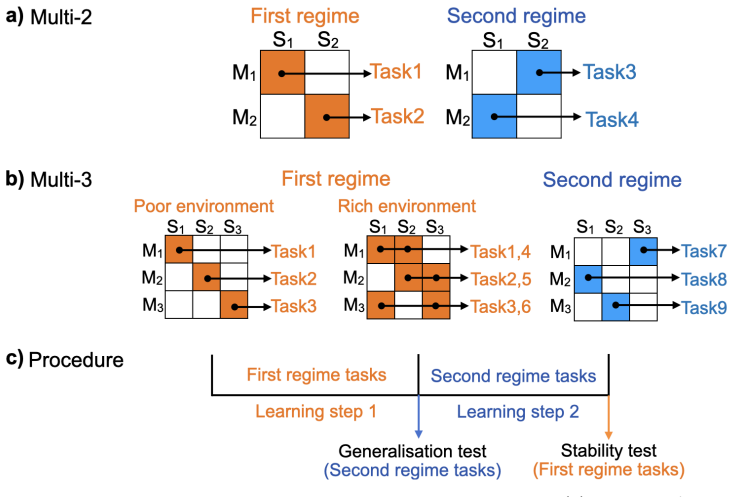
In a multi-task environment defined by combinations of two cue dimensions and characterized by graph-theory connectivity, richer task sets improve both generalization and stability, while higher connectivity between tasks further boosts these measures with especially large gains for gating-based and concatenation-based attention models relative to multilayer perceptrons.
What carries the argument
Graph-theory connectivity between tasks in the cue-dimension environment, which interacts with multiplicative gating and concatenation attention mechanisms to enable task decomposition and transfer.
If this is right
- Richer task environments produce simultaneous gains in retaining prior knowledge and transferring it to novel tasks.
- Higher graph connectivity between tasks improves both stability and generalization measures for all models.
- Attention models that sequentially allocate focus to task components show larger performance lifts from connectivity than multilayer perceptrons.
- Environmental structure and model architecture interact to determine overall cognitive flexibility.
Where Pith is reading between the lines
- Training curricula for artificial agents could be designed by deliberately increasing relevant task connections to improve flexibility without altering the network architecture.
- The same connectivity principle may apply to human skill acquisition, where overlapping task structures could accelerate both retention and transfer.
- Graph analysis of task relations could become a practical tool for predicting which model families will perform best in a given domain.
Load-bearing premise
The artificial environment of cue-dimension combinations and graph connectivity captures the main factors that govern cognitive flexibility in natural settings.
What would settle it
Finding that attention models lose their connectivity advantage, or that connectivity no longer modulates stability and generalization, in a different multi-task environment would falsify the central claim.
Figures


read the original abstract
Humans and artificial agents must often learn and switch between multiple tasks in dynamic environments. Success in such settings requires cognitive flexibility: the ability to retain prior knowledge (cognitive stability) while also transferring it to novel tasks (cognitive generalization). Cognitive flexibility research has largely focused on the role of model architecture to achieve these complementary goals. However, it is less well understood how the structure of the environment itself influences cognitive flexibility, and how it interacts with model architecture. To address this gap, we design a multi-task learning environment in which tasks are defined by a combination of two cue dimensions, allowing us to characterize the environment with graph-theory methods. We also introduce gating-based (multiplicative) and concatenation-based attention models that can decompose tasks into components and can sequentially allocate attention to them. We compare the attention-based models' performance in the multi-task learning environment to multilayer perceptrons. Generalization and stability are systematically evaluated across environments that vary in richness and task connectivity. We observe that richer environments improve both generalization and stability. In addition, a critical novel observation is that (graph theory based) connectivity between the tasks in the environment strongly modulates both stability and generalization, with especially pronounced benefits for attention-based models. These findings underscore the importance of considering not only cognitive architectures but also environmental structure and their interaction in shaping multi-task learning, generalization, and stability.
Editorial analysis
A structured set of objections, weighed in public.
Referee Report
Summary. The paper designs a multi-task learning environment where tasks are defined by combinations of two cue dimensions and characterized using graph-theory methods. It introduces gating-based (multiplicative) and concatenation-based attention models that decompose tasks into components and sequentially allocate attention. These are compared to multilayer perceptrons across environments varying in richness and task connectivity. The central empirical observations are that richer environments improve both generalization and stability, and that graph-theoretic task connectivity strongly modulates both outcomes, with especially pronounced benefits for the attention-based models over MLPs.
Significance. If the simulation results hold, the work makes a useful contribution by shifting focus from architecture alone to the interaction between environmental structure (quantified via graphs) and model type in achieving cognitive flexibility. The graph-based characterization of task connectivity provides a systematic, quantifiable way to vary the environment, and the finding that attention models leverage this structure more effectively than MLPs is a clear empirical observation within the defined setup. This could inform both AI multi-task learning and cognitive modeling.
minor comments (3)
- The abstract and introduction would benefit from an explicit statement of the precise graph metrics (e.g., degree, clustering coefficient, or path length) used to quantify task connectivity and how 'richness' is operationalized in the cue-dimension graphs.
- Ensure that the results section reports the number of independent runs, random seeds, and any statistical tests or confidence intervals supporting the claims about modulation by connectivity; this is needed to assess the reliability of the 'especially pronounced benefits' for attention models.
- Standardize notation for the two attention variants (gating vs. concatenation) across text, equations, and figures to avoid potential reader confusion when comparing their performance.
Simulated Author's Rebuttal
We thank the referee for their positive evaluation of the manuscript, including the recognition that the graph-theoretic characterization of task connectivity and its interaction with attention models represents a useful contribution. We appreciate the recommendation for minor revision and will address any specific editorial or presentational points in the revised version.
Circularity Check
No circularity: purely empirical simulation study
full rationale
The paper describes the design of an artificial multi-task environment using cue dimensions and graph connectivity, introduces gating- and concatenation-based attention models, compares them to MLPs via simulations, and reports observed effects of environment richness and task connectivity on stability and generalization. No equations, derivations, parameter fits, or predictions are presented that reduce to the inputs by construction. No self-citations are invoked as load-bearing for any uniqueness theorem or ansatz. The central claims are direct empirical observations within the constructed setup, which are self-contained and externally falsifiable through replication of the simulations.
Axiom & Free-Parameter Ledger
Reference graph
Works this paper leans on
-
[1]
Continual evaluation for lifelong learning: Identifying the stability gap
De Lange M, van de Ven GM, Tuytelaars T. Continual evaluation for lifelong learning: Identifying the stability gap. In: ICLR; 2023. p. 1-21
2023
-
[2]
Catastrophic forgetting in connectionists networks
French RM. Catastrophic forgetting in connectionists networks. Trends in Cognitive Sciences. 1999;3(4):128-35
1999
-
[3]
How does a brain build a cognitive code? Psychological review
Grossberg S. How does a brain build a cognitive code? Psychological review. 1980 Jan;87(1):1-51
1980
-
[4]
De Lange M, Aljundi R, Masana M, Parisot S, Jia X, Leonardis A, et al. A Continual Learning Survey: Defying Forgetting in Classification Tasks. IEEE Transactions on Pattern Analysis and Machine Intelligence. 2022;44(7):3366-85. doi:10.1109/TPAMI.2021.3057446
-
[5]
URLhttps: //www.sciencedirect.com/science/article/pii/S0079742108605368
McCloskey M, Cohen NJ. Catastrophic Interference in Connectionist Networks: The Sequential Learning Problem. vol. 24 of Psychology of Learning and Motivation. Academic Press; 1989. p. 109-65. doi:https://doi.org/10.1016/S0079-7421(08)60536-8
-
[6]
On the Stability-Plasticity Dilemma of Class-Incremental Learning; 2023
Kim D, Han B. On the Stability-Plasticity Dilemma of Class-Incremental Learning; 2023. arXiv:2304.01663
-
[7]
Why there are complementary learning systems in the hippocampus and neocortex: insights from the successes and failures of connectionist models of learning and memory
McClelland JL, McNaughton BL, O’Reilly RC. Why there are complementary learning systems in the hippocampus and neocortex: insights from the successes and failures of connectionist models of learning and memory. Psychological review. 1995;102(3):419
1995
-
[8]
When does compositional structure yield compositional generalization? A kernel theory
Lippl S, Stachenfeld K. When does compositional structure yield compositional generalization? A kernel theory. In: The Thirteenth International Conference on Learning Representations; 2025. Available from: https://openreview.net/forum?id=FPBce2P1er. April 16, 2026 24/28
2025
-
[9]
Rationalizing constraints on the capacity for cognitive control
Musslick S, Cohen JD. Rationalizing constraints on the capacity for cognitive control. Trends in cognitive sciences. 2021;25(9):757-75
2021
-
[10]
Humans decompose tasks by trading off utility and computational cost
Correa CG, Ho MK, Callaway F, Daw ND, Griffiths TL. Humans decompose tasks by trading off utility and computational cost. PLOS Computational Biology. 2023 Jun;19(6):e1011087
2023
-
[11]
Overcoming catastrophic forgetting in neural networks
Kirkpatrick J, Pascanu R, Rabinowitz N, Veness J, Desjardins G, Rusu AA, et al. Overcoming catastrophic forgetting in neural networks. Proceedings of the national academy of sciences. 2017;114(13):3521-6
2017
-
[12]
Continual Learning with Deep Generative Replay
Shin H, Lee JK, Kim J, Kim J. Continual Learning with Deep Generative Replay. CoRR. 2017;abs/1705.08690. Available from: http://arxiv.org/abs/1705.08690. arXiv:1705.08690
-
[13]
Learning to synchronize: How biological agents can couple neural task modules for dealing with the stability-plasticity dilemma
Verbeke P, Verguts T. Learning to synchronize: How biological agents can couple neural task modules for dealing with the stability-plasticity dilemma. PLoS computational biology. 2019
2019
-
[14]
Thalamus: a brain-inspired algorithm for biologically-plausible continual learning and disentangled representations
Hummos A. Thalamus: a brain-inspired algorithm for biologically-plausible continual learning and disentangled representations. In: The Eleventh International Conference on Learning Representations; 2023
2023
-
[15]
Sparks of cognitive flexibility: self-guided context inference for flexible stimulus-response mapping by attentional routing
Sommers RP, Thorat S, Anthes D, Kietzmann TC. Sparks of cognitive flexibility: self-guided context inference for flexible stimulus-response mapping by attentional routing. arXiv preprint arXiv:250215634. 2025
2025
-
[16]
Using top-down modulation to optimally balance shared versus separated task representations
Verbeke P, Verguts T. Using top-down modulation to optimally balance shared versus separated task representations. Neural Networks. 2022;146:256-71. doi:https://doi.org/10.1016/j.neunet.2021.11.030
-
[17]
Range, not Independence, Drives Modularity in Biologically Inspired Representations; 2025
Dorrell W, Hsu K, Hollingsworth L, Lee JH, Wu J, Finn C, et al.. Range, not Independence, Drives Modularity in Biologically Inspired Representations; 2025. arXiv:2410.06232
-
[18]
Abstract representations emerge naturally in neural networks trained to perform multiple tasks
Johnston WJ, Fusi S. Abstract representations emerge naturally in neural networks trained to perform multiple tasks. Nature Communications. 2023;14(1):1040
2023
-
[19]
Curriculum learning for human compositional generalization
Dekker RB, Otto F, Summerfield C. Curriculum learning for human compositional generalization. Proceeding of the national academy of science. 2022;119:1-12
2022
-
[20]
Humans and neural networks show similar patterns of transfer and interference during continual learning
Holton E, Braun L, Thompson JA, Grohn J, Summerfield C. Humans and neural networks show similar patterns of transfer and interference during continual learning. Nature Human Behaviour. 2026;10(1):111-25
2026
-
[21]
A mathematical theory of semantic development in deep neural networks
Saxe AM, McClelland JL, Ganguli S. A mathematical theory of semantic development in deep neural networks. Proceedings of the National Academy of Sciences. 2019;116(23):11537-46. arXiv:https://www.pnas.org/doi/pdf/10.1073/pnas.1820226116
-
[22]
Maslow’s Hammer in Catastrophic Forgetting: Node Re-Use vs
Lee S, Mannelli SS, Clopath C, Goldt S, Saxe A. Maslow’s Hammer in Catastrophic Forgetting: Node Re-Use vs. Node Activation. In: International Conference on Machine Learning. PMLR; 2022. p. 12455-77
2022
-
[23]
Collective dynamics of ‘small-world’networks
Watts DJ, Strogatz SH. Collective dynamics of ‘small-world’networks. nature. 1998;393(6684):440-2. April 16, 2026 25/28
1998
-
[24]
Task representations in neural networks trained to perform many cognitive tasks
Yang GR, Joglekar MR, Song HF, Newsome WT, Wang Xj. Task representations in neural networks trained to perform many cognitive tasks. Nature Neuroscience. 2019;22(February)
2019
-
[25]
No free lunch theorems for optimization
Wolpert DH, Macready WG. No free lunch theorems for optimization. IEEE transactions on evolutionary computation. 2002;1(1):67-82
2002
-
[26]
On the control of automatic processes: a parallel distributed processing account of the Stroop effect
Cohen JD, Dunbar K, McClelland JL. On the control of automatic processes: a parallel distributed processing account of the Stroop effect. Psychological review. 1990;97(3):332
1990
-
[27]
Attention is all you need
Vaswani A, Shazeer N, Parmar N, Uszkoreit J, Jones L, Gomez AN, et al. Attention is all you need. Advances in Neural Information Processing Systems. 2017;2017-Decem(Nips):5999-6009
2017
-
[28]
A mathematical framework for transformer circuits
Elhage N, Nanda N, Olsson C, Henighan T, Joseph N, Mann B, et al. A mathematical framework for transformer circuits. Transformer Circuits Thread. 2021;1(1):12
2021
-
[29]
The role of Disentanglement in Generalisation
Montero ML, Ludwig CJ, Costa RP, Malhotra G, Bowers J. The role of Disentanglement in Generalisation. In: International Conference on Learning Representations; 2021. Available from: https://openreview.net/forum?id=qbH974jKUVy
2021
-
[30]
Curriculum learning
Bengio Y, Louradour J, Collobert R, Weston J. Curriculum learning. In: Proceedings of the 26th Annual International Conference on Machine Learning. ICML ’09. New York, NY, USA: Association for Computing Machinery; 2009. p. 41–48
2009
-
[31]
When Do Curricula Work? In: International Conference on Learning Representations; 2021
Wu X, Dyer E, Neyshabur B. When Do Curricula Work? In: International Conference on Learning Representations; 2021
2021
-
[32]
Teacher-Student Curriculum Learning
Matiisen T, Oliver A, Cohen T, Schulman J. Teacher-Student Curriculum Learning. IEEE Transactions on Neural Networks and Learning Systems. 2017 07;PP
2017
-
[33]
Compositional clustering in task structure learning
Franklin NT, Frank MJ. Compositional clustering in task structure learning. PLoS Computational Biology. 2018:1-25
2018
-
[34]
Multi-task reinforcement learning in humans
Tomov MS, Schulz E, Gershman SJ. Multi-task reinforcement learning in humans. Nature Human Behaviour. 2021 Jan;5(6):764-73
2021
-
[35]
Skill characterization based on betweenness
S ¸im¸ sek¨O, Barto A. Skill characterization based on betweenness. Advances in neural information processing systems. 2008;21
2008
-
[36]
The hippocampus as a predictive map
Stachenfeld KL, Botvinick MM, Gershman SJ. The hippocampus as a predictive map. Nature neuroscience. 2017;20(11):1643-53
2017
-
[37]
Frontal cortex and the discovery of abstract action rules
Badre D, Kayser AS, D’Esposito M. Frontal cortex and the discovery of abstract action rules. Neuron. 2010;66(2):315-26
2010
-
[38]
Constructive enumeration of combinatorial objects
Faradˇ zev I. Constructive enumeration of combinatorial objects. In: Probl` emes combinatoires et th´ eorie des graphes; 1978. p. 131-5
1978
-
[39]
TensorFlow: A system for large-scale machine learning
Abadi M, Barham P, Chen J, Chen Z, Davis A, Dean J, et al. TensorFlow: A system for large-scale machine learning. In: 12th USENIX Symposium on Operating Systems Design and Implementation; 2016. p. 265-83. April 16, 2026 26/28 Supporting information In this appendix, we provide the full figures for all six models, including the models MLP 1, Gate 1 and Con...
2016
discussion (0)
Sign in with ORCID, Apple, or X to comment. Anyone can read and Pith papers without signing in.