Simulating frequency splittings and loss in Fabry-P\'erot cavities
Pith reviewed 2026-05-10 13:02 UTC · model grok-4.3
The pith
Finite-element simulations show that frequency splittings in Fabry-Perot cavity spectra arise from mirror-shape deviations and nonparaxial effects including spin-orbit coupling, while also yielding model-independent modal loss predictions.
A machine-rendered reading of the paper's core claim, the machinery that carries it, and where it could break.
Core claim
Finite-element simulations of optical cavities reveal frequency splittings in the resonance spectrum. The simulated fine structure is characterized by mirror-shape effects together with nonparaxial contributions that include spin-orbit coupling. The same calculations supply model-independent predictions of the modal losses for the cavity.
What carries the argument
Finite-element discretization of the electromagnetic fields inside the cavity geometry that incorporates realistic mirror surface deviations and nonparaxial wave propagation including spin-orbit coupling.
If this is right
- Frequency splittings can be calculated numerically for arbitrary mirror shapes without perturbative analytical approximations.
- Modal loss rates become available for any cavity mode directly from the simulation output.
- The contribution of spin-orbit coupling to the observed spectral fine structure can be isolated and quantified.
- Design iterations of cavity mirrors can be evaluated for their effect on both splitting and loss before fabrication.
Where Pith is reading between the lines
- The simulation approach could be applied to predict how temperature-induced mirror deformations would shift cavity spectra in real time.
- Similar finite-element models might be used to study analogous splitting phenomena in non-planar or whispering-gallery cavities.
- If the loss predictions hold, they could inform the choice of cavity parameters to reduce unwanted mode competition in lasers.
Load-bearing premise
The chosen finite-element mesh resolution and boundary conditions reproduce the physical behavior of the cavity without introducing numerical artifacts that could be mistaken for the reported frequency splittings or losses.
What would settle it
A side-by-side comparison of the simulated frequency values and loss rates against measured spectra and decay times from a real Fabry-Perot cavity with known mirror shapes would directly test whether the numerical splittings and losses match experiment.
Figures

read the original abstract
Finite-element simulations of optical cavities are presented, showing frequency splittings in the resonance spectrum. These results support the theoretical framework and experimental observations presented in van Exter et al. (2022, Phys. Rev. A 106, 013501), Koks et al. (2022, Phys. Rev. A 105, 063502) and Post et al. (2025, Phys. Rev. A 112, 033537). The simulated (fine) structure in the spectrum can be characterized by mirror-shape and nonparaxial effects including spin-orbit coupling. These simulations also provide model-independent predictions of modal losses for optical cavities.
Editorial analysis
A structured set of objections, weighed in public.
Referee Report
Summary. The manuscript presents finite-element simulations of Fabry-Pérot cavities demonstrating frequency splittings in the resonance spectrum. These splittings are characterized as arising from mirror-shape and nonparaxial effects including spin-orbit coupling. The results are stated to support the theoretical framework and experimental observations in the authors' prior works (van Exter et al. 2022, Koks et al. 2022, Post et al. 2025) while also supplying model-independent predictions of modal losses.
Significance. If the numerical fidelity is established, the simulations would supply independent confirmation of the physical mechanisms proposed in the cited prior papers and yield practical, model-independent loss predictions useful for cavity design and optimization.
major comments (2)
- [Numerical methods / simulation setup] The manuscript provides no mesh-convergence tests, residual-error bounds, or comparisons to analytic limits such as paraxial Gaussian modes. This is load-bearing for the central claim because, without such checks, the reported frequency splittings and modal losses cannot be reliably distinguished from possible FEM artifacts due to insufficient resolution near curved mirrors or inadequate PML absorption (see skeptic note on discretization fidelity).
- [Results] Quantitative agreement between the simulated splittings/losses and the specific predictions of the cited prior works (van Exter 2022, Koks 2022, Post 2025) is not shown with error metrics or direct overlays; only qualitative support is asserted, weakening the claim that the simulations independently validate those results.
minor comments (2)
- [Abstract] The abstract would be clearer if it stated the specific cavity parameters (mirror radius of curvature, separation, wavelength range) over which the simulations were performed.
- [Figures] Figure captions should explicitly list the simulation parameters and mode indices shown to allow readers to reproduce the plotted spectra.
Simulated Author's Rebuttal
We thank the referee for the careful reading of our manuscript and the constructive comments. We address each major point below and indicate the changes that will be incorporated in the revised version.
read point-by-point responses
-
Referee: The manuscript provides no mesh-convergence tests, residual-error bounds, or comparisons to analytic limits such as paraxial Gaussian modes. This is load-bearing for the central claim because, without such checks, the reported frequency splittings and modal losses cannot be reliably distinguished from possible FEM artifacts due to insufficient resolution near curved mirrors or inadequate PML absorption (see skeptic note on discretization fidelity).
Authors: We agree that explicit verification of numerical accuracy is necessary to support the central claims. In the revised manuscript we will add a new subsection on numerical validation that reports mesh-convergence results for both resonance frequencies and quality factors, together with residual-error estimates obtained by successive refinement. We will also include direct comparisons of the simulated fundamental-mode frequencies and transverse profiles against the analytic paraxial Gaussian-beam solutions to confirm that the FEM implementation reproduces the expected behavior in the appropriate limit. Additional tests confirming that PML absorption is sufficient (residual reflection below the precision of the reported splittings) will be documented. revision: yes
-
Referee: Quantitative agreement between the simulated splittings/losses and the specific predictions of the cited prior works (van Exter 2022, Koks 2022, Post 2025) is not shown with error metrics or direct overlays; only qualitative support is asserted, weakening the claim that the simulations independently validate those results.
Authors: The manuscript’s primary contribution is the provision of model-independent loss predictions, which do not rely on the analytic approximations of the cited works. We nevertheless accept that a quantitative comparison would strengthen the validation statement. The revised results section will therefore contain overlaid plots of simulated frequency splittings versus the predictions of van Exter et al. (2022) and Koks et al. (2022), together with tabulated relative differences for each mode. These additions will make the degree of agreement explicit while preserving the emphasis on the independent, FEM-derived loss values. revision: yes
Circularity Check
Finite-element simulations provide independent numerical predictions of splittings and losses
full rationale
The paper presents finite-element simulations of Fabry-Pérot cavities that exhibit frequency splittings characterized by mirror shape and nonparaxial effects. The abstract explicitly positions the computed modal losses as model-independent predictions and states that the results support prior theoretical frameworks. No derivation chain, equations, or fitted parameters are shown to reduce by construction to self-citations or prior inputs; the central outputs arise directly from the numerical solution of the vector wave equation rather than being renamed or forced equivalents of the cited works. Self-citations appear but are not load-bearing for the simulation results themselves, which remain falsifiable against mesh convergence and analytic limits outside the present manuscript.
Axiom & Free-Parameter Ledger
Reference graph
Works this paper leans on
-
[1]
Huygens-Kamerlingh Onnes Laboratory, Leiden University, P.O. Box 9504, 2300 RA Leiden, The Netherlands and * post@physics.leidenuniv.nl Finite-element simulations of optical cavities are presented, showing frequency splittings in the resonance spectrum. These results support the theoretical framework and experimental observations presented in [1–3]. The s...
-
[2]
Simulating frequency splittings and loss in Fabry-P\'erot cavities
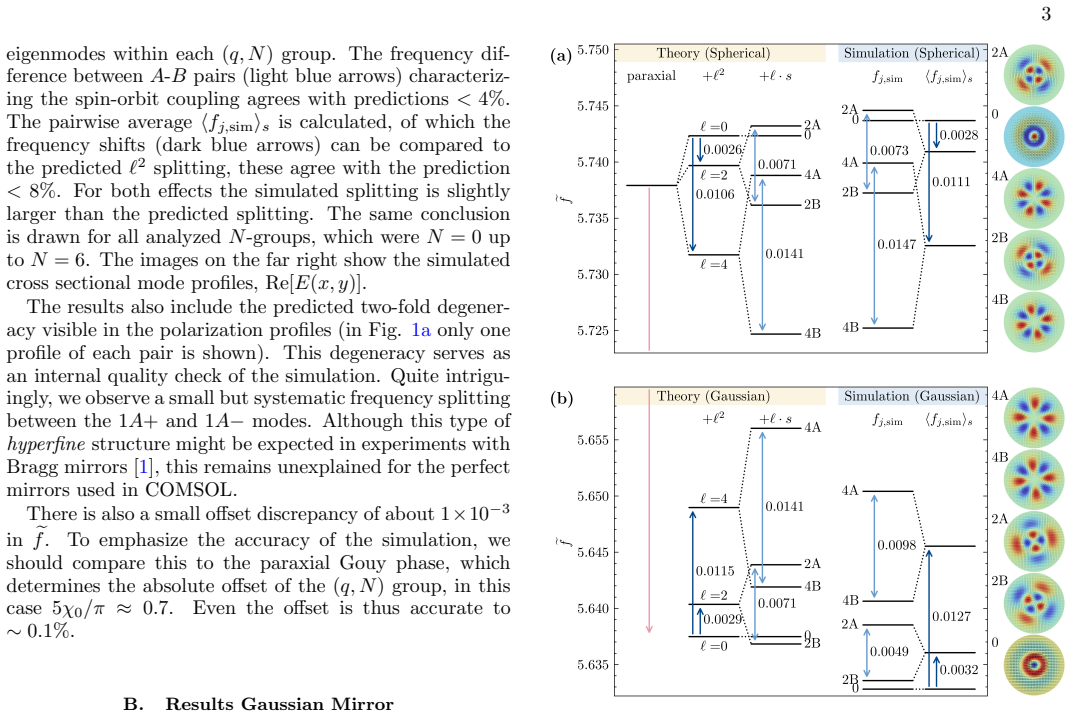
in a millimeter-wave cavity, who exploited the under- standing of their fine structure to avoid mode-mixing and improve finesse by two orders of magnitude. An additional correction for an aspheric Gaussian shaped height profile of the mirror was introduced and observed by Postet al. [3], whose cavity had close-to-Gaussian mirrors and oper- ated in an inte...
work page internal anchor Pith review Pith/arXiv arXiv 2026
-
[3]
and [2, 3] G= L 3h Rm Rm −L .(6) The cavity is thus characterized by 3-4 length scales: (i) optical wavelengthλ, (ii) cavity lengthL, (iii) mirror radius of curvatureR m, and in the case of Gaussian ge- ometry (iv) mirror depthh. Because Maxwell’s equations are scale invariant, the absolute lengths do not matter, only their ratios. All results will theref...
-
[4]
as a function of cavity length for a Gaussian mir- ror. The dashed curves present the theoretical predic- tions forkR m ≈2πR m/λpar withR m/λpar = 13.6 and 2h/λpar = 1.09, both set by the simulation geometry, with- out any fitting parameter. the splitting of eachA-Bpair visualized by the light blue arrow. The simulated pairwise splittings are smaller than...
-
[5]
Optical mi- crocavities and 2D quantum emitters
respectively. more lossy than 2A modes, which we cannot yet explain. Both the deflection loss and scattering loss models pro- posed in [3] have been fit on a logarithmic scale to the L/Rm >0.2 data, withhkas fit parameter. The deflection loss seems to fit the loss forN= 0 well, but is inaccurate for theN= 2 modes. The scattering loss does not model the da...
work page 2023
-
[6]
M. P. Van Exter, M. Wubs, E. Hissink, and C. Koks, Fine structure in Fabry-Perot microcavity spectra, Physical Re- view A106, 013501 (2022)
work page 2022
-
[7]
C. Koks, F. B. Baalbergen, and M. P. Van Exter, Observa- tion of microcavity fine structure, Physical Review A105, 063502 (2022)
work page 2022
-
[8]
J. Post, C. He, C. Koks, R. v. Velzen, A. Corazza, Y. L. Fontana, M. Erbe, R. J. Warburton, and M. P. v. Exter, Optical microcavity characterization via resonance spectra and modes, Physical Review A112, 033537 (2025)
work page 2025
-
[9]
S. H¨ außler, G. Bayer, R. Waltrich, N. Mendelson, C. Li, D. Hunger, I. Aharonovich, and A. Kubanek, Tunable Fiber-Cavity Enhanced Photon Emission from Defect Cen- ters in hBN, Advanced Optical Materials9, 2002218 (2021)
work page 2021
-
[10]
Y. Herrmann, J. Fischer, J. M. Brevoord, C. Sauerzapf, L. G. Wienhoven, L. J. Feije, M. Pasini, M. Eschen, M. Ruf, M. J. Weaver, and R. Hanson, Coherent Coupling of a Dia- mond Tin-Vacancy Center to a Tunable Open Microcavity, Physical Review X14, 041013 (2024)
work page 2024
-
[11]
G. Bayer, R. Berghaus, S. Sachero, A. B. Filipovski, L. An- toniuk, N. Lettner, R. Waltrich, M. Klotz, P. Maier, V. Agafonov, and A. Kubanek, Optical driving, spin initial- ization and readout of single SiV− centers in a Fabry-Perot resonator, Communications Physics6, 300 (2023)
work page 2023
-
[12]
E. M. Purcell, Spontaneous Emission Probabilities at Ra- dio Frequencies, Physical Review69, 681 (1946)
work page 1946
- [13]
- [14]
-
[15]
T. Zhang, M. Wu, S. R. Cohen, L. Xin, D. Das, K. K. Mul- tani, N. Peard, A.-M. Valente-Feliciano, P. B. Welander, A. H. Safavi-Naeini, E. A. Nanni, and M. Schleier-Smith, Optically accessible high-finesse millimeter-wave resonator for cavity quantum electrodynamics with atom arrays, Phys. Rev. Appl.24, L041001 (2025)
work page 2025
-
[16]
J. Post, J. van der Brink, and M. P. van Exter, Fabry-P´ erot Cavity Simulation Setup to Compute Eigenfrequencies and Mode Profiles (2026)
work page 2026
-
[17]
P. K. Yu and K. M. Luk, High-order azimuthal modes in the open resonator, Electronics Letters19, 539 (1983)
work page 1983
-
[18]
P. K. Yu and K. M. Luk, Field Patterns and Resonant Frequencies of High-Order Modes in an Open Resonator, IEEE Transactions on Microwave Theory and Techniques 32, 641 (1984)
work page 1984
- [19]
-
[20]
COMSOL Multiphysics®, COMSOLMultiphysics (2018)
work page 2018
-
[21]
COMSOL Multiphysics®, COMSOL wave optics module
-
[22]
D. Kleckner, W. T. Irvine, S. S. Oemrawsingh, and D. Bouwmeester, Diffraction-limited high-finesse optical cavities, Physical Review A81, 043814 (2010)
work page 2010
-
[23]
J. Benedikter, T. H¨ ummer, M. Mader, B. Schlederer, J. Re- ichel, T. W. Hansch, and D. Hunger, Transverse-mode cou- pling and diffraction loss in tunable Fabry–P´ erot microcav- ities, New Journal of Physics17, 053051 (2015)
work page 2015
-
[24]
J. Benedikter, T. Moosmayer, M. Mader, T. H¨ ummer, and D. Hunger, Transverse-mode coupling effects in scan- ning cavity microscopy, New Journal of Physics21, 103029 (2019)
work page 2019
discussion (0)
Sign in with ORCID, Apple, or X to comment. Anyone can read and Pith papers without signing in.