Data-Driven Probabilistic Finite mathcal{L}₂-Gain Stabilization of Stochastic Linear Systems
Pith reviewed 2026-05-10 13:02 UTC · model grok-4.3
The pith
Stochastic linear systems can be given probabilistic finite L2-gain stabilization from noisy trajectory data and imperfect disturbance forecasts.
A machine-rendered reading of the paper's core claim, the machinery that carries it, and where it could break.
Core claim
This article develops a novel concept that characterizes the L2 gain of stochastic systems in a probabilistic way. Combined with a large data set, it formulates a data-driven probabilistic finite L2-gain stabilization design using noisy trajectory measurements and the disturbance forecast that does not necessarily agree with the actual future disturbance. The design approach consists of a data-driven trajectory estimation algorithm, whose resulting estimation error covariance is integrated into the feasibility conditions for controller synthesis, leading to a convex offline design in the form of linear matrix inequalities.
What carries the argument
The integration of the estimation error covariance produced by the data-driven trajectory estimation algorithm into the LMI feasibility conditions for controller synthesis.
Load-bearing premise
The estimation error covariance from the data-driven trajectory estimation can be directly and conservatively plugged into the LMI conditions while keeping the problem convex and preserving the probabilistic guarantee, regardless of how much the disturbance forecast differs from reality.
What would settle it
Monte Carlo simulation of the closed-loop stochastic system using the designed controller, with disturbances different from the forecast, to verify if the fraction of realizations where the L2-gain exceeds the bound matches or stays below the design probability.
Figures
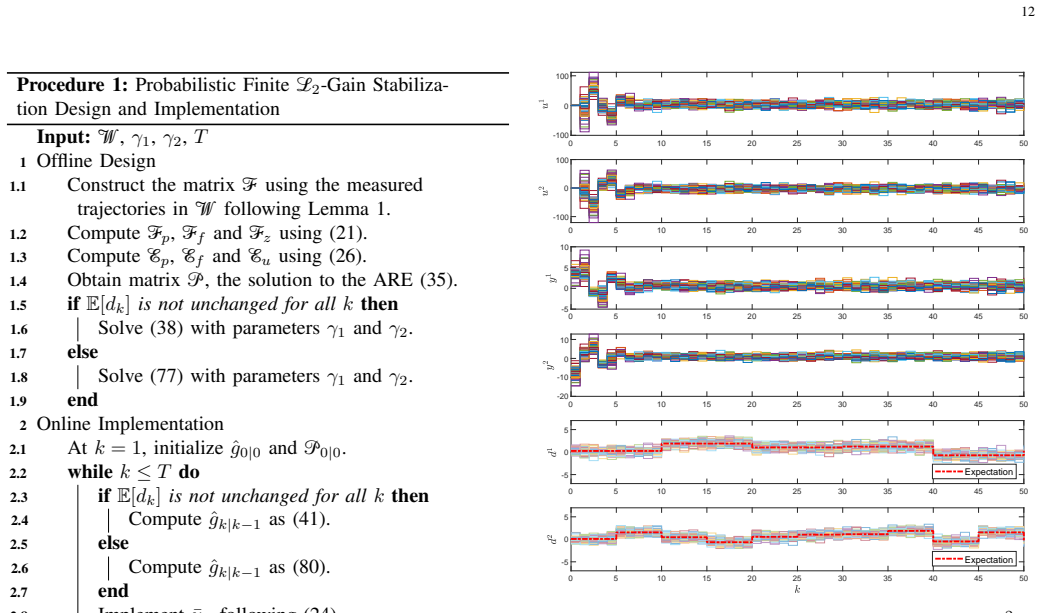


read the original abstract
In process operations, it is desirable to manage the sensitivity of the system output against external disturbance in the form of finite $\mathcal{L}_2$-gain stabilization. This matter is, however, nonsensical for stochastic systems because the stochastic uncertainties in the control input almost always lead to an unbounded $\mathcal{L}_2$ gain from the disturbance to the output. To address this issue, this article develops a novel concept that characterizes the $\mathcal{L}_2$ gain of stochastic systems in a probabilistic way. Combined with a large data set, we formulate a data-driven probabilistic finite $\mathcal{L}_2$-gain stabilization design using noisy trajectory measurements and the disturbance forecast that does not necessarily agree with the actual future disturbance. The design approach consists of a data-driven trajectory estimation algorithm, whose resulting estimation error covariance is nicely integrated into the feasibility conditions for controller synthesis, leading to a convex offline design in the form of linear matrix inequalities. The effectiveness of the proposed design, along with the additional insights provided by the approach, is illustrated via a numerical example.
Editorial analysis
A structured set of objections, weighed in public.
Referee Report
Summary. The paper introduces a probabilistic finite L2-gain concept for stochastic linear systems, where standard L2-gain is unbounded due to stochastic uncertainties. It proposes a data-driven stabilization design that uses noisy trajectory measurements and a disturbance forecast (which may differ from the true future disturbance). A trajectory estimation algorithm produces an error covariance that is integrated into LMI feasibility conditions for controller synthesis, yielding a convex offline design with probabilistic performance guarantees. Effectiveness is shown via a numerical example.
Significance. If the covariance integration rigorously preserves the probabilistic L2-gain bound despite forecast mismatch, the work would offer a practical convex LMI framework for data-driven control of stochastic systems in process operations, explicitly handling estimation errors from finite noisy data. The approach credits data-driven methods and provides additional insights in the example. However, the central integration step remains unverified in the provided description, limiting immediate impact.
major comments (2)
- Abstract and §4 (controller synthesis): The assertion that the estimation error covariance from the data-driven trajectory estimation algorithm is 'nicely integrated' into the LMI feasibility conditions to yield probabilistic finite L2-gain guarantees must be supported by an explicit derivation. It is unclear how the integration accounts for the disturbance forecast differing from the actual (unknown) future disturbance without introducing probability leakage or excessive conservatism; a concrete bound or worst-case analysis inside the LMIs is needed to confirm the guarantee transfers to the true disturbance distribution.
- §3 (trajectory estimation): The paper must demonstrate that the covariance matrix produced by the estimation algorithm remains a valid, conservative upper bound when inserted into the LMIs, even under mismatched forecasts. Without this, the convexity of the offline design does not automatically imply the claimed probabilistic performance; a counter-example or sensitivity analysis under distribution shift would strengthen the claim.
minor comments (2)
- Notation: Define 'probabilistic finite L2-gain' more formally early in the introduction, including the precise probability level and finite horizon, to avoid ambiguity with standard stochastic L2-gain concepts.
- Numerical example: Clarify the data set size, noise levels, and forecast mismatch magnitude used, and report quantitative metrics (e.g., empirical violation probability) alongside the LMI feasibility to illustrate the probabilistic guarantee.
Simulated Author's Rebuttal
We thank the referee for the thorough review and constructive feedback on our manuscript. The comments highlight important aspects of the probabilistic guarantees and the handling of forecast mismatch, which we address point by point below. We agree that additional explicit derivations and analyses will strengthen the presentation and will revise the manuscript accordingly.
read point-by-point responses
-
Referee: Abstract and §4 (controller synthesis): The assertion that the estimation error covariance from the data-driven trajectory estimation algorithm is 'nicely integrated' into the LMI feasibility conditions to yield probabilistic finite L2-gain guarantees must be supported by an explicit derivation. It is unclear how the integration accounts for the disturbance forecast differing from the actual (unknown) future disturbance without introducing probability leakage or excessive conservatism; a concrete bound or worst-case analysis inside the LMIs is needed to confirm the guarantee transfers to the true disturbance distribution.
Authors: We appreciate the referee pointing out the need for greater transparency in this central step. The manuscript derives the LMIs in Section 4 by substituting the estimation error covariance Σ (obtained from the trajectory estimation in Section 3) into the matrix inequality that bounds the probabilistic L2-gain; specifically, the term involving the forecast mismatch is over-approximated using the trace of Σ scaled by a probability factor, which is then converted to an LMI via the Schur complement. This construction ensures the probability bound holds for the true disturbance by treating the mismatch as an additive perturbation bounded in probability by the covariance. However, we acknowledge that the current presentation compresses this derivation and does not explicitly label the worst-case bound on the mismatch. In the revised version we will expand Section 4 with a step-by-step derivation (including the intermediate inequality before the LMI) and add a remark clarifying how the probability is preserved without leakage. revision: yes
-
Referee: §3 (trajectory estimation): The paper must demonstrate that the covariance matrix produced by the estimation algorithm remains a valid, conservative upper bound when inserted into the LMIs, even under mismatched forecasts. Without this, the convexity of the offline design does not automatically imply the claimed probabilistic performance; a counter-example or sensitivity analysis under distribution shift would strengthen the claim.
Authors: We agree that an explicit demonstration of conservativeness under forecast mismatch is valuable. The trajectory estimation algorithm in Section 3 computes the covariance from the available (possibly mismatched) forecast and the noisy data; by construction the resulting Σ is an upper bound on the true error covariance because any forecast error increases the residual, which is absorbed into the computed covariance. When this Σ is inserted into the LMIs of Section 4 the resulting controller therefore satisfies the probabilistic guarantee for the actual (unknown) disturbance distribution. To make this rigorous we will add a short lemma in Section 3 proving that Σ remains a valid upper bound under distribution shift, together with a sensitivity plot in the numerical example that varies the forecast mismatch level and reports the empirical probability of satisfying the L2-gain bound. revision: yes
Circularity Check
No significant circularity; derivation uses external data and LMI synthesis without self-referential reduction
full rationale
The paper develops a data-driven probabilistic finite L2-gain stabilization method by estimating trajectories from noisy measurements, incorporating the resulting estimation error covariance into LMI feasibility conditions for convex controller synthesis, and treating the disturbance forecast as an input that may differ from reality. No equations or steps reduce the claimed probabilistic performance bound to a fitted parameter, self-defined quantity, or self-citation chain by construction. The central claim depends on the validity of the covariance integration preserving convexity and the guarantee, which is an independent mathematical assertion rather than a tautology equivalent to the inputs. The approach is self-contained against the provided data and forecast without renaming known results or smuggling ansatzes via self-citation.
Axiom & Free-Parameter Ledger
axioms (2)
- domain assumption A probabilistic finite L2-gain can be defined and bounded for stochastic linear systems in a way that remains useful for stabilization.
- domain assumption The data-driven trajectory estimator produces a covariance that can be conservatively used in controller LMI conditions.
invented entities (1)
-
probabilistic finite L2-gain
no independent evidence
Reference graph
Works this paper leans on
-
[1]
A note on persistency of excitation,
J. C. Willems, P. Rapisarda, I. Markovsky, and B. L. M. De Moor, “A note on persistency of excitation,”Syst. Control Lett., vol. 54, no. 4, pp. 325–329, 2005
work page 2005
-
[2]
Behavioral systems theory in data-driven analysis, signal processing, and control,
I. Markovsky and F. D ¨orfler, “Behavioral systems theory in data-driven analysis, signal processing, and control,”Annu. Rev. Control, vol. 52, pp. 42–64, 2021
work page 2021
-
[3]
Identifiability in the behavioral setting,
——, “Identifiability in the behavioral setting,”IEEE Trans. Autom. Control, vol. 68, no. 3, pp. 1667–1677, 2023
work page 2023
-
[4]
Willems’ fundamental lemma for state-space systems and its extension to multiple datasets,
H. J. van Waarde, C. De Persis, M. K. Camlibel, and P. Tesi, “Willems’ fundamental lemma for state-space systems and its extension to multiple datasets,”IEEE Control Syst. Lett., vol. 4, no. 3, pp. 602–607, 2020
work page 2020
-
[5]
Data informativity: A new perspective on data-driven analysis and control,
H. J. van Waarde, J. Eising, H. L. Trentelman, and M. K. Camlibel, “Data informativity: A new perspective on data-driven analysis and control,” IEEE Trans. Autom. Control, vol. 65, no. 11, pp. 4753–4768, 2020
work page 2020
-
[6]
An extended Kalman filter for data-enabled predictive control,
D. Alpago, F. D ¨orfler, and J. Lygeros, “An extended Kalman filter for data-enabled predictive control,”IEEE Control Syst. Lett., vol. 4, no. 4, pp. 994–999, 2020
work page 2020
-
[7]
Y . Yan, J. Bao, and B. Huang, “On approximation of system behavior from large noisy data using statistical properties of measurement noise,” IEEE Trans. Autom. Control, vol. 69, no. 4, pp. 2414–2421, 2024
work page 2024
-
[8]
On a stochastic fundamental lemma and its use for data-driven optimal control,
G. Pan, R. Ou, and T. Faulwasser, “On a stochastic fundamental lemma and its use for data-driven optimal control,”IEEE Trans. Autom. Control, 2022
work page 2022
-
[9]
T. Faulwasser, R. Ou, G. Pan, P. Schmitz, and K. Worthmann, “Behav- ioral theory for stochastic systems? A data-driven journey from Willems to Wiener and back again,”Annu. Rev. Control, vol. 55, pp. 92–117, 2023
work page 2023
-
[10]
Data-driven simulation and control,
I. Markovsky and P. Rapisarda, “Data-driven simulation and control,” Int. J. Control, vol. 81, no. 12, pp. 1946–1959, 2008
work page 1946
-
[11]
Data-driven LQR control design,
G. R. G. da Silva, A. S. Bazanella, C. Lorenzini, and L. Campestrini, “Data-driven LQR control design,”IEEE Control Syst. Lett., vol. 3, no. 1, pp. 180–185, 2018
work page 2018
-
[12]
An approach to data-based linear quadratic optimal control,
Y . Yan, J. Bao, and B. Huang, “An approach to data-based linear quadratic optimal control,”IEEE Control Syst. Lett., vol. 8, pp. 1120– 1125, 2024
work page 2024
-
[13]
Learning robust data- based LQG controllers from noisy data,
W. Liu, G. Wang, J. Sun, F. Bullo, and J. Chen, “Learning robust data- based LQG controllers from noisy data,”IEEE Trans. Autom. Control, vol. 69, no. 12, pp. 8526–8538, 2024. 15
work page 2024
-
[14]
Formulas for data-driven control: Stabilization, optimality, and robustness,
C. De Persis and P. Tesi, “Formulas for data-driven control: Stabilization, optimality, and robustness,”IEEE Trans. Autom. Control, vol. 65, no. 3, pp. 909–924, 2019
work page 2019
-
[15]
Y . Yan, J. Bao, and B. Huang, “The intrinsic state variable in fundamen- tal lemma and its use in stability design for data-based control,”arXiv preprint arXiv:2501.12626, 2025
-
[16]
Data-enabled predictive control: In the shallows of the DeePC,
J. Coulson, J. Lygeros, and F. D ¨orfler, “Data-enabled predictive control: In the shallows of the DeePC,” inProc. 18th Eur. Control Conf.IEEE, 2019, pp. 307–312
work page 2019
-
[17]
Data-driven model predictive control with stability and robustness guarantees,
J. Berberich, J. K ¨ohler, M. A. M ¨uller, and F. Allg ¨ower, “Data-driven model predictive control with stability and robustness guarantees,”IEEE Trans. Autom. Control, vol. 66, no. 4, pp. 1702–1717, 2020
work page 2020
-
[18]
H. J. van Waarde, M. K. Camlibel, and H. L. Trentelman,Data-Based Linear Systems and Control Theory. Kindle Direct Publishing, 2025
work page 2025
-
[19]
Data-based receding horizon control of linear network systems,
A. Allibhoy and J. Cort ´es, “Data-based receding horizon control of linear network systems,”IEEE Control Syst. Lett., vol. 5, no. 4, pp. 1207–1212, 2021
work page 2021
-
[20]
Distributed data-driven predictive control via dissipative behavior synthesis,
Y . Yan, J. Bao, and B. Huang, “Distributed data-driven predictive control via dissipative behavior synthesis,”IEEE Trans. Autom. Control, vol. 69, no. 5, pp. 2899–2914, 2024
work page 2024
-
[21]
Linear tracking MPC for nonlinear systems Part II: The data-driven case,
J. Berberich, J. K ¨ohler, M. A. M ¨uller, and F. Allg¨ower, “Linear tracking MPC for nonlinear systems Part II: The data-driven case,”IEEE Trans. Autom. Control, vol. 67, no. 9, pp. 4406–4421, 2022
work page 2022
-
[22]
Data-based control of feedback linearizable systems,
M. Alsalti, V . G. Lopez, J. Berberich, F. Allg ¨ower, and M. A. M ¨uller, “Data-based control of feedback linearizable systems,”IEEE Trans. on Autom. Control, vol. 68, no. 11, pp. 7014–7021, 2023
work page 2023
-
[23]
Towards data-driven stochastic predictive control,
G. Pan, R. Ou, and T. Faulwasser, “Towards data-driven stochastic predictive control,”Int. J. Robust Nonlin., vol. 35, no. 7, pp. 2588–2610, 2025
work page 2025
-
[24]
On data-driven stochastic output-feedback predictive control,
——, “On data-driven stochastic output-feedback predictive control,” IEEE Trans. Autom. Control, vol. 70, no. 5, pp. 2948–2962, 2025
work page 2025
-
[25]
S. Boyd, L. El Ghaoui, E. Feron, and V . Balakrishnan,Linear matrix inequalities in system and control theory. SIAM, 1994
work page 1994
-
[26]
A data-driven approach to theL 2 stabilization of linear systems subject to input saturations,
A. Seuret and S. Tarbouriech, “A data-driven approach to theL 2 stabilization of linear systems subject to input saturations,”IEEE Control Syst. Lett., vol. 7, pp. 1646–1651, 2023
work page 2023
-
[27]
Synthesis of dissipative systems using input-state data,
E. T. Nguyen and H. J. van Waarde, “Synthesis of dissipative systems using input-state data,” inProc. 22nd Eur. Control Conf.IEEE, 2024, pp. 2959–2964
work page 2024
-
[28]
On the certainty-equivalence approach to direct data-driven lqr design,
F. D ¨orfler, P. Tesi, and C. De Persis, “On the certainty-equivalence approach to direct data-driven lqr design,”IEEE Trans. Autom. Control, vol. 68, no. 12, pp. 7989–7996, 2023
work page 2023
-
[29]
Data-driven control via Petersen’s lemma,
A. Bisoffi, C. De Persis, and P. Tesi, “Data-driven control via Petersen’s lemma,”Automatica, vol. 145, p. 110537, 2022
work page 2022
-
[30]
Paradigms and puzzles in the theory of dynamical systems,
J. C. Willems, “Paradigms and puzzles in the theory of dynamical systems,”IEEE Trans. Autom. Control, vol. 36, no. 3, pp. 259–294, 1991
work page 1991
-
[31]
J. W. Polderman and J. C. Willems,Introduction to mathematical systems theory: A behavioral approach. Springer Science & Business Media, New York, 1998
work page 1998
-
[32]
J. C. Willems, “Open stochastic systems,”IEEE Trans. Autom. Control, vol. 58, no. 2, pp. 406–421, 2013
work page 2013
-
[33]
LTI stochastic processes: A behavioral perspective,
G. Baggio and R. Sepulchre, “LTI stochastic processes: A behavioral perspective,”IFAC-PapersOnLine, vol. 50, no. 1, pp. 2806–2811, 2017
work page 2017
-
[34]
Algo- rithms for deterministic balanced subspace identification,
I. Markovsky, J. C. Willems, P. Rapisarda, and B. L. M. De Moor, “Algo- rithms for deterministic balanced subspace identification,”Automatica, vol. 41, no. 5, pp. 755–766, 2005
work page 2005
-
[35]
Dissipative dynamical systems Part I: General theory,
J. C. Willems, “Dissipative dynamical systems Part I: General theory,” Arch. Ration. Mech. Anal., vol. 45, no. 5, pp. 321–351, 1972
work page 1972
-
[36]
The stability of nonlinear dissipative systems,
D. Hill and P. Moylan, “The stability of nonlinear dissipative systems,” IEEE Trans. Autom. Control, vol. 21, no. 5, pp. 708–711, 1976
work page 1976
-
[37]
B. D. Anderson and J. B. Moore,Optimal filtering. Courier Corporation, 2005
work page 2005
-
[38]
H. J. Kushner,Stochastic stability and control. Academic Press, 1967
work page 1967
-
[39]
Dissipativity theory for discrete-time nonlinear stochastic dynamical systems,
W. M. Haddad and M. Lanchares, “Dissipativity theory for discrete-time nonlinear stochastic dynamical systems,”Int. J. Robust Nonlin., vol. 32, no. 11, pp. 6293–6314, 2022
work page 2022
-
[40]
Dissipative stochastic dynamical systems,
M. Lanchares and W. M. Haddad, “Dissipative stochastic dynamical systems,”Syst. Control Lett., vol. 172, p. 105451, 2023
work page 2023
discussion (0)
Sign in with ORCID, Apple, or X to comment. Anyone can read and Pith papers without signing in.