Recognition: unknown
Driving Engagement in Daily Fantasy Sports with a Scalable and Urgency-Aware Ranking Engine
Pith reviewed 2026-05-10 12:40 UTC · model grok-4.3
The pith
Adapting DIN with urgency features and temporal encodings improves daily fantasy sports match rankings by 9% over LightGBM.
A machine-rendered reading of the paper's core claim, the machinery that carries it, and where it could break.
Core claim
By injecting time-to-round-lock features and temporal positional encodings into the Deep Interest Network and training with a listwise neuralNDCG loss, the model produces urgency-aware rankings that achieve a 9% lift in nDCG@1 over a heavily optimized LightGBM baseline with handcrafted features on an industrial dataset of over 650k users and 100B interactions, while supporting scalable multi-GPU training on Ray and PyTorch as a foundation for on-device deployment.
What carries the argument
The adapted Deep Interest Network incorporating real-time time-to-round-lock urgency features and temporal positional encodings for historical interactions, optimized via listwise neuralNDCG loss and trained at scale with Ray and PyTorch.
If this is right
- Rankings become sensitive to impending round deadlines, reducing the chance that users miss time-limited matches.
- The system supports training and serving at the scale of 100 billion interactions using standard multi-GPU infrastructure.
- Offline metric gains provide a concrete basis for moving to edge-based recommendation with planned live testing.
- Listwise loss combined with temporal inputs outperforms tree-based models that rely solely on manual feature engineering in this domain.
Where Pith is reading between the lines
- The same temporal injection approach could transfer to other deadline-driven recommendation problems such as event ticketing or limited-time promotions.
- If the positional encodings truly allow dynamic recency weighting, they may improve any setting where user interest decays with time since last action.
- Edge deployment would reduce server latency for real-time urgency adjustments but would require additional compression steps not addressed in the current work.
Load-bearing premise
That adding explicit time-to-round-lock features and temporal positional encodings supplies urgency signals that handcrafted features in the LightGBM baseline do not already capture.
What would settle it
An on-device A/B test showing no lift in actual user participation rates or revenue when the new model replaces the LightGBM baseline would show that the offline nDCG improvement does not produce real-world engagement gains.
Figures
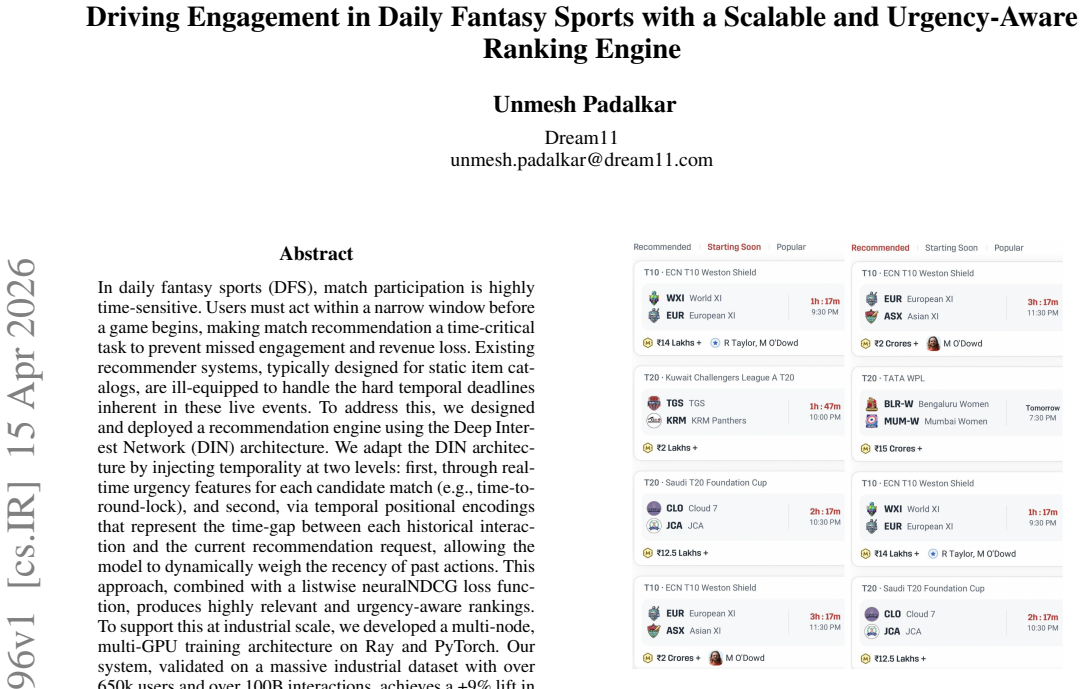


read the original abstract
In daily fantasy sports (DFS), match participation is highly time-sensitive. Users must act within a narrow window before a game begins, making match recommendation a time-critical task to prevent missed engagement and revenue loss. Existing recommender systems, typically designed for static item catalogs, are ill-equipped to handle the hard temporal deadlines inherent in these live events. To address this, we designed and deployed a recommendation engine using the Deep Interest Network (DIN) architecture. We adapt the DIN architecture by injecting temporality at two levels: first, through real-time urgency features for each candidate match (e.g., time-to-round-lock), and second, via temporal positional encodings that represent the time-gap between each historical interaction and the current recommendation request, allowing the model to dynamically weigh the recency of past actions. This approach, combined with a listwise neuralNDCG loss function, produces highly relevant and urgency-aware rankings. To support this at industrial scale, we developed a multi-node, multi-GPU training architecture on Ray and PyTorch. Our system, validated on a massive industrial dataset with over 650k users and over 100B interactions, achieves a +9% lift in nDCG@1 over a heavily optimized LightGBM baseline with handcrafted features. The strong offline performance of this model establishes its viability as a core component for our planned on-device (edge) recommendation system, where on-line A/B testing will be conducted.
Editorial analysis
A structured set of objections, weighed in public.
Referee Report
Summary. The manuscript describes an adaptation of the Deep Interest Network (DIN) for daily fantasy sports recommendations, incorporating real-time urgency features (e.g., time-to-round-lock) and temporal positional encodings to model the recency of user interactions. It employs a neuralNDCG listwise loss and a scalable Ray/PyTorch training infrastructure. On a dataset of over 650k users and 100B interactions, the model achieves a 9% lift in nDCG@1 compared to an optimized LightGBM baseline with handcrafted features, positioning it for on-device deployment.
Significance. If the performance gains are indeed due to the proposed urgency-aware modifications, this work offers a practical advancement for time-critical recommendation in live-event settings, with potential for improved engagement in DFS and similar domains. The large-scale industrial validation and focus on scalability are notable strengths. However, the lack of detailed ablations limits the ability to assess the specific contributions of the temporal encodings versus general model improvements.
major comments (1)
- [Abstract and Results] Abstract and Results: The headline result attributes the +9% nDCG@1 improvement to the injection of time-to-round-lock features and temporal positional encodings into the DIN architecture (along with neuralNDCG loss). However, the manuscript does not include ablations that isolate these components (e.g., DIN without temporal positional encodings) or provide a LightGBM baseline augmented with the same temporal features. This leaves open the possibility that the lift stems from feature differences or higher model capacity rather than the claimed urgency-aware adaptations, undermining the causal interpretation of the central claim.
minor comments (2)
- [Methods] Methods: Additional details on the exact implementation of temporal positional encodings within the attention layers and the hyperparameter tuning process for both the proposed model and the LightGBM baseline would improve reproducibility.
- [Abstract] Abstract: The dataset size is described as 'over 650k users and over 100B interactions'; clarifying whether these are unique users or total interactions would aid interpretation of scale.
Simulated Author's Rebuttal
We thank the referee for their constructive feedback and for recognizing the practical value of our urgency-aware DIN adaptation for time-critical DFS recommendations. We agree that the absence of targeted ablations weakens the causal attribution of the reported gains and will revise the manuscript accordingly to address this.
read point-by-point responses
-
Referee: [Abstract and Results] Abstract and Results: The headline result attributes the +9% nDCG@1 improvement to the injection of time-to-round-lock features and temporal positional encodings into the DIN architecture (along with neuralNDCG loss). However, the manuscript does not include ablations that isolate these components (e.g., DIN without temporal positional encodings) or provide a LightGBM baseline augmented with the same temporal features. This leaves open the possibility that the lift stems from feature differences or higher model capacity rather than the claimed urgency-aware adaptations, undermining the causal interpretation of the central claim.
Authors: We acknowledge this limitation in the current manuscript. The reported +9% nDCG@1 lift is presented as resulting from the full urgency-aware DIN system (temporal encodings, time-to-lock features, and neuralNDCG loss) versus an optimized LightGBM baseline using handcrafted features. However, without component-wise ablations, it is not possible to fully rule out contributions from model capacity or unisolated feature differences. In the revised manuscript we will add an ablation study that includes: (1) base DIN without temporal positional encodings or urgency features, (2) DIN with urgency features but without positional encodings, (3) the full DIN model with a pointwise loss instead of neuralNDCG, and (4) a LightGBM variant augmented with the identical time-to-round-lock and temporal features. These results will be reported in a new table and discussed in the Experiments section to support the causal claims. We will also clarify in the abstract and introduction that the gains are attributable to the integrated urgency-aware system rather than any single component in isolation. revision: yes
Circularity Check
Empirical lift over independent baseline is self-contained with no derivation chain
full rationale
The paper presents an engineering system description: DIN architecture adapted with time-to-lock features and temporal positional encodings, trained with neuralNDCG loss on a large industrial dataset, and evaluated via offline nDCG@1 against a separate LightGBM baseline using handcrafted features. No equations, first-principles derivations, or predictions are claimed that reduce to fitted inputs or self-referential definitions. The reported +9% lift is a direct empirical measurement on held-out data, not a constructed quantity. No self-citations, uniqueness theorems, or ansatzes are invoked as load-bearing steps. The result is therefore independent of the paper's own modeling choices and does not collapse by construction.
Axiom & Free-Parameter Ledger
axioms (2)
- domain assumption Deep Interest Network attention layers can be extended with scalar urgency features and temporal positional encodings without breaking their ability to model user interest.
- domain assumption Listwise neuralNDCG loss produces rankings that better reflect user engagement under time pressure than pointwise losses.
Reference graph
Works this paper leans on
-
[1]
MMLSpark: Unifying Machine Learning Ecosystems at Massive Scales. arXiv:1810.08744. Hidasi, B.; Karatzoglou, A.; Baltrunas, L.; and Tikk, D
-
[2]
Session-based Recommendations with Recurrent Neural Networks
Session-based Recommendations with Recurrent Neural Networks. arXiv:1511.06939. Kang, W.-C.; and McAuley, J. 2018. Self-Attentive Sequen- tial Recommendation. arXiv:1808.09781. Ke, G.; Meng, Q.; Finley, T.; Wang, T.; Chen, W.; Ma, W.; Ye, Q.; and Liu, T.-Y . 2017. LightGBM: a highly efficient gradient boosting decision tree. InProceedings of the 31st Inte...
work page internal anchor Pith review arXiv 2018
discussion (0)
Sign in with ORCID, Apple, or X to comment. Anyone can read and Pith papers without signing in.