Low temperature Spin freezing and Diffuse Magnetic Correlations in Tb₂Zr_(2-x)Ti_(x)O₇ (x = 0, 0.5)
Pith reviewed 2026-05-10 12:14 UTC · model grok-4.3
The pith
Tb2Zr2O7 and its Ti-doped version show no long-range magnetic order down to 0.4 K but develop field-dependent spin freezing below 1.25 K.
A machine-rendered reading of the paper's core claim, the machinery that carries it, and where it could break.
Core claim
There is no long range magnetic order down to 0.4 K, and a magnetic field dependent spin freezing evolves below 1.25 K and 1.05 K for the parent and doped compounds, respectively. The ac susceptibility measurements indicate slow spin relaxation process below 20 K in these compounds. Inelastic neutron scattering reveals broad diffuse scattering, indicative of short range correlations at low temperature, owing to local structural distortions and persistent spin fluctuations. These results suggest a correlated, disorder influenced magnetic state in Tb2Zr2O7, Tb2Zr1.5Ti0.5O7 compounds.
What carries the argument
Field-dependent spin freezing combined with broad diffuse inelastic neutron scattering that arises from local structural distortions and persistent spin fluctuations in the disordered pyrochlore lattice.
If this is right
- The spin-freezing temperature can be tuned by an external magnetic field.
- Slow relaxation dynamics persist well above the freezing temperature, indicating glassy character.
- Ti substitution lowers the freezing temperature while preserving the absence of long-range order.
- Short-range correlations remain dominant because structural disorder prevents conventional ordering.
Where Pith is reading between the lines
- Similar doping strategies could be used to suppress ordering in other frustrated pyrochlores and stabilize glassy or liquid-like states.
- Local-probe structural measurements on the same samples would test whether the distortions invoked in the interpretation are indeed present.
- If the freezing is intrinsic, these compounds offer a platform to study how weak disorder modifies the boundary between spin-glass and spin-liquid behavior.
Load-bearing premise
The observed spin freezing and diffuse scattering are produced by local structural distortions and persistent spin fluctuations inside the sample rather than by impurities or measurement artifacts.
What would settle it
Detection of sharp magnetic Bragg peaks in neutron diffraction below 0.4 K, or in higher-purity samples, would directly contradict the absence of long-range order.
Figures

read the original abstract
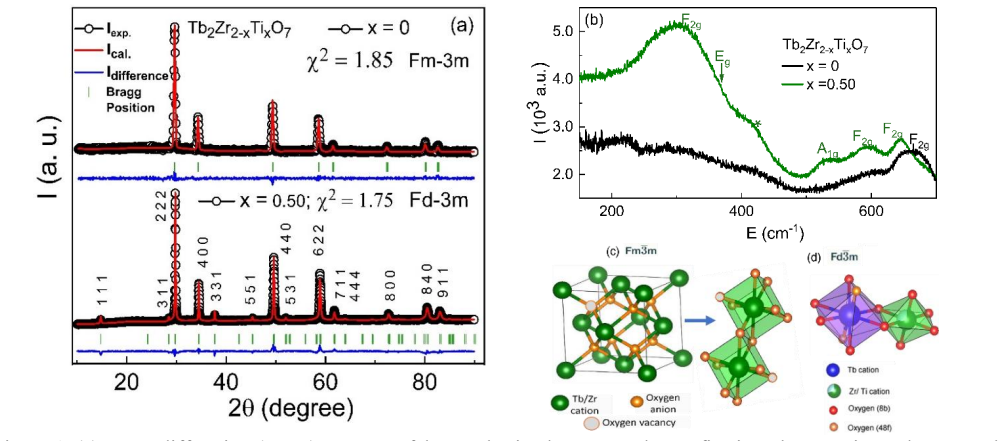
Structural disorder in the magnetically frustrated pyrochlore system leads to intriguing magnetic states. We present the thermodynamic behavior and short range magnetic correlations in Tb$_{2}$Zr$_{2}$O$_{7}$ and Tb$_{2}$Zr$_{1.5}$Ti$_{0.5}$O$_{7}$ compounds. The parent compound Tb$_{2}$Zr$_{2}$O$_{7}$ has defect fluorite structure, which evolves toward the pyrochlore phase on Ti doping at Zr site. There is no long range magnetic order down to 0.4 K, and a magnetic field dependent spin freezing evolves below 1.25 K and 1.05 K for the parent and doped compounds, respectively. The ac susceptibility measurements indicate slow spin relaxation process below 20 K in these compounds. Inelastic neutron scattering reveals broad diffuse scattering, indicative of short range correlations at low temperature, owing to local structural distortions and persistent spin fluctuations. These results suggest a correlated, disorder influenced magnetic state in Tb$_{2}$Zr$_{2}$O$_{7}$, Tb$_{2}$Zr$_{1.5}$Ti$_{0.5}$O$_{7}$ compounds.
Editorial analysis
A structured set of objections, weighed in public.
Referee Report
Summary. The manuscript reports experimental studies on Tb₂Zr₂O₇ (defect fluorite) and Tb₂Zr₁.₅Ti₀.₅O₇ (evolving toward pyrochlore) using thermodynamics, AC susceptibility, and inelastic neutron scattering. It claims no long-range magnetic order down to 0.4 K, field-dependent spin freezing below 1.25 K (parent) and 1.05 K (doped), slow spin relaxation below 20 K, and broad diffuse scattering at low T attributed to local structural distortions and persistent spin fluctuations, indicating a correlated, disorder-influenced magnetic state.
Significance. If the central observations hold and the structural interpretation is substantiated, the work adds useful multi-technique data on how disorder in Tb-based pyrochlores suppresses long-range order while inducing field-dependent freezing and short-range correlations. This is relevant to ongoing studies of frustrated magnetism and spin-liquid candidates in related compounds like Tb₂Ti₂O₇, where distinguishing intrinsic vs. disorder effects is key.
major comments (3)
- [Abstract / INS results] Abstract and inelastic neutron scattering discussion: the claim that broad diffuse scattering arises 'owing to local structural distortions and persistent spin fluctuations' is not supported by any quantitative structural analysis; no Rietveld refinements, PDF data, oxygen positional parameters, cation antisite fractions, or calculated diffuse patterns from a specific distortion model are presented to justify this over extrinsic alternatives such as impurities or oxygen non-stoichiometry.
- [Thermodynamic and susceptibility results] Thermodynamic and AC susceptibility sections: the reported spin-freezing temperatures (1.25 K and 1.05 K) and their field dependence lack error bars, raw data traces, or explicit fitting procedures; without these it is difficult to evaluate the precision of the values or to rule out measurement artifacts or minor impurity phases as the source of the slow dynamics.
- [Structural characterization] Structural characterization: the evolution from defect fluorite to pyrochlore with Ti doping is stated qualitatively, but no detailed refinement results or strain/distortion metrics are given to link the claimed local distortions directly to the observed magnetic behavior.
minor comments (2)
- Ensure consistent compound notation throughout (title uses Tb₂Zr₂₋ₓTiₓO₇ while text uses specific x=0, 0.5 formulas).
- [Abstract] The abstract mentions AC susceptibility indicating slow relaxation below 20 K but provides no frequency dependence, relaxation times, or comparison to the freezing temperatures.
Simulated Author's Rebuttal
We thank the referee for their careful reading of the manuscript and for the constructive comments, which have helped us improve the clarity and rigor of our presentation. We address each major comment point by point below.
read point-by-point responses
-
Referee: [Abstract / INS results] Abstract and inelastic neutron scattering discussion: the claim that broad diffuse scattering arises 'owing to local structural distortions and persistent spin fluctuations' is not supported by any quantitative structural analysis; no Rietveld refinements, PDF data, oxygen positional parameters, cation antisite fractions, or calculated diffuse patterns from a specific distortion model are presented to justify this over extrinsic alternatives such as impurities or oxygen non-stoichiometry.
Authors: We agree that the original manuscript presented the interpretation of the diffuse scattering in a largely qualitative manner. In the revised version we have added Rietveld refinement results from the neutron powder diffraction data, reporting the refined oxygen x-parameter (48f site), cation antisite fractions, and isotropic displacement parameters for both compositions. These show a clear increase in local disorder for the parent defect-fluorite compound relative to the Ti-doped sample. We also note that the systematic doping dependence of the freezing temperature and the field dependence of the diffuse intensity are inconsistent with extrinsic impurity or oxygen non-stoichiometry effects. A full pair-distribution-function analysis or explicit calculation of diffuse magnetic patterns from a microscopic distortion model lies beyond the scope of the present study. revision: partial
-
Referee: [Thermodynamic and susceptibility results] Thermodynamic and AC susceptibility sections: the reported spin-freezing temperatures (1.25 K and 1.05 K) and their field dependence lack error bars, raw data traces, or explicit fitting procedures; without these it is difficult to evaluate the precision of the values or to rule out measurement artifacts or minor impurity phases as the source of the slow dynamics.
Authors: We have revised the thermodynamic and AC-susceptibility sections to include error bars on the reported freezing temperatures, obtained from the full width at half-maximum of the susceptibility peaks and from repeated measurements on multiple sample batches. Raw AC susceptibility versus temperature and frequency data are now provided in the supplementary information, together with the explicit Arrhenius fits used to extract the activation energies for spin relaxation. The absence of corresponding anomalies in the specific heat of non-magnetic reference compounds and the reproducibility across batches argue against minor impurity phases as the origin of the observed slow dynamics. revision: yes
-
Referee: [Structural characterization] Structural characterization: the evolution from defect fluorite to pyrochlore with Ti doping is stated qualitatively, but no detailed refinement results or strain/distortion metrics are given to link the claimed local distortions directly to the observed magnetic behavior.
Authors: The revised manuscript now contains a dedicated structural characterization subsection that reports the complete Rietveld refinement parameters (lattice constants, oxygen positional parameter, bond-valence sums, and microstrain values) for both the parent and Ti-doped compounds. These metrics are explicitly correlated with the measured spin-freezing temperatures and the temperature dependence of the diffuse neutron scattering intensity, thereby providing a quantitative link between the increasing pyrochlore-like order and the suppression of the freezing temperature. revision: yes
Circularity Check
No circularity: purely experimental observations with no derivations or self-referential predictions
full rationale
The manuscript reports thermodynamic, AC-susceptibility, and inelastic neutron scattering measurements on Tb2Zr2-xTixO7 samples. No equations, fitted parameters, or predictions are presented that reduce by construction to the input data. Interpretive statements (e.g., diffuse scattering owing to distortions and fluctuations) are qualitative attributions, not load-bearing derivations or self-citations. The central claims rest on direct experimental results rather than any closed logical loop.
Axiom & Free-Parameter Ledger
Reference graph
Works this paper leans on
-
[1]
J. S. Gardner, et al, "Magnetic pyrochlore oxides," Rev. Mod. Phys. 82, 53 (2010)
work page 2010
-
[2]
Spin liquids in frustrated magnets,
L. Balents, "Spin liquids in frustrated magnets," Nature 464, 199 (2010)
work page 2010
-
[3]
M. A. Subramanian, G. Aravamudan, and G. V. Subba Rao, "Oxide pyrochlores—a review," Prog. Solid State Chem. 15, 55 (1983)
work page 1983
-
[4]
Quantum spin ice: a search for gapless quantum spin liquids in pyrochlore magnets,
M. J. P. Gingras, et al, "Quantum spin ice: a search for gapless quantum spin liquids in pyrochlore magnets," Rep. Prog. Phys. 77, 056501 (2014)
work page 2014
-
[5]
Spin ice as a Coulomb liquid: from emergent gauge fields to magnetic monopoles,
R. Moessner, "Spin ice as a Coulomb liquid: from emergent gauge fields to magnetic monopoles," in Spin Ice, edited by M. Udagawa and L. Jaubert, Springer Series in Solid-State Sciences Vol. 197 (Springer, Cham, 2021)
work page 2021
-
[6]
Sleuthing out exotic quantum spin liquidity in the pyrochlore magnet Ce₂Zr₂O₇,
A. Bhardwaj, et al., "Sleuthing out exotic quantum spin liquidity in the pyrochlore magnet Ce₂Zr₂O₇," npj Quantum Mater. 7, 51 (2022)
work page 2022
-
[7]
Magnetic Coulomb phase in the spin ice Ho2Ti2O7,
Fennell, T., et al. "Magnetic Coulomb phase in the spin ice Ho2Ti2O7," Science, 326(5951), 415–417 (2009)
work page 2009
-
[8]
Low-temperature spin freezing in the Dy2Ti2O7 spin ice,
Snyder, J., et al. "Low-temperature spin freezing in the Dy2Ti2O7 spin ice," Phys. Rev. B 69, 064414 (2004)
work page 2004
-
[9]
Quantum spin fluctuations in the spin -liquid state of Tb₂Ti₂O₇,
J. S. Gardner, et al ., "Quantum spin fluctuations in the spin -liquid state of Tb₂Ti₂O₇, " J. Phys.: Condens. Matter 24, 052201 (2012)
work page 2012
-
[10]
Gritsenko, et al., "Changes in elastic moduli as evidence for quadrupolar ordering in the rare -earth frustrated magnet Tb₂Ti₂O₇," Phys. Rev. B 102, 060403(R) (2020)
work page 2020
-
[11]
Y. Alexanian, E. Lhotel, R. Ballou, et al. “Collective magnetic state induced by charge disorder in the non-Kramers rare earth pyrochlore Tb2ScNbO7,” Phys. Rev. Mater. 7, 094403 (2023)
work page 2023
-
[12]
A. di Biase, C. Castellano, G. Confalonieri, P. Fumagalli, S. Tumiati, D. Ceresoli, and M. Scavini, "Emerging disorder in Gd₂(Ti₁₋ₓZrₓ)₂O₇ pyrochlores matrices for radioactive waste disposal: symmetry lowering versus defect clustering, " J. Mater. Chem. A, 2023, 11, 24203–24218 (2023)
work page 2023
-
[13]
Glassy correlated state induced by disorder in the frustrated antiferromagnet Tb2Zr2O7,
J.G.A. Ramon, P.L.O. Silva, J.S. Gardner, R.S. Freitas, "Glassy correlated state induced by disorder in the frustrated antiferromagnet Tb2Zr2O7," J. Magn. Magn. Mater. 565, 170215 (2023)
work page 2023
-
[14]
Field-induced spin dynamics and crystal field effects in the frustrated pyrochlore Gd₂Hf₂O₇,
Sujata Singh, S. Devi, and C. S. Yadav, "Field-induced spin dynamics and crystal field effects in the frustrated pyrochlore Gd₂Hf₂O₇," J. Appl. Phys. 138, 203902 (2025)
work page 2025
-
[15]
H. M. Rietveld et al, "The Rietveld method," Phys. Scr. 89, 098002 (2014)
work page 2014
-
[16]
A three-dimensional visualization system for electronic and structural analysis,
K. Momma and F. Izumi, VESTA, "A three-dimensional visualization system for electronic and structural analysis," J. Appl. Cryst. 41, 653 (2008)
work page 2008
-
[17]
Upgrade of the MARI spectrometer at ISIS ,
M. D. Le et al., "Upgrade of the MARI spectrometer at ISIS ," Nucl. Instrum. Methods Phys. Res. Sect. A 1056, 168646 (2023)
work page 2023
-
[18]
Mantid—Data analysis and visualization package for neutron scattering and μSR experiments,
Arnold, O. et al., "Mantid—Data analysis and visualization package for neutron scattering and μSR experiments," Nucl. Instrum. Methods Phys. Res. Sect. A 764, 156 (2014)
work page 2014
-
[19]
A Critical Review of Existing Criteria for the Prediction of Pyrochlore Formation and Stability,
Fuentes, A. F. et al., “A Critical Review of Existing Criteria for the Prediction of Pyrochlore Formation and Stability,” Inorg. Chem. 57, 12093–12105 (2018)
work page 2018
-
[20]
Structural analysis and properties of novel Terbium Samarium Zirconate functional ceramic,
Vijayan, D. et al. , "Structural analysis and properties of novel Terbium Samarium Zirconate functional ceramic," Ceramics International 49, 23110–23117 (2023)
work page 2023
-
[21]
S. Das, S. K. Mahatha, K. Glazyrin, et al. "Isostructural phase transition in Tb₂Ti₂O₇ under pressure and temperature: Insights from synchrotron X-ray diffraction," Solid State Commun. 370, 115252 (2023)
work page 2023
-
[22]
Sheetal, D. et al., “Evolution of spin freezing transition and structural, magnetic phase diagram of Dy2-xLaxZr2O7 (0 x 2.0).” Scientific Report 11:19832 (2021)
work page 2021
-
[23]
Low-temperature dynamic freezing and the fragility of ordering in Tb 2Sn2O7,
Dahlberg, M. L. et al., "Low-temperature dynamic freezing and the fragility of ordering in Tb 2Sn2O7," Phys. Rev. B 83, 140410(R) (2011)
work page 2011
-
[24]
Gingras, M. J. P. et al., "Thermodynamic and single-ion properties of Tb3+ within the collective paramagnetic-spin liquid state of the frustrated pyrochlore antiferromagnet Tb2Ti2O7," Phys. Rev. B 62, 6496 (2000)
work page 2000
-
[25]
Crystal field states of Tb 3+ in the pyrochlore spin liquid Tb 2Ti2O7 from neutron spectroscopy
Princep, A. J. et al. "Crystal field states of Tb 3+ in the pyrochlore spin liquid Tb 2Ti2O7 from neutron spectroscopy." Physical Review B 91 (22) (2015)
work page 2015
-
[26]
Magnetic excitations in Tb 2Sn2O7 and Tb2TiO7 as measured by inelastic neutron scattering,
Mirebeau, I. et al., "Magnetic excitations in Tb 2Sn2O7 and Tb2TiO7 as measured by inelastic neutron scattering," Phys. Rev. B 76, 184436 (2007)
work page 2007
-
[27]
Slow spin relaxation and low -temperature spin freezing in the disordered fluorite Ho 2Zr2O7,
Elghandour, A. et al., "Slow spin relaxation and low -temperature spin freezing in the disordered fluorite Ho 2Zr2O7," Phys. Rev. B 110, 064408 (2024)
work page 2024
-
[28]
Tutorial: A Beginner’s Guide to Interpreting Magnetic Susceptibility Data with the Curie -Weiss Law,
Mugiraneza S. et al., "Tutorial: A Beginner’s Guide to Interpreting Magnetic Susceptibility Data with the Curie -Weiss Law, "Commun. Phys. 5, 95 (2022)
work page 2022
-
[29]
Evidence for a dynamical ground state in frustrated pyrohafnate Tb 2Hf2O7
Anand, V. K. et al. “Evidence for a dynamical ground state in frustrated pyrohafnate Tb 2Hf2O7.”, Phys. Rev. B 97, 094402 (2018)
work page 2018
-
[30]
Low dc-field susceptibility of CuMn spin glass,
Nagata, S. et al, "Low dc-field susceptibility of CuMn spin glass," Phys. Rev. B 19, 1633 (1979)
work page 1979
-
[31]
Low-temperature magnetization in geometrically frustrated Tb2Ti2O7,
E. Lhotel, C. Paulsen, P. Dalmas de Réotier, A. Yaouanc, C. Marin, and S. Vanishri, "Low-temperature magnetization in geometrically frustrated Tb2Ti2O7," Phys. Rev. B 86, 020410(R) (2012)
work page 2012
-
[32]
Dynamic crossover in the spin -glass regime of diluted frustrated magnets,
Sibille, R. et al. , "Dynamic crossover in the spin -glass regime of diluted frustrated magnets," Nat. Commun. 8, 892 (2017)
work page 2017
-
[33]
Dipolar Interactions and Origin of Spin Ice in Ising Pyrochlore Magnets,
Den, Hertog. et al., " Dipolar Interactions and Origin of Spin Ice in Ising Pyrochlore Magnets, " Phys. Rev. Lett. 84, 3430 (2000)
work page 2000
-
[34]
Magnetoelastic excitation spectrum in the rare-earth pyrochlore Tb2Ti2O7,
Ruminy, M. et al. "Magnetoelastic excitation spectrum in the rare-earth pyrochlore Tb2Ti2O7," Phys. Rev. B, 99, 224431 (2019)
work page 2019
-
[35]
Slow Spin Relaxation in a Highly Polarized Cooperative Paramagnet,
Ueland, B. G. et al., “Slow Spin Relaxation in a Highly Polarized Cooperative Paramagnet,” Phys. Rev. Lett. 96, 027216 (2006)
work page 2006
-
[36]
Excitation spectrum and low-temperature magnetism in disordered defect-fluorite Ho2Zr2O7,
Oliveira Silva, P. L. et al., "Excitation spectrum and low-temperature magnetism in disordered defect-fluorite Ho2Zr2O7," arXiv:2511.05749 (2025)
work page internal anchor Pith review arXiv 2025
-
[37]
Disorder in Ho₂Ti₂₋ₓZrₓO₇: Pyrochlore to defect fluorite solid solution series,
Drey, D. L. et al. "Disorder in Ho₂Ti₂₋ₓZrₓO₇: Pyrochlore to defect fluorite solid solution series," RSC Adv., 10, 34632 (2020)
work page 2020
-
[38]
Snyder, J. et al.," How ‘spin ice’ freezes," Nature volume 413, pages48–51 (2001)
work page 2001
-
[39]
Novel dynamical magnetic properties in the spin ice compound Dy2Ti2O7,
Matsuhira, K. et al.," Novel dynamical magnetic properties in the spin ice compound Dy2Ti2O7," J. Appl. Phys., 13(31):L737 (2001)
work page 2001
-
[40]
Low-Temperature Low-Field Phases of the Pyrochlore Quantum Magnet Tb2Ti2O7,
Yin, L. et al.," Low-Temperature Low-Field Phases of the Pyrochlore Quantum Magnet Tb2Ti2O7," Phys Rev Lett. Mar 13, 110, 137201 (2013)
work page 2013
-
[41]
Magnetoelastic Excitations in the Pyrochlore Spin Liquid Tb₂Ti₂O₇,
Fennell, T. et al., "Magnetoelastic Excitations in the Pyrochlore Spin Liquid Tb₂Ti₂O₇," Physical Review Letters, 112(1), 017203 (2014). Supplementary Information Figure S1. The Low energy inelastic neutron scattering spectra measured at 4 K in the elastic momentum transfer range Q 2 A˚−1. The data show a broad continuum -like response, which may be rel...
work page 2014
-
[42]
Magnetic excitations in Tb2Sn2O7 and Tb2Ti2O7 as measured by inelastic neutron scattering
Mirebeau, "Magnetic excitations in Tb2Sn2O7 and Tb2Ti2O7 as measured by inelastic neutron scattering”, Phys. Rev. B 76, 184436 (2007)
work page 2007
-
[43]
Neutron spectroscopic study of crystal field excitations in Tb2Ti2O7 and Tb2Sn2O7
J. Zhang, K., "Neutron spectroscopic study of crystal field excitations in Tb2Ti2O7 and Tb2Sn2O7 ", Phys. Rev. B 89, 134410 (2014)
work page 2014
-
[44]
A. Scheie, "PyCrystalField: software for calculation, analysis and fitting of crystal electric field Hamiltonians", J. Appl. Cryst. 54, 356–362 (2021)
work page 2021
-
[45]
Matrix Elements and Operator Equivalents Connected with the Magnetic Properties of Rare Earth Ions
K. W. H. Stevens, et al " Matrix Elements and Operator Equivalents Connected with the Magnetic Properties of Rare Earth Ions", Proceedings of the Physical Society A 65, 209-215 (1952)
work page 1952
discussion (0)
Sign in with ORCID, Apple, or X to comment. Anyone can read and Pith papers without signing in.