High-gain and large-bandwidth Josephson parametric amplifier influenced by Fabry-P\'erot interference
Pith reviewed 2026-05-10 13:22 UTC · model grok-4.3
The pith
A quantum input-output model incorporating Fabry-Pérot interference from waveguide reflections accurately explains the distorted gain spectra of high-gain Josephson parametric amplifiers.
A machine-rendered reading of the paper's core claim, the machinery that carries it, and where it could break.
Core claim
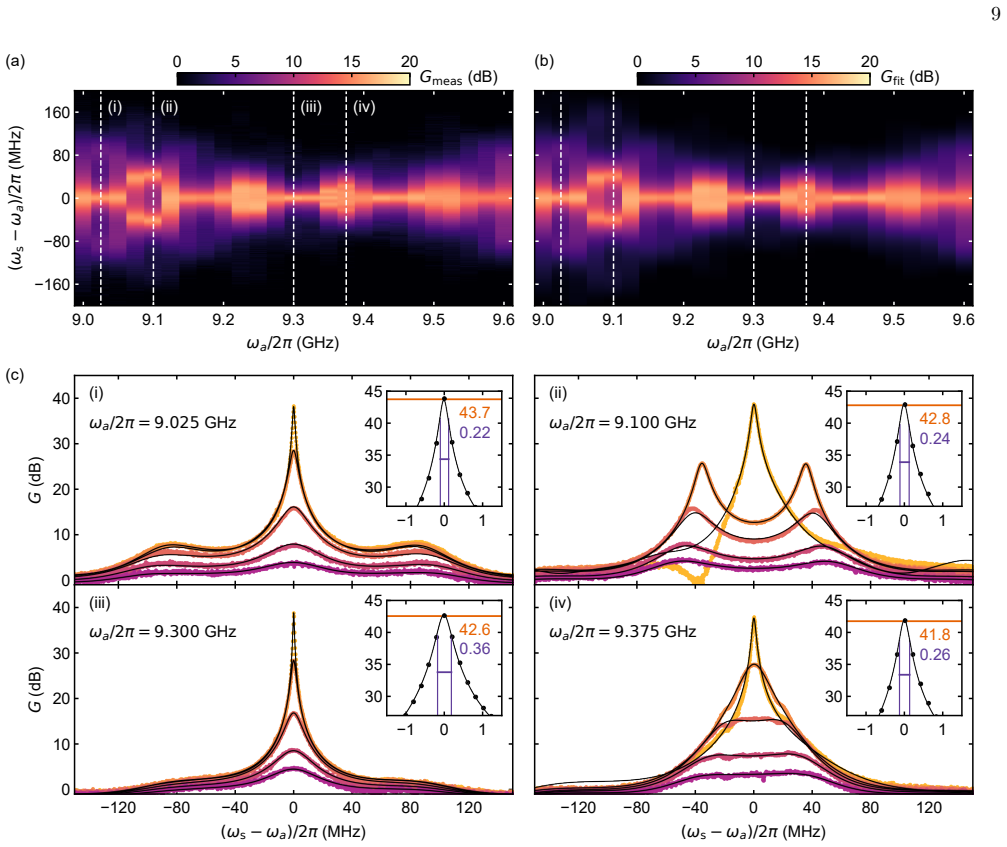
The authors report a flux-driven lumped-element Josephson parametric amplifier based on a SQUID array that delivers near-quantum-limited phase-preserving amplification with a net gain of 20 dB and a 3 dB bandwidth of approximately 50 MHz. They measure gain spectra that show complex frequency-dependent features and attribute these to weak reflections in the input-output waveguide. Extending the quantum input-output theory to include multiple reflections in a Fabry-Pérot manner yields analytical expressions that match the experimental spectra and reveal their dependence on environmental parameters such as mismatch positions and reflection coefficients.
What carries the argument
The Fabry-Pérot interference incorporated into the quantum input-output model, which treats the signal as undergoing multiple reflections between the amplifier and distant impedance mismatches in the waveguide.
Load-bearing premise
The distortions in the gain spectra result primarily from weak reflections caused by impedance mismatches in the input-output waveguide, rather than from unmodeled internal device effects or experimental artifacts.
What would settle it
If the gain spectrum is remeasured after significantly reducing reflections, for example by inserting better matched attenuators or changing the waveguide length, and the complex features either vanish or shift in period exactly as predicted by the Fabry-Pérot model, that would support the claim; failure of the spectrum to change accordingly would falsify it.
Figures






read the original abstract
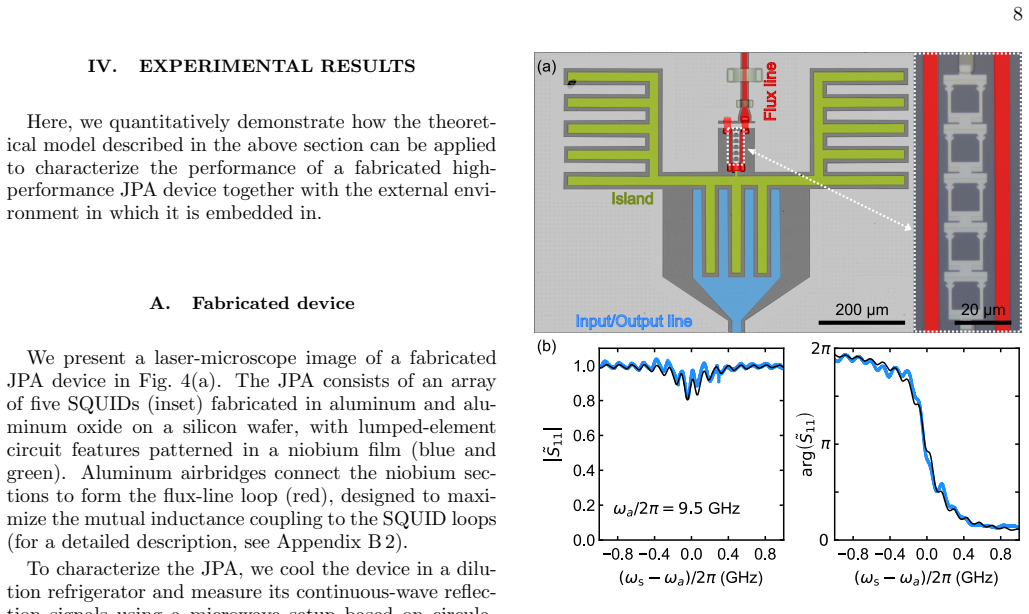
Quantum-limited parametric amplifiers are essential components for many quantum technologies operating in the microwave domain. Achieving both high gain and broad bandwidth, however, remains challenging due to trade-offs between gain and bandwidth, pump efficiency, and dynamic range. Moreover, high-gain broadband amplifiers become increasingly sensitive to their external electromagnetic environment, which can distort their gain spectra and hinder reliable operation. Here, we present an accurate theoretical model and a systematic design methodology for a flux-driven, lumped-element Josephson parametric amplifier based on a SQUID array. Our device achieves near-quantum-limited, phase-preserving amplification with a net gain of 20 (maximally 44) dB and a 3-dB bandwidth of $\sim$50 ($\lesssim$0.2) MHz. We further show that the gain spectra exhibit pronounced sensitivity to weak reflections in the input-output waveguide caused by impedance mismatches in the microwave environment. By incorporating Fabry-P\'erot-type interference into a quantum input-output model, we analytically reproduce these complex spectral features and identify how they depend on the physical parameters of the environment. More generally, our results provide a practical framework for separating the intrinsic dynamics of parametric amplifiers from environmental effects. This approach enables reliable characterization and optimization of amplifier performance while providing a systematic strategy for diagnosing microwave reflections and engineering environmental interference to shape amplifier gain spectra, thereby offering a pathway toward robust, reproducible, and truly quantum-limited microwave amplification.
Editorial analysis
A structured set of objections, weighed in public.
Referee Report
Summary. The paper presents a flux-driven lumped-element Josephson parametric amplifier (JPA) based on a SQUID array that achieves 20 dB net gain (max 44 dB) with ~50 MHz 3-dB bandwidth while remaining near quantum-limited. It augments standard quantum input-output theory with a Fabry-Pérot interference term arising from weak reflections at impedance mismatches in the input-output waveguide, claiming that this analytical model reproduces the observed complex gain spectra (peaks, ripples, bandwidth modifications) and directly ties the distortions to environmental parameters, thereby separating intrinsic JPA dynamics from external effects.
Significance. If the attribution and analytical reproduction hold, the work supplies a practical, parameter-tied framework for diagnosing and mitigating environmental interference in high-gain broadband JPAs—an important practical advance for quantum-limited microwave amplification in quantum information and sensing applications. The explicit linkage of spectral features to measurable waveguide parameters is a strength over purely phenomenological fits.
major comments (2)
- [Abstract / Theoretical Model] Abstract and theoretical-model section: the central claim that Fabry-Pérot interference 'analytically reproduces' the measured gain spectra requires explicit demonstration that the reflection coefficients and phase lengths are fixed by independent measurements (e.g., separate S11 data or line-length variation) rather than adjusted to fit the amplifier spectra; without this, the reproduction risks being post-hoc and the parameter identification non-unique.
- [Experimental Results] Experimental characterization section: the attribution of spectral distortions primarily to weak linear reflections is load-bearing, yet the manuscript does not report power-dependent gain spectra, controlled mismatch experiments, or pump-power sweeps that would exclude competing mechanisms such as SQUID-array nonlinearities, pump-induced quasiparticles, or calibration artifacts; such tests are needed to establish uniqueness.
minor comments (2)
- [Abstract] Clarify the precise meaning of 'net gain of 20 (maximally 44) dB' and the corresponding bandwidth values; the parenthetical maxima should be tied to specific operating points or device variants.
- [Figures] Figure captions and legends should explicitly state which curves are data, which are model, and which parameters were held fixed versus fitted.
Simulated Author's Rebuttal
We thank the referee for their careful reading and constructive comments, which have helped us improve the clarity and rigor of our claims. We address each major comment below and indicate the revisions made to the manuscript.
read point-by-point responses
-
Referee: [Abstract / Theoretical Model] Abstract and theoretical-model section: the central claim that Fabry-Pérot interference 'analytically reproduces' the measured gain spectra requires explicit demonstration that the reflection coefficients and phase lengths are fixed by independent measurements (e.g., separate S11 data or line-length variation) rather than adjusted to fit the amplifier spectra; without this, the reproduction risks being post-hoc and the parameter identification non-unique.
Authors: We agree that independent constraints on the model parameters are necessary to establish that the reproduction is not post-hoc. In the revised manuscript we have added a dedicated subsection (now Section III.C) that reports separate S11 measurements of the input-output waveguide performed without the JPA attached. These data directly fix the reflection coefficient magnitudes and the round-trip phase lengths (determined from the known physical line lengths and the propagation velocity). We also include a sensitivity analysis in which each parameter is varied by its experimental uncertainty while holding the others fixed; the resulting gain spectra remain within the observed ripple amplitudes, confirming uniqueness within measurement precision. These additions are now referenced from the abstract and the main theoretical-model section. revision: yes
-
Referee: [Experimental Results] Experimental characterization section: the attribution of spectral distortions primarily to weak linear reflections is load-bearing, yet the manuscript does not report power-dependent gain spectra, controlled mismatch experiments, or pump-power sweeps that would exclude competing mechanisms such as SQUID-array nonlinearities, pump-induced quasiparticles, or calibration artifacts; such tests are needed to establish uniqueness.
Authors: We acknowledge that additional tests strengthen the attribution. The revised manuscript now includes power-dependent gain spectra acquired at several pump powers well below the 1-dB compression point; the ripple pattern and bandwidth remain unchanged, indicating that the features are not driven by power-dependent nonlinearities or quasiparticle generation. We have added a paragraph discussing why SQUID-array nonlinearities or calibration artifacts would produce qualitatively different spectral signatures (e.g., asymmetric sidebands or frequency-independent offsets) inconsistent with the observed periodic Fabry-Pérot fringes. Controlled mismatch experiments that deliberately vary the waveguide impedance would require new device fabrications and are therefore outside the scope of the present work; we note this limitation explicitly and outline it as a direction for future studies. revision: partial
- Controlled mismatch experiments that would require fabrication of additional devices with engineered impedance variations.
Circularity Check
No circularity: standard input-output model augmented with interference to match spectra
full rationale
The paper extends quantum input-output theory by adding Fabry-Pérot interference terms to analytically reproduce measured gain spectra and tie distortions to waveguide parameters. This is a modeling step that separates intrinsic amplifier dynamics from environmental effects without any quoted reduction of predictions to fitted inputs by construction, without load-bearing self-citations, and without ansatz smuggling or renaming. The central claim remains independent and falsifiable against external microwave measurements.
Axiom & Free-Parameter Ledger
axioms (1)
- domain assumption Quantum input-output theory applies to the lumped-element SQUID-array parametric amplifier
Reference graph
Works this paper leans on
-
[1]
Experimental setup Figure 11 illustrates the experimental setup, includ- ing cryogenic wiring in the dilution refrigerator and room-temperature electronics. Coherent measurements are performed using a vector network analyzer (VNA) (red), while power spectral measurements use a signal microwave source and a spectrum analyzer (purple); the two configuration...
-
[2]
Fabrication process The fabrication of the JPA devices is summarized as follows. First, a 200 nm-thick Nb film sputtered on a high-resistivity Si wafer is patterned by photolithography and CF 4 plasma etching to define the lumped-element resonator, signal line, and flux-line structures. Next, the SQUID array is fabricated using electron- beam lithography ...
work page 2008
-
[3]
Calibration based on qubits We show a simplified schematic of the calibration setup for the signal power level in Fig. 13(a). The system pa- rameters of the qubit–qubit power calibrator system are shown in Table II. By measuring the reflection coefficient of the readout qubit as a function of probe frequency and power, we can estimate the input power and ...
-
[4]
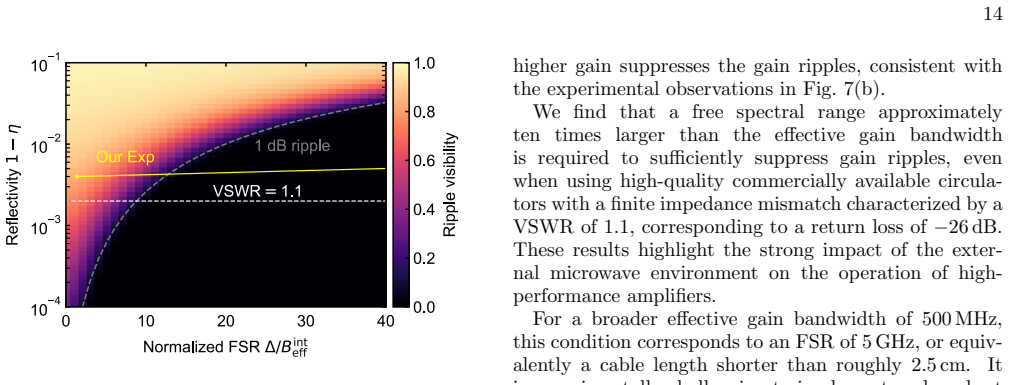
Calculation for Fabry–P´ erot-cavity–JPA system In contrast to characterizing the on-chip performance of quantum-limited amplifiers, we explicitly account for the effects of the nearest circulator required for reflection- type amplifiers and the cable loss between the circulator and the JPA device. As described in Fig. 13c, this model- ing yields more pra...
-
[5]
Relation between charge and flux Two-port circuit elements, such as capacitors, induc- tors, and Josephson junctions, can be characterized by the relation between electric charge and generalized mag- netic flux. Here, the charge (Q) and flux (Φ) of a two-port element are defined as Q= Z dt I,and Φ = Z dt V,(E1) whereIis the current through the element and...
-
[6]
Superconducting Quantum Interference Device (SQUID) with a loop inductance In the following, we will derive the charge-flux rela- tion of a superconducting quantum interference device (SQUID), i.e. a parallel circuit of two identical Josephson junctions, while taking into account a loop inductance. a. Lagrange inversion theorem Deriving the charge-flux re...
-
[7]
Flux pumping of SQUIDs a. Equivalent circuit of a flux-pumped SQUID To operate the flux-driven JPA, the external magnetic flux through each SQUID loop needs to be modulated at a frequency twice that of the JPA. As shown in Fig.17(a), this modulation is typically achieved by applying a mi- crowave pump through a waveguide that is terminated with a shunt in...
-
[8]
Hamiltonian of JPA with SQUID array a. Canonical form Here, we consider a flux-driven lumped-element JPA, formed by a parallel circuit of a capacitor with a total capacitance and a SQUID array, as shown in Fig. 1. The Hamiltonian consists of the kinetic (capacitive) energy in Eq. (4), the potential (inductive) energy in Eq. (E53), and the pump term in Eq....
-
[9]
Model description To understand the effect of an imperfect environment, for example, a JPA connected to a circulator that might have an impedance mismatch, we consider the case of a quantum system with annihilation operator ˆa, emitting into a waveguide in which a mirror with transmittance ηis located at a distancevτ(wherevis the microwave velocity in the...
-
[10]
By substituting the first row of Eq
Effective Heisenberg equation In this section, we derive an effective Heisenberg equa- tion for the combined system of the JPA and the Fabry– P´ erot cavity. By substituting the first row of Eq. (16) into Eq. (14), we have ˆain(t) =T ∗√η0 ˆcin(t) +R √η0 ˆbout(t−2τ) + p 1−η 0 ˆuin(t).(G1) 28 The field ˆbout can be eliminated using Eq. (15), leading to ˆain...
-
[11]
Effective input–output relation In the following, we consider a flux-driven JPA as the quantum system described in the previous section. The Hamiltonian of the flux-driven JPA is given by ˆH=ℏω a ˆa†ˆa+ℏΩp 4 ˆa†2e−iωpt + ˆa2eiωpt ,(G11) where we neglect the self-Kerr energy term for simplic- ity. In this analysis, we are primarily interested in the gain s...
-
[12]
Effective amplifier model As described in Eq. (G15), we obtain the input–output relation of the signal field for the combined JPA–Fabry– P´ erot cavity system, which can be characterized by a gainG FPJ and an added photon noiseN FPJ as shown in Fig. 18(a). The added noise is defined as the sum of the inevitable vacuum noise and the excess noise aris- ing ...
-
[13]
C. M. Caves, Physical Review D26, 1817 (1982)
work page 1982
-
[14]
A. A. Clerk, M. H. Devoret, S. M. Girvin, F. Marquardt, and R. J. Schoelkopf, Rev. Mod. Phys.82, 1155 (2010)
work page 2010
- [15]
- [16]
-
[17]
K. Inomata, Z. Lin, K. Koshino, W. D. Oliver, J.-S. Tsai, T. Yamamoto, and Y. Nakamura, Nature communica- tions7, 12303 (2016)
work page 2016
-
[18]
S. Kono, K. Koshino, Y. Tabuchi, A. Noguchi, and Y. Nakamura, Nat. Phys.14, 546 (2018)
work page 2018
- [19]
-
[20]
R. Kokkoniemi, J.-P. Girard, D. Hazra, A. Laitinen, J. Govenius, R. Lake, I. Sallinen, V. Vesterinen, M. Par- tanen, J. Tan,et al., Nature586, 47 (2020)
work page 2020
- [21]
-
[22]
M. A. Castellanos-Beltran, K. Irwin, G. Hilton, L. Vale, and K. Lehnert, Nat. Phys.4, 929 (2008)
work page 2008
-
[23]
T. Yamamoto, K. Inomata, M. Watanabe, K. Matsuba, T. Miyazaki, W. D. Oliver, Y. Nakamura, and J. S. Tsai, Appl. Phys. Lett.93, 042510 (2008)
work page 2008
- [24]
-
[25]
S. Kono, Y. Masuyama, T. Ishikawa, Y. Tabuchi, R. Ya- mazaki, K. Usami, K. Koshino, and Y. Nakamura, Phys- ical review letters119, 023602 (2017)
work page 2017
-
[26]
C. Eichler, D. Bozyigit, C. Lang, M. Baur, L. Steffen, J. M. Fink, S. Filipp, and A. Wallraff, Phys. Rev. Lett. 107, 113601 (2011)
work page 2011
- [27]
- [28]
-
[29]
K. G. Fedorov, M. Renger, S. Pogorzalek, R. D. Candia, Q. Chen, Y. Nojiri, K. Inomata, Y. Nakamura, M. Par- tanen, A. Marx, R. Gross, and F. Deppe, Sci. Adv.7, eabk0891 (2021)
work page 2021
- [30]
- [31]
- [32]
- [33]
-
[34]
J. Heinsoo, C. K. Andersen, A. Remm, S. Krinner, T. Walter, Y. Salath´ e, S. Gasparinetti, J.-C. Besse, A. Potoˇ cnik, A. Wallraff,et al., Physical Review Applied 10, 034040 (2018)
work page 2018
-
[35]
T. White, A. Opremcak, G. Sterling, A. Korotkov, D. Sank, R. Acharya, M. Ansmann, F. Arute, K. Arya, J. C. Bardin, A. Bengtsson, A. Bourassa, J. Bo- vaird, L. Brill, B. B. Buckley, D. A. Buell, T. Burger, B. Burkett, N. Bushnell, Z. Chen, B. Chiaro, J. Co- gan, R. Collins, A. L. Crook, B. Curtin, S. Demura, A. Dunsworth, C. Erickson, R. Fatemi, L. F. Bur-...
work page 2023
-
[36]
B. Abdo, A. Kamal, and M. Devoret, Physical Review B—Condensed Matter and Materials Physics87, 014508 (2013)
work page 2013
-
[37]
B. A. Kochetov and A. Fedorov, Phys. Rev. B92, 224304 (2015)
work page 2015
- [38]
- [39]
-
[40]
M. Esposito, A. Ranadive, L. Planat, and N. Roch, Appl. Phys. Lett.119(2021)
work page 2021
-
[41]
C. Macklin, K. O’brien, D. Hover, M. Schwartz, V. Bolkhovsky, X. Zhang, W. Oliver, and I. Siddiqi, Sci- ence350, 307 (2015)
work page 2015
- [42]
-
[43]
C. S. Chang, A. F. Van Loo, C.-C. Hung, Y. Zhou, C. Gnandt, S. Tamate, and Y. Nakamura, Phys. Rev. Appl.24, 044081 (2025)
work page 2025
-
[44]
K. O’Brien, C. Macklin, I. Siddiqi, and X. Zhang, Phys- ical review letters113, 157001 (2014)
work page 2014
- [45]
-
[46]
A. Ranadive, M. Esposito, L. Planat, E. Bonet, C. Naud, O. Buisson, W. Guichard, and N. Roch, Nat. Commun. 13, 1737 (2022)
work page 2022
-
[47]
J. Wang, K. Peng, J. M. Knecht, G. D. Cunningham, A. E. Lombo, A. Yen, D. A. Zaidenberg, M. Gingras, B. M. Niedzielski, H. Stickler, K. Sliwa, K. Serniak, M. E. Schwartz, W. D. Oliver, and K. P. O’Brien, High- efficiency, low-loss floquet-mode traveling wave paramet- ric amplifier (2025), arXiv:2503.11812 [quant-ph]
-
[48]
Aumentado, IEEE Microwave magazine21, 45 (2020)
J. Aumentado, IEEE Microwave magazine21, 45 (2020)
work page 2020
-
[49]
J. Y. Mutus, T. C. White, R. Barends, Y. Chen, Z. Chen, B. Chiaro, A. Dunsworth, E. Jeffrey, J. Kelly, A. Megrant, C. Neill, P. J. J. O’Malley, P. Roushan, D. Sank, A. Vainsencher, J. Wenner, K. M. Sundqvist, A. N. Cleland, and J. M. Martinis, Appl. Phys. Lett.104, 263513 (2014)
work page 2014
-
[50]
T. Roy, S. Kundu, M. Chand, A. M. Vadiraj, A. Ranadive, N. Nehra, M. P. Patankar, J. Aumentado, A. A. Clerk, and R. Vijay, Appl. Phys. Lett.107, 262601 (2015)
work page 2015
-
[51]
B. Qing, L. B. Nguyen, X. Liu, H. Ren, W. P. Livingston, N. Goss, A. Hajr, T. Chistolini, Z. Pedramrazi, D. I. San- tiago, J. Luo, and I. Siddiqi, Phys. Rev. Res.6, L012035 (2024)
work page 2024
-
[52]
P. Duan, Z. Jia, C. Zhang, L. Du, H. Tao, X. Yang, L. Guo, Y. Chen, H. Zhang, Z. Peng,et al., Appl. Phys. Express14, 042011 (2021)
work page 2021
- [53]
-
[54]
L. Ranzani, G. Ribeill, B. Hassick, and K. C. Fong, in Proc. IEEE Int. Conf. Quantum Comput. Eng. (QCE) (2022) pp. 314–319
work page 2022
-
[55]
D. Ezenkova, D. Moskalev, N. Smirnov, A. Ivanov, A. Matanin, V. Polozov, V. Echeistov, E. Malevannaya, A. Samoylov, E. Zikiy,et al., Appl. Phys. Lett.121 (2022)
work page 2022
-
[56]
R. Kaufman, T. White, M. I. Dykman, A. Iorio, G. Ster- ling, S. Hong, A. Opremcak, A. Bengtsson, L. Faoro, J. C. Bardin, T. Burger, R. Gasca, and O. Naaman, Phys. Rev. Appl.20, 054058 (2023)
work page 2023
-
[57]
C.-C. Hung, H. Kutsuma, C. W. S. Chang, A. F. van Loo, and Y. Nakamura, Phys. Rev. Appl.24, 064019 (2025)
work page 2025
- [58]
-
[59]
X. Zhou, V. Schmitt, P. Bertet, D. Vion, W. Wustmann, V. Shumeiko, and D. Esteve, Phys. Rev. B89, 214517 (2014)
work page 2014
-
[60]
N. Frattini, V. Sivak, A. Lingenfelter, S. Shankar, and M. Devoret, Phys. Rev. Appl.10, 054020 (2018)
work page 2018
-
[61]
T. Elo, T. S. Abhilash, M. R. Perelshtein, I. Lilja, E. V. Korostylev, and P. J. Hakonen, Appl. Phys. Lett.114, 152601 (2019)
work page 2019
-
[62]
M. Esposito, J. Rahamim, A. Patterson, M. Mergen- thaler, J. Wills, G. Campanaro, T. Tsunoda, P. Spring, S. Sosnina, S. Jebari,et al., inEPJ Web Conf., Vol. 198 (EDP Sciences, 2019) p. 00008
work page 2019
-
[63]
R. Kaufman, C. Liu, K. Cicak, B. Mesits, M. Xia, C. Zhou, M. Nowicki, J. Aumentado, D. Pekker, and M. Hatridge, Phys. Rev. Appl.24, 014052 (2025)
work page 2025
- [64]
- [65]
- [66]
-
[67]
Z. K. Minev, Z. Leghtas, S. O. Mundhada, L. Christakis, I. M. Pop, and M. H. Devoret, npj Quantum Information 7, 131 (2021)
work page 2021
-
[68]
D. Willsch, D. Rieger, P. Winkel, M. Willsch, C. Dickel, J. Krause, Y. Ando, R. Lescanne, Z. Leghtas, N. T. Bronn,et al., Nature Physics20, 815 (2024)
work page 2024
- [69]
- [70]
-
[71]
P. Kurpiers, T. Walter, P. Magnard, Y. Salathe, and A. Wallraff, EPJ Quantum Technol.4, 1 (2017)
work page 2017
-
[72]
J. Y. Mutus, T. C. White, E. Jeffrey, D. Sank, R. Barends, J. Bochmann, Y. Chen, Z. Chen, B. Chiaro, A. Dunsworth, J. Kelly, A. Megrant, C. Neill, P. J. J. O’Malley, P. Roushan, A. Vainsencher, J. Wenner, I. Sid- diqi, R. Vijay, A. N. Cleland, and J. M. Martinis, Appl. Phys. Lett.103, 122602 (2013)
work page 2013
- [73]
-
[74]
I. Mahboob, H. Toida, K. Kakuyanagi, Y. Nakamura, and S. Saito, Appl. Phys. Express15, 062005 (2022)
work page 2022
-
[75]
D. J. Parker, M. Savytskyi, W. Vine, A. Laucht, T. Duty, A. Morello, A. L. Grimsmo, and J. J. Pla, Phys. Rev. Appl.17, 034064 (2022)
work page 2022
- [76]
-
[77]
A. Mohamed, E. Zohari, J. J. Pla, P. E. Barclay, and S. Barzanjeh, Phys. Rev. Appl.21, 064052 (2024)
work page 2024
- [78]
- [79]
- [80]
discussion (0)
Sign in with ORCID, Apple, or X to comment. Anyone can read and Pith papers without signing in.