Optimally Controlled Storage of a Qubit in an Inhomogeneous Spin Ensemble
Pith reviewed 2026-05-10 13:04 UTC · model grok-4.3
The pith
Optimal cavity modulation extends qubit lifetime in inhomogeneous spin ensembles by an order of magnitude.
A machine-rendered reading of the paper's core claim, the machinery that carries it, and where it could break.
Core claim
Optimal cavity modulation, designed with the aid of a concurrently developed Krylov theory, achieves an order of magnitude enhancement in the lifetime of a qubit stored in a macroscopic inhomogeneous spin ensemble relative to the losses caused by frequency inhomogeneity and cavity decay.
What carries the argument
Optimal cavity modulation computed via Krylov theory to steer the collective dynamics of a large inhomogeneous spin ensemble.
Load-bearing premise
The Krylov theory accurately captures the essential dynamics of the large spin ensemble under cavity modulation without uncontrolled approximations that erase the claimed lifetime gain.
What would settle it
An experiment that applies the computed optimal cavity modulation to a spin ensemble and measures whether the qubit coherence time increases by approximately a factor of ten over the unmodulated inhomogeneous and cavity decay timescales.
Figures


read the original abstract
The storage of quantum information in spin-ensembles is limited by practically unavoidable inhomogeneous broadening, and the macroscopic number of spins in such an ensemble makes the design of control solutions to increase the coherence time a challenging task. Together with a concurrently developed Krylov theory that allows us to treat the control problem efficiently, we design optimal cavity modulation for such spin ensembles that achieve an order of magnitude enhancement in qubit lifetime compared to the losses due to inhomogeneity and cavity decay.
Editorial analysis
A structured set of objections, weighed in public.
Referee Report
Summary. The manuscript addresses the challenge of storing quantum information in macroscopic inhomogeneous spin ensembles, where inhomogeneous broadening and cavity decay limit qubit lifetime. It introduces optimal cavity modulation designed with the aid of a concurrently developed Krylov subspace theory that reduces the control problem to a tractable size, claiming an order-of-magnitude enhancement in effective qubit lifetime relative to the unoptimized losses from inhomogeneity and cavity decay.
Significance. If the result holds after validation of the underlying reduction, the work would be significant for quantum memory applications, as it provides a concrete control protocol to overcome a major practical limitation in ensemble-based qubits. The use of Krylov methods to enable optimal control on otherwise intractable macroscopic systems is a technical strength worth highlighting if the approximation is shown to preserve the relevant open-system dynamics.
major comments (2)
- [Krylov reduction section] Krylov reduction section: the subspace dimension chosen, the error bound on the projected Liouvillian, and any benchmarking of truncation error against exact dynamics for inhomogeneous ensembles are not reported. Without these, it is impossible to confirm that the projection preserves inhomogeneity-induced dephasing and cavity-induced decay channels; if either is artificially suppressed, the claimed lifetime enhancement would be an artifact rather than a physical result.
- [Results on lifetime enhancement] Results on lifetime enhancement: the abstract asserts an order-of-magnitude gain, yet the manuscript provides no explicit definition or numerical extraction of the lifetime (e.g., via decay rate of the stored qubit coherence or fidelity), nor any comparison table or plot against the unmodulated case. This detail is load-bearing for the central claim.
minor comments (2)
- The abstract and introduction should include a short statement of the ensemble size, inhomogeneity width, and cavity parameters used in the demonstration to allow immediate assessment of the regime in which the enhancement is obtained.
- All references to the concurrent Krylov theory paper must be explicit and complete so that readers can consult the reduction method independently.
Simulated Author's Rebuttal
We thank the referee for their careful reading and constructive comments, which help clarify the presentation of our results on optimal cavity modulation for qubit storage in inhomogeneous spin ensembles. We address each major comment below and indicate the revisions planned for the next version of the manuscript.
read point-by-point responses
-
Referee: [Krylov reduction section] Krylov reduction section: the subspace dimension chosen, the error bound on the projected Liouvillian, and any benchmarking of truncation error against exact dynamics for inhomogeneous ensembles are not reported. Without these, it is impossible to confirm that the projection preserves inhomogeneity-induced dephasing and cavity-induced decay channels; if either is artificially suppressed, the claimed lifetime enhancement would be an artifact rather than a physical result.
Authors: We agree that explicit reporting of these validation details is necessary to confirm the fidelity of the Krylov reduction. The current manuscript relies on the concurrently developed Krylov theory for tractability but does not include the requested specifics. In the revised version we will add the chosen subspace dimension, the derived error bounds on the projected Liouvillian, and benchmarking comparisons of truncation error versus exact dynamics on smaller inhomogeneous ensembles. These additions will explicitly verify that both inhomogeneity-induced dephasing and cavity decay channels are preserved under the projection. revision: yes
-
Referee: [Results on lifetime enhancement] Results on lifetime enhancement: the abstract asserts an order-of-magnitude gain, yet the manuscript provides no explicit definition or numerical extraction of the lifetime (e.g., via decay rate of the stored qubit coherence or fidelity), nor any comparison table or plot against the unmodulated case. This detail is load-bearing for the central claim.
Authors: The order-of-magnitude enhancement is obtained from numerical simulations of the qubit coherence evolution under optimal modulation, as described in the results section. To make the central claim fully transparent, we will add an explicit definition of the effective lifetime (extracted as the decay constant of the stored coherence or fidelity) together with a direct comparison plot and table against the unmodulated case in the revised manuscript. revision: yes
Circularity Check
No significant circularity; lifetime enhancement is computed output of control design
full rationale
The paper presents the order-of-magnitude qubit lifetime enhancement as the result of applying optimal cavity modulation, designed using a concurrently developed Krylov theory for efficient control of the inhomogeneous spin ensemble. No equations or steps reduce the claimed enhancement to a fitted parameter, self-defined quantity, or unverified self-citation by construction. The derivation chain treats the Krylov method as an enabling tool whose output (the modulated dynamics) feeds into the control optimization, with the lifetime improvement emerging as an independent numerical or analytical consequence rather than presupposed input. Potential concerns about Krylov truncation accuracy pertain to correctness or approximation validity, not to circular reduction of the central claim.
Axiom & Free-Parameter Ledger
axioms (2)
- domain assumption Inhomogeneous broadening and cavity decay are the dominant decoherence channels.
- ad hoc to paper Krylov theory provides an efficient and sufficiently accurate reduction for the control problem in macroscopic ensembles.
Reference graph
Works this paper leans on
- [1]
-
[2]
M. Saffman and K. Mølmer, Scaling the neutral-atom rydberg gate quantum computer by collective encoding in holmium atoms, Phys. Rev. A78, 012336 (2008)
work page 2008
-
[3]
K. Tordrup, A. Negretti, and K. Mølmer, Holographic quantum computing, Phys. Rev. Lett.101, 040501 (2008)
work page 2008
-
[4]
K. Surmacz, J. Nunn, K. Reim, K. C. Lee, V. O. Lorenz, B. Sussman, I. A. Walmsley, and D. Jaksch, Efficient spa- tially resolved multimode quantum memory, Phys. Rev. A78, 033806 (2008)
work page 2008
-
[5]
G. Kurizki, P. Bertet, Y. Kubo, K. Mølmer, D. Pet- rosyan, P. Rabl, and J. Schmiedmayer, Quantum tech- nologies with hybrid systems, Proc. Natl. Acad. Sci. 5 U.S.A.112, 3866 (2015)
work page 2015
-
[6]
A. A. Clerk, K. W. Lehnert, P. Bertet, J. R. Petta, and Y. Nakamura, Hybrid quantum systems with cir- cuit quantum electrodynamics, Nature Physics16, 257 (2020)
work page 2020
-
[7]
A. Imamo˘ glu, Cavity qed based on collective magnetic dipole coupling: Spin ensembles as hybrid two-level sys- tems, Phys. Rev. Lett.102, 083602 (2009)
work page 2009
-
[8]
J. H. Wesenberg, A. Ardavan, G. A. D. Briggs, J. J. L. Morton, R. J. Schoelkopf, D. I. Schuster, and K. Mølmer, Quantum computing with an electron spin ensemble, Phys. Rev. Lett.103, 070502 (2009)
work page 2009
-
[9]
Y. Kubo, C. Grezes, A. Dewes, T. Umeda, J. Isoya, H. Sumiya, N. Morishita, H. Abe, S. Onoda, T. Ohshima, V. Jacques, A. Dr´ eau, J.-F. Roch, I. Diniz, A. Auffeves, D. Vion, D. Esteve, and P. Bertet, Hybrid quantum cir- cuit with a superconducting qubit coupled to a spin en- semble, Phys. Rev. Lett.107, 220501 (2011)
work page 2011
-
[10]
H. Wu, R. E. George, J. H. Wesenberg, K. Mølmer, D. I. Schuster, R. J. Schoelkopf, K. M. Itoh, A. Arda- van, J. J. L. Morton, and G. A. D. Briggs, Storage of multiple coherent microwave excitations in an electron spin ensemble, Phys. Rev. Lett.105, 140503 (2010)
work page 2010
- [11]
-
[12]
C. Grezes, B. Julsgaard, Y. Kubo, M. Stern, T. Umeda, J. Isoya, H. Sumiya, H. Abe, S. Onoda, T. Ohshima, V. Jacques, J. Esteve, D. Vion, D. Esteve, K. Mølmer, and P. Bertet, Multimode storage and retrieval of mi- crowave fields in a spin ensemble, Phys. Rev. X4, 021049 (2014)
work page 2014
-
[13]
K. Hammerer, A. S. Sørensen, and E. S. Polzik, Quantum interface between light and atomic ensembles, Rev. Mod. Phys.82, 1041 (2010)
work page 2010
-
[14]
N. Sangouard, C. Simon, H. de Riedmatten, and N. Gisin, Quantum repeaters based on atomic ensembles and linear optics, Rev. Mod. Phys.83, 33 (2011)
work page 2011
-
[15]
B. Julsgaard, C. Grezes, P. Bertet, and K. Mølmer, Quantum memory for microwave photons in an inho- mogeneously broadened spin ensemble, Phys. Rev. Lett. 110, 250503 (2013)
work page 2013
-
[16]
W. M. Witzel and S. Das Sarma, Nuclear spins as quan- tum memory in semiconductor nanostructures, Phys. Rev. B76, 045218 (2007)
work page 2007
-
[17]
Y. Kubo, F. R. Ong, P. Bertet, D. Vion, V. Jacques, D. Zheng, A. Dr´ eau, J.-F. Roch, A. Auffeves, F. Jelezko, J. Wrachtrup, M. F. Barthe, P. Bergonzo, and D. Esteve, Strong coupling of a spin ensemble to a superconducting resonator, Phys. Rev. Lett.105, 140502 (2010)
work page 2010
-
[18]
D. I. Schuster, A. P. Sears, E. Ginossar, L. DiCarlo, L. Frunzio, J. J. L. Morton, H. Wu, G. A. D. Briggs, B. B. Buckley, D. D. Awschalom, and R. J. Schoelkopf, High-cooperativity coupling of electron-spin ensembles to superconducting cavities, Phys. Rev. Lett.105, 140501 (2010)
work page 2010
-
[19]
S. Putz, D. O. Krimer, R. Ams¨ uss, A. Valookaran, T. N¨ obauer, J. Schmiedmayer, S. Rotter, and J. Majer, Protecting a spin ensemble against decoherence in the strong-coupling regime of cavity qed, Nature Physics10, 720 (2014)
work page 2014
-
[20]
S. Putz, A. Angerer, D. O. Krimer, R. Glattauer, W. J. Munro, S. Rotter, J. Schmiedmayer, and J. Majer, Spec- tral hole burning and its application in microwave pho- tonics, Nature Photonics11, 36 (2017)
work page 2017
-
[21]
M. Gross and S. Haroche, Superradiance: An essay on the theory of collective spontaneous emission, Physics Reports93, 301 (1982)
work page 1982
-
[22]
B. Julsgaard and K. Mølmer, Fundamental limitations in spin-ensemble quantum memories for cavity fields, Phys. Rev. A88, 062324 (2013)
work page 2013
- [23]
-
[24]
G. de Lange, Z. H. Wang, D. Rist` e, V. V. Dobrovitski, and R. Hanson, Universal dynamical decoupling of a sin- gle solid-state spin from a spin bath, Science330, 60 (2010)
work page 2010
-
[25]
H. de Riedmatten, M. Afzelius, M. U. Staudt, C. Simon, and N. Gisin, A solid-state light–matter interface at the single-photon level, Nature456, 773 (2008)
work page 2008
-
[26]
M. Afzelius, C. Simon, H. de Riedmatten, and N. Gisin, Multimode quantum memory based on atomic frequency combs, Phys. Rev. A79, 052329 (2009)
work page 2009
-
[27]
E. S. Redchenko, M. Zens, M. ˇZemliˇ cka, M. Peruzzo, F. Hassani, R. Sett, P. Zieli´ nski, H. S. Dhar, D. O. Krimer, S. Rotter, and J. M. Fink, Observation of col- lapse and revival in a superconducting atomic frequency comb, Phys. Rev. Lett.134, 063601 (2025)
work page 2025
-
[28]
B. A. Chase and J. M. Geremia, Collective processes of an ensemble of spin-1/2 particles, Phys. Rev. A78, 052101 (2008)
work page 2008
-
[29]
N. Shammah, S. Ahmed, N. Lambert, S. De Liberato, and F. Nori, Open quantum systems with local and col- lective incoherent processes: Efficient numerical simula- tions using permutational invariance, Phys. Rev. A98, 063815 (2018)
work page 2018
-
[30]
J. H. Wesenberg, Z. Kurucz, and K. Mølmer, Dynamics of the collective modes of an inhomogeneous spin ensemble in a cavity, Phys. Rev. A83, 023826 (2011)
work page 2011
-
[31]
B. Julsgaard and K. Mølmer, Dynamical evolution of an inverted spin ensemble in a cavity: Inhomogeneous broadening as a stabilizing mechanism, Phys. Rev. A86, 063810 (2012)
work page 2012
-
[32]
D. O. Krimer, M. Zens, and S. Rotter, Critical phenom- ena and nonlinear dynamics in a spin ensemble strongly coupled to a cavity. i. semiclassical approach, Phys. Rev. A100, 013855 (2019)
work page 2019
- [33]
-
[34]
M. Zens, D. O. Krimer, and S. Rotter, Critical phenom- ena and nonlinear dynamics in a spin ensemble strongly coupled to a cavity. ii. semiclassical-to-quantum bound- ary, Phys. Rev. A100, 013856 (2019)
work page 2019
- [35]
-
[36]
H. S. Dhar, M. Zens, D. O. Krimer, and S. Rotter, Vari- ational renormalization group for dissipative spin-cavity systems: Periodic pulses of nonclassical photons from mesoscopic spin ensembles, Phys. Rev. Lett.121, 133601 (2018)
work page 2018
-
[37]
M. Zens, D. O. Krimer, H. S. Dhar, and S. Rotter, Peri- 6 odic cavity state revivals from atomic frequency combs, Phys. Rev. Lett.127, 180402 (2021)
work page 2021
- [38]
- [39]
-
[40]
J. H. Shirley, Solution of the schr¨ odinger equation with a hamiltonian periodic in time, Phys. Rev.138, B979 (1965)
work page 1965
-
[41]
M. Tavis and F. W. Cummings, Exact solution for ann- molecule—radiation-field hamiltonian, Phys. Rev.170, 379 (1968)
work page 1968
-
[42]
P. Kok, W. J. Munro, K. Nemoto, T. C. Ralph, J. P. Dowling, and G. J. Milburn, Linear optical quantum computing with photonic qubits, Rev. Mod. Phys.79, 135 (2007)
work page 2007
-
[43]
R. H. Dicke, Coherence in spontaneous radiation pro- cesses, Physical review93, 99 (1954)
work page 1954
-
[44]
C. M. Wilson, G. Johansson, A. Pourkabirian, M. Simoen, J. R. Johansson, T. Duty, F. Nori, and P. Delsing, Observation of the dynamical casimir effect in a superconducting circuit, Nature479, 376 (2011)
work page 2011
-
[45]
P. L¨ ahteenm¨ aki, G. S. Paraoanu, J. Hassel, and P. J. Hakonen, Dynamical casimir effect in a josephson meta- material, Proceedings of the National Academy of Sci- ences110, 4234 (2013)
work page 2013
-
[46]
J. Xu, C. Zhong, X. Han, D. Jin, L. Jiang, and X. Zhang, Floquet cavity electromagnonics, Phys. Rev. Lett.125, 237201 (2020)
work page 2020
-
[47]
W. Magnus, On the exponential solution of differential equations for a linear operator, Communications on Pure and Applied Mathematics7, 649 (1954)
work page 1954
-
[48]
T. Kuwahara, T. Mori, and K. Saito, Floquet–magnus theory and generic transient dynamics in periodically driven many-body quantum systems, Annals of Physics 367, 96–124 (2016)
work page 2016
-
[49]
H.-P. Breuer and F. Petruccione,The Theory of Open Quantum Systems(Oxford University Press, 2007)
work page 2007
-
[50]
N. Lambert, E. Gigu` ere, P. Menczel, B. Li, P. Hopf, G. Su´ arez, M. Gali, J. Lishman, R. Gadhvi, R. Agarwal, A. Galicia, N. Shammah, P. Nation, J. R. Johansson, S. Ahmed, S. Cross, A. Pitchford, and F. Nori, QuTiP 5: The quantum toolbox in python, Phys. Rep.1153, 1 (2026). 7 END MA TTER I. Hamiltonian under cavity modulation To find the modulated Hamilt...
work page 2026
-
[51]
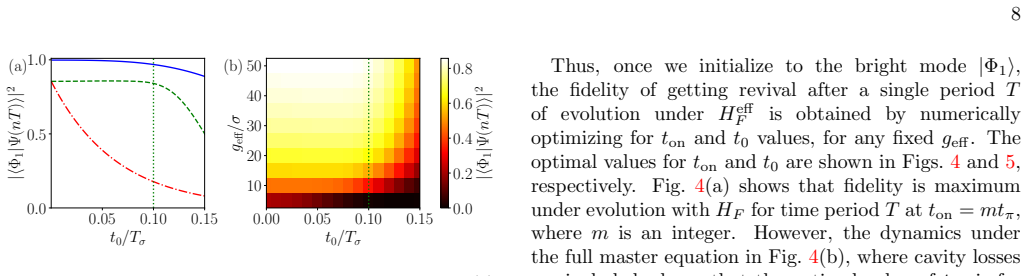
This simplifies the Hamiltonian H(0) F =H s m + geffton T (|Φ0⟩⟨Φ1|+|Φ 1⟩⟨Φ0|) =H s m + geffton T ˆσx 01.(23) 8 0.05 0.10 0.15 t0/Tσ 0.0 0.5 1.0 |⟨Φ1|Ψ(nT )⟩|2 (a) 0.00 0.05 0.10 0.15 t0/Tσ 10 20 30 40 50geff/σ (b) 0.0 0.2 0.4 0.6 0.8 |⟨Φ1|Ψ(nT )⟩|2 FIG. 5. Optimal periodt 0 when coupling is switched off: (a) fidelity variation during evolution over a sing...
discussion (0)
Sign in with ORCID, Apple, or X to comment. Anyone can read and Pith papers without signing in.