Optimal control of the coagulation-fragmentation equation
Pith reviewed 2026-05-10 12:14 UTC · model grok-4.3
The pith
A scalar time-dependent multiplier on the coagulation kernel steers the particle size distribution to a desired terminal state.
A machine-rendered reading of the paper's core claim, the machinery that carries it, and where it could break.
Core claim
The authors establish that the optimal control problem for the coagulation-fragmentation equation admits solutions under weak continuity of the control-to-state map in weighted L1. For bounded coagulation kernels they prove differentiability of the dynamics, obtain an adjoint equation, and derive a Pontryagin-type minimum principle. These analytic results justify a projected-gradient algorithm with Armijo line search and are illustrated numerically by driving the number of particles inside a prescribed size window to a target value.
What carries the argument
The scalar time-dependent control that multiplies the coagulation kernel, together with the weakly continuous control-to-state map in weighted L1 and the adjoint equation for the bounded-kernel case.
If this is right
- Existence of optimal controls follows directly from weak continuity and the direct method in the calculus of variations.
- Gamma-convergence of the cost functionals guarantees that optimal controls remain stable under truncation of the kernels.
- Differentiability of the dynamics for bounded kernels produces an adjoint equation and a first-order necessary condition in the form of a minimum principle.
- Lipschitz continuity of the reduced gradient ensures convergence of the projected-gradient algorithm with Armijo backtracking.
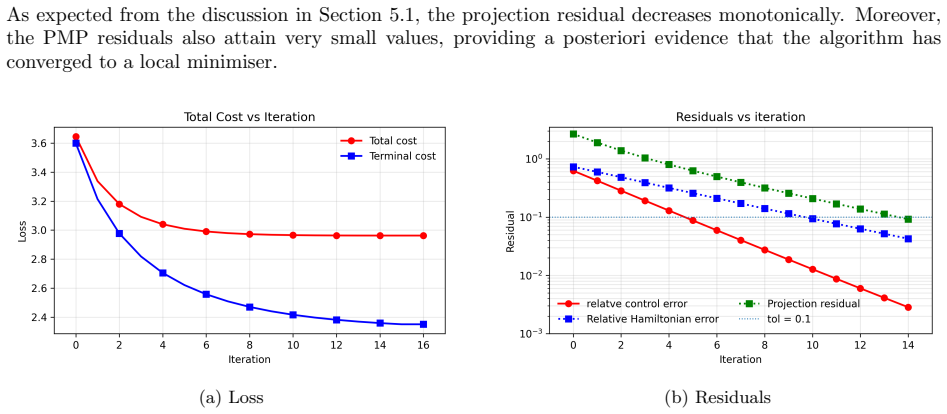
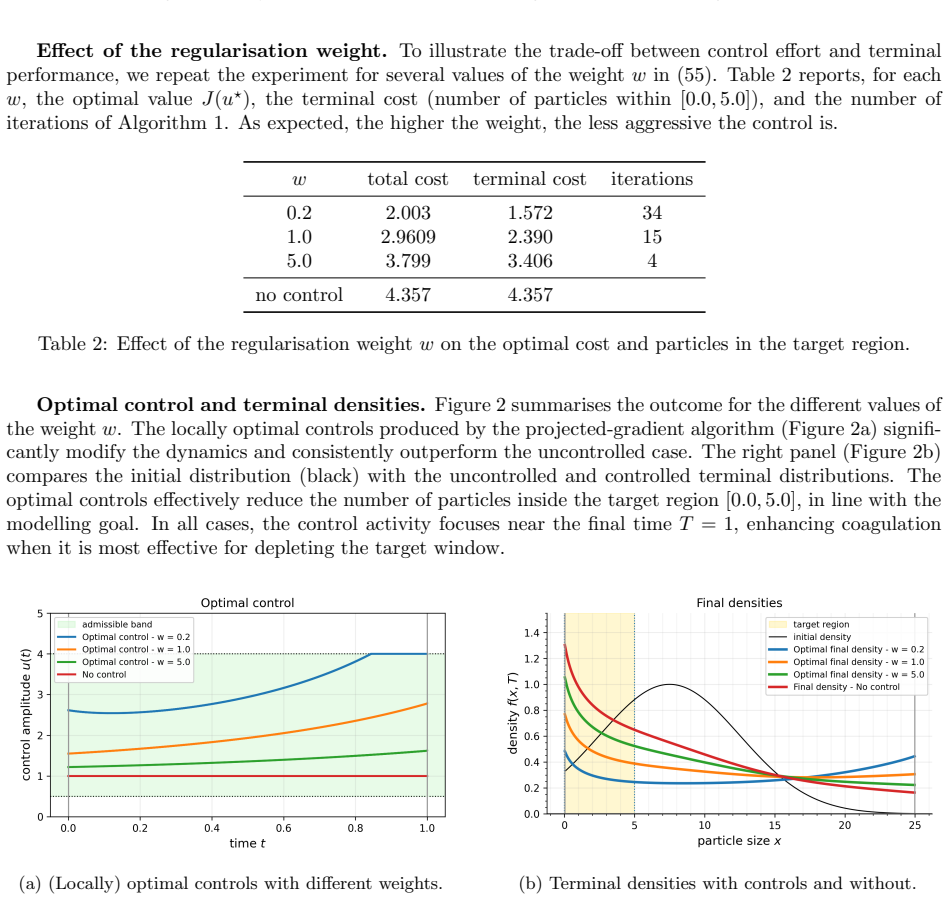
- Numerical finite-volume experiments confirm that the low-dimensional actuator can drive particle counts inside chosen size intervals to prescribed targets.
Where Pith is reading between the lines
- The same weak-continuity and Gamma-convergence arguments could be reused for control problems that also modulate the fragmentation kernel.
- The adjoint-based gradient could be combined with model-reduction techniques to handle kernels that remain unbounded on large size domains.
- The proof-of-concept finite-volume scheme suggests that real-time feedback control of coagulation processes may be feasible once reliable on-line measurements of the size distribution become available.
Load-bearing premise
The map from control to solution remains weakly continuous in the chosen weighted L1 space whenever the coagulation kernels meet the stated integrability and boundedness conditions.
What would settle it
A concrete counter-example in which the control-to-state map loses weak continuity, so that a minimizing sequence of controls fails to produce a limit that achieves the same terminal cost.
Figures
read the original abstract
We formulate and analyse an optimal control problem for the coagulation-fragmentation equation, where a scalar, time-dependent control modulates the coagulation rate by multiplying the coagulation kernel. The objective functional consists of a quadratic penalisation of the control and a terminal cost depending on the final size distribution. In a weighted $L^1$ framework, we prove weak-to-weak continuity of the control-to-state map under perturbations of the coefficients and obtain existence of optimal controls by the direct method. We then establish $\Gamma$-convergence of the corresponding cost functionals, providing stability of optimal controls and justifying truncation of unbounded kernels in the optimisation setting. For bounded coagulation kernels we show differentiability of the dynamics, derive an adjoint equation, and obtain a Pontryagin-type minimum principle. Lipschitz continuity of the gradient with respect to the control yields, at the continuous level, convergence of a projected-gradient algorithm with Armijo backtracking. A proof-of-concept finite-volume implementation is then used in a numerical study targeting the number of particles within a prescribed size window, demonstrating that a single low-dimensional actuator can effectively reshape an infinite-dimensional particle-size distribution.
Editorial analysis
A structured set of objections, weighed in public.
Referee Report
Summary. The manuscript formulates an optimal control problem for the coagulation-fragmentation equation in which a scalar time-dependent control multiplies the coagulation kernel. In a weighted L1 setting it proves weak-to-weak continuity of the control-to-state map under integrability conditions on the kernels, obtains existence of minimizers by the direct method, establishes Gamma-convergence of the cost functionals to justify truncation and stability of optima, derives the adjoint equation and a Pontryagin-type minimum principle for bounded kernels, shows Lipschitz continuity of the gradient to guarantee convergence of a projected-gradient algorithm with Armijo line search, and presents a finite-volume numerical example in which the scalar actuator successfully targets the number of particles in a prescribed size window.
Significance. If the stated continuity, differentiability, and Gamma-convergence results hold under the kernel assumptions, the work supplies a rigorous framework for low-dimensional control of an infinite-dimensional coagulation-fragmentation process. The combination of direct-method existence, Gamma-convergence for truncation, adjoint-based optimality conditions, and a convergent numerical algorithm constitutes a coherent contribution that directly addresses the practical question of whether a single actuator can reshape a particle-size distribution.
major comments (1)
- [§3, Assumption 2.1, Theorem 4.3] §3 (weak continuity of the control-to-state map): the proof relies on the integrability and boundedness conditions on the coagulation kernel stated in Assumption 2.1; if these conditions are only sufficient but not necessary, the claim that the map is weakly continuous for the full class of kernels used in the Gamma-convergence argument (Theorem 4.3) requires an explicit verification that the same integrability passes to the truncated kernels.
minor comments (2)
- [§6] The finite-volume scheme in §6 is described only at a high level; adding the precise quadrature rule for the coagulation integral and a short mesh-convergence table would strengthen reproducibility of the numerical demonstration.
- [§4] Notation for the weighted L1 space (norm, weight function) is introduced in §2 but used without repeated reminder in the Gamma-convergence section; a single sentence recalling the weight would improve readability.
Simulated Author's Rebuttal
We thank the referee for the positive assessment, the recommendation of minor revision, and the precise observation concerning the compatibility between the weak continuity result and the Gamma-convergence argument. We address the single major comment below and will incorporate the requested clarification.
read point-by-point responses
-
Referee: [§3, Assumption 2.1, Theorem 4.3] §3 (weak continuity of the control-to-state map): the proof relies on the integrability and boundedness conditions on the coagulation kernel stated in Assumption 2.1; if these conditions are only sufficient but not necessary, the claim that the map is weakly continuous for the full class of kernels used in the Gamma-convergence argument (Theorem 4.3) requires an explicit verification that the same integrability passes to the truncated kernels.
Authors: We agree that an explicit verification is required. The truncation used to obtain the approximating kernels in Theorem 4.3 is realized by multiplying the original kernel K by a smooth cutoff function χ_R ∈ [0,1] that equals 1 on [0,R] and vanishes outside [0,2R]. Because χ_R ≤ 1, every integrability or boundedness integral appearing in Assumption 2.1 for K is majorized by the same integral for the truncated kernel K_R = χ_R K. Consequently the hypotheses of Assumption 2.1 remain satisfied with identical constants, and the weak-to-weak continuity of the control-to-state map established in §3 applies verbatim to each truncated problem. We will insert a short paragraph immediately after Assumption 2.1 and a corresponding remark in the proof of Theorem 4.3 that records this inheritance. This addition removes any ambiguity and confirms that the continuity result covers the entire approximating sequence used for Gamma-convergence. revision: yes
Circularity Check
No significant circularity; derivation is self-contained
full rationale
The manuscript applies classical functional-analysis tools (weak-to-weak continuity in weighted L1, direct method for existence, Gamma-convergence for truncation) and standard optimal-control results (adjoint equation, Pontryagin minimum principle, projected-gradient convergence) to the coagulation-fragmentation PDE. All load-bearing steps are justified by stated integrability/boundedness assumptions on the kernels and by well-known theorems external to the paper; no self-definitional loops, fitted inputs renamed as predictions, or load-bearing self-citations appear. The numerical example is presented only as illustration, not as a fitted prediction. The central claim that a scalar control can reshape the distribution follows directly from the established continuity and optimality results without reduction to the inputs by construction.
Axiom & Free-Parameter Ledger
axioms (2)
- domain assumption The state space is a weighted L1 space in which the control-to-state map is weakly continuous under perturbations of the coefficients.
- domain assumption Coagulation kernels are non-negative and satisfy suitable integrability conditions that allow truncation and Gamma-convergence arguments.
Reference graph
Works this paper leans on
-
[1]
M. Aizenman and T. A. Bak. Convergence to equilibrium in a system of reacting polymers.Commu- nications in Mathematical Physics, 65(3):203–230, 1979
work page 1979
-
[2]
O. Alomari and P. B. Dubovski. Recovery of the integral kernel in the kinetic fragmentation equation. Inverse Problems in Science and Engineering, 21(1):171–181, 2013. 30
work page 2013
-
[3]
J. Andrejevic, L. M. Lee, S. M. Rubinstein, and C. H. Rycroft. A model for the fragmentation kinetics of crumpled thin sheets.Nature Communications, 12(1):1470, 2021
work page 2021
-
[4]
J. Banasiak and L. Arlotti.Perturbations of positive semigroups with applications. Springer, 2006
work page 2006
-
[5]
J. Banasiak, W. Lamb, and P. Lauren¸ cot.Analytic Methods for Coagulation-Fragmentation Models, Volume I. Chapman and Hall/CRC, 2019
work page 2019
-
[6]
J. Banasiak, W. Lamb, and P. Lauren¸ cot.Analytic Methods for Coagulation-Fragmentation Models, Volume II. Chapman and Hall/CRC, 2019
work page 2019
-
[7]
J. Carr. Asymptotic behaviour of solutions to the coagulation–fragmentation equations. I. The strong fragmentation case.Proceedings of the Royal Society of Edinburgh Section A: Mathematics, 121(3- 4):231–244, 1992
work page 1992
-
[8]
T. Cazenave and A. Haraux.An Introduction to Semilinear Evolution Equations. Clarendon Press, 1998
work page 1998
-
[9]
M. Chyba, J.-M. Coron, P. Gabriel, A. Jacquemard, G. Patterson, G. Picot, and P. Shang. Optimal geometric control applied to the protein misfolding cyclic amplification process.Acta Applicandae Mathematicae, 135(1):145–173, 2015
work page 2015
- [10]
-
[11]
M. G. F. de Moraes, M. A. Grover, M. B. de Souza Jr, P. L. C. Lage, and A. R. Secchi. Optimal control of crystal size and shape in batch crystallization using a bivariate population balance modeling. IFAC-PapersOnLine, 54(3):653–660, 2021
work page 2021
- [12]
- [13]
-
[14]
K.-J. Engel and R. Nagel.One-parameter semigroups for linear evolution equations. Springer, 2000
work page 2000
-
[15]
M. Escobedo, S. Mischler, and M. R. Ricard. On self-similarity and stationary problem for fragmentation and coagulation models.Annales de l’Institut Henri Poincar´ e C, 22(1):99–125, 2005
work page 2005
-
[16]
P. J. Flory.Principles of polymer chemistry. Cornell University Press, 1953
work page 1953
-
[17]
S. K. Friedlander.Smoke, Dust, and Haze: Fundamentals of Aerosol Dynamics, volume 198. Oxford University Press, New York, 2000
work page 2000
-
[18]
A. K. Giri. On the uniqueness for coagulation and multiple fragmentation equation.Kinetic and Related Models, 6(3):589–599, 2013
work page 2013
-
[19]
E. M. Hendriks, M. H. Ernst, and R. M. Ziff. Coagulation equations with gelation.Journal of Statistical Physics, 31:519–563, 1983
work page 1983
-
[20]
W. C. Hinds and Y. Zhu.Aerosol technology: properties, behavior, and measurement of airborne particles. John Wiley & Sons, 2022
work page 2022
- [21]
-
[22]
S. Hofmann, N. Bajcinca, J. Raisch, and K. Sundmacher. Optimal control of univariate and multivariate population balance systems involving external fines removal.Chemical Engineering Science, 168:101– 123, 2017
work page 2017
-
[23]
M. Z. Jacobson, D. B. Kittelson, and W. F. Watts. Enhanced coagulation due to evaporation and its effect on nanoparticle evolution.Environmental Science & Technology, 39(24):9486–9492, 2005
work page 2005
-
[24]
S. Kumar and D. Ramkrishna. On the solution of population balance equations by discretization—I. A fixed pivot technique.Chemical Engineering Science, 51(8):1311–1332, 1996. 31
work page 1996
-
[25]
K. Matyjaszewski and T. P. Davis.Handbook of radical polymerization, volume 922. Wiley Online Library, 2002
work page 2002
-
[26]
E. D. McGrady and R. M. Ziff. “Shattering” transition in fragmentation.Physical Review Letters, 58(9):892, 1987
work page 1987
-
[27]
Z. A. Melzak. A scalar transport equation.Transactions of the American Mathematical Society, 85(2):547–560, 1957
work page 1957
-
[28]
Z. A. Melzak. A scalar transport equation. II.Michigan Mathematical Journal, 4(3):193–206, 1957
work page 1957
- [29]
-
[30]
Z. K. Nagy. A population balance model approach for crystallization product engineering via distribution shaping control. In18th European Symposium on Computer Aided Process Engineering – ESCAPE 18, volume 25 ofComputer Aided Chemical Engineering, pages 139–144. Elsevier, 2008
work page 2008
-
[31]
Pazy.Semigroups of linear operators and applications to partial differential equations, volume 44
A. Pazy.Semigroups of linear operators and applications to partial differential equations, volume 44. Springer Science & Business Media, 2012
work page 2012
-
[32]
R. W. Samsel and A. S. Perelson. Kinetics of rouleau formation. I. A mass action approach with geometric features.Biophysical Journal, 37(2):493–514, 1982
work page 1982
-
[33]
R. W. Samsel and A. S. Perelson. Kinetics of rouleau formation. II. Reversible reactions.Biophysical Journal, 45(4):805–824, 1984
work page 1984
-
[34]
J. H. Seinfeld and S. N. Pandis.Atmospheric chemistry and physics: from air pollution to climate change. John Wiley & Sons, 2016
work page 2016
-
[35]
M. V. Smoluchowski. Drei Vortrage uber Diffusion, Brownsche Bewegung und Koagulation von Kol- loidteilchen.Zeitschrift fur Physik, 17:557–585, 1916
work page 1916
-
[36]
M. V. Smoluchowski. Versuch einer mathematischen Theorie der Koagulationskinetik kolloider L¨ osun- gen.Zeitschrift f¨ ur physikalische Chemie, 92(1):129–168, 1918
work page 1918
-
[37]
I. W. Stewart and E. Meister. A global existence theorem for the general coagulation–fragmentation equation with unbounded kernels.Mathematical Methods in the Applied Sciences, 11(5):627–648, 1989
work page 1989
-
[38]
G. Tim´ ar, J. Bl¨ omer, F. Kun, and H. J. Herrmann. New universality class for the fragmentation of plastic materials.Physical Review Letters, 104(9):095502, 2010
work page 2010
-
[39]
P. G. J. Van Dongen and M. H. Ernst. Size distribution in the polymerisation model AfRBg.Journal of Physics A: Mathematical and General, 17(11):2281, 1984
work page 1984
-
[40]
R. D. Vigil and R. M. Ziff. On the stability of coagulation—fragmentation population balances.Journal of Colloid and Interface Science, 133(1):257–264, 1989
work page 1989
-
[41]
R. M. Ziff and E. D. McGrady. The kinetics of cluster fragmentation and depolymerisation.Journal of Physics A: Mathematical and General, 18(15):3027, 1985. 32
work page 1985
discussion (0)
Sign in with ORCID, Apple, or X to comment. Anyone can read and Pith papers without signing in.