Recognition: unknown
A Modular and T-Gate Efficient Architecture for Quantum Leading-Zero/One Counter
Pith reviewed 2026-05-10 12:46 UTC · model grok-4.3
The pith
Reformulating leading-zero counting as conditional bit flips produces a modular quantum architecture with 40 percent lower T-count and 60 percent lower T-depth.
A machine-rendered reading of the paper's core claim, the machinery that carries it, and where it could break.
Core claim
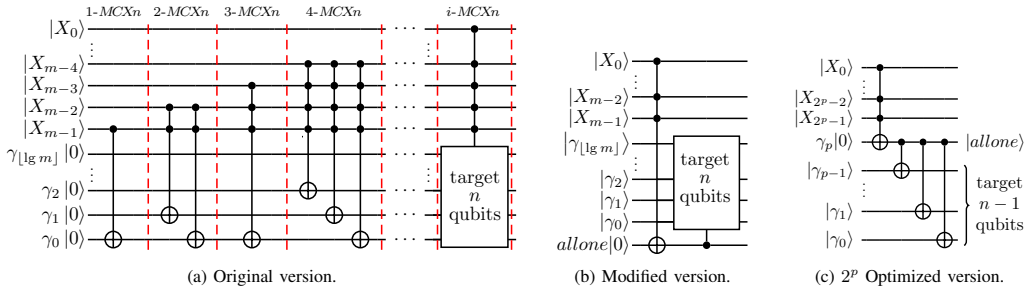
The central discovery is that leading-zero or leading-one counting can be performed by a sequence of systematic conditional bit-flip operations on all-zero or all-one qubit blocks together with a hierarchical merge strategy. This yields a single modular design that works for any input width, supports easy toggling between zero and one modes, and in its fan-out optimized form achieves T-depth of order log m instead of linear in m. Comparative evaluation shows the design uses 40 percent fewer T gates and 60 percent smaller T-depth than existing quantum leading-zero counters.
What carries the argument
The hierarchical merge strategy on blocks of identical qubits, which reduces the problem size logarithmically while preserving the count information through conditional flips.
If this is right
- The same circuit module can be reused for both leading-zero and leading-one detection by a simple control toggle.
- T-depth grows only logarithmically with input size rather than linearly.
- The design maintains low and predictable T-count across different bit widths without manual adjustment.
- Quantum arithmetic processors can incorporate this as a standard component to lower overall gate costs in normalization and scaling operations.
Where Pith is reading between the lines
- Similar block-merge techniques might apply to other quantum functions that detect runs of identical bits, such as certain priority encoders.
- Adoption in quantum compilers could allow automatic insertion of width-scalable counters without custom circuit design for each size.
- Hardware experiments on small instances would confirm whether the assumed correctness of the bit-flip reformulation holds in the presence of gate errors.
- The logarithmic depth reduction could compound in larger algorithms that use multiple such counters in parallel.
Load-bearing premise
The proposed sequence of conditional bit-flip operations and hierarchical merge produces the exact leading zero or one position for every possible input bit string.
What would settle it
Simulating the circuit for an 8-bit input with a known leading-zero count of 3 and verifying that the output register holds the binary representation of 3 after all gates are applied.
Figures




read the original abstract
The Quantum Leading-Zero/One Counter (QLZOC) is a fundamental component in quantum arithmetic, playing a critical role in normalization, floating-point units, dynamic range scaling, and logarithmic approximations. Conventional designs primarily rely on direct Boolean-to-quantum mapping, which results in inefficient resource utilization such as irregular gate growth and width-dependent resource overhead. In this work, we propose a scalable, modular, and resource efficient architecture for QLZOC by reformulating the counting process into a sequence of systematic conditional bit-flip operations. Moreover, our design achieves functional polymorphism so that the same design can be easily toggled between zero and one detection, while ensuring seamless scalability to any bit-width without manual re-tuning. We further introduce a Parallel QLZOC (PQLZOC) variant and a Fan-Out optimized (FO-PQLZOC) design. In this work, we evaluate resource efficiency based on the classic criteria about T gates, including the number of total T gates being used (T-count) and the number of sequential T gate layers (T-depth). By exploiting the properties of all-zero/one qubit blocks and a hierarchical merge strategy, the proposed FO-PQLZOC reduces the T-depth from O(m) to O(log m), where m is the input size. Comparative analysis demonstrates that our optimized architecture achieves a 40% reduction in T-count and a 60% reduction in T-depth over state-of-the-art designs, providing a high-performance, T-gate efficient solution for general-purpose quantum arithmetic processors.
Editorial analysis
A structured set of objections, weighed in public.
Referee Report
Summary. The manuscript proposes a modular, scalable architecture for the Quantum Leading-Zero/One Counter (QLZOC) by reformulating the function as a sequence of systematic conditional bit-flip operations combined with a hierarchical merge strategy. It introduces Parallel QLZOC (PQLZOC) and Fan-Out optimized (FO-PQLZOC) variants that achieve functional polymorphism (toggling between zero and one detection), O(log m) T-depth scaling for m-bit inputs, and claims 40% T-count and 60% T-depth reductions relative to prior designs, positioning the work as a T-gate efficient building block for quantum arithmetic.
Significance. If the reformulation is shown to be correct, the modular and polymorphic design would represent a useful advance for resource-constrained quantum arithmetic circuits, particularly in normalization, floating-point units, and logarithmic approximations. The explicit focus on T-count and T-depth metrics is well-aligned with fault-tolerant quantum computing requirements, and the hierarchical merge approach could enable better scalability than direct Boolean mappings.
major comments (2)
- [Proposed Architecture and Reformulation] The performance claims presuppose that the conditional bit-flip sequence plus hierarchical merge exactly computes the leading-zero/one position for arbitrary m and all 2^m input states. The manuscript provides no inductive argument, formal proof, or exhaustive verification (e.g., simulation over all basis states or measurement outcomes) that the quantum circuit produces the correct output register without phase or entanglement errors; this verification is load-bearing for both the functional-polymorphism claim and the reported T-gate reductions.
- [Comparative Analysis] § on comparative analysis: the 40% T-count and 60% T-depth reductions are stated without accompanying tables, explicit gate-count breakdowns, or circuit diagrams that would allow direct comparison to the cited state-of-the-art designs; the abstract alone does not supply the concrete resource numbers needed to substantiate the headline figures.
minor comments (1)
- [Abstract] The abstract refers to 'classic criteria about T gates' but does not define the precise T-count and T-depth measurement conventions (e.g., whether Clifford gates are counted or how fan-out is costed) used in the evaluation.
Simulated Author's Rebuttal
We thank the referee for the constructive feedback and detailed assessment of our manuscript on the modular QLZOC architecture. We address each major comment below and will revise the manuscript to strengthen the presentation of correctness and comparative analysis.
read point-by-point responses
-
Referee: [Proposed Architecture and Reformulation] The performance claims presuppose that the conditional bit-flip sequence plus hierarchical merge exactly computes the leading-zero/one position for arbitrary m and all 2^m input states. The manuscript provides no inductive argument, formal proof, or exhaustive verification (e.g., simulation over all basis states or measurement outcomes) that the quantum circuit produces the correct output register without phase or entanglement errors; this verification is load-bearing for both the functional-polymorphism claim and the reported T-gate reductions.
Authors: We acknowledge the referee's point that an explicit inductive proof and verification were not included in the submitted version. The reformulation is derived from adapting classical leading-zero detection algorithms (such as those based on priority encoding and hierarchical merging) into quantum conditional bit-flips, which are unitary operations that map basis states correctly by construction. In the revised manuscript, we will add a dedicated subsection with an inductive proof of correctness for the bit-flip sequence and merge strategy across arbitrary m, showing that the output register encodes the exact position without extraneous phases or entanglement for computational basis inputs. We will also include exhaustive simulation results for small m (e.g., m=4 and m=8) confirming correct outputs for all 2^m states, along with a note that the design uses only standard Clifford+T gates that preserve the required unitarity. revision: yes
-
Referee: [Comparative Analysis] § on comparative analysis: the 40% T-count and 60% T-depth reductions are stated without accompanying tables, explicit gate-count breakdowns, or circuit diagrams that would allow direct comparison to the cited state-of-the-art designs; the abstract alone does not supply the concrete resource numbers needed to substantiate the headline figures.
Authors: We agree that the comparative claims require more explicit supporting data. The reported 40% T-count and 60% T-depth reductions are calculated from our resource estimates for the FO-PQLZOC (leveraging parallelization and fan-out optimization) versus the direct Boolean mappings and prior QLZOC designs referenced in the paper. In the revision, we will expand the comparative analysis section to include a detailed table with T-count and T-depth breakdowns for each modular component (e.g., bit-flip blocks and merge stages), explicit comparisons to the cited works, and high-level circuit diagrams or pseudocode for the key subcircuits to enable direct verification of the numbers. revision: yes
Circularity Check
No circularity; direct architectural reformulation with independent gate-count claims
full rationale
The manuscript describes a proposed quantum circuit architecture obtained by reformulating leading-zero/one counting as conditional bit-flip operations plus hierarchical merge. No equations, parameters, or outputs are defined in terms of the claimed T-count/T-depth reductions; the reductions are presented as the result of explicit gate enumeration on the constructed circuit versus external prior designs. No self-citation is invoked as a uniqueness theorem or load-bearing premise for the functional correctness or resource figures. The derivation chain is therefore self-contained and does not reduce to its inputs by construction.
Axiom & Free-Parameter Ledger
axioms (1)
- domain assumption Standard quantum gates including T-gates can implement conditional bit-flip operations for arithmetic circuits.
Reference graph
Works this paper leans on
-
[1]
Quantum algorithms for scientific computing,
R. Au-Yeung, B. Camino, O. Rathore, and V . Kendon, “Quantum algorithms for scientific computing,”Reports on Progress in Physics, vol. 87, no. 11, p. 116001, 2024. [Online]. Available: https: //doi.org/10.1088/1361-6633/ad85f0
-
[3]
Available: https://arxiv.org/abs/2303.09353
[Online]. Available: https://arxiv.org/abs/2303.09353
-
[4]
Scaling up and down of 3-d floating-point data in quantum computation,
M. Xu, D. Lu, and X. Sun, “Scaling up and down of 3-d floating-point data in quantum computation,”Scientific Reports, vol. 12, no. 1, p. 2771,
-
[5]
Available: https://doi.org/10.1038/s41598-022-06756-w
[Online]. Available: https://doi.org/10.1038/s41598-022-06756-w
-
[6]
A resource-efficient design for a reversible floating point adder in quantum computing,
T. D. Nguyen and R. Van Meter, “A resource-efficient design for a reversible floating point adder in quantum computing,”ACM Journal on Emerging Technologies in Computing Systems, vol. 11, no. 2, pp. 1–18, 2014
2014
-
[7]
Design of an efficient reversible single precision floating point adder,
A. AnanthaLakshmi and G. Sudha, “Design of an efficient reversible single precision floating point adder,”International Journal of Computational Intelligence Studies, vol. 4, no. 1, pp. 2–30,
-
[8]
Available: https://www.inderscienceonline.com/doi/abs/ 10.1504/IJCISTUDIES.2015.069830
[Online]. Available: https://www.inderscienceonline.com/doi/abs/ 10.1504/IJCISTUDIES.2015.069830
-
[9]
T-count optimized quantum circuit designs for single- precision floating-point division,
S. S. Gayathri, R. Kumar, S. Dhanalakshmi, G. Dooly, and D. B. Duraibabu, “T-count optimized quantum circuit designs for single- precision floating-point division,”Electronics, vol. 10, no. 6, p. 703, 2021
2021
-
[10]
Efficient Floating- point Division Quantum Circuit using Newton-Raphson Division,
S. S. Gayathri, R. Kumar, and S. Dhanalakshmi, “Efficient Floating- point Division Quantum Circuit using Newton-Raphson Division,”J. Phys. Conf. Ser., vol. 2335, no. 1, p. 012058, 2022
2022
-
[11]
Optimized quantum leading zero detector circuits,
F. Orts, G. Ortega, E. F. Combarro, and et al., “Optimized quantum leading zero detector circuits,”Quantum Information Processing, vol. 22, p. 28, 2023
2023
-
[12]
Supplementary of qlzoc,
“Supplementary of qlzoc,” https://github.com/nckuStone/Supplementary-of-QLZOC
-
[13]
Design automation and design space exploration for quantum computers,
M. Soeken, M. Roetteler, N. Wiebe, and G. De Micheli, “Design automation and design space exploration for quantum computers,” in Design, Automation & Test in Europe Conference & Exhibition (DATE), 2017, March 2017, pp. 470–475
2017
-
[14]
Elementary gates for quantum computation,
A. Barenco, C. Bennett, R. Cleve, D. DiVincenzo, N. Margolus, P. Shor, T. Sleator, J. Smolin, and H. Weinfurter, “Elementary gates for quantum computation,”Physical Review A, vol. 52, 03 1995
1995
-
[15]
A meet-in-the- middle algorithm for fast synthesis of depth-optimal quantum circuits,
M. Amy, D. Maslov, M. Mosca, and M. Roetteler, “A meet-in-the- middle algorithm for fast synthesis of depth-optimal quantum circuits,” IEEE Transactions on Computer-Aided Design of Integrated Circuits and Systems, vol. 32, no. 6, pp. 818–830, June 2013
2013
-
[16]
A meet-in-the-middle algorithm for fast synthesis of depth-optimal quantum circuits,
A. Amy, D. Maslov, and M. Mosca, “A meet-in-the-middle algorithm for fast synthesis of depth-optimal quantum circuits,”IEEE Transactions on Computer-Aided Design of Integrated Circuits and Systems, vol. 32, no. 6, pp. 818–830, 2013
2013
-
[17]
Low-overhead constructions for the fault-tolerant toffoli gate,
C. Jones, “Low-overhead constructions for the fault-tolerant toffoli gate,” Physical Review A, vol. 87, no. 2, p. 022328, 2013
2013
-
[18]
Quantum circuits oft-depth one,
P. Selinger, “Quantum circuits oft-depth one,”Phys. Rev. A, vol. 87, p. 042302, Apr 2013. [Online]. Available: https://link.aps.org/doi/10. 1103/PhysRevA.87.042302
2013
-
[19]
Halving the cost of quantum addition,
C. Gidney, “Halving the cost of quantum addition,”Quantum, vol. 2, p. 74, 2018
2018
-
[20]
An algorithmic and novel design of a leading zero detector circuit: comparison with logic synthesis,
V . G. Oklobdzija, “An algorithmic and novel design of a leading zero detector circuit: comparison with logic synthesis,”IEEE Transactions on Very Large Scale Integration (VLSI) Systems, vol. 2, no. 1, pp. 124–128, Mar. 1994
1994
-
[21]
Leading zero anticipation and detection- a comparison of methods,
M. Schmookler and K. Nowka, “Leading zero anticipation and detection- a comparison of methods,” inProceedings 15th IEEE Symposium on Computer Arithmetic. ARITH-15 2001, June 2001, pp. 7–12
2001
-
[22]
Modular design of fast leading zeros counting circuit,
N. Milenkovi ´c, V . Stankovic, and M. Mili ´c, “Modular design of fast leading zeros counting circuit,”Journal of Electrical Engineering, vol. 66, pp. 329–333, 11 2015
2015
-
[23]
An efficient base-4 leading zero detector design,
A. Walker and E. Sowells-Boone, “An efficient base-4 leading zero detector design,”Electrical Engineering : An International Journal, vol. 5, pp. 01–07, 03 2018
2018
-
[24]
G. Aleksandrowicz, T. Alexander, P. Barkoutsoset al., “Qiskit: An open-source framework for quantum computing,” Jan. 2019. [Online]. Available: https://doi.org/10.5281/zenodo.2562111
-
[25]
Sliqsim: A quantum circuit simulator and solver for probability and statistics queries,
T.-F. Chen and J.-H. R. Jiang, “Sliqsim: A quantum circuit simulator and solver for probability and statistics queries,” inInternational Conference on Tools and Algorithms for the Construction and Analysis of Systems (TACAS), 2025, pp. 129–138
2025
discussion (0)
Sign in with ORCID, Apple, or X to comment. Anyone can read and Pith papers without signing in.