Singular Solutions of the Tolman Oppenheimer Volkoff Equation with a Cosmological Constant Classification and Properties
Pith reviewed 2026-05-10 12:50 UTC · model grok-4.3
The pith
All singular solutions of the Tolman-Oppenheimer-Volkoff equation with a cosmological constant share a universal geometric structure.
A machine-rendered reading of the paper's core claim, the machinery that carries it, and where it could break.
Core claim
We obtain a general classification of solutions to the Tolman-Oppenheimer-Volkoff equation with a cosmological constant for general thermodynamically consistent equations of state, without imposing regularity at the center. Formulating the problem as an initial value system integrated from an outer boundary inwards, we show that singular configurations dominate the solution space. All singular solutions share a universal geometric structure and give rise to spacetimes that are bounded-acceleration complete, indicating that the associated singularities are comparatively mild. Our results extend the classification previously obtained for Lambda equal to zero and reveal qualitatively new ures.
What carries the argument
The initial-value integration of the TOV equation from an outer boundary inwards, which produces the classification and reveals the universal geometric structure shared by singular solutions.
If this is right
- Singular solutions dominate the solution space for the TOV equation with a cosmological constant.
- All singular solutions produce spacetimes that are bounded-acceleration complete.
- For negative cosmological constant, solutions exist with approximate horizon structures that mimic black holes in equilibrium with Hawking radiation.
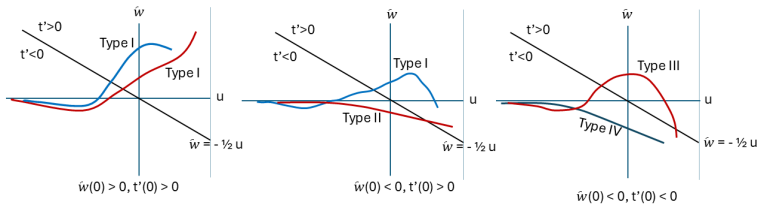
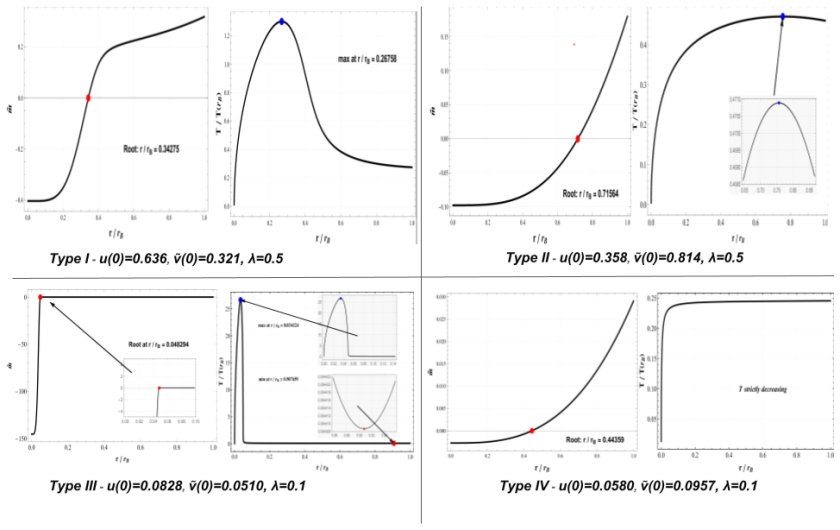
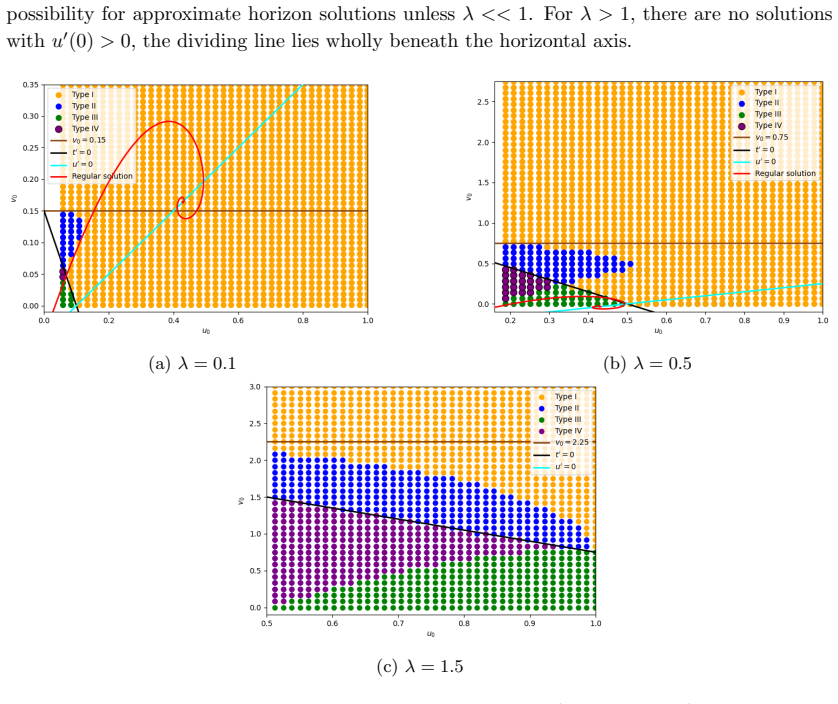
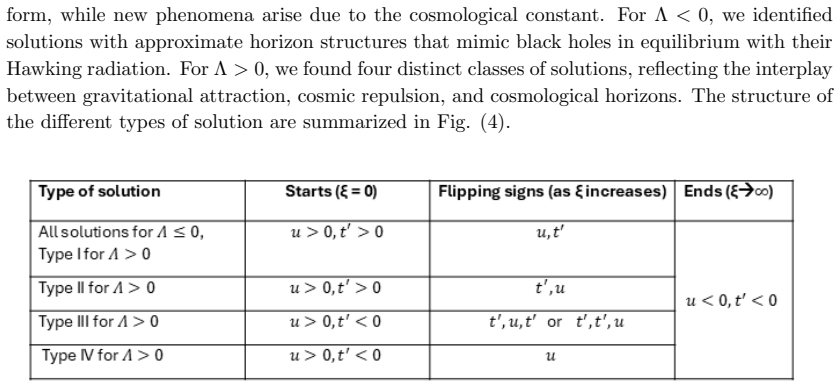
- For positive cosmological constant, four distinct classes of solutions with cosmological horizons appear, distinguished by their temperature gradients.
Where Pith is reading between the lines
- If bounded-acceleration completeness holds generally, these mild singularities could permit global spacetime extensions more easily than stronger curvature singularities in stellar models.
- The same initial-value classification approach might reveal similar dominance of mild singularities when applied to other matter models or modified gravity theories.
- The horizon-mimicking solutions for negative Lambda could serve as equilibrium configurations for studying thermal properties in anti-de Sitter settings.
Load-bearing premise
The integration proceeds from an outer boundary inwards without imposing regularity at the center, for general thermodynamically consistent equations of state.
What would settle it
A numerical integration that produces a singular solution lacking the claimed universal geometric structure or a resulting spacetime that fails to be bounded-acceleration complete.
Figures
read the original abstract
We study the Tolman-Oppenheimer-Volkoff equation in the presence of a cosmological constant for general thermodynamically consistent equations of state, without imposing regularity at the center. Formulating the problem as an initial value system integrated from an outer boundary inwards, we obtain a general classification of solutions and show that singular configurations dominate the solution space. We demonstrate that all singular solutions share a universal geometric structure and give rise to spacetimes that are bounded-acceleration complete, indicating that the associated singularities are comparatively mild. Our results extend the classification previously obtained for {\Lambda}=0 and reveal qualitatively new features for $\Lambda \neq 0$. For $\Lambda < 0$, we identify solutions with approximate horizon structures that mimic black holes in equilibrium with their Hawking radiation. For $\Lambda > 0$, we find four distinct classes of solutions with cosmological horizons, distinguished by the behavior of their temperature gradients.
Editorial analysis
A structured set of objections, weighed in public.
Referee Report
Summary. The manuscript studies singular solutions of the Tolman-Oppenheimer-Volkoff equation with nonzero cosmological constant for arbitrary thermodynamically consistent equations of state. Formulating the system as an initial-value problem integrated inward from an outer boundary (without central regularity), the authors classify solutions and argue that singular configurations dominate the space. They claim all singular solutions share a universal near-singularity geometry that renders the associated spacetimes bounded-acceleration complete. The work extends the prior Λ=0 classification and identifies new horizon structures: approximate black-hole-like horizons in equilibrium with Hawking radiation for Λ<0, and four distinct classes of cosmological-horizon solutions for Λ>0 distinguished by temperature-gradient behavior.
Significance. If the classification and universality statements hold, the results provide a systematic extension of singular stellar models to asymptotically (anti-)de Sitter settings. The bounded-acceleration completeness of the singularities and the explicit identification of new horizon classes for nonzero Λ constitute concrete advances with potential relevance to gravitational collapse, horizon thermodynamics, and the structure of singularities in general relativity with matter. The inward-IVP approach for general EOS is a methodological strength that avoids ad-hoc central assumptions.
minor comments (3)
- [Abstract] The abstract introduces 'bounded-acceleration complete' without a brief definition or reference; adding one sentence would improve accessibility for readers unfamiliar with the term.
- [Results section on Λ>0] The four classes of Λ>0 solutions are distinguished by temperature-gradient behavior; a compact table or diagram summarizing the distinguishing features of each class would aid comparison.
- [Section introducing the TOV system with Λ] Notation for the temperature gradient and its relation to the metric functions should be stated explicitly at first use to avoid ambiguity when comparing to the Λ=0 case.
Simulated Author's Rebuttal
We thank the referee for their positive assessment of our manuscript, accurate summary of the main results, and recommendation for minor revision. We are pleased that the significance of the inward-IVP approach, the dominance of singular solutions, the universal near-singularity geometry, and the new horizon classes for nonzero Lambda are recognized as advances.
Circularity Check
No significant circularity detected in derivation chain
full rationale
The paper sets up the TOV equation with cosmological constant as a standard initial-value problem integrated inward from an outer boundary for arbitrary thermodynamically consistent equations of state, without center regularity. The classification of singular solutions, their shared near-singularity geometry, and bounded-acceleration completeness follow directly from analysis of the resulting ODE system and its asymptotic behavior. Extension of the Λ=0 classification is achieved by the same inward-integration technique applied to the modified equations, with new horizon classes for Λ≠0 emerging as direct consequences of the altered potential terms; no parameter fitting, self-referential definitions, or load-bearing self-citations reduce any central claim to its own inputs. The mathematical results are self-contained against the differential-equation structure.
Axiom & Free-Parameter Ledger
axioms (2)
- domain assumption Thermodynamically consistent equations of state
- standard math Einstein equations with cosmological constant
Reference graph
Works this paper leans on
-
[1]
C. Anastopoulos and N. Savvidou,Classification Theorem and Properties of Singular Solu- tions to the Tolman-Oppenheimer-Volkoff Equation, Class. Quant. Grav. 38, 075024 (2021). 16
work page 2021
-
[2]
W. H. Zurek and D. N. Page,Black-hole Thermodynamics and Singular Solutions of the Tolman-Oppenheimer-Volkoff Equation, Phys. Rev. D29, 628 (1984)
work page 1984
-
[3]
G. L. Comer and J. Katz,Some Conditions for Existence of Tension Stars, MNRAS 267, 51 (1994)
work page 1994
-
[4]
C. Anastopoulos and N. Savvidou,Entropy of Singularities in Self-Gravitating Radiation, Class. Quant. Grav. 29, 025004 (2012)
work page 2012
-
[5]
D. Kotopoulis and C. Anastopoulos,Thermodynamics and Phase Transitions of Black Holes in Contact with a Gravitating Heat Bath, Class. Quant. Grav. 38 , 195026 (2021)
work page 2021
-
[6]
H. C. Kim,Classifying Self-Gravitating Radiations, Phys. Rev. D95, 044021 (2017)
work page 2017
-
[7]
Z. Stuchl´ ık,Spherically Symmetric Static Configurations of Uniform Density in Spacetimes with a non-zero Cosmological Constant, Acta Phys. Slovaca 50 , 219 (2000)
work page 2000
-
[8]
C. G. B¨ ohmer,Eleven Spherically Symmetric Constant Density Solutions with Cosmological Constant, Gen. Rel. Grav. 36, 1039 (2004)
work page 2004
-
[9]
C. G. B¨ ohmer and T. Harko,Does the Cosmological Constant Imply the Existence of a Minimum Mass?, Phys. Lett. B 630, 73 (2005)
work page 2005
- [10]
-
[11]
Winter,Analysis of the Cosmological Oppenheimer-Volkoff Equations, J
D. Winter,Analysis of the Cosmological Oppenheimer-Volkoff Equations, J. Math. Phys. 41, 5582 (2000)
work page 2000
-
[12]
S. W. Hawking and G. R. F. Ellis,The Large Scale Structure of Spacetime(Cambridge University Press, Cambridge 1973)
work page 1973
-
[13]
R. P. Geroch,What is a Singularity in General Relativity?, Ann. Phys. (New York), 48, 526 (1968)
work page 1968
-
[14]
D. Kotopoulis and C. Anastopoulos,Thermodynamics of Spherically Symmetric Thin-Shell Spacetimes, Class. Quant. Grav. 40, 22505 (2023)
work page 2023
-
[15]
R. Penrose,Singularities and Time-Asymmetry, in “Einstein Centenary Volume”, S. W. Hawking and G. Ellis (eds.) (Cambridge University Press, Cambridge 1979)
work page 1979
-
[16]
The Future of Theoretical Physics and Cosmology
R. Penrose,The Problem of Spacetime Singularities: Implications for Quantum Gravity?, in “The Future of Theoretical Physics and Cosmology”, G. Gibbons, P. Shellard and S. Rankin (eds.) (Cambridge University Press, Cambridge 2002)
work page 2002
-
[17]
G. W. Gibbons and S. W. Hawking,Cosmological Event Horizons, Thermodynamics, and Particle Creation, Phys. Rev. D15, 2738 (1977)
work page 1977
-
[18]
J. M. Maldacena,The Large N Limit of Superconformal Field Theories and Supergravity, Adv. Theor. Math. Phys. 2, 231 (1998). 17
work page 1998
- [19]
- [20]
-
[21]
D. Kubizˇ n´ ak and R. B. Mann,P–V Criticality of Charged AdS Black Holes, JHEP 1207, 033 (2012)
work page 2012
-
[22]
D. Kubizˇ n´ ak, R. B. Mann, and M. Teo,Black Hole Chemistry: Thermodynamics with Lambda, Class. Quant. Grav. 34, 063001 (2017)
work page 2017
-
[23]
Kottler, ¨Uber die Physikalischen Grundlagen der Einsteinschen Gravitationstheorie
F. Kottler, ¨Uber die Physikalischen Grundlagen der Einsteinschen Gravitationstheorie. An- nalen der Physik 361, 401 (1918)
work page 1918
-
[24]
Z. Stuchl´ ık and S. Hled´ ık,Some Properties of the Schwarzschild–de Sitter and Schwarzschild–anti–de Sitter Spacetimes, Phys. Rev. D60, 044006 (1999)
work page 1999
-
[25]
J. Katz and Y. Manor,Entropy Extremum of Relativistic Self-Bound Systems: A Geometric Approach, Phys. Rev. D12, 956 (1975)
work page 1975
-
[26]
N. Savvidou and C. Anastopoulos,The Thermodynamics of Self-gravitating Systems in Equilibrium is Holographic, Class. Quant. Grav. 31, 055003 (2014)
work page 2014
-
[27]
J. C. Collins,Renormalization, (Cambridge University Press, Cambridge 1984)
work page 1984
-
[28]
J. Smoller and B. Temple,On the Oppenheimer-Volkoff Equations in General Relativity, Arch. Rational Mech. Anal. 142, 177 (1998)
work page 1998
-
[29]
C. Anastopoulos and N. Savvidou,The Thermodynamics of a Black Hole in Equilibrium Implies the Breakdown of Einstein Equations on a Macroscopic Near-Horizon Shell, JHEP 144 (2016). 18
work page 2016
discussion (0)
Sign in with ORCID, Apple, or X to comment. Anyone can read and Pith papers without signing in.