Tests of Lorentz Symmetry using X-ray Polarimetry
Pith reviewed 2026-05-10 13:12 UTC · model grok-4.3
The pith
X-ray polarization from active galactic nuclei tightens Lorentz symmetry limits by four orders of magnitude over optical results.
A machine-rendered reading of the paper's core claim, the machinery that carries it, and where it could break.
Core claim
X-ray polarization measurements of active galactic nuclei yield new constraints on Lorentz invariance violation parameters in the Standard-Model Extension that improve previous optical bounds by four orders of magnitude.
What carries the argument
Polarization of X-rays from active galactic nuclei, whose sensitivity to accumulated travel-time differences between polarization modes over cosmological distances allows detection of tiny Lorentz-violating effects.
If this is right
- Tighter bounds apply to the photon-sector coefficients of the Standard-Model Extension.
- No vacuum birefringence is detected at X-ray energies for the observed sources at the new sensitivity level.
- High-energy astrophysical polarization serves as a cumulative probe that grows more powerful with source distance.
Where Pith is reading between the lines
- The same accumulation principle could be tested with future X-ray polarimeters on more distant or brighter sources to reach even higher energies.
- If a nonzero signal appears in larger datasets, it would directly indicate a breakdown of special relativity at accessible energies.
- Cross-checks with gamma-ray polarization data from the same objects would test whether the effect scales with photon energy as predicted by the framework.
Load-bearing premise
The measured X-ray polarization from the active galactic nuclei is dominated by propagation effects over cosmological distances and is not significantly altered by source-intrinsic emission processes or other unaccounted astrophysical propagation effects.
What would settle it
Detection that the observed X-ray polarization angles or degrees are fully explained by source emission models or local astrophysical effects without any propagation-induced rotation would remove the basis for the reported constraints.
Figures
read the original abstract
Lorentz symmetry is the fundamental symmetry of Einstein's theory of Special Relativity and has been tested to great precision. Nevertheless, the possibility remains that it is violated at the Planck scale, as predicted by some theories of quantum gravity. While the Planck scale is not directly accessible to experiments, minute residual deviations from Lorentz symmetry at attainable energies may be observable. The polarization of light from astrophysical sources is a particularly powerful probe because tiny differences accumulate as light travels over astrophysical distances, and polarization is sensitive to light travel time differences between polarization modes on the order of the oscillation period of the electromagnetic wave. Here, we report on new constraints on Lorentz invariance violation derived from X-ray polarization measurements of active galactic nuclei. The new constraints, presented in the framework of the Standard-Model Extension, improve on our previous work, which used optical polarization measurements, by four orders of magnitude.
Editorial analysis
A structured set of objections, weighed in public.
Referee Report
Summary. The manuscript reports new upper limits on Lorentz-violating coefficients in the photon sector of the Standard-Model Extension (SME), obtained from X-ray polarization measurements of active galactic nuclei. It claims these limits improve on the authors' prior optical-polarization constraints by four orders of magnitude, owing to the E^2 scaling of birefringence and the longer cosmological baselines probed at X-ray energies.
Significance. If the central assumption holds, the work supplies substantially tighter, observationally grounded bounds on possible Planck-scale Lorentz violation within a well-established effective-field-theory framework. The use of existing X-ray polarimetry data sets and the explicit comparison to previous optical results constitute a clear incremental advance in astrophysical tests of fundamental symmetries.
major comments (1)
- [§3.2] §3.2 and Table 2: the claim that source-intrinsic polarization is negligible relies on a qualitative argument about AGN emission mechanisms; a quantitative estimate of the maximum allowable intrinsic rotation (or a reference to a dedicated study) is needed to confirm that propagation effects dominate at the reported precision.
minor comments (3)
- The energy range and specific AGN sources contributing to each bound should be stated explicitly in the abstract or §2 for reproducibility.
- [Eq. (7)] Eq. (7) introduces the birefringence phase without defining the sign convention for the Stokes parameters; a brief parenthetical clarification would prevent ambiguity when comparing to other SME analyses.
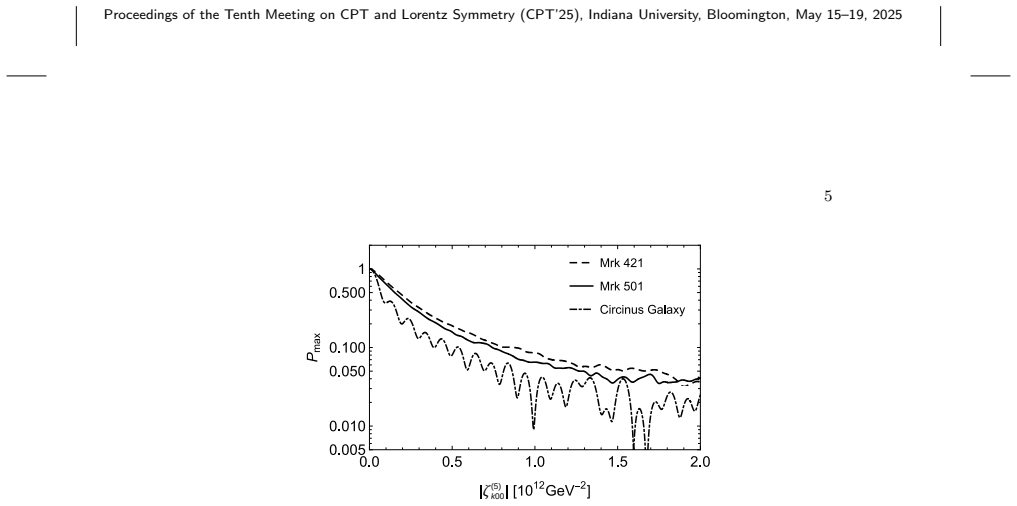
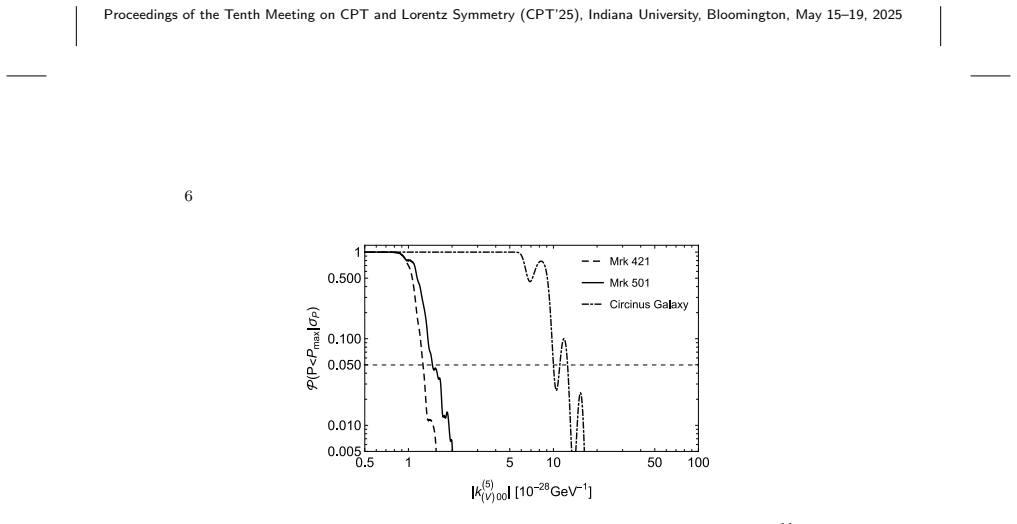
- [Figure 3] Figure 3 caption should note whether the plotted limits are 95 % or 99 % CL and how the combined constraint is obtained from the individual sources.
Simulated Author's Rebuttal
We thank the referee for the careful reading of the manuscript and the constructive comment. The positive overall assessment is appreciated. We address the single major comment below and have revised the manuscript to incorporate a more quantitative justification.
read point-by-point responses
-
Referee: [§3.2] §3.2 and Table 2: the claim that source-intrinsic polarization is negligible relies on a qualitative argument about AGN emission mechanisms; a quantitative estimate of the maximum allowable intrinsic rotation (or a reference to a dedicated study) is needed to confirm that propagation effects dominate at the reported precision.
Authors: We agree that the original discussion in §3.2 was largely qualitative and that a quantitative estimate or explicit reference would strengthen the case. In the revised manuscript we have added a paragraph in §3.2 that provides a rough upper bound on source-intrinsic rotation, derived from typical X-ray polarization fractions and emission models for AGN (synchrotron and inverse-Compton processes in jets). We cite dedicated studies on intrinsic polarization in blazars and Seyfert galaxies that indicate rotation angles well below 0.1° for the relevant sources and energies. This bound is negligible compared with the accumulated propagation-induced rotation over cosmological baselines at X-ray energies. We have also updated the text surrounding Table 2 to reference this estimate explicitly. revision: yes
Circularity Check
No significant circularity; observational limits from external data
full rationale
The paper reports new upper limits on SME photon-sector coefficients from X-ray polarization measurements of AGN. These limits are obtained by applying the established SME birefringence formalism to published polarization data; the four-order improvement is explicitly attributed to the higher photon energies and cosmological baselines of the X-ray observations relative to prior optical work by the same author. No derivation step redefines a fitted parameter as a prediction, imports a uniqueness theorem from self-citation, or reduces the final bound to an input by algebraic identity. The cited prior optical result serves only as a benchmark for improvement and is not required to justify the present analysis.
Axiom & Free-Parameter Ledger
axioms (1)
- domain assumption The Standard-Model Extension provides the correct effective field theory parametrization for possible Lorentz violation at low energies.
Reference graph
Works this paper leans on
-
[1]
R.C. Myers and M. Pospelov, Phys. Rev. Lett.90, 211601 (2003); T.G. Rizzo, J. High Energy Phys.2005, 036 (2005); V.A. Kosteleck´ y and S. Samuel, Phys. Rev. D39, 683 (1989); C.P. Burgesset al., J. High Energy Phys.2002, 043 (2002); R. Gambini and J. Pullin, Phys. Rev. D59, 124021 (1999); M. Pospelov and Y. Shang, Phys. Rev. D85, 105001 (2012); M. Li, Y.F....
work page 2003
-
[2]
V. Vasileiouet al., Phys. Rev. D87, 122001 (2013); F. Kislat and H. Krawczynski, Phys. Rev. D92, 045016 (2015); J.J. Wei and X.F. Wu, Front. Phys.16, 44300 (2021)
work page 2013
- [3]
-
[4]
V.A. Kosteleck´ y and M. Mewes, Phys. Rev. Lett.110, 201601 (2013)
work page 2013
- [5]
-
[6]
F. Kislat and H. Krawczynski, Phys. Rev. D95, 083013 (2017); F. Kislat, Symmetry10, 596 (2018); R. Gerasimov, P. Bhoj, and F. Kislat, Symmetry 13, 880 (2021)
work page 2017
-
[7]
D. Colladay and V.A. Kosteleck´ y, Phys. Rev. D55, 6760 (1997); D. Colladay and V.A. Kosteleck´ y, Phys. Rev. D58, 116002 (1998); V.A. Kosteleck´ y and M. Mewes, Phys. Rev. D66, 056005 (2002); V.A. Kosteleck´ y, Phys. Rev. D 69, 105009 (2004)
work page 1997
- [8]
-
[9]
M. Weisskopfet al., J. Astron. Telescopes Instrum. Syst.8, 026002 (2022)
work page 2022
- [10]
- [11]
- [12]
- [13]
-
[14]
V.E. Gianolliet al., Mon. Not. Royal Astron. Soc.523, 4468 (2023); V.E. Gianolliet al., Astron. Astrophys.691, A29 (2024)
work page 2023
- [15]
- [16]
- [17]
- [18]
- [19]
- [20]
- [21]
-
[22]
K. Tomaet al., Phys. Rev. Lett.109, 241104 (2012); P. Laurentet al., Phys. Rev. D83, 121301(R) (2011); F.W. Stecker, Astropart. Phys.35, 95 (2011)
work page 2012
discussion (0)
Sign in with ORCID, Apple, or X to comment. Anyone can read and Pith papers without signing in.