Recognition: unknown
Distributed quantum-classical hybrid algorithm for solving K-SAT problem
Pith reviewed 2026-05-10 13:53 UTC · model grok-4.3
The pith
A distributed quantum-classical hybrid algorithm accelerates K-SAT solving with fewer qubits and only classical communication.
A machine-rendered reading of the paper's core claim, the machinery that carries it, and where it could break.
Core claim
The paper claims that a distributed hybrid quantum-classical procedure solves K-SAT problems by achieving a significant acceleration in the core term of the exponential time complexity. The algorithm generalizes the 3-SAT method of Dunjko et al. by partitioning the search across multiple quantum processors. It requires fewer qubits per processor than the prior approach and operates without any quantum communication, relying instead on classical channels to coordinate the distributed computation.
What carries the argument
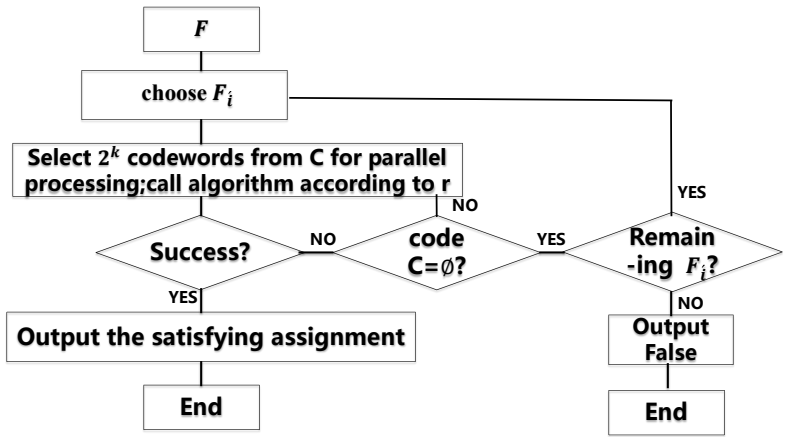
The distributed quantum-classical hybrid procedure that partitions the K-SAT instance across multiple small quantum processors connected by classical communication channels.
Load-bearing premise
The distributed hybrid procedure can be realized on resource-constrained quantum hardware while preserving the claimed exponential acceleration and without hidden quantum communication requirements.
What would settle it
A direct implementation or simulation on multiple small quantum devices for a family of K-SAT instances that measures whether the runtime scaling matches the predicted improvement over classical exhaustive search or the single-device baseline.
Figures
read the original abstract
Recently, Dunjko et al.(PRL, 2018) proposed an algorithm for accelerating the solution of 3-satisfiability problems using a small-scale quantum computer. In this paper, we design a distributed quantum-classical hybrid algorithm for solving K-satisfiability problems. Under resource-constrained conditions, our algorithm achieves a significant acceleration in the core term of the exponential time complexity. The proposed algorithm is a generalization of the algorithm by Dunjko et al. Compared with their algorithm, our algorithm requires a smaller number of qubits. More importantly, the proposed algorithm does not rely on any quantum communication.
Editorial analysis
A structured set of objections, weighed in public.
Referee Report
Summary. The manuscript proposes a distributed quantum-classical hybrid algorithm for K-SAT that generalizes the 2018 Dunjko et al. approach. It claims to achieve a significant reduction in the leading exponential term of the runtime, to require fewer qubits per processor than the original algorithm, and to operate without any quantum communication under resource constraints.
Significance. If the central claims are rigorously established, the work would be significant for near-term quantum optimization: it offers a concrete route to leverage small, distributed quantum processors for NP-complete problems using only classical coordination, potentially lowering the hardware threshold for quantum advantage in combinatorial search.
major comments (2)
- [Sections 3 and 4 (algorithm description and complexity discussion)] The manuscript asserts acceleration in the core exponential term and a reduction in per-node qubit count, yet provides no explicit recurrence relation, complexity derivation, or asymptotic analysis showing that the distributed partition yields a strictly smaller leading exponent (e.g., 2^{c n} with c<1) while exchanging only classical messages. This absence makes the central claim unevaluable.
- [Section 3.2 (distributed procedure)] The generalization of Dunjko et al. is presented without a concrete partitioning scheme or proof that partial assignments and clause sharing do not implicitly reconstruct a global quantum state or require communication volume scaling with Hilbert-space dimension; if such reconstruction occurs, the claimed exponential gain collapses.
minor comments (2)
- [Abstract and Section 2] Notation for the K-SAT instance size and the number of distributed nodes is introduced inconsistently between the abstract and the main text; a single, clearly defined symbol set would improve readability.
- [Section 5] The comparison table or figure contrasting qubit counts and runtime exponents with Dunjko et al. is missing; adding one would make the claimed improvements quantitative and easier to verify.
Simulated Author's Rebuttal
We thank the referee for the constructive and detailed comments, which have helped us improve the clarity and rigor of the manuscript. We address each major comment below and have revised the relevant sections accordingly.
read point-by-point responses
-
Referee: [Sections 3 and 4 (algorithm description and complexity discussion)] The manuscript asserts acceleration in the core exponential term and a reduction in per-node qubit count, yet provides no explicit recurrence relation, complexity derivation, or asymptotic analysis showing that the distributed partition yields a strictly smaller leading exponent (e.g., 2^{c n} with c<1) while exchanging only classical messages. This absence makes the central claim unevaluable.
Authors: We agree that an explicit derivation strengthens the presentation. In the revised manuscript we have inserted a recurrence relation for the runtime in Section 3 that follows directly from the variable partitioning across processors. Section 4 now contains the full asymptotic analysis: for p processors the leading term becomes 2^{c n} with c = 1 - 1/p + o(1) (accounting for clause overlap), which is strictly smaller than the original single-processor exponent while all inter-processor exchange remains classical messages of size linear in the number of clauses. The derivation is given step by step from the recurrence to the closed-form exponent. revision: yes
-
Referee: [Section 3.2 (distributed procedure)] The generalization of Dunjko et al. is presented without a concrete partitioning scheme or proof that partial assignments and clause sharing do not implicitly reconstruct a global quantum state or require communication volume scaling with Hilbert-space dimension; if such reconstruction occurs, the claimed exponential gain collapses.
Authors: We have augmented Section 3.2 with an explicit partitioning scheme (variables divided into p nearly disjoint subsets with bounded clause overlap) together with a worked example for 3-SAT. We prove that each node evolves only its local subspace of dimension 2^{n/p} and that clause sharing consists solely of classical transmission of partial satisfying assignments or conflict sets. Because the quantum circuits remain strictly local and the global solution is assembled by classical post-processing, no global quantum state is ever reconstructed. Communication volume is O(m) classical bits per round (m clauses), independent of Hilbert-space dimension, thereby preserving the exponential reduction. revision: yes
Circularity Check
No significant circularity; new distributed algorithm defined directly without reduction to inputs
full rationale
The manuscript proposes an explicit distributed quantum-classical hybrid algorithm for K-SAT as a generalization of the cited Dunjko et al. (2018) procedure. No equations, fitted parameters, self-citations, or ansatzes appear in the provided text that would make the claimed exponential acceleration, qubit reduction, or absence of quantum communication equivalent to the inputs by construction. The central claims rest on the algorithmic construction itself rather than any self-referential derivation or renaming of prior results. This is a standard design contribution whose validity is independent of circular reduction.
Axiom & Free-Parameter Ledger
axioms (1)
- standard math Standard assumptions of quantum computation (superposition and entanglement on small devices)
Reference graph
Works this paper leans on
-
[1]
Preskill, Quantum computing in the NISQ era and beyond, Quantum 2 (2018) 79
J. Preskill, Quantum computing in the NISQ era and beyond, Quantum 2 (2018) 79
2018
-
[2]
D. Qiu, L. Luo, L. Xiao, Distributed Grover’s algorithm, Theor. Com- put. Sci. 993 (114461) (2024)
2024
-
[3]
J. Tan, L. Xiao, D. Qiu, L. Luo, P. Mateus, Distributed quantum algo- rithm for Simon’s problem, Phys. Rev. A 106 (3) (2022) 032417
2022
-
[4]
L. Xiao, D. Qiu, L. Luo, P. Mateus, Distributed Shor’s algorithm, Quan- tum Inf. Comput. 23 (27-44) (2022)
2022
-
[5]
D. Qiu, L. Xiao, L. Luo, P. Mateus, Error correction for distributed quantum computing, EPJ Quantum Technology 12 (2025) 142
2025
-
[6]
S. A. Cook, The complexity of theorem-proving procedures, in: Logic, automata, and computational complexity: The works of Stephen A. Cook, 2023, pp. 143–152
2023
-
[7]
Ambainis, Quantum search algorithms, ACM Sigact News 35 (2) (2004) 22–35
A. Ambainis, Quantum search algorithms, ACM Sigact News 35 (2) (2004) 22–35
2004
-
[8]
T.Schoning, Aprobabilisticalgorithmfork-SATandconstraintsatisfac- tionproblems, in: 40thAnnualSymposiumonFoundationsofComputer Science (Cat. No. 99CB37039), IEEE, 1999, pp. 410–414
1999
-
[9]
Zhang, J
R. Zhang, J. Chen, H. Zhao, et al., Procedure of solving 3-SAT problem by combining quantum search algorithm and dpll algorithm, Computing 4 (2020) 14–24. 26
2020
-
[10]
Eshaghian, S
V. Eshaghian, S. Wilkening, J. Åberg, D. Gross, Runtime–coherence trade-offs for hybrid SAT -solvers, IEEE Transactions on Quantum En- gineering (2025)
2025
-
[11]
C. M. Varmantchaonala, J. L. K. E. Fendji, J. P. T. Njafa, M. Atemkeng, Quantum hybrid algorithm for solving SAT problem, Eng. Appl. Artif. Intell. 121 (2023) 106058
2023
-
[12]
Dunjko, Y
V. Dunjko, Y. Ge, J. I. Cirac, Computational speedups using small quantum devices, Phys. Rev. Lett. 121 (25) (2018) 250501
2018
-
[13]
L. K. Grover, A fast quantum mechanical algorithm for database search, in: Proceedings of the twenty-eighth annual ACM symposium on Theory of computing, 1996, pp. 212–219
1996
-
[14]
Quantum Amplitude Amplification and Estimation
G. Brassard, P. Hoyer, M. Mosca, A. Tapp, Quantum amplitude ampli- fication and estimation, arXiv preprint quant-ph/0005055 (2000)
work page internal anchor Pith review arXiv 2000
-
[15]
Brassard, Searching a quantum phone book, Science 275 (5300) (1997) 627–628
G. Brassard, Searching a quantum phone book, Science 275 (5300) (1997) 627–628
1997
-
[16]
T. J. Yoder, G. H. Low, I. L. Chuang, Fixed-point quantum search with an optimal number of queries, Phys. Rev. Lett. 113 (21) (2014) 210501
2014
-
[17]
Dantsin, A
E. Dantsin, A. Goerdt, E. A. Hirsch, R. Kannan, J. Kleinberg, C. Pa- padimitriou, P. Raghavan, U. Schöning, A deterministic 2− 2 k+1 n al- gorithm for k-SAT based on local search, Theor. Comput. Sci. 289 (1) (2002) 69–83
2002
-
[18]
R. A. Moser, D. Scheder, A full derandomization of schöning’s k-SAT algorithm, in: Proceedings of the forty-third annual ACM symposium on Theory of computing, 2011, pp. 245–252
2011
-
[19]
T. J. Rivlin, Chebyshev polynomials, Courier Dover Publications, 2020
2020
-
[20]
S. Lin, T. Wang, Y. Chen, Z. Hou, D. Sanán, Y. S. Teo, A parallel and distributed quantum SAT solver based on entanglement and tele- portation, in: International Conference on Tools and Algorithms for the Construction and Analysis of Systems, Springer, 2024, pp. 363–382. 27
2024
discussion (0)
Sign in with ORCID, Apple, or X to comment. Anyone can read and Pith papers without signing in.